






Sušárna chmele Hassmann Other
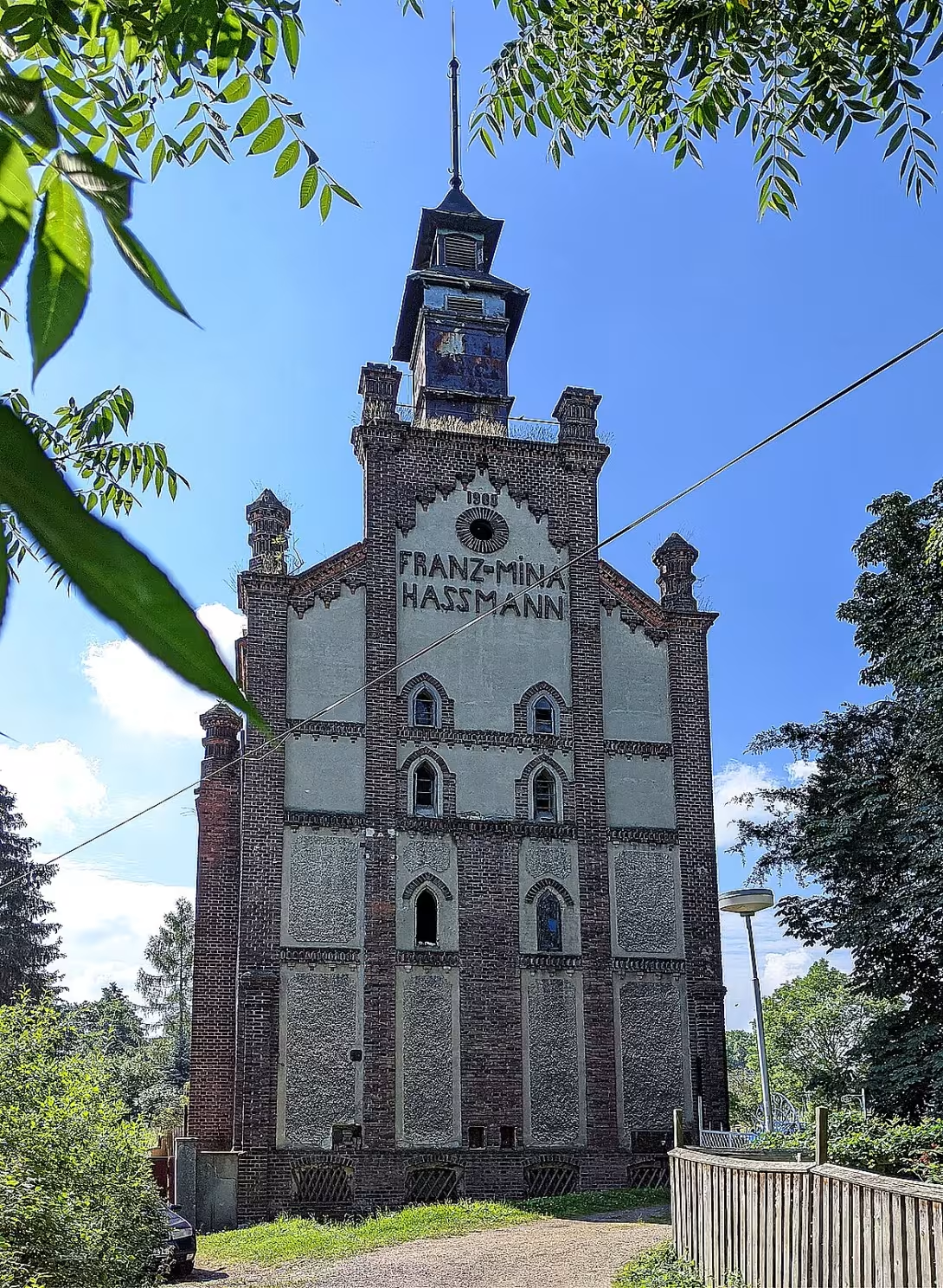
Sušárna chmele Hassmann in Žatek Trnovany is a neo-gothic industrial building from 1908, which has been registered since 2021 as a cultural monument of the Czech Republic. The object is an important proof of the region's hop history and is currently undergoing a gradual reconstruction aimed at creating a cultural centre.
The oven was created by reconstructing an older economic building, probably a barn, whose foundation dates back to the beginning of the 19th century. On the north column supporting the trapeze of the ceiling beams is engraved dating 1807 and 1907, which confirms the long history of the site. The neo-gothic oven itself was built in 1908 to thank the nephew Franz Hassan for the support his family provided during his studies of architecture in Vienna. At that time Austria-Hungary was an important hop producer and Žatecko experienced the peak of its fame, which was reflected in the form of industrial buildings.
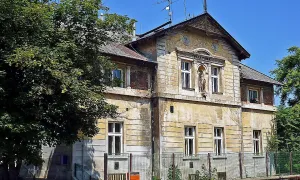
The building is a stand-alone two-storey object on a rectangular plan. The construction combines a quarry opalescence stone with a view brick wall. The facade carries elements of the neo-gothic style, with three-story risalite on the north side being the dominant element. Its shield contains an open circular hole framed by bricks, over which the year 1908 is folded and under it the inscription FRANZ-MINA HASSMANN. The roof is made up of burnt bimonas and the building's mass is supplemented by a metal evaporator in the form of a turret with a lantern and a needle roof.
The original technological system was preserved in the interior, including two runners, drop holes in the floors and a lever mechanism to control the tilting mills. At the level of the first floor there are visible belt openings for inserting caskets with hops and hanging rails for transport along the roof. The interesting thing is the use of smolk paint on the walls, which should have historically prevented insects from entering the premises. In the attic there is a loading box with a door, which was used to handle the crop.
The area belonged to the Hassmann family, important hop growers whose hop stamps are now stored in the Regional Museum in Žatci. Later the building was owned by the aristocratic rodina von Schönfeldů, after which one of the beams had a pencil painted heart with initials. Following the relocation of the von Schönfeld family and subsequent decaying, the economic court was demolished. In 2000, Šárka Mejcharová and her husband purchased the premises, which, after ten years of waiting to settle the restitution, started a gradual reconstruction.
Part of the complex is also a historical mill, the oldest parts of which come from the 14th century and which was rebuilt in 1867. Current owners plan to rebuild the Drying Room into a cultural centre and a mill into a hotel in the future.
Sušárna chmele Hassmann is a valuable document of technical maturity and architectural care dedicated to agricultural buildings in the early 20th century. Visiting this place offers a unique insight into the history of Zátečské chmeláří and efforts to save industrial heritage.
Then and now
Drag the slider to compare how the landmark may have looked when it was built with the view today.
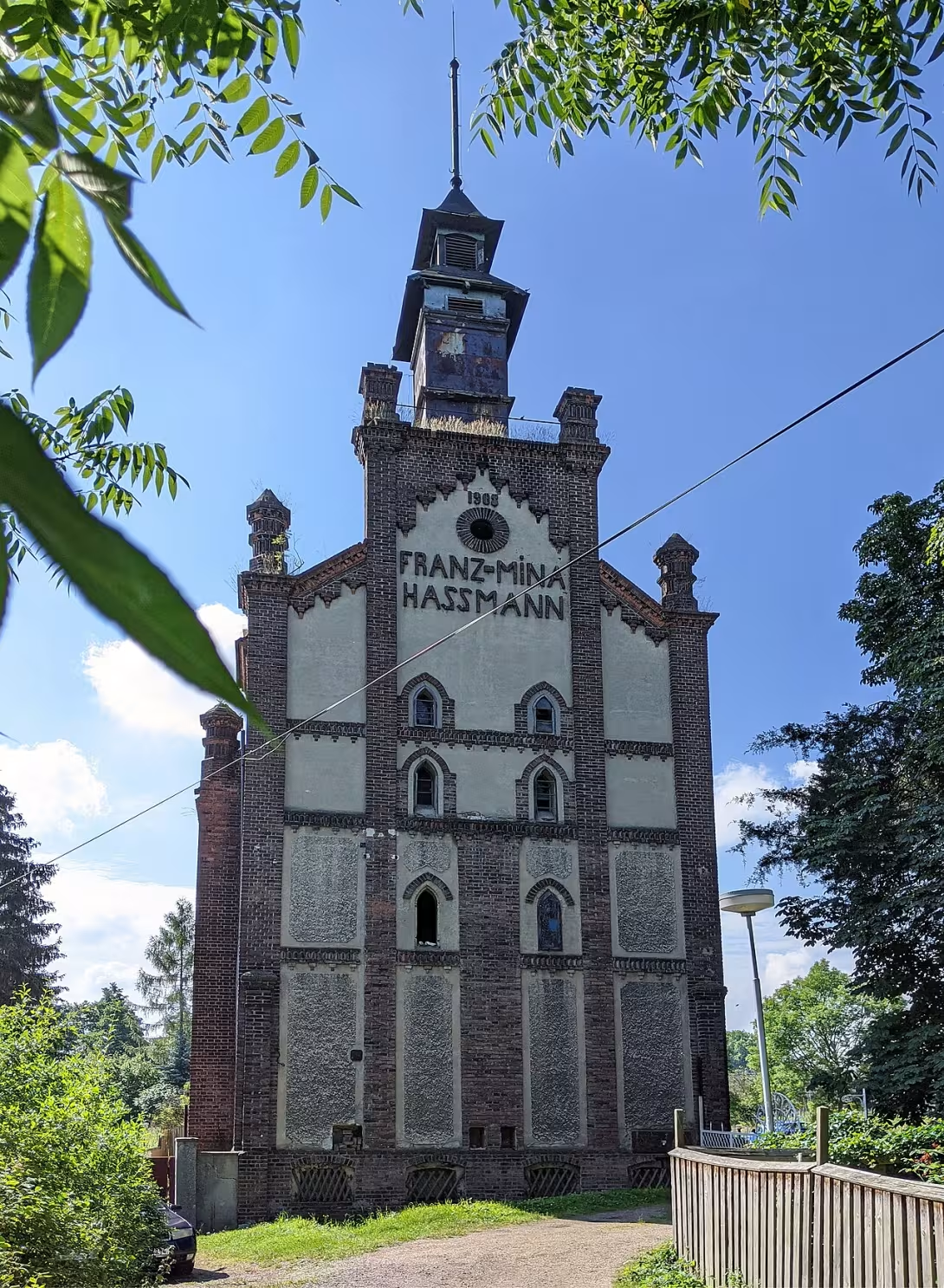
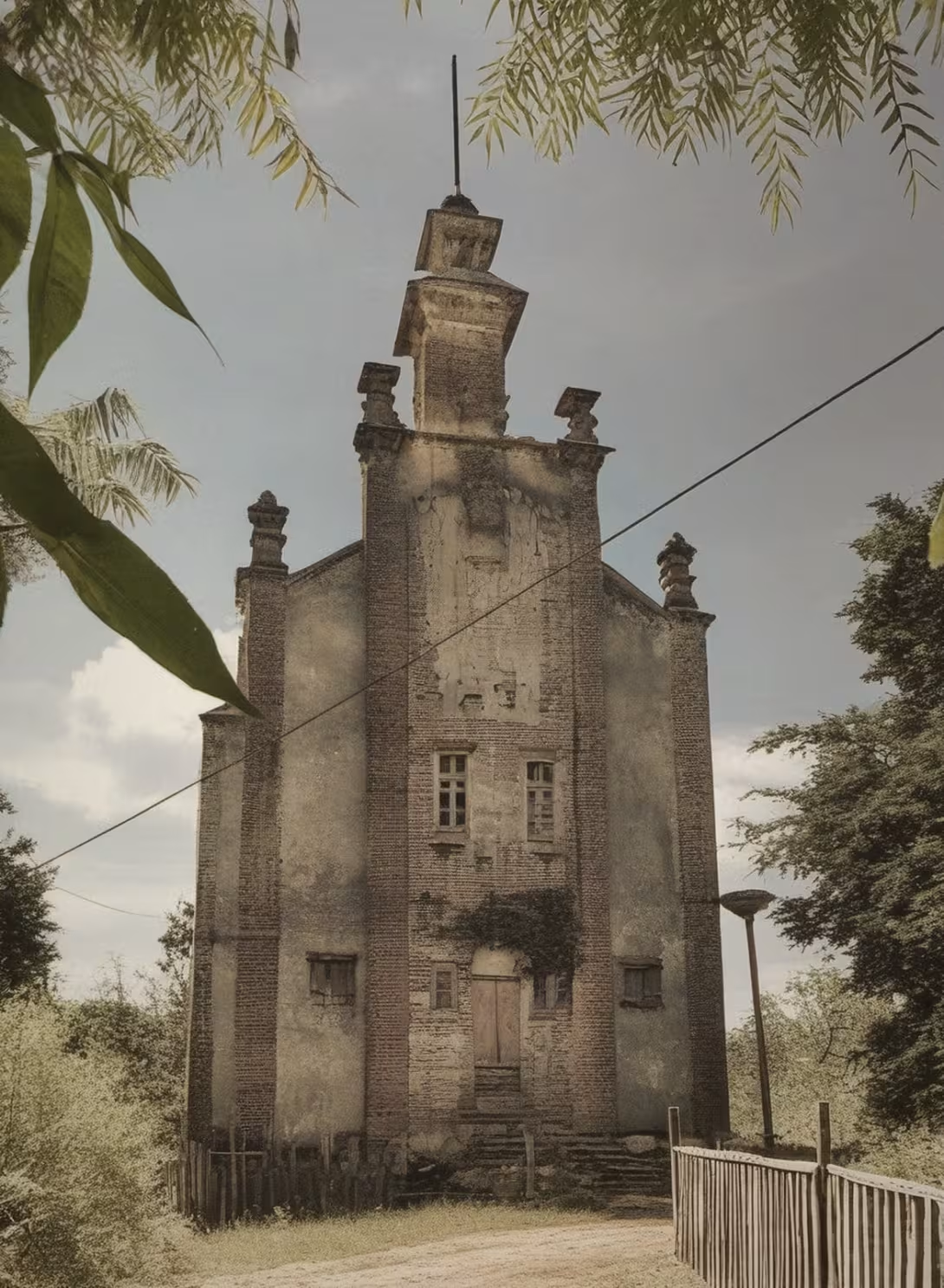
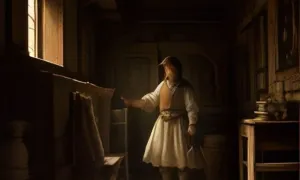
The historical appearance on the left is an AI-generated visualisation and serves as inspiration only.
Historical milestones
- 1807
- The expected formation of the older object (barn) according to the dating on the beam.
- 1908
- Completion of the Neo-gothic Drying House hops the Hassan family.
- 2021
- The building of the oven is declared a cultural monument.
Architectural development
The original building of the barn was converted into a neo-gothic hops oven in 1908. The construction uses a quarry leaf stone and a concrete brick wall. The interior includes a preserved system of drop holes, lever mechanism to control the presses and original smolk wall coatings.
Historical events
1908: Completion of the construction of the oven. 2000: Purchase of the premises by new owners. 2021: Registration of the drying plant to the Central List of Real Cultural Monuments.
Owners
Hassmann family, rodina von Schönfeldů, Šárka Mejcharová with husband.
Points of interest
- The building has since two thousand twenty-one been registered as a cultural monument of the Czech Republic. - On the north column supporting the passage of the ceiling beams, the date is engraved eighteen hundred seven and nineteen hundred seven. - The Novogothic Drying House was built in nineteen hundred and eight to thank the nephew Franz Hassan for his support in architecture studies in Vienna. - The walls were used with smolk paint to historically prevent insects from entering the premises. - In the interior on one of the beams, a pencil-painted heart with initials left behind by the aristocratic rodina von Schönfeldů.
Guide
Show guide text
This text was created by artificial intelligence and has not been editorially reviewed. It may contain inaccuracies.
Welcome to Trnovany, part of the beautiful Žatka, which is deeply interwoven with the stories of old crafts and agricultural traditions. You are standing in front of one of the most important building units in this area, in front of the Hassmann Drying House. Before you go on your next journey, stop for a moment and feel the atmosphere of this place. In front of your eyes is a building that combines industrial strength and unusual aesthetic beauty. Perhaps at first glance it acts as something noble, as if it were intended for a purpose other than the drying of crops, and that is no coincidence. Her appearance speaks the language of history and deep respect.
Now let's look at the past together to fully understand why this building looks like this. This oven is not just a random piece of architecture. It's a story about family gratitude and how one person can influence the shape of the whole neighborhood. Although the building you are now observing was completed in nineteen hundred and eight, its roots are much older. Already in the year one thousand eight hundred and seven there was probably an older building, a simple and functional barn. Imagine that place when agriculture and hop cultivation were the foundation of all life in the region. Later, however, the Hassmann family decided to completely transform this older structure. But it was not just the restoration of the old. The family wanted to create something special as a token of their deep gratitude to their nephew, Franz Hassan. This young man gave great support in his studies of architecture. In this way, a simple agricultural building became a neo-gothic monument, built as a living monument to recognition, talent and family happiness.
Now pay attention to the details you have right in front of you. Look at the body of this building itself and perceive this incredible game of materials. When you look at the walls, your eyes come across a fascinating combination. Do you see the stones that form the base part of the walls? It's a quarry. It's a material that has depth and nature in it, which is perfectly complementary to a worked brick. This brick, combined with the stone, gives the building its unmistakable character. It's like a dialogue between nature and the human hand, between the roughness of stone and the precision of bricks. The entire building is carried out in a neo-gothic style, which you can tell by its specific shapes and dignity. Note above all how the building exposes itself from the main line, the so-called risalite, which gives it dynamism and visual richness. And if you raise your eyes higher, you will see a tower with a lantern standing above the roof and acting as the silent guardian of this place, which has been watching the area since nineteen hundred and eight.
When you look at these walls, remember the people who left their mark. In addition to Franz Hassan, whose name is inextricably linked to this place, there are other important personalities. Mína Hassmann, the von Schonfeld family and also Šárka Mejcharová are names that are closely related to this place and its history. Each of these names represents a different layer of history, a different era, which was encountered in this place. It's fascinating how one object can preserve memories of generations of people who have lived here, worked here, or cared for this place.
Before you go on another journey, I'd like to draw your attention to one small but very interesting thing that may attract an attentive observer. If you had the opportunity to get closer to one of the northern columns that holds the ceiling beams, you could find something very rare there. Because there's a date engraved. It's not just one number, but two important dates: eighteen hundred seven and nineteen-seven. These engraved numbers are like silent testimonies of time that protrude through this building. It's like a hidden code that reminds us of the beginning of the older object and the period when everything in this place was fundamentally changing.
This oven today is much more than just a former industrial object. Since the year two thousand twenty-one is officially registered as a cultural monument of the Czech Republic. This means that its historical value for our history and for our common identity is recognised and protected. It is proof that even a place like this oven can be a rare treasure worth protecting for all future generations.
I hope that this brief view of the history of Hassan's Drying House has enriched you and that this view of the past has inspired you. Before you go any further, please stop for a moment, feel the silence and beauty of this place. Take a look around, feel the atmosphere and enjoy every moment spent discovering these hidden treasures in the Žatec. I wish you a nice walk and goodbye.
Tips for visitors
The best time for a visit is late spring or early autumn, when the landscape of Žetek hops is the most photogenic and the weather wishes to walk around. Due to the ongoing reconstruction, it is recommended to monitor the official site for public access.
Easier to reach the drying room by car, parking is possible in the nearby area according to the current traffic signs. If you choose public transport, use the connection to Žatka and then take a walk or local transport to the memory; Check the exact connections in the travel applications.
When visiting, wear fixed shoes suitable for the field and for movement around the historical building. Don't forget about the camera because the neo-gothic elements of the building offer great details for the images, especially with soft light during the golden watch before sunset.
In the vicinity of the drying room you can explore the picturesque landscape of the Žatek hops or visit the neighbouring historical mill. The city Žatec itself offers a rich history associated with the cultivation of this crop, which is an ideal destination for a longer trip.
For families with children, the location is suitable as a stop when exploring technical monuments. Children can admire the unconventional architecture of the oven, but due to the ongoing construction work, take care of their safety and only move in designated areas.
Businesses nearby
Do you run a restaurant, accommodation, shop, museum, rental, wellness or other visitor service near this monument? Show yourself directly to the people heading to it — this is how they will see you in the app and on the web:
Events nearby

Zdroj akcí: otevřená data měst a obcí ČR (Národní katalog otevřených dat) a kalendář akcí Národního památkového ústavu.
Nearby
Krajina žateckého chmele, sousední historický mlýn, město Žatec s bohatou chmelařskou historií.
Accommodation nearby
Themed route
1. City Žatec (city) - A place with rich hop history, which is the perfect beginning of the journey. 2. The landscape of Žetek hops (landscape) - It offers typical views of hop cultivation in the area. 3. The neighbouring historical mill (mill) - Interesting technical construction located near the main target. 4.Sušárna chmele Hassmann (Drying room) - The main destination of the trip, which represents a unique industrial monument.
Seasonal recommendations
Spring brings around the historic building awakening nature and softer light, which is ideal for observing the details of the building as well as ongoing restoration. The atmosphere is fresh, but prepare for workplace dust. I recommend layered clothes because the wounds are usually cold and the afternoon can be warm. It's the best time for quiet observation without large groups of people.
Summer is a period of the greatest excitement and the sun hits the facades, highlighting their shapes. Due to high temperatures and crowds it is better to come early in the morning when the air is still cold and there are not so many visitors around. Don't forget the sun cap and enough water to enjoy the tour in peace.
Autumn brings golden colors and foggy mornings to the surroundings, which gives the memory a mysterious mood. The light is low and very photogenic in this period. For a walk around the building, prepare stronger shoes because moisture and falling leaves can cause slippery paths. It's the perfect time for those who seek peace and melancholy beauty.
Winter is a period of quiet and sharp air around the monument, which creates a raw but beautiful atmosphere, especially if snow falls. Due to lower temperatures and shorter days it is necessary to wear a very warm jacket and scarf. Check the actual opening hours before visiting, since it is limited during this period.
Visualizations and artistic views


The visualisations are generated by artificial intelligence and serve as inspiration.
Photos from the area
Real photos taken near the monument


Zdroj a licence jsou uvedeny u každého snímku.
Tips from visitors
No tips yet. Be the first!
Log in and add your tip.
Sources and literature
Photos: MartinVeselka / CC BY-SA 4.0 — Wikimedia Commons. The author and licence also appear when you hover over the image.
Faktickým podkladem tohoto textu byl článek na Wikipedii, jehož autory jsou přispěvatelé Wikipedie. Článek je dostupný pod licencí CC BY-SA 4.0.
Location on the map
Příběhy a pověsti
Legendy, pověsti a příběhy spjaté s touto památkou
Fotografie návštěvníků
Zatím žádné fotografie. Buďte první, kdo přidá fotografii z návštěvy!
Log in a přidejte svou fotografii nebo hodnoťte.
Za ověřenou návštěvu v aplikaci získáte víc bodů — poznáme podle GPS, že jste na místě.
Reviews and comments