



Svatý Antonínek Chapel
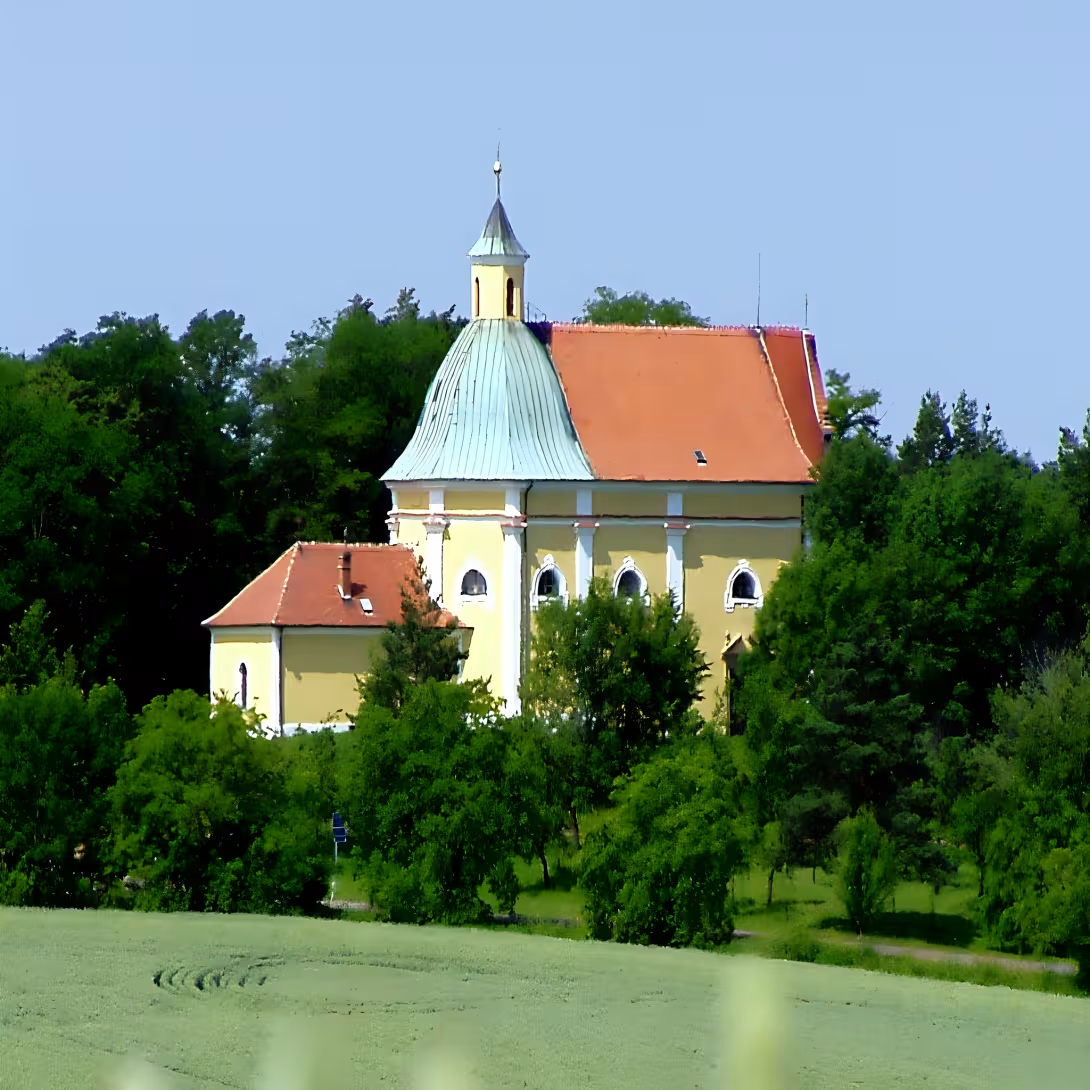
The chapel is located on the hilly edge of the Vizovická výština, 14 kilometers south of Uherský Hradiště, on the border of the districts of Uherské Hradiště and Hodonin. This hill has served as an important landmark in the past and, according to archaeological views, could have previously been a pagan godhouse and a Slavic burial ground. Even before I was placed here in the seventeenth century, a very old cross stood on top of the verb. People's tradition remembers that in the ninth century, Saint Cyril and Methodius passed through here on their way to the Velegrad.
The beginning of the chapel dates back to 1662, when Prince Hartmann z Lichtenštejna, owner of the island estate, requested permission from the Bishop of Olomouc for construction. In space-national faith, he hoped that a new chapel dedicated to Saint Anthony Paduan would avert the unusual weather and adversity that prevailed in the region and threatened the harvest. After several urgens he received his consent in 1668 when the basic stone was laid in the spring of the year in the presence of the Rector of the Jesuit College in Uherské Hradiště and the captain of the island estate. The construction was completed two years later, in 1670. The inventaries of 1672 capture the richness of the chapel: a silver chalice with a patent, ciborium from the blatant church, portatile with the remains of the saints on a fixed altar and six wooden candlesticks.
Based on robots, the inhabitants of the surrounding villages - Blatiny, Ostrožská Lhoty and Noise participated. At the turn of the seventeenth and eighteenth centuries, there was another expansion. In 1696-1697, a temple ship was added to the original eight-sided rotunda, in which an Italian stucco called Rezzy (probably Rossi da Lucca) worked, which also produced a new painting of St. Anthony for the chapel. There was a pilgrimage house next to the chapel for refreshments of pilgrims. The chapel was restored in the middle of the eighteenth century. The Blatnik priest Jiří Hnátek initiated a reconstruction in 1748-49, where a tower was built over the presbytery and a water spring was opened near the top of the hill. This discovery had miraculous effects - the number of heals increased and the interest in this pilgrimage site increased. In 1771 the chapel already had two altars: one dedicated holy family and the other fourteen holy helpers.
The end of the eighteenth century brought the bond to a severe test. The reforms of emperor Joseph II led to the gradual destruction of pilgrimage places. In 1784 the archbishop's consistor was allowed to dispose of the chapel, and two years later, the chapel was abolished and desecrated from the governor's decree. The equipment was dismantled for poor churches and the building itself was sold to Jewish Sarah Dobrušková, who wanted to use it as building material. The chapel was left in ruins - without wooden choir, without doors and windows, without roof and ceilings. The cattle walked freely in it.
The chapel was restored only during the wars of Naples and after they were completed. In 1810 Martin Straka from Ostrožský Suburb built a new cross at the chapel. After negotiations from 1812-1815 and the audience with Emperor Franz I, Blatnici managed to regain the ravaged chapel. She purchased it for 2000 gold from voluntary contributions and undertook to repair it on 30 May 1815 and maintain it forever. The chapel was consecrated until 16 June 1819, after long and financially demanding work, which was financed by the contribution of surrounding municipalities and even from Slovakia. At that time, he had the keys to the chapel, a blatnik vicar, to whom the creditor's office also seemed to compensate.
Today Svatý Antonínek stands as a protected cultural monument of the Czech Republic and remains open year round. Visitors can observe its baroque architectural elements and feel the atmosphere of an old pilgrimage tradition that has accompanied it for more than three and a half centuries.
Then and now
Drag the slider to compare how the landmark may have looked when it was built with the view today.
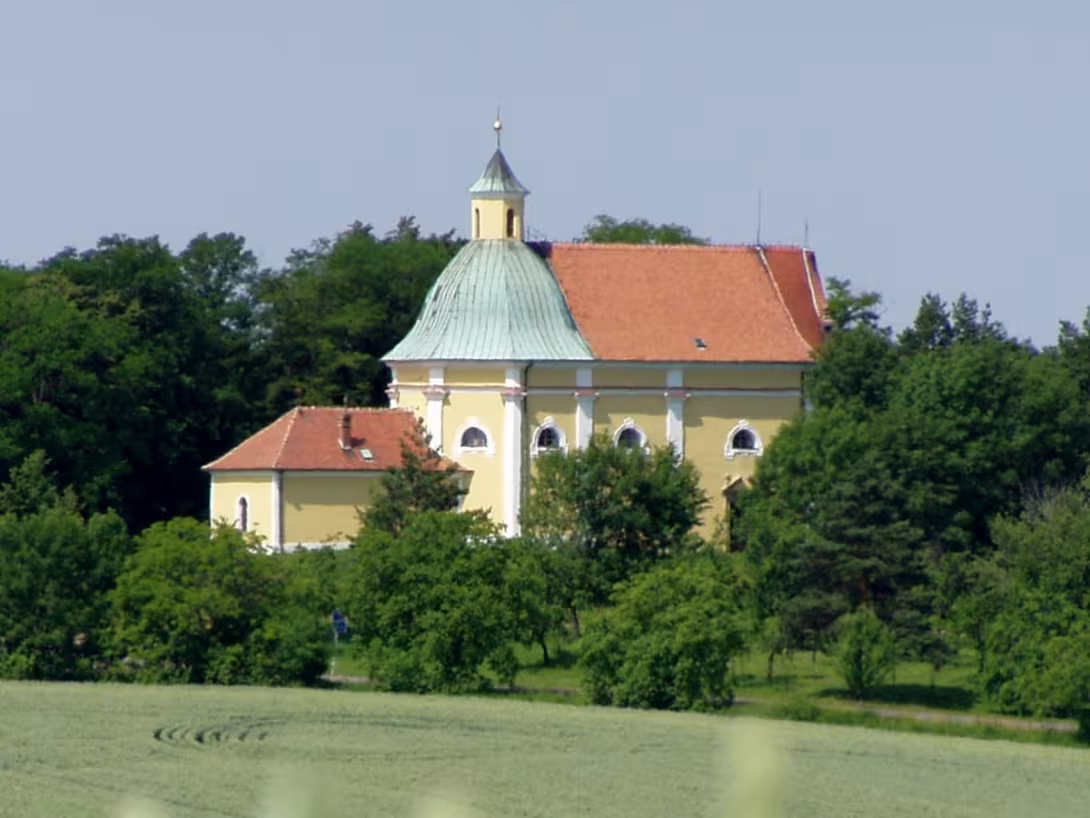
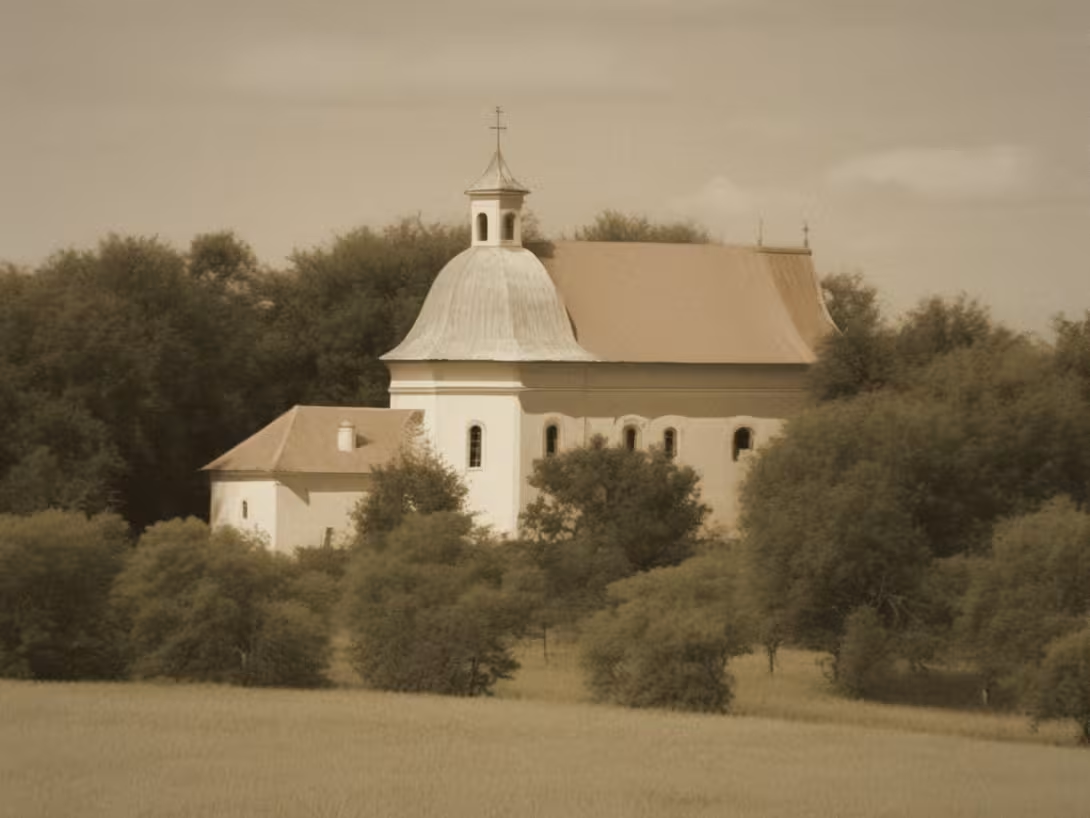
The historical appearance on the left is an AI-generated visualisation and serves as inspiration only.
Historical milestones
- 1662
- Request permission to build a chapel.
- 1670
- Completion of chapel construction.
- 1819
- The consecration of the chapel after reconstruction.
Architectural development
Originally an eight-sided rotunda was extended to include a temple ship in 1696-1697. In 1748-49, a tower was built over the presbytery.
Historical events
- 1662
- Hartmann z Lichtenštejna has requested permission to build a chapel.
- 1670
- The chapel construction has been completed.
- 1819
- The chapel was reconsecrated after reconstruction.
Owners
Prince Hartmann z Lichtenštejna was behind the founding of the chapel. After its cancellation in 1786, she was sold to the Jewish woman Sara Dobrušková and later repurchased by the municipality of Blatina.
Points of interest
- The chapel is located on the hilly edge of the Vizovická výština, 14 kilometers south of Uherský Hradiště, on the border of the districts of Uherské Hradiště and Hodonin. - This hill has served as an important landmark in the past and, according to archaeological views, it could have been a pagan godland and a Slavic burial ground. - The folk tradition remembers that St. Cyril and Methodius passed through here in the ninth century. The chapel was dedicated to Saint Anthony of Paduan to avert the unusual weather and adversity that prevailed in the county and threatened the harvest. - The chapel was completed in 1670. - The inventaries of 1672 capture the richness of the chapel: silver chalice with a patent, ciborium from the blatant church, portatile with saints on a fixed altar and six wooden candlesticks. At the turn of the seventeenth and eighteenth centuries, there was another expansion of the chapel. - In 1696-1697 a temple ship was added to the original eight-sided rotunda. - There was a pilgrimage home next to the chapel. - The Blatnik priest Jiří Hnutek initiated a reconstruction of the chapel in 1748-49, where a tower was built over the presbytery and a water spring was opened near the top of the hill. - In 1771 the chapel already had two altars: one dedicated holy family and the other fourteen holy helpers. - The chapel was abolished and desecrated in 1786. - The chapel was left in ruins - without wooden choir, without doors and windows, without roof and ceilings. - The chapel was restored only during the Naples Wars and after they were completed. - In 1810 Martin Straka of Ostrožský Suburb built a new cross at the chapel.
Guide
This guide is narrated by a synthetic voice generated by artificial intelligence.
Show guide text
This text was created by artificial intelligence and has not been editorially reviewed. It may contain inaccuracies.
Saint Antonínek is a Baroque pilgrimage chapel from the 17th century dedicated to Saint Anthony of Padua. It stands on Antonínský kopec between Ostrožská Lhota and Blatnice pod Svatým Antonínkem, 14 kilometers south of Uherské Hradiště. The hill marks the border between the Zlín Region and the South Moravian Region. The chapel is protected as a cultural monument.
The hill is an extension of the Vizovická vrchovina highlands and has long served as a landmark, possibly also for the defense of the surrounding area. Archaeologists believe there was once a pagan sanctuary and Slavic burial ground here. Before the chapel was built, there is said to have been a very old cross standing on the summit. Local legend tells that in the 9th century, Saint Cyril and Methodius passed through here on their way to Veligrad. The slopes have been covered with vineyards for centuries.
In 1662, Prince Hartmann of Liechtenstein, the owner of the Ostrožský estate, requested permission to build. He hoped the chapel would ward off bad weather, which often threatened crops in the region. He received approval from the Olomouc consistory only after several reminders in 1668, and that same spring the foundation stone was laid. The construction was completed in 1670.
The original octagonal rotunda received a church nave between 1696 and 1697. An Italian stuccoworker was involved in this, and he also created a new painting of Saint Anthony for the chapel. Inhabitants of Blatnice, Ostrožská Lhota, and Hluk worked on the construction as corvée labor. At the same time, a pilgrimage house was built to provide refreshment for pilgrims. During renovations in 1748 and 1749, initiated by the Blatnice rector Jiří Hnátek, a small tower was added above the presbytery. At that time, a spring was discovered near the summit, which became associated with miraculous healings, and interest in pilgrimages increased.
A turning point came with the reforms of Emperor Joseph II. In 1786 the chapel was closed and deconsecrated, its furnishings were moved to poor churches, and the building was purchased by Sára Dobrušková, who wanted to demolish it for building materials. The chapel was left without a roof, ceilings, windows, or doors, and livestock roamed freely through the ruins.
A turnaround came after the Napoleonic Wars. After years of negotiations and an audience with Emperor Francis I, the municipality of Blatnice purchased the chapel in 1815 from voluntary contributions for 2000 guilders and committed itself to its repair and perpetual maintenance. The costly restoration was supported by neighboring municipalities and even donors from Slovakia. It was reconsecrated on June 16, 1819.
Tips for visitors
The best time to visit is from spring to autumn, when the weather is the hottest and the chapel is accessible.
The chapel is available by car or public transport.
We do not recommend visiting the chapel in the rain because it is accessible only by stairs.
It is advisable to bring your own water and food because there are not many options for refreshments in the area.
Photographs can only be taken outside the chapel, photography inside is forbidden. The best place to photograph is west of the chapel, where the sun is in the late afternoon.
Frequently asked questions
Can the monument be visited?
Religious buildings are usually open mainly during services; at other times a visit is normally arranged with the parish or the operator. We have not verified specific times.
Where is the monument?
Location: Blatnice pod Svatým Antonínkem, Jihomoravský kraj. The map on this page shows the exact spot.
For kids
Approximately 356 years ago, a building began on a small hill, which was a source of wonder and mystery. It was like people thought, "Oh, boy, we're gonna have something really special!" And so the chapel of St. Anthony of Padua was built, also known as Svatý Antonínek. This Baroque pilgrimage chapel was turned off on Antonín Hill between two municipalities - Ostrožská Lhota and Blatnice under Saint Anthony, as if she wanted to show herself to the whole of South Moravia.
Businesses nearby
Do you run a restaurant, accommodation, shop, museum, rental, wellness or other visitor service near this monument? Show yourself directly to the people heading to it — this is how they will see you in the app and on the web:
Nearby
The chapel stands on the border of Zlín and South Moravian Region. There are vineyards in the vicinity and it is close to the border with Uherské Hradiště.
Accommodation nearby
Themed route
Thematic cruise route around the chapel Svatý Antonínek
1. * * Chapel Svatý Antonínek (Chapel) This small but charming chapel stands on the border of Zlín and South Moravian Region. It is a place of peace and comfort for visitors and locals who have visited for centuries. The chapel is not only a spiritual centre, but also a beautiful example of architecture in the region.
2. * * Vinohrady around Blatnice pod Svatým Antonínkem (natural and cultural monument) After visiting the chapel, the paths taken lead to extensive vineyards that cover the valley around the village. Vineyards are not only the economic pillar of the region, but also provide an opportunity to explore local wine and how it is produced. It is a great opportunity for wine lovers to know and appreciate local assortment.
3. * * Border with Hungarian Hradiště (natural border) You are moving towards the border line which separates the Czech Republic from Slovakia. This place offers a unique view of the landscape and is an ideal place for those interested in the geography and history of the region. Here you can enjoy a quiet moment while noticing the differences between the two sides of the border.
4. * * Local markets and cafes in Blatnica under St. Antonín (cultural experience) After exploring the surrounding vineyards and borders, return to the village where you can visit local markets. Here you will find a wide selection of local goods and food, which are an ideal addition to each trip. In addition, the offer of cafes allows you to relax with good coffee or tea and enjoy the local atmosphere.
This route offers a combination of spiritual, cultural and natural experiences in one region. Each point of the journey has its own unique character and will ensure that your day is full of memories.
Seasonal recommendations
In spring, the chapel shines with the awakening nature and flowering trees. The atmosphere is fresh and full of optimism, which makes the visit a comforting experience. We recommend to dress more layers of clothing because the weather in this area is very variable. It is ideal to set off in the morning when the air is the cleanest.
The summer season brings a bright sun and a rich green landscape that contrasts beautifully with a white facade of monuments. There are more visitors in the main season, which is why it is best to come early in the morning to enjoy peace. Don't forget light, breathable clothes and plenty of fluids for the journey.
Autumn is a time of golden colours and morning fog that the chapel surrounds with a mysterious aura. Nature travels around the monument in colour, creating ideal conditions for photography. Due to the humid terrain, choose fixed shoes and a warm sweater, especially if you plan to visit in late afternoon.
In winter Svatý Antonínek operates minimally and quietly, especially if snow covers the landscape. The atmosphere here is most overshadowed by calm and freezing air. It is necessary to wear warm thermal clothes and count on a shorter day, so plan a visit by noon to make sure you have enough light.
Visualizations and artistic views


The visualisations are generated by artificial intelligence and serve as inspiration.
Photos from the area
Real photos taken near the monument


Zdroj a licence jsou uvedeny u každého snímku.
Atmosphere of the place
This atmospheric visualisation of the place and period was generated by artificial intelligence. It is not real footage of the location.
Tips from visitors
No tips yet. Be the first!
Log in and add your tip.
Sources and literature
Photos: Bohumil Blahuš / CC BY-SA 3.0, rozlišení zvýšeno umělou inteligencí — Wikimedia Commons. The author and licence also appear when you hover over the image.
Faktickým podkladem tohoto textu byl článek na Wikipedii, jehož autory jsou přispěvatelé Wikipedie. Článek je dostupný pod licencí CC BY-SA 4.0.
Location on the map
More monuments – Blatnice pod Svatým Antonínkem
Show all in the municipality



Příběhy a pověsti
Legendy, pověsti a příběhy spjaté s touto památkou

Fotografie návštěvníků
Zatím žádné fotografie. Buďte první, kdo přidá fotografii z návštěvy!
Log in a přidejte svou fotografii nebo hodnoťte.
Za ověřenou návštěvu v aplikaci získáte víc bodů — poznáme podle GPS, že jste na místě.
Reviews and comments