



Švehlova kolej s kinem Track
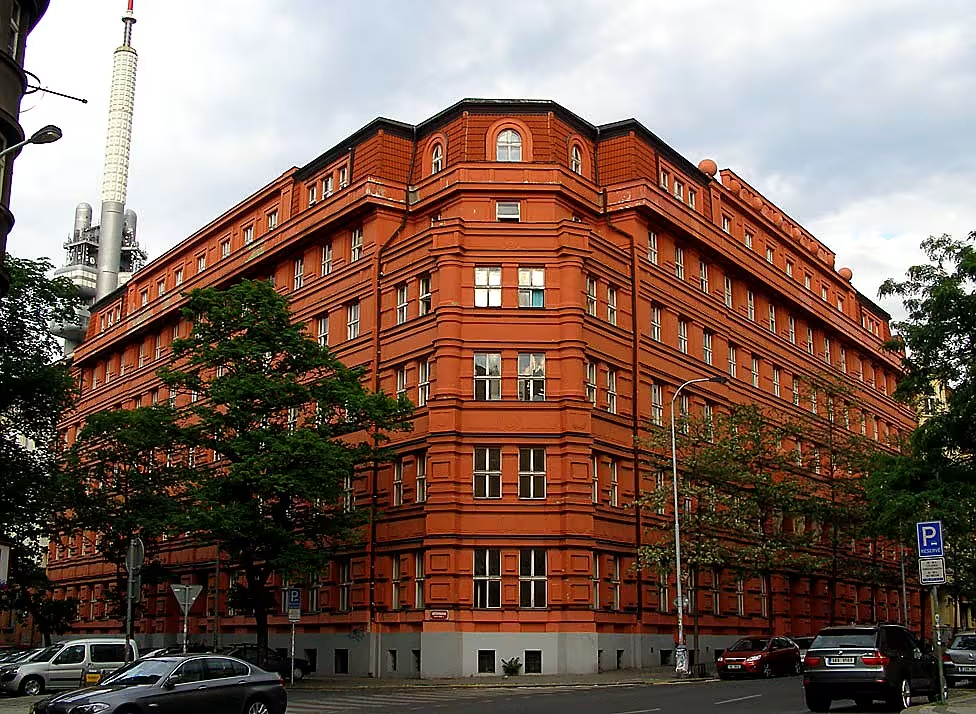
The Švehl College is a historical building on Prague's Žižkov. It serves as a student accommodation with a capacity of 731 beds. It was created between 1923 and 1925 and represents an important example of rondocubism. Since 2004 it has been protected as a cultural monument.
Construction on the corner of today's streets Slavikov and Křížkovsky was built according to the design of architect Jan Chládek. The implementation was carried out by the Žižkov construction company Hippo & Hils, the sculpture elements created by František Úprka. The funding was provided by gifts, lotteries and purchase of cooperative shares worth 500 KKS. They had to buy the students' parents out to pay off the mortgage. The building is named Antonín Švehl, who was the Prime Minister at the time of construction.
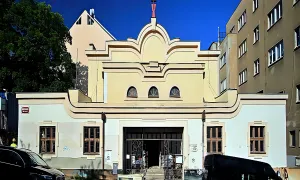
The old part of the building is performed in a rondocubistic style. Over the three-part entrance there are cariatis showing the four seasons that carry the entry ship. There is a massive stone ball on one line and a terrace on the fifth floor is set on the corner. The original division of the entrance part and the ventilation staircase remained in the interior. The building includes student rooms, study rooms, gym, laundry room, doorman and menza that no longer works. In 1928, the ACADEMIA cinema was set up in the interblock wing.
A new part was added to the building in the 1950s towards the street of Křížkovsky. This completion was created in the style of socialist realism. Her facade is decorated with the busts of Bernard Bolzan, John E. Purkka and Bedřich the Terrible. In this part there are student rooms, on the ground floor there are private companies.
The college has undergone several changes over the years. Since 1954, she was named College on May 5 behind the socialist regime. In 1939, it was the site of the Reich Protection Police intervention. After the demonstrations and funeral of Jan, the police were drastically arresting the protesters. Currently, the building is in the administration of the Charles University and the former Academy Theatre is located in the premises of the Venus Theatre.
The building represents a unique connection between two different architectural editions. It is a valuable witness to the history of students and political changes in Prague. Visiting this place offers the opportunity to observe the details of Czech rondocubism and socialist realism in one place.
Historical milestones
- 1923
- start of track construction
- 1925
- completion of building construction
- 1928
- establishment of the evening cinema Academia on the ground floor
- 2004
- publication of the building by cultural monument
Architectural development
The old part of the building is built in the style of rondocubism with cariatides and stone balls for attics. A new part in the style of socialist realism was added in the 1950s. The facade of the new part is decorated with busts of distinguished personalities.
Historical events
In 1939, members of the Reich Protection Police invaded the building and arrested participants in demonstrations after the funeral of Jan Opletal. In 1954, the building was renamed College on May 5.
Owners
Charles University
Points of interest
- The building was built between 1923 and 1925 and is an important example of Rondocubism. - There are cariatis above the entrance depicting four seasons of the year and there are stone balls on the attics. - In 1928, there was an ACADEMIA cinema in a wing headed for the interblock. - The new part of the 1950s is in the style of socialist realism and its facade is decorated with busts. - In 1939, the Reichstag police drastically arrested the participants of the protests after Jan Opletal's funeral.
Guide
Show guide text
This text was created by artificial intelligence and has not been editorially reviewed. It may contain inaccuracies.
Welcome to Žižkov, one of Prague's most colorful neighborhoods. You're standing right in front of a building that, both its size and its appearance, dominates the area. It is the Švehl College, a place that has been serving as a home for students and a centre of cultural events for over a hundred years. If you look at it now, you'll see a massive building that connects the practical function of a hostel with a high aesthetic demand. It is a building that tells the story of the ambitions of a young Czechoslovak state and of an effort to provide future intellectuals with a dignified background for study and rest.
Now let's stop a little bit at how this building came into being and why it actually stands here. The construction began in the year one thousand nine hundred twenty-three and completed two years later, in the year one thousand nine hundred twenty-five. He bears his name in honor of Antonín Švehl, who was the Prime Minister at the time. At that time, it was important to create institutions that would support education and build the identity of the new republic. That is why this vast college was created, designed to accommodate a large number of people. Even today, we will still find a capacity of seven hundred thirty beds, which makes her one of the largest student houses in the city centre.
Now, I would like to ask you to pay attention to the very appearance of the building. Please look up towards the top of the facade. Note the details that the architect Jan Chládek has placed here. Above the main entrance, your eyes will surely capture the cariatis, which are statues of female figures serving as supports. These four figures represent four seasons, which gives the building a poetic dimension and resembles the cycle of time that accompanies the student years. If you move the view even higher, to the Attica itself, you will see the stone balls that elegantly end the upper edge of the building. This whole style is an important example of so-called rondocubism, a direction that combines a strict line with round, round shapes. It is an architecture that acts playfully but also very firmly and representatively.
When you're looking at buildings, think of it not only as a pile of stone and concrete, but as a place where great personalities met. This place is associated with names we know from history in textbooks. It is for example Jan Opletal, a symbol of student resistance, or Bernard Bolzan and Jan E. Purkyně. Even Bedřich Hrozný, the famous decipher of ancient scriptures, is connected to this space. Imagine all the discussions, arguments about science and philosophy that have taken place in these corridors over the decades. The college was not only a place for sleep, but a real tangent of ideas, where future generations of Czech scholars and politicians formed.
Now let's move on to something that might surprise you. Notice the downstairs building. Today, the Venus Theatre resides here, but the history of this space is even more paramount. In the year one thousand nine hundred twenty-eight came into existence in a wing headed for the interblock, the evening cinema Academy. Imagine the atmosphere when people came to a new phenomenon, which was a film, and they were looking for fun and escape from the everyday space of the student college. It is fascinating that one building was so naturally able to combine a strict study regime with the ease of cinema and theatre.
If you observe the building carefully, you will notice that it is not completely unified. In addition to the beautiful style of the 1920s, you will find a newer part of the 1950s. This part was built in the spirit of the time, in the so-called socialist style, which is much sharper and more functional. This contrast between the decorative Pondocubism and later minimalism is like an open book of the history of our last decade. It's a visual record of how ideology changed and how the way we built our cities changed with them.
Due to its importance and uniqueness, the building was officially declared a cultural monument in the year two thousand and four. This means that its appearance and character must be protected for future generations. It is a recognition that Jan Chládek has created a work that does not age but gains value.
Now, if you look at the whole building again, try to imagine the lives of the students a century ago. What kind of dreams did they have when they walked out this door to the streets of Žižkova this morning? What movies did they watch at the Academy? This building is a silent witness to thousands of personal stories that intersect here.
Thank you for stopping by the Švehl College with me. I hope this information has enriched you and that you now see more than just a hostel in this building. I invite you now to slowly say goodbye to this place and continue to explore other hidden corners and monuments of this fascinating district. Let yourself be guided by curiosity and enjoy your stay in Prague. Goodbye.
Tips for visitors
The building is best visited during autumn months, when the colors of the surrounding Žižkova complement the appearance of the historical building from the 1920s. For transport to this part of Prague use public transport or your own car; Check specific connections and stopping options in current traffic search engines.
When visiting, we recommend to bring comfortable shoes for a walk on the Zizkov streets and a photographic machine. The best light for pictures of the facade of the building can be found in late afternoon hours when the sun hits the walls at a pleasant angle.
If you are looking for the best places to take pictures, focus on the architecture details from the college construction period, which resembles the style of the time. Since this is student accommodation, take care of the privacy of residents.
For families with children, it may be an interesting story about the history of the building and the personality of Antonín Švehl, who was Prime Minister. There are no other specific points of interest in the vicinity of the monument, so we recommend focusing on the architecture of the building itself.
Frequently asked questions
Can the monument be visited?
We have not verified whether this monument is accessible. Please ask the owner or operator, or the local municipal office.
Where is the monument?
Location: Žižkov. The map on this page shows the exact spot.
Why is the monument protected?
It is listed in the Central List of Cultural Monuments of the Czech Republic as a cultural monument (register no. 1187014694).
Businesses nearby
Do you run a restaurant, accommodation, shop, museum, rental, wellness or other visitor service near this monument? Show yourself directly to the people heading to it — this is how they will see you in the app and on the web:
Events nearby

Zdroj akcí: otevřená data měst a obcí ČR (Národní katalog otevřených dat) a kalendář akcí Národního památkového ústavu.
Nearby
🏰 Historic sites (1686)
- Anna Katzová 0.1 km
- Krakonoš 0.1 km
- Pavel Kovanic 0.2 km
- Gertruda Kowanitzová 0.2 km
- František Kowanitz 0.2 km
- Augusta Kovanicová 0.2 km
- Jana Kowanitzová 0.2 km
- Josef Hanuš Pollak 0.2 km
- Petr Leo Pollak 0.2 km
- Marie Grünbaumová 0.2 km
- Františka Blattnerová 0.2 km
- Leo Grünbaum 0.2 km
- Jaroslav Seifert 0.2 km
- HIDDEN 0.2 km Bořivojova 106 web
- hunt kastner 0.2 km Bořivojova 85 +420 222 969 887 web
- MUDr. Arnošt Pachner 0.2 km
- Elsa Pachnerová 0.2 km
- Olga Bondyová 0.3 km
- Václav Vydra 0.3 km
- základní kámen žižkovského vysílače 0.3 km
🍽️ Restaurants and dining (5503)
- Prádelna Café 0.1 km Slavíkova 21
- Hanil 0.1 km Slavíkova 24
- Tasty Toasts 0.1 km Slavíkova 24
- ROSSOPOMODORO 0.1 km Krkonošská 17 +420777833921 web
- Sumi Garden 0.1 km Slavíkova 18 web
- Bowl & Tonic 0.1 km
- Dóttir 0.1 km Slavíkova 15
- Tisse 0.1 km web
- Funwari 0.1 km Slavikova 18 web
- uno bistro 0.1 km
- Mi I'm 0.1 km Slavíkova 27 +420 721 084 428
- Pizza Mňam 0.1 km Slavíkova +42 777198773 web
- Acai Poke 0.1 km Slavíkova 1204/16 +420 604 179 616 web
- La Casa di Erminio 0.1 km Krkonošská 10 +420 704 087 191 web
- Olympos 0.1 km Kubelíkova 9 +420 222 722 239 web
- PHO Slavíkova 12 0.1 km
- u fleku 0.1 km
- Karawba 0.1 km Čerchovská 11 +420 792 750 565 web
- U Sadu 0.1 km Škroupovo náměstí 1528/6 +420 222 727 072 web
- Profesor artisan cafe bistro 0.1 km
🏨 Accommodation (825)
- Clown & Bard Hostel 0.2 km +420 222 716 453 web
- City Crown 0.3 km Bořivojova 687/90 +420 222 744 199 web
- One Room Hotel 0.3 km Mahlerovy sady 1 web
- Pension 15 0.3 km
- Budget Apartment 0.4 km Kubelíkova 40
- La Fenice 0.4 km
- Prague City Stay Jagellonská ApartHotel 0.4 km Jagellonská 1062/11
- EA Hotel Victoria 0.5 km Seifertova 26 +420 222 712 980 web
- Hotel Ariston & Ariston Patio 0.5 km Seifertova 65 +420 222 782 517 web
- Sklep 0.5 km Seifertova 53 +420 724 398 623 web
- Theatrino 0.5 km Bořivojova 1216/53 web
- Hostel One Prague 0.5 km Cimburkova 8 web
- Eurowings Hotel 0.5 km Milíčova 415/5
- Taurus 0.6 km Vinohradská 105/137 +420 222 727 313 web
- Residence Tabor 0.6 km
- Claris 0.6 km
- Hotel Carlton Prague 0.6 km Táboritská 18 +420 222 711 177 web
- Golden City Garni 0.6 km Táboritská 3 +420 222 711 008 web
- Ostaš 0.6 km
- Aparthotel G.E.O. 0.6 km
🚲 Rentals and sport (544)
- Bicykl 0.2 km Bořivojova 108
- Pavé Cycles 0.4 km Chvalova 1577/12 +420 606364758 web
- Sokol Praha Královské Vinohrady 0.4 km
- Dookie 0.5 km
- Tišerova škola boxu 0.6 km
- Kolalevne 0.7 km web
- Sport Servis 0.7 km
- Streetmarket 0.7 km Husitská 13 +420 703378306 web
- Muškaření 0.7 km
- Moira 0.7 km Budečská 1020/20 +420 222 515 544 web
- HUDYsport 0.7 km Slezská 8 web
- Moje Kolo 0.7 km Seifertova 7 +420 595 532 416 web
- bazén Olšanka 0.7 km web
- Hanibal Sport 0.8 km Korunní 732/16 +420 222 522 416;+420 220 920 820 web
- Husky 0.9 km Vinohradská 118 +420 271 751 218 web
- TJ Bohemians Praha 0.9 km
- Intersport 0.9 km
- Sportfotbal.cz 1.0 km Voroněžská 174/28 +420 725 743 811 web
- Bikeclinic 1.0 km Korunní 2569/108 web
- Tělocvičná jednota Sokol Žižkov I. 1.0 km
🥾 Hiking and nature (471)
- Žižkovský vysílač 0.3 km Mahlerovy sady 1
- historická váha 0.9 km
- Ateliér Ladislava Šalouna 0.9 km Slovenská 2499/4
- Kryt civilního obyvatelstva Parukářka 1.0 km web
- Vrch svatého Kříže 1.1 km
- Národní muzeum věž 1.2 km
- Čelakovského sady 1.2 km
- grotta 1.2 km
- Čelakovského sady 1.2 km
- Heroldovy sady 1.2 km
- Exilvorstand der deutschen Sozialdemokratie 1933 bis 1938 1.3 km
- park Přemysla Pittera 1.4 km
- Mind Maze 1.4 km
- Vítkov 1.5 km
- Na Příkopě 1.5 km
- Dannerův park 1.5 km
- Celetná 1.6 km
- Park Jiřího Koláře 1.6 km
- Celetná 1.6 km
- Na Příkopě 1.6 km
Accommodation nearby
Trips and activities nearby
Guided tours, tickets and activities nearby from GetYourGuide
Affiliate link: if you buy from the partner, we may receive a commission. The price for you does not change.
Search tours and activities →Themed route
Švehlova kolej s kinem 1. Švehlova kolej s kinem (building with projection hall): The main destination of the trip, where you can admire architecture and unique cinema. 2. Train station (outdoor area): A place for rest and tour of the outside area of the building. 3. Interior expositions (exhibitions): Walk through the inner spaces that represent the history and purpose of this place.
Seasonal recommendations
In the spring, the surroundings wake up to life and the fresh greenery in the streets of Žižkova create a fresh contrast with the historical appearance of the building. We recommend a visit in the morning when the light is fine. Due to the variable weather, it is advisable to choose layered clothes and comfortable shoes for walks along the surrounding hills.
Summer brings bright sun and long days, thanks to which the architecture of the building is well seen until late evenings. It's best to go early in the season to avoid the hottest heat. Don't forget the light summer clothes and the sun hat.
Autumn turns the atmosphere melancholic, especially when the leaves of trees in the surroundings turn yellow and red. Soft evening light is ideal for observing facade details. The practical thing is to carry a waterproof jacket and tight shoes because the streets can be wet.
Zimą reigns in the area of calm and the building operates in the freezing air very monumentally. In advent time the area is lit up and it looks cozy. Due to low temperatures and possible snow walking, it is necessary to wear warm winter clothes, wool caps and gloves.
Visualizations and artistic views

The visualisations are generated by artificial intelligence and serve as inspiration.
Photos from the area
Real photos taken near the monument


Zdroj a licence jsou uvedeny u každého snímku.
Tips from visitors
No tips yet. Be the first!
Log in and add your tip.
Sources and literature
Photos: Michal Kmínek / CC BY-SA 3.0 — Wikimedia Commons. The author and licence also appear when you hover over the image.
Faktickým podkladem tohoto textu byl článek na Wikipedii, jehož autory jsou přispěvatelé Wikipedie. Článek je dostupný pod licencí CC BY-SA 4.0.
Location on the map
Příběhy a pověsti
Legendy, pověsti a příběhy spjaté s touto památkou
Fotografie návštěvníků
Zatím žádné fotografie. Buďte první, kdo přidá fotografii z návštěvy!
Log in a přidejte svou fotografii nebo hodnoťte.
Za ověřenou návštěvu v aplikaci získáte víc bodů — poznáme podle GPS, že jste na místě.
Reviews and comments