



Synagoga v Kasejovicích Synagogue
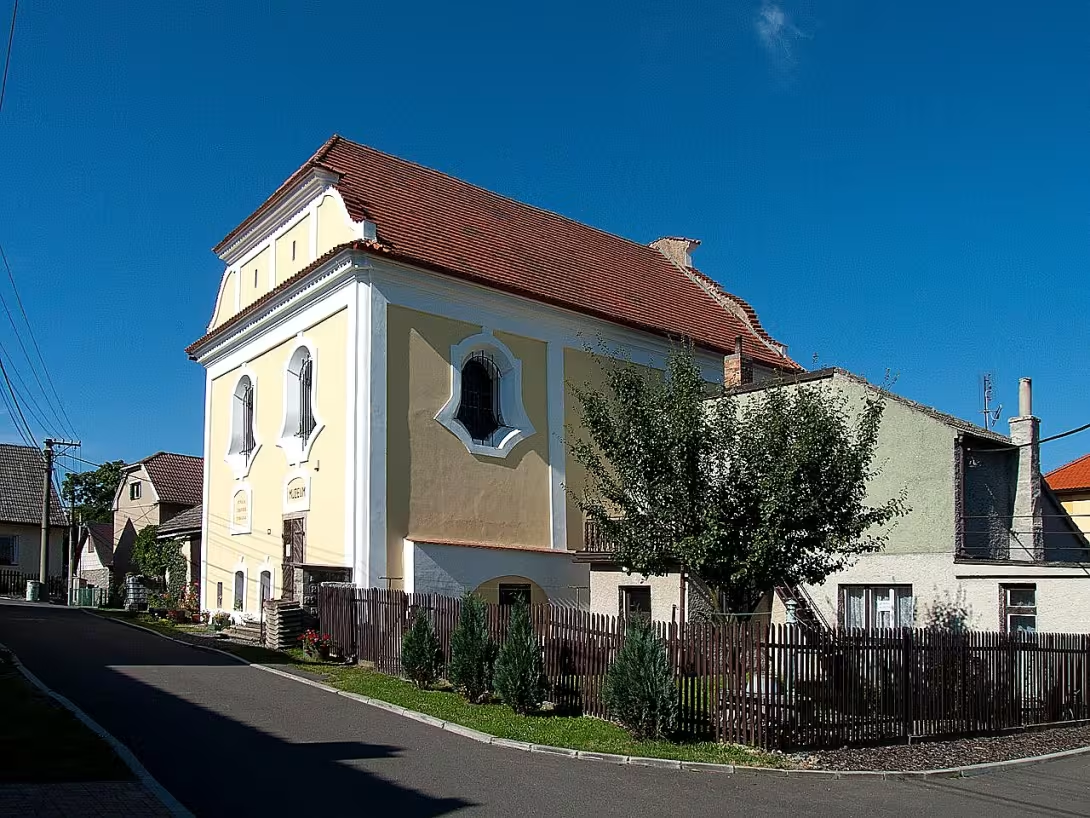
Synagoga v Kasejovicích is a Baroque building from the second half of the 18th century. Located in the village of Kasejovice in the district of Pilsen-south. The Kasejovice Museum is currently in the building and the building serves as an important witness to Jewish history.
The oldest records of the Jewish community in Kazejovice dates back to 1570. Local residents of Judaism devoted themselves to craft sales, moribund, teaching, money lending and toll collection. Between 1725 and 1730, a Jewish town or ghetto was established near the Brewery pond, whose houses were marked with Roman numerals. It was within this ghetto that the synagogue was erected in the second half of the 18th century.
This sacral structure was performed in the Baroque style and in the 1930s it underwent reconstruction. The interior was traditionally divided into a male and female part, each sex having its own entrance. 66 seats were available for men, 45 for women.
Prayer was not only a service, but also a school for interpretation of the Bible and teaching. Later, a separate Jewish school grew up behind the building, which today serves as a library. Since 1909 Jewish children have been transferred to a local municipal school due to small numbers. The tragic turning point in history was 1942, when the Ghetto inhabitants were deported to Terezin and then died in Auschwitz and other Nazi concentration camps. Only one woman survived the Holocaust.
In October 1945, a collection of artistic and industrial objects of the local native Václav Mentberger moved into the building, creating the Museum Kasejovice. While the original Jewish objects travelled to the State Jewish Museum in Prague, the synagogue remained a renovated decoration of the walls and box on the Torah. There are also Jewish candlesticks from Mirovic. The current exhibition offers a wide range of items including porcelain, stoneware, glass, valuable pipes called caskets, paintings, embroidery, textiles, books, notes, photographs, posters and minerals.
The original Jewish ghetto was preserved in the village, which represents the only preserved settlement of this type in Western Bohemia. The Jewish cemetery, whose history dates back to 1669, is situated in the northern part of the village, on the roof of the guard.
Synagoga v Kasejovicích presents a unique combination of religious architecture and regional history. Visiting this place allows a deeper understanding of the fate of the Jewish community in the Pilsen-South district.
Then and now
Drag the slider to compare how the landmark may have looked when it was built with the view today.
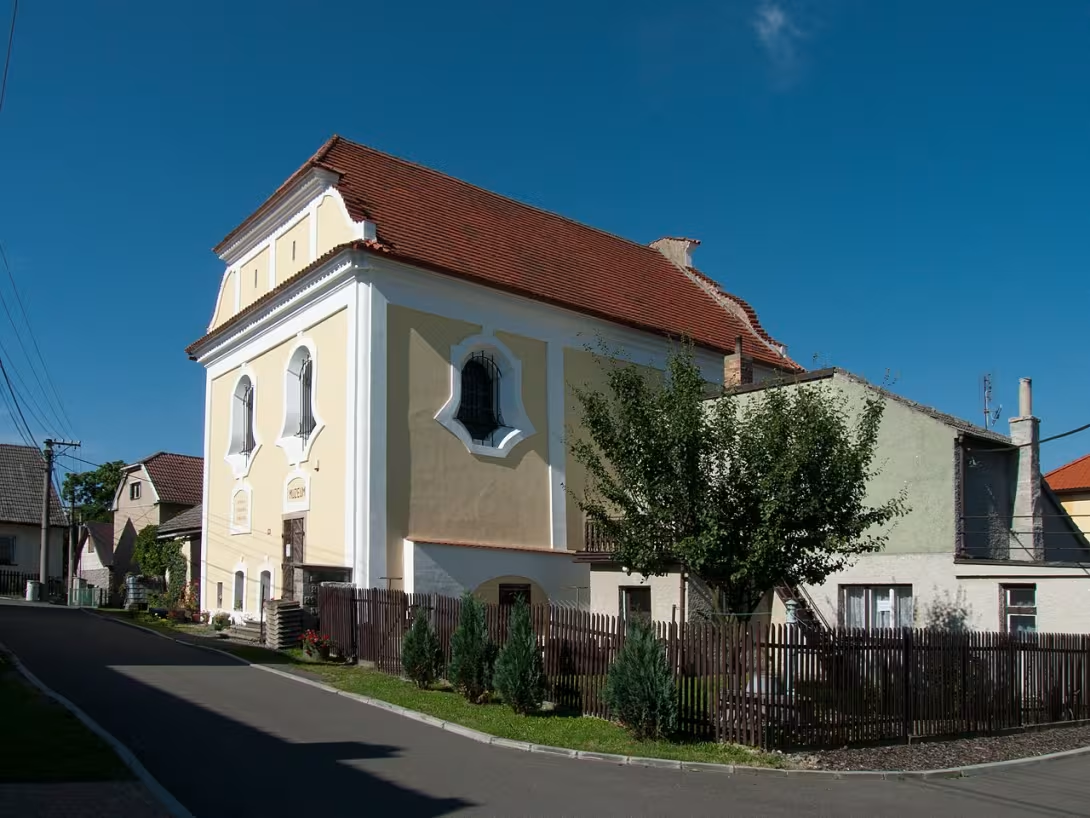

The historical appearance on the left is an AI-generated visualisation and serves as inspiration only.
Historical milestones
- 1725-1730
- The establishment of the Jewish ghetto at the Brewery Pond.
- 1830
- Synagogue reconstruction.
- 1909
- Transfer Jewish children from Jewish school to local municipal school.
- 1942
- Deportation of ghetto residents to Terezin.
- 1945
- Establishment of Museum Kasejovice in synagogue building.
Architectural development
The building was originally built in Baroque style. It was rebuilt in the 1930s. The interior has traditionally been divided into a male and female section with separate entrances.
Historical events
The establishment of the Jewish ghetto in 1725-1730, the deportation of the inhabitants of the ghetto to Terezín in 1942, the establishment of the Museum Kasejovice in October 1945.
Points of interest
- Synagoga v Kasejovicích is a Baroque building dating back to the second half of the 18th century. - The interior of the synagogue was divided into male and female parts, with 66 seats and 45 women available. - Prayer used to serve as a school for interpretation of the Bible and teaching, and later grew up behind the building a separate Jewish school. In 1942, Ghetto residents were deported to Terezin and then killed in concentration camps, with only one female survivor. - The Kasejovice Museum is located in the building, which was created in October 1945 by moving the collection of Václav Mentberger.
Guide
Show guide text
This text was created by artificial intelligence and has not been editorially reviewed. It may contain inaccuracies.
Welcome to Kazejovice. Right now, you're standing in front of a building that's much more than just an ordinary building made of stone and mortar. In front of you is the former synagogue, a silent but talkative witness to the events that shaped the history of this town and the entire Pilsen-South district. Stop for a moment, take a breath and feel the atmosphere of this place. Even though today the building serves another purpose, its walls still tell the story of faith, community, hope and deep sadness.
Look at the overall design of the building. In front of you is a Baroque architecture that dates back to the second half of the eighteenth century. At the time the synagogue was built, it was not only a religious building, but the real heart of the Jewish quarter. To understand why the synagogue is standing right here, we have to go back a few centuries in our minds, namely from 1725 to 1730. It was during this period that the Jewish ghetto was founded at the Brewery pond. Imagine then Kasejovice as a place where two worlds existed next to each other. The Jewish community had its own streets, houses and this synagogue, which was the center of their spiritual and social life.
Now, when you're looking at the facade and the general appearance of the building, take note of its character. Although the details of time are erased, it is known the influence of the baroque style, which was typical for the time being. However, the building was not static over the years. If you look carefully, remember that the construction you see has undergone a significant change in the 1930s. That's when the synagogue was rebuilt to better serve the growing community and meet the new needs of the time. This reconstruction in 1830 gave the building a form that follows us until today.
Now let's think about what happened inside these walls. The synagogue was not only a prayer. In her quarters, there was a shrine to daily education. In the early days there was a school where the Bible was taught and the interpretation of sacred texts took place. Imagine the noise of children here who learned to read and write and at the same time deep silence during prayers. This dual function of the building shows how important the education for the Jewish community was.
An interesting detail that you can imagine, if you move in the building later, is the interior layout. In line with the traditions at the time, the interior was strictly divided into male and female parts. This separation was not random, but it was part of a ritual order. For an idea of the size of the community, we have specific numbers. Sixty-six seats were available for men while forty-five were prepared for women. These numbers give us an idea of how many people could gather here at one point to look together for answers to life and faith issues.
When we talk about people who were connected to this place, we must not forget personalities like Václav Mentberger. The names of such people are often only in the archives, but they were the ones who formed the tissue of the Kazuovic Society. Jewish citizens were integrated, traded, worked and contributed to the development of the city in Kassovice. The year 1909 was a significant milestone in the integration process. At that time there was an important shift when Jewish children were transferred from their own school to a local municipal school. It was a symbol of openness and efforts to unite communities, which indicated that the ghetto's borders were slowly disappearing in people's minds.
Unfortunately, history also brought dark chapters. If you are now aware of the peace of mind, remember 1942. That was the year that changed the face of Kassovic forever. This year, Jewish ghetto residents were violently deported to Terezin. At that moment the prayers were silent, the Bible's teaching was silent, and the building that served as a refuge of faith for over a hundred years remained empty. So this synagogue is not only an architectural unique but, above all, a painful monument to the tragedy that has struck thousands of families. He is a silent witness to a time when human hatred outweighed living together.
Now look at the building from another perspective. After the end of World War II, in 1945, the synagogue was given a new role. The building became the seat of the Museum Kasejovice. It's a fascinating turn of fate. A place dedicated to God and studying sacred texts has become a place where the memory of the whole city and its inhabitants is preserved. In a sense, the museum continues the original synagogue mission, which was the education and transfer of knowledge, only to a much wider extent.
Now try asking yourself what these walls would tell you if they could talk. Would you hear the baroque sermon, the children's laughter of Bible lessons, or perhaps the silence of the 1942 empty streets of the ghetto? This building is like a book whose pages are made of stone. Every detail, from baroque features to later modifications, is one word in this story.
Notice how the synagogue dominates in space. Although the ghetto no longer exists in its original form, this construction still shows where the Jewish district was located near the Brewery Pond. It's an anchor that connects us to the past and reminds us that history isn't just a list of data in textbooks, it's real people, their homes, and their dreams.
Now that you know the basic story of this place, I suggest you take a closer look at the building. Feel her texture and think about the people who went through it. Whether you were curious about architecture or interested in history, I hope you were interested in this place with its troubled past and peaceful presence.
I invite you to enter the Kasejovice Museum now, where you can discover other layers of local history and see the expositions that complement the picture of this fascinating city. Explore the premises that once hosted sixty-six men and forty-five women in prayer, and let yourself be carried away by memories of the old Kasejovice.
Thank you for accompanying me on this short journey through time. I wish you a pleasant rest of the visit and plenty of new discoveries. Goodbye.
Tips for visitors
To visit the Kazuovic Synagogue, it is best to choose the morning hours, when the sunlight ideally illuminates the Baroque facade of the building and the historic streets of the former ghetto.
Take with you fixed shoes on the road, because historical installations and surrounding terrain can have uneven surfaces. If you plan a longer trip connected to the discovery of local history, a bottle with a drink and a small snack are also useful, as the refreshments at the sights are limited.
We recommend to capture the atmosphere of the narrow streets of the former Jewish ghetto, located in the immediate vicinity of the synagogue. The best light for exterior images is in the morning, when the sun pleasantly illustrates the historical nature of the whole location.
In the wider surroundings of the monument, or in the northern part of the village on the hill On guard, do not miss a visit to the historical Jewish cemetery founded in 1669, which forms a whole with the Jewish ghetto and synagogue.
Families with children can take a visit as an educational trip to history. Since this is a sensitive historical monument and a nearby cemetery, it is advisable to prepare the children in advance for a quieter atmosphere and movement in the historical environment of the former ghetto.
Frequently asked questions
Can the monument be visited?
Religious buildings are usually open mainly during services; at other times a visit is normally arranged with the parish or the operator. We have not verified specific times.
Where is the monument?
Location: Kasejovice, Plzeňský kraj. The map on this page shows the exact spot.
Why is the monument protected?
It is listed in the Central List of Cultural Monuments of the Czech Republic as a cultural monument (register no. 1000140219).
Businesses nearby
Do you run a restaurant, accommodation, shop, museum, rental, wellness or other visitor service near this monument? Show yourself directly to the people heading to it — this is how they will see you in the app and on the web:
Nearby
In the northern part of the village on the hill The Jewish cemetery from 1669 is on guard. The original Jewish ghetto is also nearby.
Accommodation nearby
Themed route
1.Synagoga v Kasejovicích Type: Synagogue Why is it worth a visit: The main destination of our route is an important historical monument commemorating the former Jewish community in the village. The construction will take on its architecture and atmosphere associated with the fate of local inhabitants.
2. Original Jewish ghetto Type: Historical installation Why is it worth a visit: In the immediate vicinity of the synagogue is the original Jewish ghetto, which draws the historical character of this part of the village. The walk offers a view of the preserved development connected with history.
3. Jewish Cemetery Type: Cemetery Why is it worth visiting? This cemetery from 1669 lies on the top On guard in the northern part of the village. Located within walking distance and offers a quiet environment with valuable historical tombstones.
Seasonal recommendations
Spring in Kasejovice brings the surrounding South Bohemian nature to life and the ongoing restoration of this monument matches the awakening greenery. The interior of the synagogue gradually illuminates the first stronger sun rays that penetrate high windows and create a unique game of lights on original plaster. The atmosphere here at this time is very quiet and contemplative, ideal for the perception of genius loci. As for practical advice, crowds of tourists are not yet a problem in the spring months, so you can enjoy the tour in complete peace. It is convenient to bring layered clothes with you because old stone masonry is still cold after winter. The best time to visit is the morning clock, when the sun best illuminates the main hall.
Summer brings full tourist revival to Kasejovice and the main season when the monument is accessible to the widest extent. The surroundings of the synagogue are lit by summer flora colours, and long days provide enough light for detailed discovery of exterior and interior. The atmosphere is alive and the air in the building is pleasantly warm, which encourages a longer examination of the details of Jewish architecture. Since this is the main holiday period, we recommend adjusting the visiting time and arriving either in the morning or in the late afternoon to avoid the biggest temperature fluctuations and possible group tours. Put on light, breathtaking clothes and don't forget your sunglasses and a bottle of water for the road.
Autumn covers Kasejovice in melancholic robes of colorful leaves, which make a beautiful scene for shooting outside facades. The light in this period is soft, often coloured with foggy herpes, which gives the tour a deeply nostalgic dimension. A calm atmosphere without summer excitement records deeper reflection on the history of the local community. Practically, it is necessary to count on colder weather and occasional rain, therefore fixed shoes and waterproof jacket or coat are necessary. The best time to visit is around noon, when the thermometer reaches its daily maximum and the fog usually dissolves.
Winter shows Kasejovice and the local synagogue in a minimalist, clean silence that underlines the snowfall in the surrounding countryside. The interior lighting is muted and the short day forces to quickly adjust the schedule. The atmosphere in advent time and during winter months is extremely chaotic and raw, completely free from the outside rush. The tour requires honest preparation because the historical building is not permanently heated; The necessity is warm winter clothes, hats, gloves and warm shoes. The best time to visit is early afternoon, while there's still enough daylight out there.
Visualizations and artistic views


The visualisations are generated by artificial intelligence and serve as inspiration.
Photos from the area
Real photos taken near the monument

Zdroj a licence jsou uvedeny u každého snímku.
Tips from visitors
No tips yet. Be the first!
Log in and add your tip.
Sources and literature
Photos: Jitka Erbenová (cheva) / CC BY-SA 3.0 — Wikimedia Commons. The author and licence also appear when you hover over the image.
Faktickým podkladem tohoto textu byl článek na Wikipedii, jehož autory jsou přispěvatelé Wikipedie. Článek je dostupný pod licencí CC BY-SA 4.0.
Location on the map

Příběhy a pověsti
Legendy, pověsti a příběhy spjaté s touto památkou
Fotografie návštěvníků
Zatím žádné fotografie. Buďte první, kdo přidá fotografii z návštěvy!
Log in a přidejte svou fotografii nebo hodnoťte.
Za ověřenou návštěvu v aplikaci získáte víc bodů — poznáme podle GPS, že jste na místě.
Reviews and comments