



Drážní vodárna Kasejovice Waterworks
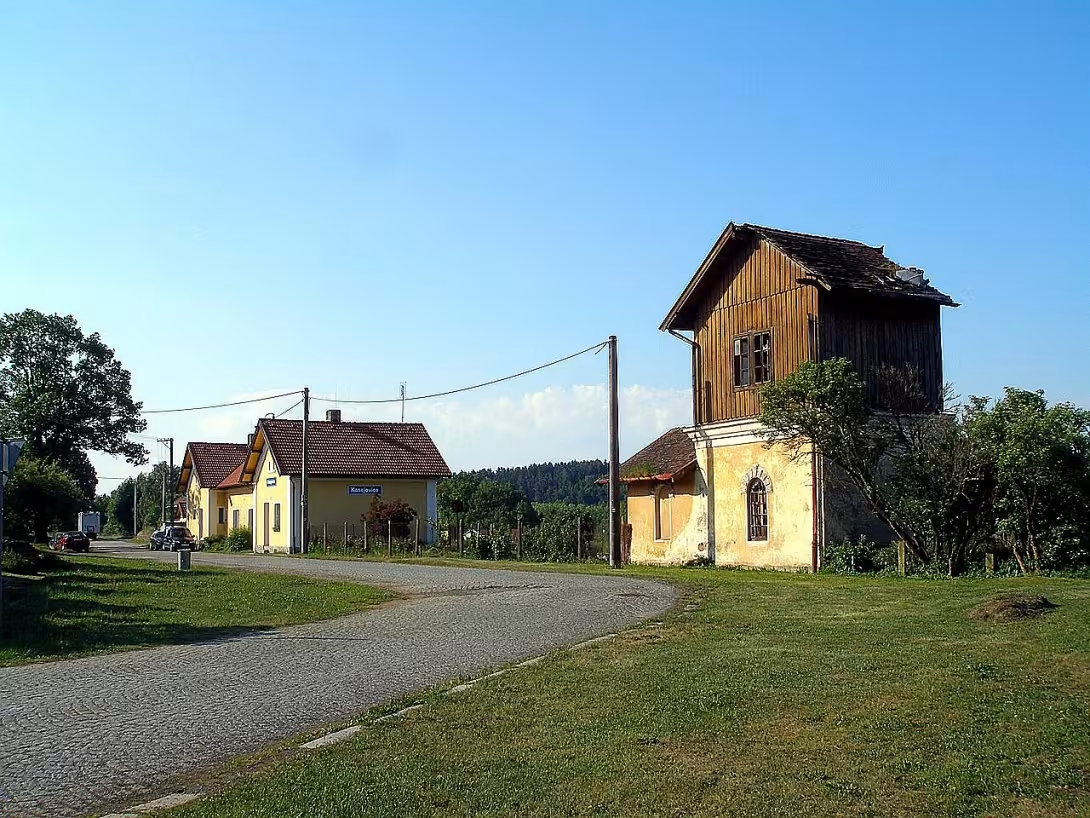
The water plant is located in the railway station Kasejovice on the cadastral territory of the district Plzeň-jih. It was built as part of the construction of the local route from Blatná to Nepomuk, on which a group of dealers obtained permission in February 1897. This authorisation was to be merged with the earlier authorisation of June 1896 to build a line from Strakonice to Březnice. The projects were developed by engineer Jan Kodl of the Sand. Construction work started in November 1897 by the company Living-Count-Kovářík under the direction of engineer Jiří Hauser. The line operation started in 1899.
The runway waterworks were located on the track on the range of steam locomotives. They were created according to the typical plans of the Railway Department of the Regional Committee of the Kingdom of the Czech Republic. The whole railway area included a typical local-type shipping building, warehouse with ramp, toilets, water crane, well, cleaning pit and other facilities. The water plant served as the most important part - it drew and stored water for steam locomotives.
Steam operation durал for several decades. In 1928 they introduced motorbikes for passenger transport, while steam locomotives remained in service for freight until 1969. The water plant itself stopped working in the 1980s.
The construction has an asymmetric composition with a storey northern part of the water tower and a ground-floor southern perpendicular to coal. The ground floor of the water tower was equipped with a boiler, on the floor there is a riveted open tank of 30 cubic metres. The ground floor is made of burnt bricks and smooth plastered, floor paved with brick lining. Roofs are saddled, covered with ceramic burnt bags. The building is divided by quarted stone plinth and ends with a massive brick crown ledge. The entrances have plastic vaults, in the original wall preserved the build sign - water level indicator.
Original technological equipment included steam boiler, pulsometer and piping lines. During electrification, the steam pump was replaced by an electric pump. The feeding and sampling lines with valves have been fully preserved. The water was drawn from the well in front of the north facade into the tank and brought to the crane by the track.
The Ministry of Culture of the Czech Republic declared the railway waterworks a cultural monument in 2020. The preserved building today resembles the technical development of railway operation and engineering solutions of the second half of the nineteenth century.
Then and now
Drag the slider to compare how the landmark may have looked when it was built with the view today.
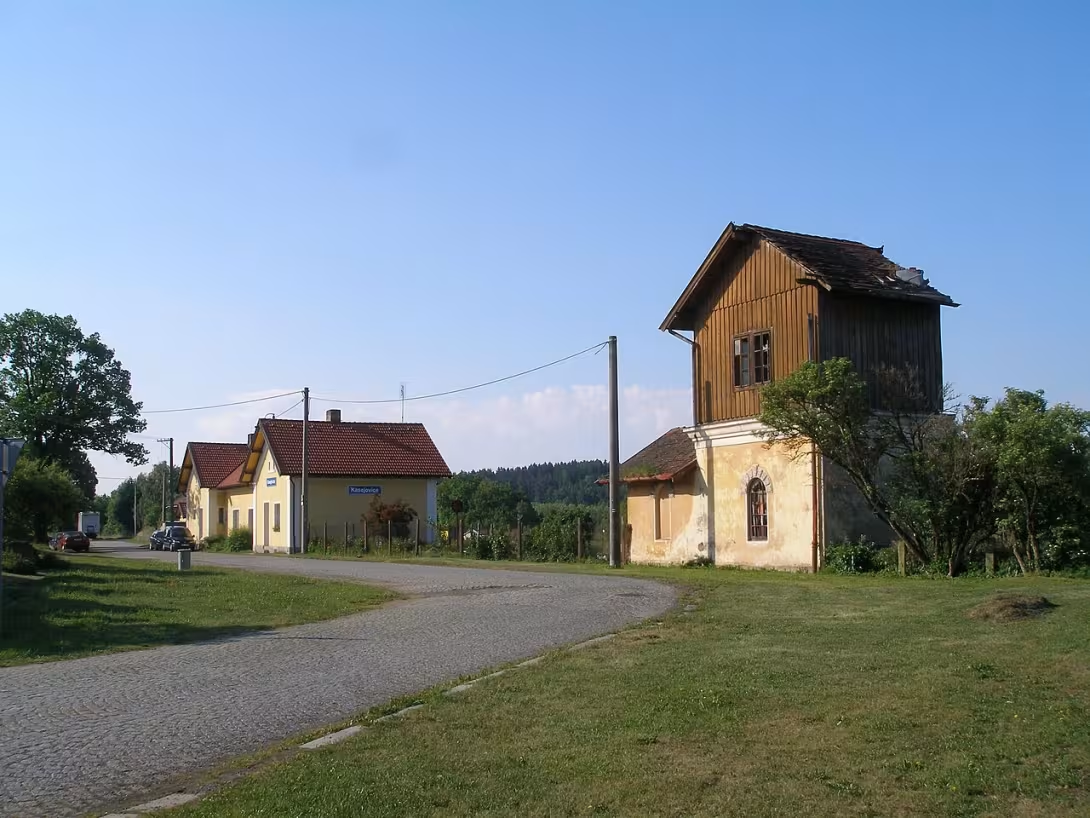
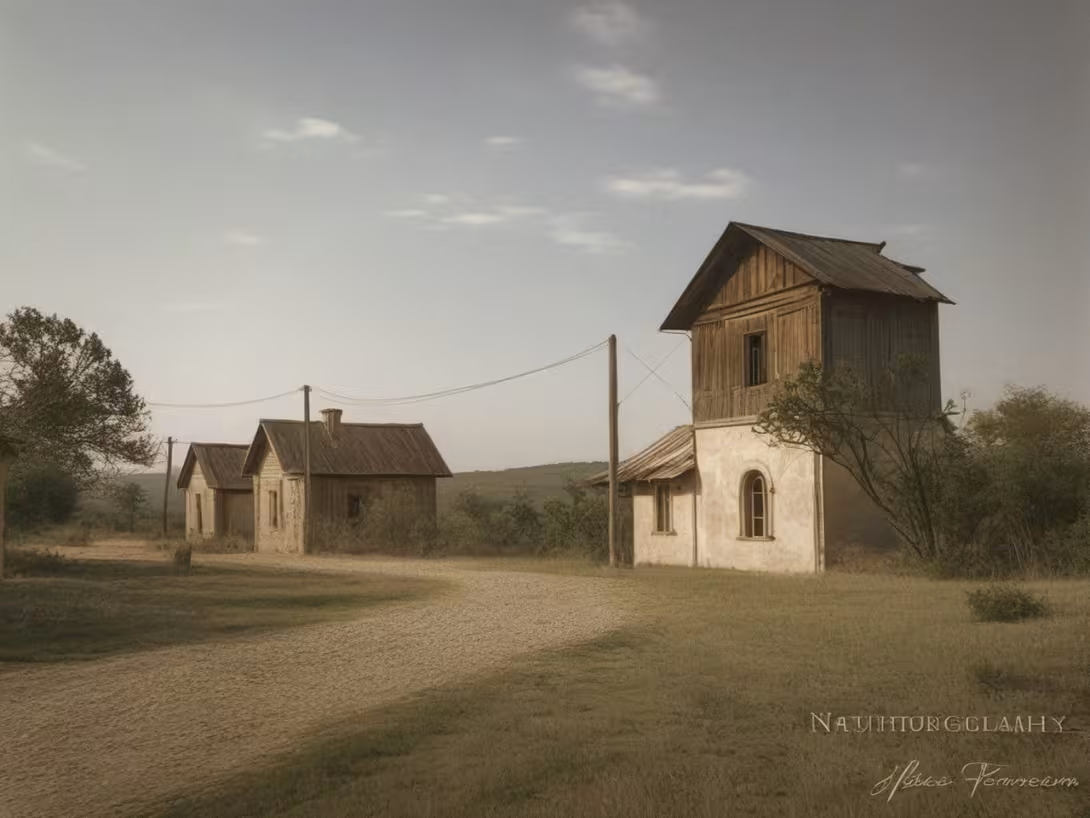
The historical appearance on the left is an AI-generated visualisation and serves as inspiration only.
Historical milestones
- 1897
- Getting permission to build a railway line from Blatná to Nepomuk.
- 1899
- Start of operation of the railway water plant.
- 1928
- Introduction of motor vehicles for passenger transport.
- 1969
- End of steam operation for freight transport.
- 20
- Declaration of construction cultural monument of the Czech Republic.
Architectural development
The building is walled from burnt bricks with smooth plaster and stone plinth. The storey part of the water tower is raked with a brick lining and boxed vertically. Roofs are low-tenacity saddles, covered with ceramic burnt bags with bobbins. The original steam boiler and pump were later replaced by an electric pump.
Historical events
In February 1897 a permit was issued for the construction of the railway line from Blatná to Nepomuk. The operation of the water plant started in 1899. In 1928, motorbikes were introduced for passenger transport, while steam traffic remained for freight until 1969. In the 1980s, the water plant was shut down.
Points of interest
- Although the water plant is known for its technological equipment, the fascinating thing is that the original steam pump was replaced by an electric pump after 1969. This transition from steam to electricity reflects a wider technological transformation in the Czech Republic.
- The ownership history of the water plant is linked to the Railway Department of the Regional Committee of the Kingdom of the Czech Republic, which underlines its importance for the management of local railway lines. This historical link shows administrative structures in the period before the First World War.
- The water works architecture includes a formatted floor with plank boards, which was a common building solution at the time. This detail shows a combination of traditional and innovative construction techniques used in the late 19th century.
- The water plant was built under the guidance of engineer Jiří Hauser, whose contribution to the railway infrastructure is less known compared to other dealers of that time. His work at the water plant Kasejovice contributed to the development of regional rail traffic.
- Originally, the water plant was designed to supply steam locomotives, which is interesting in the context of modern electrification of railways. This historic transition from steam to electricity illustrates the evolution of railway technology and its impact on the industrial revolution in Central Europe.
Guide
This guide is narrated by a synthetic voice generated by artificial intelligence.
Show guide text
This text was created by artificial intelligence and has not been editorially reviewed. It may contain inaccuracies.
The railway water station in Kasejovice in the Plzeň region is a standardised building that supplied steam locomotives with water on the local railway line. In 2020, the Ministry of Culture declared it a cultural monument.
Its story begins with the railway from Blatná to Nepomuk. A group of concessionaires received permission to build in February 1897. It was supposed to be merged with the concession for the local line from Strakonice to Březnice, which the same group had already received in June 1896. The plans were drawn up by the firm of engineer Jan Kodl from Písek. The construction company Životský, Hrabě and Kovářík began work in November 1897 and the construction was supervised by engineer Jiří Hauser. Operations began in 1899. Water stations were built according to how far steam locomotives could travel. One was therefore located in Kasejovice and another in Blatná.
From 1928 onwards, motorised rail cars were used for passenger transport. Steam locomotives continued to pull freight trains until 1969. In the nineteen eighties, the water station ceased to serve its purpose.
The station received a set of standardised buildings according to plans for local lines, which were managed by the Railway Department of the Provincial Committee of the Kingdom of Bohemia. In addition to the station building, there was a warehouse with a ramp, toilets, a water crane, a well, a cleaning pit and a rubbish pit.
The water station itself is a free-standing building with a rectangular floor plan. The northern part consists of a two-storey water reservoir, the southern part a single-storey coal shed. On the ground floor of the reservoir was a boiler room, probably originally with a steam boiler. On the first floor is a riveted open tank holding thirty cubic metres of water.
The ground floor is made of fired bricks and is smoothly plastered. It is surrounded by a low base of ashlar stone and the water reservoir is topped at this height by a massive brick cornice. The first floor is timber-framed, filled with bricks and clad with vertical boards with segmentally cut lower ends. Both parts are covered with low pitched roofs with overhangs and fired beaver tail tiles. The roof of the reservoir is perpendicular to the long axis of the building, the roof of the shed runs parallel to it.
Two entrances lead to the railway tracks, one to the shed and one to the reservoir. Both are decorated with plastic arches of rough plaster. To the left of the entrance is an original water level gauge set into the masonry, which showed the height of the water level in the tank.
Water was pumped from a well in front of the northern façade into the tank and from there flowed by gravity into the illuminated water crane by the track. Originally it was pumped by a pulsometer, a steam pump, which was later replaced by an electric one. The water crane disappeared during track repairs. The inlet and outlet pipes with valves have been preserved in their entirety.
Tips for visitors
This period also provides ideal lighting conditions for shooting architectural details of the building.
When planning a visit, remember suitable clothes, especially if you visit during the winter months. Also bring a camera or mobile phone to capture the historical details of the building that is surrounded by natural environment.
For photography, choose a time near noon when the light is brighter and fewer shadows. The best places to capture the overall view of the waterworks can be found from both sides of the building or from a considerable distance to highlight its architectural beauty.
Frequently asked questions
Can the monument be visited?
The building is in use (offices, a school, shops and the like). The interior is generally accessible only during operating hours and tours are not usually offered; we have not verified the details. You can see the exterior from the street.
Where is the monument?
Location: Kasejovice, Plzeňský kraj. The map on this page shows the exact spot.
Why is the monument protected?
It is listed in the Central List of Cultural Monuments of the Czech Republic as a cultural monument (register no. 1999993578).
For kids
Hello, adventurers! Prepare to travel back in time and discover the secrets of the Rail Waterworks Kasejovice! Let's stop here where the magic of technology and history happens. Imagine you're a detective and you're supposed to uncover the secrets of this old place.
Good will and innovation created this special object long before you were born. The water plant was built for a great task - to power steam locomotives with water. It was like a natural road for trains so they could drive fast and safe on the tracks. This was 12 hours a day, so the locomotives had enough power to run.
Businesses nearby
Do you run a restaurant, accommodation, shop, museum, rental, wellness or other visitor service near this monument? Show yourself directly to the people heading to it — this is how they will see you in the app and on the web:
Nearby
ITEX Show interactive overview of the surroundings - restaurants, accommodation, rentals and other places within a 15 km radius.
Data: OpenStreetMap contributors, 15 km radius.
‡ Historical monuments
- Memorial to victims of the Second World War (0.8 km)
- sv. Donate from Arezza (3.0 km)
- Gallery Carriers of the tradition of folk crafts (6.1 km)
- na Memory of World War I (7.1 km)
- Battle of Murder (7.5 km)
- Castle Blatna (10.5 km)
- Municipal Museum Blatna (10.6 km)
- Model Railway (10.7 km)
Restaurant and catering
- Hostika U Butterla (1.0 km - Kasejovice 172)
- Castle Restaurant (3.1 km)
- Cultural House Chanovice (6.3 km)
- Guesthouse at Barochod (10.6 km)
- Confectionery Kavarna Citi (10.6 km)
- Casa Verde (10.7 km)
- Monroe café (10.7 km)
- Kebab-Us Rytmus (10.8 km - Peace Square 202)
Accommodation
- AGRO motel (2.4 km - 384)
- Na Pansk (2.8 km)
- Na Statku (5.4 km)
- Chat settlement (9.4 km)
- Beránek (10.6 km)
- Pension Slunce (10.6 km)
- Motel Pyramid Nepomuk (11.6 km)
- Scout Camping (11.8 km)
› Rental and sports
- Joyride (10.6 km)
- KarBikesporto (10.6 km)
© Tourism and nature
- Nad (5.1 km)
- Nepomuk žst (10.8 km)
- Pachejov (zw) (11.5 km)
- Forest stopping (12.2 km)
- Red bridge (12.7 km)
- Klášter (13.1 km)
- village Monastery and Cistercian monastery (No)
- Buková hora - Chýlava (13.2 km)
Accommodation nearby
Themed route
1. Drážní vodárna Kasejovice, technical monument. A tour of a unique industrial building which was used to provide water for rail transport. 2. Exposure in the water plant area, educational part. Here you can find out about historical devices and techniques used for water management. 3. Water tower, technical construction. This part of the object shows internal mechanisms and offers a view of the surrounding areas. 4. Waterworks tank, outdoor area. A walk in the immediate vicinity of the building will allow you to better perceive the overall architecture of this work.
Seasonal recommendations
Spring: In the spring season, Drážní vodárna Kasejovice is transformed into a haven full of new life, where flowering shrubs and trees color the surroundings with beautiful colors. The sun rays illuminate the water work in light, which emphasizes the architectural beauty of the monument. At this time the likelihood of visitors enjoying natural changes increases, so we recommend visiting an early afternoon to avoid larger crowds. Fine spring temperatures mean that it is advisable to take light clothes with you, but also some layer for any cool wind.
Summer: Summer offers Drážní vodárna Kasejovice an ideal environment for relaxing and using tight days. The atmosphere is particularly lively when the sun illuminates the water work with long rays, which adds a different dimension to their architectural design. In the main summer season, the number of visitors increases, so we recommend visiting the memory earlier in the day and bringing sun protection. Hot clothes are necessary as well as sufficient volume of drinking drink to maintain hydration during your visit.
Autumn: Autumn season brings a specific atmosphere to the Rail Water Plant Kasejovice, when tree leaves are transformed into golden and red shades. This change in the color of the environment creates a unique background for a water work which is illuminated alternately by sunlight and silent leaves falling to the ground. Due to mild temperatures, it is recommended to visit the memorial between 10:00 and 14:00, when the hottest part of the day is. It is advisable to bring layered clothes to adapt to rapid temperature changes.
Winter: In winter months, Drážní vodárna Kasejovice offers a quiet and quiet environment, where ice crystals decorate the surrounding landscape. Sun rays illuminate the water work in a special light, adding magic and peace to its architectural elements. It is necessary to bring warm clothes and possibly protective items against rain or snow for a more comfortable visit.
Visualizations and artistic views


The visualisations are generated by artificial intelligence and serve as inspiration.
Atmosphere of the place
This atmospheric visualisation of the place and period was generated by artificial intelligence. It is not real footage of the location.
Tips from visitors
No tips yet. Be the first!
Log in and add your tip.
Sources and literature
Photos: Miloš Hlávka / CC BY-SA 3.0 — Wikimedia Commons. The author and licence also appear when you hover over the image.
Faktickým podkladem tohoto textu byl článek na Wikipedii, jehož autory jsou přispěvatelé Wikipedie. Článek je dostupný pod licencí CC BY-SA 4.0.
Location on the map



Příběhy a pověsti
Legendy, pověsti a příběhy spjaté s touto památkou

Fotografie návštěvníků
Zatím žádné fotografie. Buďte první, kdo přidá fotografii z návštěvy!
Log in a přidejte svou fotografii nebo hodnoťte.
Za ověřenou návštěvu v aplikaci získáte víc bodů — poznáme podle GPS, že jste na místě.
Reviews and comments