



Újezd nade Mží Chateau
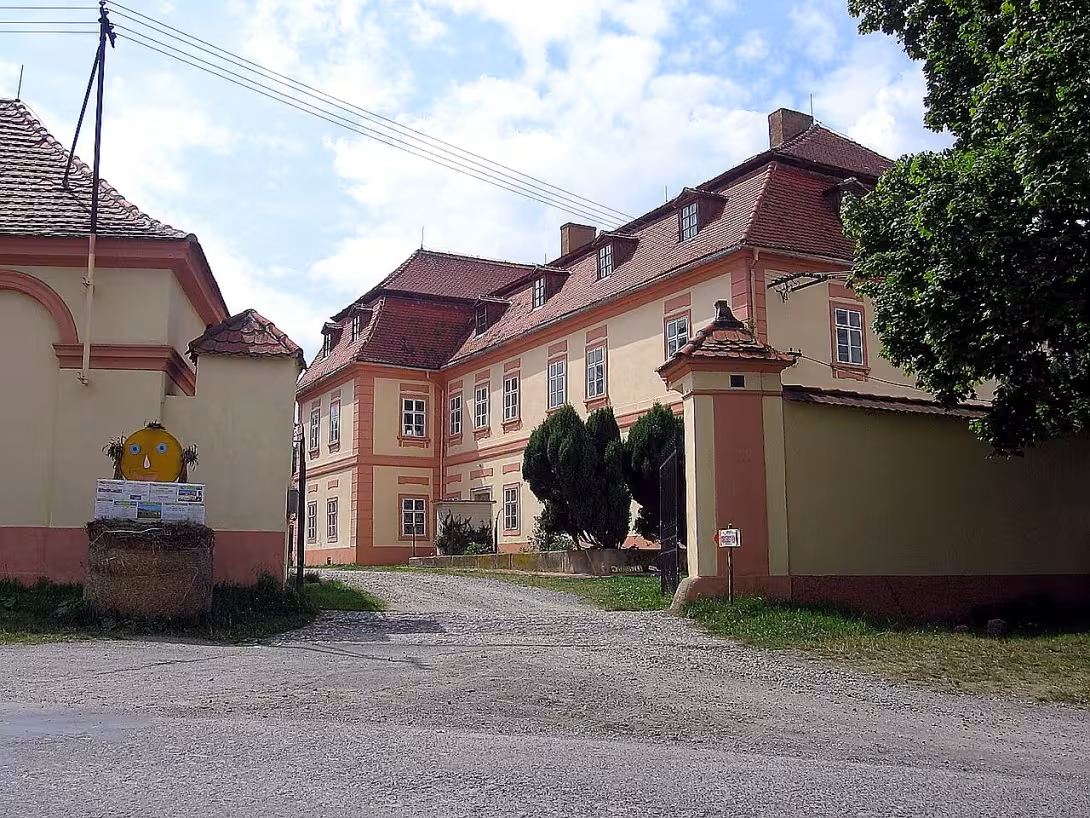
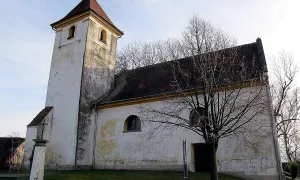
The Újezd nade Mží Chateau is located on the southwest edge of the village of the same name in the Plzeň-sever district. It is not only the chateau palace itself, but a whole with the relevant economic court including the state of the administrative, hozepalata and storage buildings which are protected as a whole as a cultural monument of the Czech Republic.
The construction was preceded by a Renaissance fortress, which was confiscated by the state power by its owner Jost Adam Shirntyngar of Shirntyng as punishment for participating in the state uprising. The first preserved mention of the estate dates back to 1623 when Severin Táhlo z Horštejna bought it for 9437 kicks of Míšín grosches. After Severin's death, his daughter Kateřina inherited the property, who married Jan Jindřich of Bedeberk. Jindřich was the Plzeň mayor and in 1650 he sold the estate to Theophilus Kle of Roudná. In this period, sometime between the centre and the burning of the old fortress, the Baroque chateau was probably built in its place. After Theophilus Kle's death in 1666, his heirs could not agree on the division of the property and the court of the Land decided to sell it. In 1673 Maria Steinbachová z Kranichštejna was bought by a single village estate and its descendants owned it until the eighteenth century. The then owner Karel Maximilian Wilhelm Steinbach had to sell it for debts in 1723. The owners took turns: Karel from Schönau bought in 1725, later owned Franz Joseph Kölisch and Judith Saidlrova from Wolfsfeld. Since 1790 the estate belonged to the Schirnding family, and under Karl Schirnding the chateau was rebuilt in 1817 in a classical style.
Construction forms reflect rich history: the old Renaissance fortress has preserved cellars and remains of the former granary masonry. The main building has a rectangular plan with one smaller side wing. The facade is decorated by corner boasts and double windows in shambles; The ground floor is connected with the vaulted vaults, while the floors have flat ceilings. On the south side there is a storey granary with passage to the yard, where there are brick portals. Part of the complex is an administrative building with a rectangular plan, the facade of which is divided by lizenas and windows with flat ledge on the ground floor, two stables, two barns, a deputant house and a former greenhouse converted into horse stables. To the west of the chateau lies the former garden, in the south an unpreserved park surrounded by brick wall with pillars.
The chateau represents a valuable witness to the long development of Czech architecture from Renaissance to Baroque to Classicism. His economic court is a rare example of an organically growing estate preserved until today.
Then and now
Drag the slider to compare how the landmark may have looked when it was built with the view today.
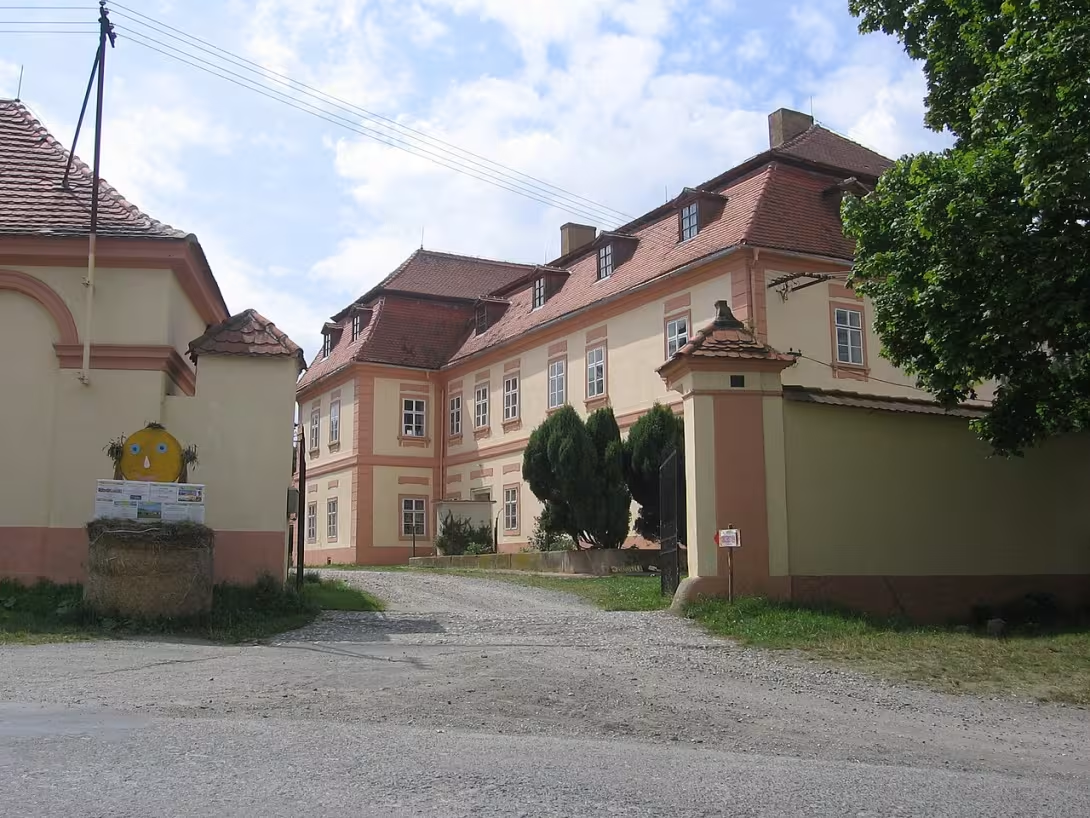
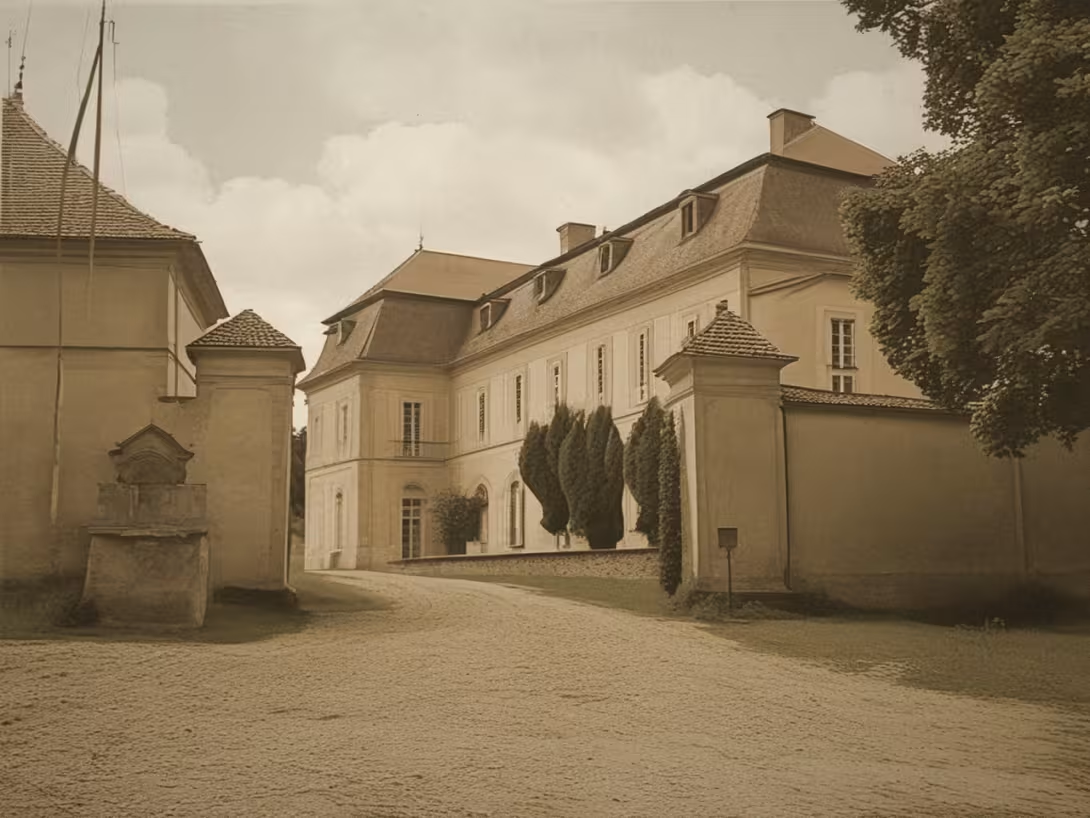
The historical appearance on the left is an AI-generated visualisation and serves as inspiration only.
Historical milestones
- 1623
- First written mention of the fort after the confiscation of property.
- 1650
- The estate buys Theofil Kleo z Roudné, at which time it is likely to be a Baroque chateau.
- 1817
- Classicist reconstruction of the chateau under Karl Schirnding.
Architectural development
The original Renaissance fortress was replaced by a Baroque chateau from which the cellars and part of the masonry granary were preserved. The main building has a rectangular floor plan with corner boasts and window shambles. In the 19th century a classical reconstruction was carried out, which imprinted the building in its current form with the Mansard roofs.
Historical events
1623: First written mention of the fortress in connection with the confiscation of property. 1650: The sale of the estate to Theophilus Kle of Roudná, when the construction of the chateau probably began. 1817: Classicist reconstruction of the chateau for Karl Schirnding.
Owners
Severin Táhlo z Horštejna (from 1623), Jan Jindřich z Bedeberka, Theofil Kleo z Roudné (from 1650), Maria Steinbachová z Kranichštejna (from 1673), Karel from Schönau (1725), Franz Joseph Kölisch, Judita Saidlrova from Wolfsfeld, family Schirnding (from 1790).
Points of interest
- The chateau is not just the palace itself, but it forms a whole with an economic court which includes administrative, economic and storage buildings. The whole area is protected as a cultural monument of the Czech Republic. - The original Renaissance fort was confiscated by the owner of Jost Adam Shirntyngar of Shirntyng as punishment for participating in the state uprising. - The Baroque chateau was probably built on the site of an old fort between the center and its burning. - In 1817 the chateau was rebuilt for Karl Schirnding in a classical style. - The old Renaissance fort has until today preserved the cellars and remnants of the former granary.
Guide
This guide is narrated by a synthetic voice generated by artificial intelligence.
Show guide text
This text was created by artificial intelligence and has not been editorially reviewed. It may contain inaccuracies.
The castle in Újezdě nade Mží stands in the municipality of the same name in the Plzeň-sever district. It was created approximately in the middle of the seventeenth century. The entire castle complex, including administrative and farm buildings, is protected as a cultural monument.
The castle was preceded by a fortified manor. It belonged to Jošt Adam Širntyngar of Širntyngu, who had it confiscated along with the estate for his participation in the Estates' Revolt. The first written mention of the fortified manor dates from sixteen twenty-three. At that time, Severin Táhlo of Horštejna bought the estate for nine thousand four hundred thirty-seven kopecks of Meissen groshes. After him, the property was inherited by his daughter Kateřina, who was married to Jan Jindřich of Bedeberka. He was the mayor of Plzeň and in sixteen fifty he sold the estate to Theofil Kleo of Roudná. It was probably around that time that a Baroque castle was built on the site of the previously burned-down fortified manor.
Theofil Kleo died in sixteen sixty-six. His heirs could not agree on how to divide the property, so the regional court decided that it should be sold. The estate, which consisted of a single village, was bought in sixteen seventy-three by Maria Steinbachová of Kranichštejna. It belonged to her descendants until seventeen twenty-three, when Karel Maxmilián Vilém Steinbach had to sell it due to debts. In seventeen twenty-five, the estate was owned by Karel of Schönau, followed by František Josef Kölisch and Judita Saidlrová of Wolfsfeldu. From seventeen ninety onwards it belonged to the Schirndingen family. Under Karel Schirndinger, the castle was rebuilt in the Classicist style in eighteen seventeen. According to August Sedláček, however, the castle only came into being in that year.
The castle is part of a farmyard on the southwestern edge of the village. From the older Renaissance fortified manor, only the cellars and part of the granary walls remained. To the west of the castle is a former garden, and in the south of the complex lies an unmaintained park. It is surrounded by a brick wall articulated by pillars, with a facade decorated with pilasters and lisenes.
The main building has a rectangular floor plan and one smaller side wing. The facade is articulated by corner rustication and double windows in surrounds. The ground floor is vaulted with a barrel vault, and the rooms on the first floor have flat ceilings. To the south is a two-story basement granary with a passage into the courtyard. To the right of the passage is a bricked-up segmental portal and further on another rectangular portal.
Opposite the castle stands an administrative building with a rectangular floor plan. Its facades are articulated by lisenes and two-winged windows, on the ground floor covered with flat cornices. The complex also includes two stables, two barns, a deputy's cottage, and a former greenhouse used as a horse stable.
Tips for visitors
The best time to visit is during the late spring or early autumn, when the surrounding landscape around the river Mje is the most photogenic and the weather wishes to walk on the grounds of the chateau and adjacent economic yard.
If you choose public transport, check the current connection to the village Újezd nade Mží in the available search engines.
When photographing the Baroque architecture of the chateau with a mansard roof, use soft morning or evening light to highlight historical details of the facade. We recommend to bring with us fixed shoes, as the terrain around the farm yard can be uneven.
In the immediate surroundings you can visit the picturesque village Újezd nade Mží, which offers a quiet atmosphere, or go to the nearby River Mizu and dam Hracholusky, which are ideal for relaxation in nature.
For families with children the location is suitable primarily as a starting point for easy walks in nature. Children will appreciate the area around the farm yard and the proximity of the water level of the dam Hracholusky, where local fauna can be observed.
Frequently asked questions
Can the monument be visited?
Some buildings of this kind are open for guided tours, others serve another purpose or are privately owned. We have not verified whether and when this monument is open – please ask the operator.
What are the opening hours and admission?
We have not verified the opening hours or admission. Current information is published by the operator.
Where is the monument?
Location: č.p. 1, Újezd nade Mží, Plzeňský kraj. The map on this page shows the exact spot.
Why is the monument protected?
It is listed in the Central List of Cultural Monuments of the Czech Republic as a cultural monument (register no. 26319/4-1595).
For kids
Imagine wild landscapes filled with forests and streams, where everything begins with the mysterious chateau Újezd nade Mží. This beautiful chateau was built in the middle of the seventeenth century, which is like older than your grandparents and much older than any real magical story. To find out how everything started, we must return to the time when there were chateaux, like huge chateaux with high walls and deep pits.
Businesses nearby
Do you run a restaurant, accommodation, shop, museum, rental, wellness or other visitor service near this monument? Show yourself directly to the people heading to it — this is how they will see you in the app and on the web:
Nearby
The village Újezd nade Mží is located in the district of Plzeň-sever, close to the River Mje and dam tanks Hracholusky.
Accommodation nearby
Trips and activities nearby
Guided tours, tickets and activities nearby from GetYourGuide
Affiliate link: if you buy from the partner, we may receive a commission. The price for you does not change.
Search tours and activities →Themed route
Thematic cruise route chateau Újezd nade Mží
1. Chateau Újezd nade Mží - Type: Historical chateau - Why is it worth a visit: Chateau Újezd nade Mží is a beautiful example of Baroque architecture, which excels with its history and artistic details. It is an ideal place for those who like history and architectural pearls.
2. Hracholusky dam - Type: dam tank - Why is it worth a visit: Located near the chateau and offers beautiful views of the surrounding countryside. It is an ideal place for relaxation, picnic or those who love nature.
3. The River May - Type: River - Why is it worth a visit: Walk along the Mze River offers a quiet and comfortable entertainment, with the opportunity to observe the natural beauty of the surrounding valley. It is also an ideal place for cyclists or runners.
4. Chateau tank - Type: Historical courtyard - Why it is worth a visit: The chateau tank is part of the whole complex and offers a view of historical architecture. It's a place where you can relax and look at the details of the building.
5. Park zone around the Chateau - Type: Park - Why it is worth a visit: The park zone around the chateau is an ideal place for relaxing and looking at beautiful garden architecture. It's also a place where you can get beautiful pictures.
This route offers visitors the opportunity to explore the historical chateau Újezd nade Mží and its surroundings with natural and cultural attractions.
Seasonal recommendations
Spring brings a fresh touch of restoration and fine colour of blooming plants to the area around the chateau. The light is softer in this period, which beautifully highlights the details of the historical building in its satisfactory environment. For a visit I recommend choosing layered clothes because morning cold can still be felt. It is an ideal time for a quieter tour without large groups, especially if you arrive soon after opening.
Summer months offer the most sunny hours and rich, rich green vegetation around the chateau. The atmosphere is lively and full of energy, making the monument a popular place for family trips. Due to the main summer season get ready for a larger number of people, therefore it is best to arrive early in the morning or in the late afternoon so that you do not burn direct sun. Don't forget light summer clothes and heat protection.
Autumn turns the surroundings into a varied palette of golden and brown shades, which, combined with the morning mist, creates a very poetic and melancholic atmosphere. The lighting is low and golden in this period, which is ideal for photo lovers. Practically, it is advisable to carry waterproof shoes and a warmer layer of clothing. The number of visitors is decreasing gradually, so you can enjoy a quieter pace of exploration.
The winter season around the chateau is very quiet and distant, especially if snow covers the surrounding countryside. Days are short and light is weak, which gives the memory a mysterious touch. For a visit it is necessary to have very warm clothes and fixed shoes in case of slippery paths. In advent time and during freezing days, the monument is almost empty, which allows a deeper perception of history in silence.
Visualizations and artistic views


The visualisations are generated by artificial intelligence and serve as inspiration.
Atmosphere of the place
This atmospheric visualisation of the place and period was generated by artificial intelligence. It is not real footage of the location.
Tips from visitors
No tips yet. Be the first!
Log in and add your tip.
Sources and literature
Photos: Jik jik / CC BY-SA 3.0 — Wikimedia Commons. The author and licence also appear when you hover over the image.
Faktickým podkladem tohoto textu byl článek na Wikipedii, jehož autory jsou přispěvatelé Wikipedie. Článek je dostupný pod licencí CC BY-SA 4.0.
Location on the map
More monuments – Újezd nade Mží
Show all in the municipality



Příběhy a pověsti
Legendy, pověsti a příběhy spjaté s touto památkou
Fotografie návštěvníků
Zatím žádné fotografie. Buďte první, kdo přidá fotografii z návštěvy!
Log in a přidejte svou fotografii nebo hodnoťte.
Za ověřenou návštěvu v aplikaci získáte víc bodů — poznáme podle GPS, že jste na místě.
Reviews and comments