



Velehradský klášter Monastery
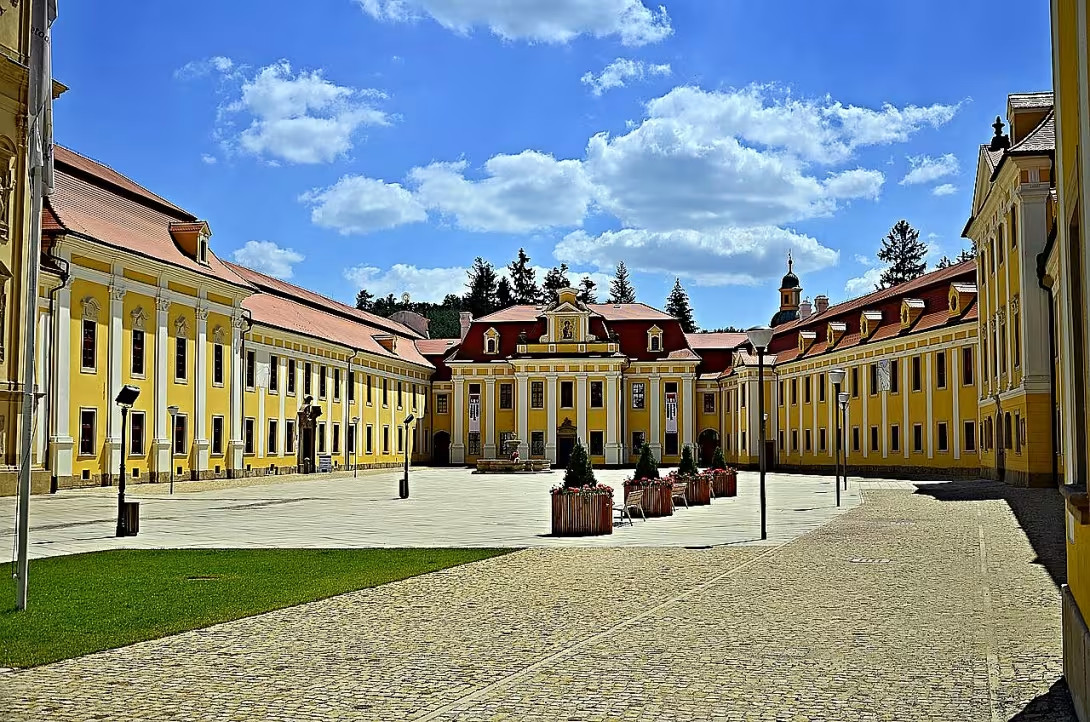
Velehradský klášter is located at the eastern foot of the Chřiba in the village Velehrad, approximately five kilometres from the Old Town near the Hungarian Hradiště. It is a former Cisteriac monastery, which is the oldest member of this order in Moravia and is on the list of protected cultural monuments of the Czech Republic.
The monastery was founded by moravský markrabě Vladislav Jindřich in the early 13th century, at the initiative of Jindřich Vítkovice from Prčice and Hradec and Olomouc Bishop Robert. On November 11, 1205, a group of twelve monks from the monastery of Pláska came with Abbot Thesil to set up the first Cistercian monastery in Moravia. The construction was carried out in a late Romanesque style with the influence of early Gothic and was consecrated on the 27th November, 1228 by Bishop Robert, whom the presence of King Přemysl Otakar I., his wife Kunhuta and their son Margrave Přemysl.
The monastery experienced the first demolition in January 1421 when the Moral Hussites burned it. In the attack, the abbot was burned at the stake and four monks, the monks managed to escape to the nearby Hradiště. The monastery was restored after the abbot Ekard of Schwoben from 1587 to 1592. During the Thirty Years' War, the monastery was affected twice: first in 1623 by the army of Prince Gabriel Bethlen of the Seven Hrad and, second in 1626, during the invasion of the insurgents of Wallachia.
The Baroque form of the monastery began to take place between 1629 and 1635 under the leadership of Abbot Jan Greifenfels of Pilsenburg. Due to the elevation of the surrounding terrain by two metres, the monastery buildings had to be adapted. In the sixteenth century, the Романská bell tower above the cross of the ship was rebuilt into a Renaissance tower, later removed and replaced by a Baroque dome. Two of the original five Romanesque apsid have been removed to adapt to the new terrain. The monastery received its present form between 1685 and 1735 on the basis of the reconstruction carried out after the Great Fire of 1681. This process continued under the abbey Peter Silavecký, Bernard Kashpárek, Florian Nezorin and Joseph Malý.
In 1784 the monastery was abolished as a result of the Josephine reforms. The buildings were subsequently used for military purposes as barracks and Lazaret, while the church served as parishes, although the rectory was only established in 1825. In 1837 the monastery was purchased by a Viennese banker, and in 1883 its descendants sold it to the Archbishop of Olomouc.
Since the middle of the nineteenth century, the importance of the site in connection with the Cyrilo-Methodology link has increased. In 1890, the monastery was acquired by Tovaryštvo Jesus, who set up a college and later a boys' gymnasium. The Jesuits then manage the pilgrimage place and parish Velehrad to this day. The monastery and its basilica have become the most important pilgrimage place in the Czech Republic, every year tens to hundreds of thousands of pilgrims, including participants in the National pilgrimage at Velehrad and many smaller pilgrimage events. Stojan High School is in his part.
Then and now
Drag the slider to compare how the landmark may have looked when it was built with the view today.
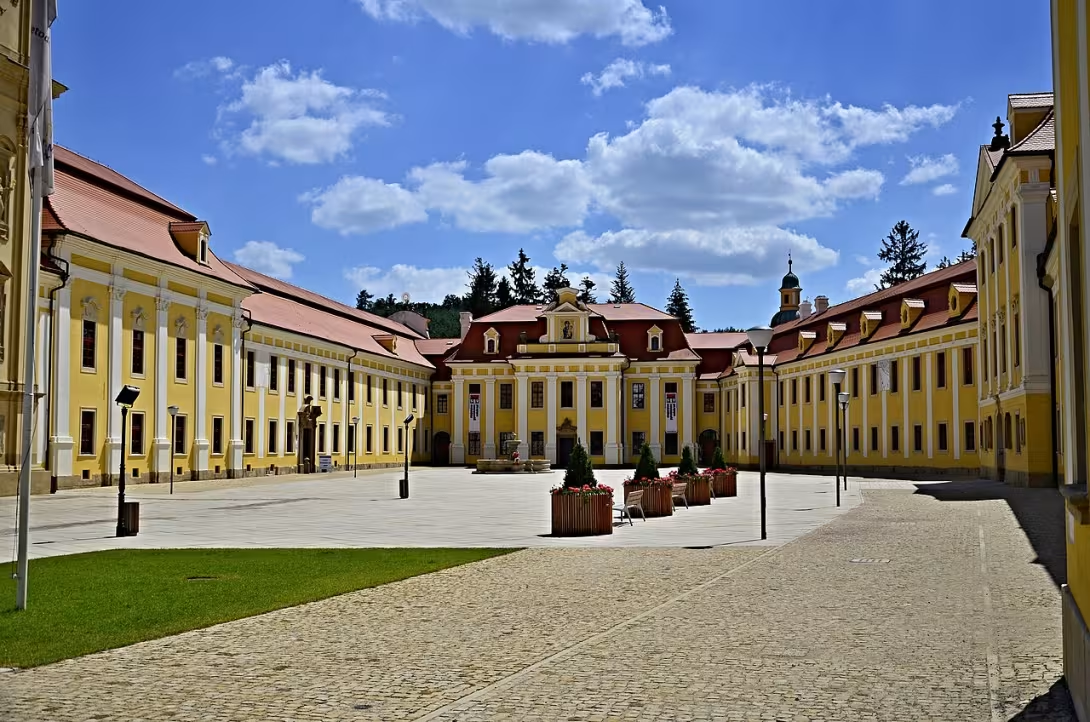

The historical appearance on the left is an AI-generated visualisation and serves as inspiration only.
Historical milestones
- 1205
- The arrival of twelve monks from the Plane to establish a monastery
- 1228
- The consecration of the monastery building by Bishop Robert
- 1421
- The first demolition of the monastery by firing Moravian Hussites
- 1587-1592
- Restoration of the monastery under the leadership of Abbot Ekard of Schwoben
- 1623
- Damage to the monastery by the army of the Seven Hrad prince
- 1784
- The abrogation of the monastery as a result of the Josephine reforms
Architectural development
The monastery was originally built in a late Romanesque style with the influence of early Gothic. After the destruction of the Hussite and the Thirty Years War, a Baroque reconstruction took place, which respected the changes in the terrain and added new architectural elements.
Historical events
- 1421
- The monastery was burned by geese.
- 1623 and 1626
- Destruction during the Thirty Years' War.
- 1685-1735
- Baroque reconstruction after a fire in 1681.
Owners
- 1205-1784
- 1784-1837
- 1837-1883
- 1883- now
Points of interest
- It's the oldest Cistercian monastery in Moravia. - The monastery was founded by moravský markrabě Vladislav Jindřich in the early 13th century. - In January 1421 the monastery was burned by the Moravian Hussites. - In 1784 the monastery was abolished as a result of the Josephine reforms. - The monastery and its basilica became the most important pilgrim place in the Czech Republic.
Guide
This guide is narrated by a synthetic voice generated by artificial intelligence.
Show guide text
This text was created by artificial intelligence and has not been editorially reviewed. It may contain inaccuracies.
Velehrad Monastery is a former Cistercian monastery on the eastern foothills of Chřiby, about five kilometers from Staré Město u Uherského Hradiště. It was founded in the early thirteenth century and is the oldest Cistercian monastery in Moravia. Together with the basilica, it is today the most significant pilgrimage site in the Czech lands, thanks to its connection with the Cyril and Methodius legacy. Every year the National Pilgrimage to Velehrad takes place here, attended by tens of thousands to hundreds of thousands of pilgrims. Velehrad is also a place where the traditions of the East and West meet, and a symbol of Christian unity in Europe.
The monastery was founded by Moravian margrave Vladislav Jindřich at the initiative of Jindřích of Vítkovice from Prčice and Hradec and Robert, the bishop of Olomouc. It took its name from the nearby village of Veligrad, today's Staré Město. On the eleventh of November twelve hundred five, twelve monks from the Plaská monastery arrived here under the leadership of abbot Thezil. The building in late Romanesque style with the influence of early Gothic was consecrated on the twenty seventh of November twelve hundred twenty eight by bishop Robert in the presence of King Přemysl Otakar the First.
Early in the morning on the twelfth of January fourteen twenty one, the monastery was set on fire by Moravian Hussites. They destroyed the library built over two centuries and burned the abbot and four monks at the stake. The others managed to escape to Hradiště. Reconstruction only took place between fifteen eighty seven and fifteen ninety two. During the Thirty Years War, the monastery was damaged twice, in sixteen twenty three by the army of Bethlen Gábor, prince of Transylvania, and in sixteen twenty six by rebels from Valašsko.
It acquired its present appearance after the fire of sixteen eighty one, during the years sixteen eighty five to seventeen thirty five. The surrounding terrain rose by two meters over the centuries and the reconstruction had to account for that. The Renaissance tower above the crossing of the naves was replaced by a Baroque dome, two of the five Romanesque apses were removed, and many valuable elements were hidden by Baroque facades.
During the time of Josephine reforms, in seventeen eighty four, the monastery was dissolved. The church became a parish church and the buildings served as barracks and a hospital. From the middle of the nineteenth century, the importance of the place associated with Cyril and Methodius grew. In eighteen sixty three, for the thousandth anniversary of their arrival in Great Moravia, the celebration was attended by almost a hundred thousand people. Archbishop of Olomouc Antonín Cyril Stojan played a great role in the development of the pilgrimage site.
In eighteen ninety the monastery was acquired by the Jesuits and they established a college there and later a boys gymnasium. In nineteen hundred one the Slavic Hall was created, a hall decorated with vedute paintings of places memorable for the Slavic peoples. Christian intellectuals and theologians from all over Europe gathered in it. The Jesuits manage the monastery today and Stojan Gymnasium is housed in part of it.
Tips for visitors
The best time to visit Velehrad is spring and summer when the landscape around the hill is green and the weather usually favourable for walks. As this is one of the most important pilgrimage places in the Czech Republic, expect a higher attendance during the summer months and holidays, so it is good to come early in the morning or late in the afternoon to enjoy a quieter atmosphere and a better light for photography.
Transport to Velehrad is ensured both by car and public transport.
When visiting the monastery and basilica, take with you comfortable shoes because the area is large and includes outdoor areas. Since this is an active pilgrimage site, it is advisable to take sufficient drinking regime, especially in warm months. If you are planning a longer stay, consider taking a light snack with you so you can relax in the area.
The best place for photographers is the Basilica itself and the monastery complex, especially in the morning or evening light, which creates dramatic shadows and emphasizes architecture. The views from hill Velehrad on the surrounding landscape of the Zlín Region are also very photogenic. However, be respectful of other visitors and pilgrims and respect any prohibition on photography within the sacral spaces.
Since there are no specific places in the area within 30 minutes, we recommend focusing on the monastery and its surroundings, which offers a rich cultural and spiritual program. For families with children the visit is suitable if children are able to handle longer walks and respect the quiet atmosphere of the pilgrimage place. Children may be fascinated by history and architecture, but it is important to inform them in advance about the behavior in the church and monastery.
Frequently asked questions
Can the monument be visited?
Religious buildings are usually open mainly during services; at other times a visit is normally arranged with the parish or the operator. We have not verified specific times.
Where is the monument?
Location: Nádvoří 1, Velehrad, Zlínský kraj. The map on this page shows the exact spot.
Why is the monument protected?
It is listed in the Central List of Cultural Monuments of the Czech Republic as a national cultural monument (register no. 337).
For kids
Businesses nearby
Do you run a restaurant, accommodation, shop, museum, rental, wellness or other visitor service near this monument? Show yourself directly to the people heading to it — this is how they will see you in the app and on the web:
Events nearby


Zdroj akcí: otevřená data měst a obcí ČR (Národní katalog otevřených dat) a kalendář akcí Národního památkového ústavu.
Nearby
ITEX Show interactive overview of the surroundings - restaurants, accommodation, rentals and other places within a 15 km radius.
Data: OpenStreetMap contributors, 15 km radius.
‡ Historical monuments
- sv Jan Nepomucký (0.3 km)
- Blue - On (0.9 km)
- Panna Maria (1.2 km)
- St. Jan Nepomucký (5.1 km)
- memory of the Jewish cemetery destroyed by the Nazis (7.3 km)
- Memorial to Holy v. Victims and Liberation (11.2 km)
- T.G. Masaryk (11.2 km)
- K. H. Borovský (11.5 km)
Restaurant and catering
- Myslivecke (1.2 km)
- Guesthouse Ego (4.0 km)
- Café Greta (5.6 km)
- U Eskymáka (5.8 km - ev.70)
- U Kozelko (10.2 km - 370)
- Restaurant Aquarium Stupava (10.6 km)
- Popobar (10.9 km - 132)
- Bar U nás (11.2 km)
Accommodation
- Hotel Skanzen (1.0 km)
- kamp Velehrad (2.1 km)
- Guesthouse Max (4.2 km)
- Guesthouse On the square (4.4 km)
- Guesthouse On Dam (5.1 km)
- Ranch Equator (5.6 km)
- Slunce (6.1 km)
- AGROPenn Boards (6.5 km)
› Rental and sports
- Lyze Wheels Šmídek (4.4 km)
- Cycloservice Lysonky Ivo (4.7 km)
- Sportisimo (5.1 km)
- inFitness (6.2 km)
- M-Cyclon (6.2 km)
- Help Mi Bike (6.7 km - U Stadium 270)
- Fitness (6.8 km)
- Napajedla - Pahrbek (10.3 km)
© Tourism and nature
- Blue skanzen (0.8 km)
- Blue - On (0.8 km)
- Lower mill (1.5 km)
- Blue (rozhl., rozc.) (1.7 km)
- 5. Fellows of beech "Pear" (4.9 km)
- White Hill (clay) (9.1 km)
- Bunè (year) (9.5 km)
- Brdo (9.8 km)
Accommodation nearby
Trips and activities nearby
Guided tours, tickets and activities nearby from GetYourGuide
Affiliate link: if you buy from the partner, we may receive a commission. The price for you does not change.
Search tours and activities →Themed route
1. Basilica of the Assumption of the Virgin Marie, sacral building, represents the heart of the whole complex with a wonderful inner space. 2. Monastic courtyard , monastery area, allows visitors to explore the building of the inner spaces. 3. Monastic Garden , a green area, offers a quiet place to relax right next to the monastery walls. 4. Monastic exposition , historical exhibition, brings the rich past and importance of this abbey closer.
Seasonal recommendations
Spring: In the spring the monastery comes to life together with nature in the surroundings. Growing gardens and fresh greenery provide a peaceful and optimistic atmosphere to the place. The light is delicate and ideal for capturing the details of architecture. We recommend wearing layered clothes because morning cold can be surprising. The journey will be less crowded than in the summer months, allowing you to perceive spiritual silence without much excitement.
Summer: Summer season brings bright energy and full sun to Velehrad. Historical buildings in sharp midday light appear monumental, but can also be very hot. Due to the increased interest of visitors, we recommend arriving as early as possible in the morning to avoid the biggest crowds and to take advantage of more pleasant temperatures. Remember light clothing, headgear and plenty of fluids to ensure comfort during the tour of the outdoor areas.
Autumn: Autumn months cover the monastery in golden and brown shades. Foggy morning awakening and falling leaves create a melancholy, deep atmosphere suitable for contemplation. It is ideal to visit the memory in the afternoon when the sun shines low and the colors are the most intense. Due to humidity and colder days, solid shoes and warmer layers of clothing are useful.
Winter: In winter, the monastery is covered in silence and quiet, which is ideal for those who seek spiritual shelter. If snow falls, the roof of the monument looks very impressive. The light is weak and the days are short, so plan a visit in bright morning to use the maximum daylight. The need for quality winter clothes and warmer shoes is necessary, because it can be very cold in open spaces.
Visualizations and artistic views


The visualisations are generated by artificial intelligence and serve as inspiration.
Photos from the area
Real photos taken near the monument

Zdroj a licence jsou uvedeny u každého snímku.
Atmosphere of the place
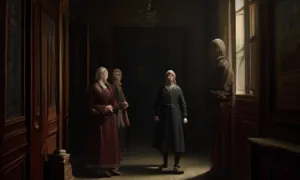
This atmospheric visualisation of the place and period was generated by artificial intelligence. It is not real footage of the location.
Tips from visitors
No tips yet. Be the first!
Log in and add your tip.
Sources and literature
Photos: Bjalek Michal / CC BY-SA 3.0 — Wikimedia Commons. The author and licence also appear when you hover over the image.
Faktickým podkladem tohoto textu byl článek na Wikipedii, jehož autory jsou přispěvatelé Wikipedie. Článek je dostupný pod licencí CC BY-SA 4.0.
Location on the map


Příběhy a pověsti
Legendy, pověsti a příběhy spjaté s touto památkou
Fotografie návštěvníků
Zatím žádné fotografie. Buďte první, kdo přidá fotografii z návštěvy!
Log in a přidejte svou fotografii nebo hodnoťte.
Za ověřenou návštěvu v aplikaci získáte víc bodů — poznáme podle GPS, že jste na místě.
Reviews and comments