






Vinohradská tržnice Market
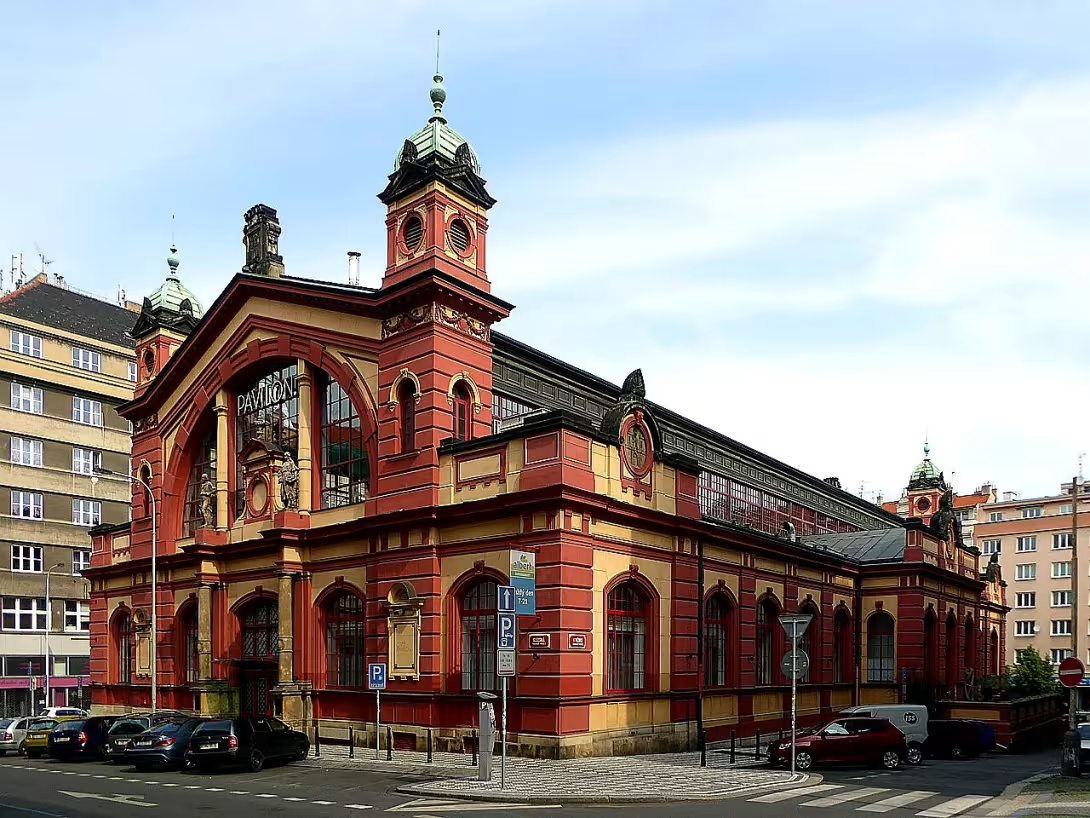
Vinohradská tržnice, since 1994 known as Pavilon, is a historical building in Prague 2 built between 1901 and 1903 in the style of eclectic historism. This object occupies the interblock parcels formed by the Vinohradská class, Silesian and Budech streets and represents an important architectural element in the location.
The construction was built on the site of the former mill machinery factory. The building was built by the city of the Royal Vinohrady, which became part of the Great Prague in 1922. The project was designed by architect Antonín Turk in order to create a marketplace for 100 food stands.
Architecturally, the object is shown as a three-ship basilical hall. The facade is decorated with two towers, a clock and a thermal window. The construction combines wall parts with modern steel lattice roof construction. At the time of its creation, the building was technologically advanced because it contained electric refrigerators and air conditioning. The facade is decorated with two statues of Vladimir Astl from 1903: A woman with poultry and a man with fish that symbolizes the focus of the market on meat and fish.
The history of the building includes an attempt to move the marketplace from Tyl Square. But the vendors who were transferred to Vinohrad soon came back because they thought the place was remote. In the 1980s, the market was closed and the building burned down in 1986. Demolition was prevented by the Club for Old Prague, which made the building declared a cultural monument.
The building was adapted to a department store in 1994-1995. In 2013, during the Desigblok exhibition he opened a shop specialized in modern design furniture, the reconstruction of which was awarded the Trade of the Year of Czech Grand Design.
Today, the building serves as a department store and is open to the public. This monument is a valuable witness to the development of the Royal Vinohrad and shows how historical styles combine with new industrial materials. The visit to this building offers an insight into the urban development of Prague 2 at the turn of the century.
Historical milestones
- 1901- 1903
- market construction
- 1986
- building fire
- 1999-1995
- adaptation to the department store
- 2013
- opening of design shop during the Desigblock exhibition
Architectural development
The building combines the walls with a modern steel lattice roof construction. The facade is characterized by two towers, a thermal window and a clock. In 1994-1995, the building was reconstructed and adapted to new commercial applications.
Historical events
In 1986 the building burned down, but was saved from demolition thanks to the merits of the Old Prague Club. It was adapted to a department store in 1994-1995.
Points of interest
- Vinohradská tržnice was built between 1901 and 1903 in the style of eclectic historism. - The building contained electrical refrigerators and air conditioning, which made it technologically advanced at the time of its creation. - The facade is decorated with two statues by Vladimir Astl from 1903: A woman with poultry and a man with fish, symbolizing the focus of the market on meat and fish. - The building was declared a cultural monument thanks to the efforts of the Old Prague Club after it burned down in 1986. - The building was adapted to a department store in 1999-1995.
Guide
Show guide text
This text was created by artificial intelligence and has not been editorially reviewed. It may contain inaccuracies.
Welcome to the heart of Prague two, in the beautiful district of Vinohrady. Stop for a second and take a breath. You are standing in front of a building that carries more than a century of Prague history and is a silent witness to the transformation of this city. Before you, there is a building that many of us now know under the name Pavilon, but its original name and functions were much more practical and closely linked to the daily needs of the people. It's Vinohradská tržnice. Stop, look around and perceive the atmosphere of this interblock, where today urban tourism meets the calm of historical architecture.
Let us now return together in time to the full beginning of the twentieth century. This building was built in the years of a thousand nine hundred and one to a thousand nine hundred and three. At that time, the Vinohrady was rapidly developing, modern neighborhoods were becoming, and the city urgently needed a new, hygienic and spacious place to sell food. That is why architect Antonín Turk was commissioned to design a space that would not only be fully functional but also aesthetically attractive and representative. Imagine the hustle and bustle at the time, the smell of fresh pastries, vegetables, fruits and various kinds of meat offered by local traders every day. It was a neighborhood artery, a place where people met, exchanged news, and bought the best that the surrounding countryside offered.
Now pay attention to the very form of construction that you are currently facing. If you look at the overall shape and arrangement, you'll see it's a three-boat basilica hall. That's a very interesting architectural element. It means that the building has one main, higher central section and two lower side ships. Such a solution was not chosen at random. This construction provided much better lighting of the inner spaces with natural light while allowing for better air flow, which was absolutely crucial in the market to maintain the freshness of the goods. The whole style of the building is described as an eclectic historical style. This means that the architect Turk was not bound by just one rule, but drew inspiration from various historical periods and joined them together into one harmonious unit, which is both noble and stable. Look at the facade and see how this building dominates the space within the block and how it creates a sense of enclosed, safe space.
Now, if you look closer to decorating the facade, notice two remarkable statues. These plastic elements were created by artist Vladimír Astl in the year of a thousand nine hundred and three, i.e. the year when the construction was completed. There are people here who made up the soul of the market and its everyday life. On one side you'll see a woman with poultry and on the other side a man with fish. These characters are not just an ornament to the facade, but a profound reminder of what this building was at its core. They are symbols of craft, trade and work. When you look at them, try to imagine the real people who became here a century ago with their baskets and goods. These details tell us a story about the ordinary life of the Prague people, their needs and the weight of food quality and fair trade at the time.
You may think that the market was just an ordinary hall built of stone and bricks at the time, but it was actually a technological miracle of its time. Imagine that at the very beginning of the twentieth century, the building was equipped with modern electric refrigerators and air conditioning. At a time when most residents were still relying on ice cellars or fast selling goods to avoid spoiling, Vinohradská tržnice was the absolute top of modern technology. This allowed food to be stored in much better condition and guaranteed freshness for much longer. This made the market one of the most modern and desirable places in Prague. It was a place where the tradition of selling in the market met with the latest scientific knowledge about food storage.
But the history of the building was not just about flourishing and success. Let us now move forward in time to the year one thousand nine hundred eighty-six. This year, the building was hit by a devastating fire that left deep marks in the construction and appearance of the building. It might seem that such an event is the end of the building, but due to its high architectural value and importance to the surroundings, the construction was not demolished. On the contrary, in the years one thousand and nine hundred ninety-four to ninety-five she had undergone extensive adaptation. It was during this period of transformation that the building began to be called Pavilon and its function changed fundamentally. The place of food sales has become a modern building serving as a department store. It was a new beginning that breathed new life into the building and allowed it to survive in a new era.
Another important milestone in modern history was the year two thousand thirteen. A shop focused on modern designs and aesthetics was opened here as part of a large exhibition of modern shapes and styles. This gave a whole new, contemporary dimension to the building. The practical marketplace became a space for creativity and beauty. It is fascinating to follow this path from the sale of fish and poultry through the devastating fire to the current galleries and shops with modern objects.
Today we no longer buy fresh fish or poultry, but Pavilion remains an important and beautiful architectural element of our Vinohrads. It's a real bridge between a practical, artisanal past and a creative, aesthetic presence. This building teaches us that architecture can change its function, but its souls and beauty remain.
Now I invite you to take a closer look at the building from your own experience. Take a look at the surroundings, look again at the statues of Vladimir Astl and try to visualize in your mind the noise, the smell and the hustle that existed here over a century ago. Feel the contrast between the silent interlock and the history that still breathes in these walls. Thank you for accompanying me on this short journey through the history of the Vinohrady Market. I wish you a pleasant continuation in exploring the hidden corners and beauty of Prague. Goodbye.
Tips for visitors
The best time to visit is in the morning or early afternoon, when the most natural light enters the space of the Basilica Hall, which best highlights the eclectic style details. The location is available by car and by public transport; Check the current connection and parking possibilities in the area in the map search engine.
We recommend that you take with you comfortable shoes and a camera to document in detail the historical architecture from the beginning of the twentieth century. For the best photos focus attention on the three-boat layout of the hall and the historical elements that look best in bright daylight.
In the immediate vicinity you can walk through the Vinohradská class, Silesian street or Buděčská street, which forms the interblock where the building is located. For families with children, the hall space is suitable for safe walking and exploring the historical environment.
Businesses nearby
Do you run a restaurant, accommodation, shop, museum, rental, wellness or other visitor service near this monument? Show yourself directly to the people heading to it — this is how they will see you in the app and on the web:
Events nearby

Zdroj akcí: otevřená data měst a obcí ČR (Národní katalog otevřených dat) a kalendář akcí Národního památkového ústavu.
Nearby
Stavba se nachází ve vnitrobloku tvořeném Vinohradskou třídou, Slezskou a Budečskou ulicí v Praze 2.
Accommodation nearby
Trips and activities nearby
Guided tours, tickets and activities nearby from GetYourGuide
Affiliate link: if you buy from the partner, we may receive a commission. The price for you does not change.
Search tours and activities →Themed route
Vinohradská tržnice Type: Cultural and gastronomic monument Why: This historic building in the interblock is the heart of Prague's market life. Visitors will appreciate the atmosphere of old Prague, fresh products and the opportunity to taste regional specialities right at the stands.
Intermediate block between Vinohradska, Silesia and Budečská Type: Architectural space Why: The area around the market consists of a quiet interblock that contrasts with the ruckus of surrounding streets. The walk here allows you to admire the historical development and find a quiet place to relax after shopping.
Wine-growing class Type: Historical street Why: This main artery around the market offers a view of the typical Prague architecture. It is an ideal place for a short walk that connects the market to the surrounding parts of the district.
Silesian Street Type: City street Why: One of the boundaries of the interblock where other historical buildings are located. It allows a smooth continuation of the journey and the discovery of smaller alleys in the immediate vicinity of the main destination.
Budapest Street Type: City street Why: Third party of the interblock that closes the area around the market. The walk along this street completes the picture of the whole area and offers additional views of the local development.
This route focuses exclusively on the immediate vicinity of the main destination, namely the interblock and the streets that form it. You don't have to go far to experience the atmosphere of this place. Start by visiting the market itself, where you can take a break and buy something. Then take a walk around the perimeter of the interblock to enjoy the peace and quiet that exists here. The journey is short and comfortable, suitable for anyone who wants to get to know this part of Prague at close range without the need to travel to more remote parts of the city.
Seasonal recommendations
Spring: In spring, the market wakes up along with the surrounding greenery. The sun shines softer and the air smells fresh. It's the perfect time for walking between stalls when the trees are in full bloom. I recommend you take several layers of clothing because the wounds are cold and the afternoon can be warm. It's best to come by around 10:00 a.m. when people are just starting to meet.
Summer: The summer season brings to the market the largest crowd of people and merry noise. The light is very sharp and the sun burns, which creates a lively but hot atmosphere. Due to large crowds and high temperatures, it is best to arrive first thing in the morning before the greatest heat begins. Dress lightly and don't forget to drink to avoid heat fatigue.
Autumn: Autumn moons offer a calmer and a little melancholy atmosphere. Leaf turns color into gold, and morning fog gives the place a mystery. The lighting is low and very photogenic. It is advisable to carry a waterproof jacket and a warmer sweater for a visit because the weather is changing quickly. The perfect time for a visit is in the morning before it rains.
Winter: In winter time there are fewer people and there is a quiet, calm mood. Days are short and light is weak, which creates a cosy but cold atmosphere. It is necessary to prepare for frost, so choose a strong jacket, scarf and hat. Since the opening time is shorter in this period, I recommend planning a visit around noon when the most light is.
Visualizations and artistic views

The visualisations are generated by artificial intelligence and serve as inspiration.
Photos from the area
Real photos taken near the monument


Zdroj a licence jsou uvedeny u každého snímku.
Tips from visitors
No tips yet. Be the first!
Log in and add your tip.
Sources and literature
Photos: Renardo la vulpo / CC BY-SA 4.0 — Wikimedia Commons. The author and licence also appear when you hover over the image.
Faktickým podkladem tohoto textu byl článek na Wikipedii, jehož autory jsou přispěvatelé Wikipedie. Článek je dostupný pod licencí CC BY-SA 4.0.
Location on the map
Příběhy a pověsti
Legendy, pověsti a příběhy spjaté s touto památkou

Fotografie návštěvníků
Zatím žádné fotografie. Buďte první, kdo přidá fotografii z návštěvy!
Log in a přidejte svou fotografii nebo hodnoťte.
Za ověřenou návštěvu v aplikaci získáte víc bodů — poznáme podle GPS, že jste na místě.
Reviews and comments