



Vodní mlýn Teplice nad Metují (Dolní Teplice) Water mill
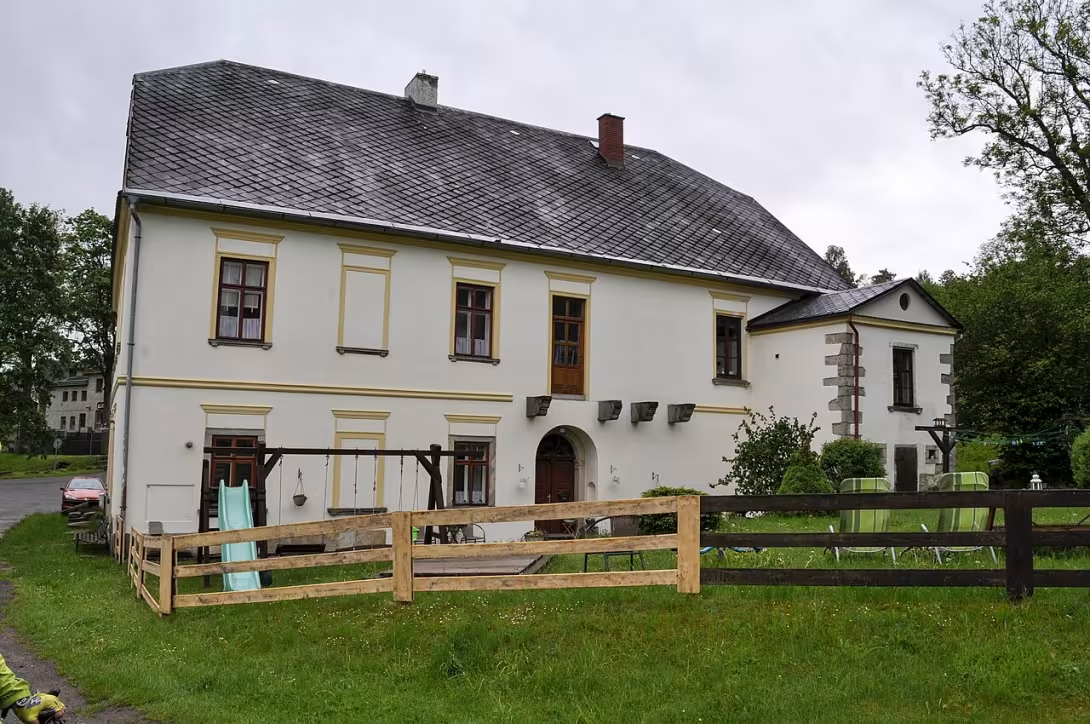
Winter Mill in Lower Teplice is a classic water mill on the Metamuje River in the village Teplice nad Metují in the district of Náhod. This real estate cultural monument was built in 1855. It is an important evidence of the technical maturity of the 19th century miller and is characterized by a folk-classicing architecture of the Broumian type.
The history of the building is closely related to the fate of the original wood mill which burned down in 1854. In the same year, the owner Jan Hampl laid the foundation stone of a new building whose implementation took one year. In 1861, the miller set up a cross in the place of the degraded wooden building, which resembles the former form of the mill.
The building is walled from stone and bricks on a suspected stone block. It's covered by a saddle roof with halves. The draught wall of the object is situated perpendicular to the communication and the drive leads along the shield wall between the construction and the road. The interior layout is three-piece, two-way in the residential area. The ground floor is dominated by a segmented arched hall, divided by original cassette-sized, partially glazed doors. The entrance to the living rooms and the mill in front of the hall is lined with sandstone prism shaped lining. The floor in these areas covers a copy of the original ceramic tiles.
The history of the mill reflects the changes of the 20th century. In 1930, the building was owned by Jan Winter. After his shift in 1945 the family of the miller Jaroslav Bitnar took over the mill. In 1951, the building was confiscated and managed by the State Farm until 1990.
The technical equipment of the mill used the energy of the river Metuje through the drive and the wheel on the top water. In 1930 the mill had one wheel of 4,85 HP power, 0.211 m ³ / s and a drop of 2.65 meters. Although the water wheel has ceased to exist, until today the original grinding stones, including French and sandstone, and the operation of the saw have been preserved in the interior.
Winter Mill is now a valuable witness to the regional history and technical style of our ancestors during the period of industrial modernization of the 19th century. Visiting this place offers a unique opportunity to look into the authentic preserved spaces that tell you about everyday life and the work of miller workers in the foothills.
Then and now
Drag the slider to compare how the landmark may have looked when it was built with the view today.
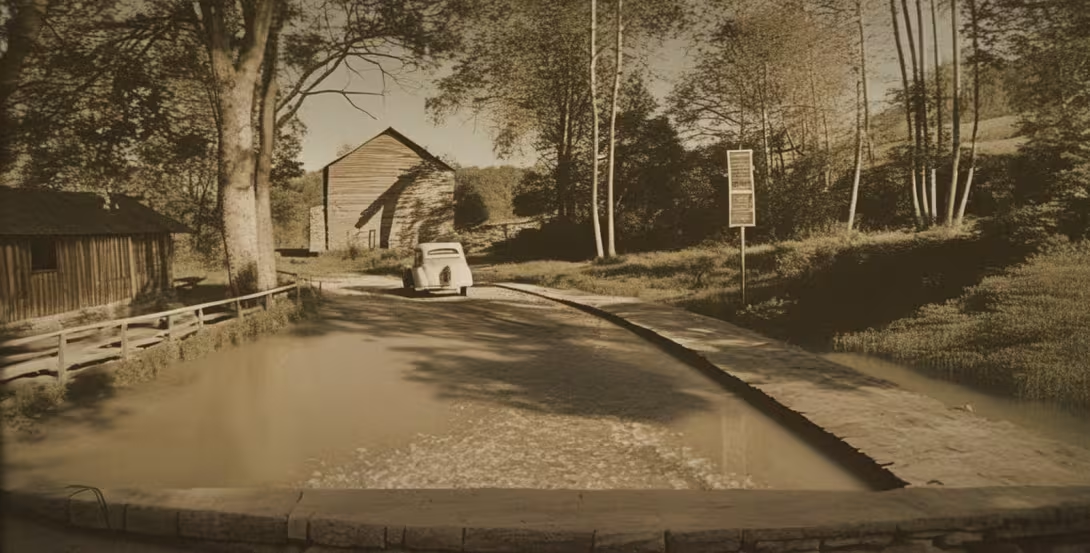
The historical appearance on the left is an AI-generated visualisation and serves as inspiration only.
Historical milestones
- 1854
- Fire of the original wood mill and laying of the base stone of a new building.
- 1861
- The raising of the cross in the place of the former wooden mill.
- 1951
- The confiscation of the mill and its transfer to the administration of the State farm.
Architectural development
The building is walled from stone and bricks on a suspected stone block. It has a saddle roof with halves and a folk classic facade. The inner spaces are divided into a residential part and a mill, the hall on the ground floor is segmented.
Historical events
The fire of the original wood mill in 1854, the construction of a new brick building in 1855, the confiscation of the mill by the State in 1951.
Owners
Jan Hampl (from 1855), Jan Winter (until 1945), Jaroslav Bitnar family (from 1945), State farm (1951-1990).
Points of interest
- The building is a classicist water mill built in 1855, which represents a proof of the technical maturity of the 19th century mill. - In 1854, the owner of the Jan Hampl had the cross erected in 1861. - The internal areas of the mill contain original grinding stones, namely French and sandstone, as well as the preserved operation of the saw. - In 1930, the mill used a water wheel with the power of four whole eighty-five hundredths of horsepower. - After 1951 the mill was confiscated and managed by a state-owned agricultural enterprise until 1990.
Guide
Show guide text
This text was created by artificial intelligence and has not been editorially reviewed. It may contain inaccuracies.
Welcome to the water mill in Lower Teplice. You are standing right in front of a building that is a solid part of this landscape and which, in its appearance, tells the story of the power of water, human endurance and the relentless forces of nature. In front of your eyes is a brick storey building that looks very dignified and stable. Feel the atmosphere of a place where a man's work is combined with the constant movement of the river. This whole space that you are now going around is deeply connected to water and how people have been able to use this energy in the past to make a living and to develop the entire region.
Imagine now the moment when everything changed. We must return to the year one thousand eight hundred fifty-four. At that time, there was not this stone and walled house that you see now. The original wood mill was located in his place. It was a cosy but fragile object that was part of the everyday life of the locals. But fate was cruel and in that year there was a great tragedy. The fire, which was so devastating, completely engulfed the wooden structure and left nothing but ashes and sadness. However, this event did not lead to an end, but to a new beginning. It was from this ash that a new, much more resilient form of this place was born thanks to the determination of the owners. As early as the year one thousand eight hundred fifty-five began to be placed under the foundations of a new building, which was supposed to be a symbol of the stability and technical maturity of its time.
Now pay attention to the architecture of the building right in front of you. Look at her facade. Although the mill is built in the middle of the nineteenth century, its appearance is not simple. Notice the decorative elements on the walls. This decoration is one of the so-called Broumian types, which means that it combines a folk tradition with the elements of classicism. It is the way that the craftsmen at the time expressed themselves that the building should not only look like a work structure, but have its own beauty and character. It is a harmonious mix between the useful function and the aesthetic expression that is typical of this region. This building is today protected as a cultural monument, as it is a rare example of how in the nineteenth century the technical ability to build durable objects with a desire for beauty was united.
If you had the opportunity to enter the inner space, you should be prepared to meet history in every detail. The internal layout of the mill was very thoughtful and included both the mill, where the most important work was carried out and the residential part for the people who lived here. Note how historical elements are preserved in the interior that allow you to feel the spirit of the past. There are, for example, beautiful cassette doors, which by their structure resemble the order and precision of the time. Another important element is sandstone lining around the holes, which gives the interior a feeling of strength and elegance. These materials, such as sandstone, were chosen with regard to their durability and appearance.
People are behind every building like this. The mill was not just an empty shell, but a home and workplace of specific personalities. In his history, names like Jan Hampl appear, which was a key figure in the post-fire recovery period. It was his decision and effort that allowed this new, walled-up building to be born from the ashes of the old wood mill. Another name associated with this place is Jan Winter, after which the mill is often called today. Let us not forget Jaroslav Bitnar, whose name is also part of the history of this place. These people were part of a live chain that kept this mill going and made it the heart of the local economy.
I want to tell you now one interesting thing that carries a breath of memory and respect for the past. Although the new building was completed in a thousand eight hundred fifty-five, the memory of what happened in a thousand eight hundred fifty-four remained alive. In the year one thousand eight hundred sixty-one, the owner had erected in the place where the original wooden mill, the cross, once stood. This cross served as a reminder of loss and as a symbol of faith in renewal. It's a beautiful example of how people in the past have been able to integrate their pain and hope directly into the landscape. This mill is therefore not only the technical unique of the nineteenth century, but also the place where human destinies and memories collide.
When you look at this whole building, you realize how important technical maturity was at that time. The mill was not just a building, it was a complex machine that used the power of water to grind the grain, which at that time was absolutely essential for the survival of entire communities. This building is living proof of how people could adapt to nature and control it for their needs.
Now that you have become familiar with the main features of this place, I suggest you continue your walk and see the surrounding landscape. Look at how the water moves in the trough and reflects off the wall of the mill. Let yourself be carried away by the atmosphere of this place that survived the fire, the changes in political regimes and the advancing modernization of the world. This mill still stands here as a silent witness to history. Thank you for spending this moment with us and for being interested in this piece of our heritage. We wish you a pleasant further journey around.
Tips for visitors
The best time to visit is during the morning hours of the working week when you avoid crowds of tourists and enjoy the quiet atmosphere of the historic building in the river Metuje valley. In the morning light, the facade of the mill excels thanks to its classical decoration.
You can easily reach the mill by car and public transport. For precise route planning, we recommend using internet connection search engines to offer you current transport options.
When visiting, bring with you fixed shoes suitable for movement around the river and in the field. If you plan to take pictures, you can get the best shots from the bank of the River Metuje, where there is a beautiful view of the whole storey mill building, especially with soft afternoon lighting.
In the immediate vicinity you can visit the city Teplice nad Metují itself or take a walk to Teplický Rocks, which offer unique natural scenery. The area is ideal for hiking and exploring the history of the region.
The location is suitable for families with children due to the low terrain around the mill and the vicinity of the river. Children will certainly be interested in the historical appearance of the building and the possibility to observe the flow of water, but we recommend taking extra care near the shores.
Frequently asked questions
Can the monument be visited?
This is a technical monument. Some are open as exhibitions, others are out of use or on private land. We have not verified whether this one is accessible.
What are the opening hours and admission?
We have not verified the opening hours or admission. Current information is published by the operator.
Where is the monument?
Location: Teplice nad Metují, Královéhradecký kraj. The map on this page shows the exact spot.
Why is the monument protected?
It is listed in the Central List of Cultural Monuments of the Czech Republic as a cultural monument (register no. 1000144209).
Businesses nearby
Do you run a restaurant, accommodation, shop, museum, rental, wellness or other visitor service near this monument? Show yourself directly to the people heading to it — this is how they will see you in the app and on the web:
Nearby
Řeka Metuje, město Teplice nad Metují, Teplické skály.
Accommodation nearby
Themed route
1. City Teplice nad Metují (village) - The starting point of the road where you can navigate and walk through the centre of the village. 2. Teplice rocks (natural formations) - Majestic rocks that offer beautiful views of the landscape. 3. Water Mill Teplice nad Metují (Mill) - The main destination of the trip, which represents a unique construction with a rich history. 4. The River Metates (Water Flow) - A natural path along the water that serves to relax and connects the surrounding sights.
Seasonal recommendations
In spring the mill will surround the flowering trees and with the help of melting snow more water flows in the stream. The atmosphere is fresh and the light acts gently. I recommend moisture-resistant shoes because the roads can be muddy. An ideal visit in the afternoon.
The summer season brings rich green nature and hot air that cools the closeness of water. It's time for the greatest rush, so come first thing in the morning to avoid crowds. Dress light fabrics and don't forget to protect them from the sun.
In autumn, the surroundings turn into a mosaic of colors, and there is often fog above the river. The light is golden and the environment is more peaceful. Layer clothes for changing weather are suitable. The best time for a walk is late afternoon.
In winter, snow can cover the memory and frost creates ice crystals on the water. There is silence and a strange room. Don't forget very warm clothes and tight shoes. Pay attention to the shorter opening times that are common during this period.
Visualizations and artistic views


The visualisations are generated by artificial intelligence and serve as inspiration.
Photos from the area
Real photos taken near the monument


Zdroj a licence jsou uvedeny u každého snímku.
Tips from visitors
No tips yet. Be the first!
Log in and add your tip.
Sources and literature
Photos: Jirka Dl / CC BY-SA 4.0 — Wikimedia Commons. The author and licence also appear when you hover over the image.
Faktickým podkladem tohoto textu byl článek na Wikipedii, jehož autory jsou přispěvatelé Wikipedie. Článek je dostupný pod licencí CC BY-SA 4.0.
Location on the map


Příběhy a pověsti
Legendy, pověsti a příběhy spjaté s touto památkou
Fotografie návštěvníků
Zatím žádné fotografie. Buďte první, kdo přidá fotografii z návštěvy!
Log in a přidejte svou fotografii nebo hodnoťte.
Za ověřenou návštěvu v aplikaci získáte víc bodů — poznáme podle GPS, že jste na místě.
Reviews and comments