






Vysoká škola uměleckoprůmyslová v Praze Czech university
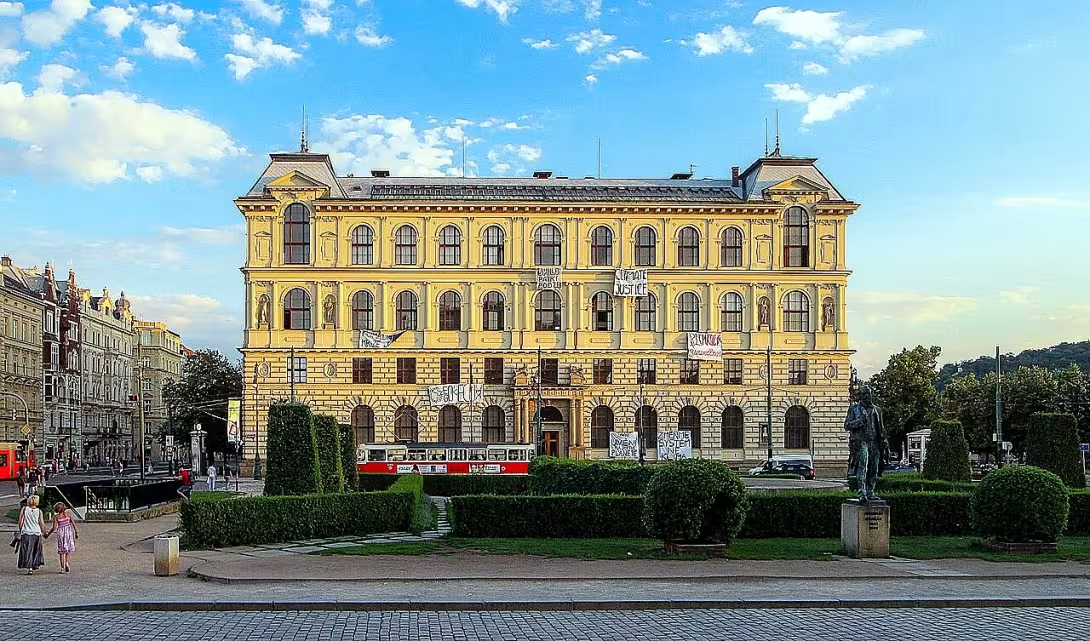
The Academy of Fine Arts in Prague, known as UMPRUM or Vysoká škola uměleckoprůmyslová v Praze (VŠUP), is an excellent public university in Staré Město, Praha. Established in 1885, it is a distinction between the first Czech art school. UMPRUM significantly influenced the Czech cultural and artistic landscape, especially through its connection with the Art Nouveau Movement and later modernist styles.
Established as a School of Arts in Prague (UPS), the Academy focused on the care of qualified artists for industry and education. Its establishment was a major development in Czech art education, which corresponded to wider European trends towards specialized art training during this period. Initially focused on applied art, the school shifted its attention from fine arts to 1896 for nationalization of the Academy of Fine Arts.
Under leaders such as František Schmoranz Jr., and faculty members such as Josef Václav Myslbek and Jakub Schikaneder, UMPRUM quickly became an influential centre for artistic education. At the turn of the century he became the center of Art Nouveau and gained international recognition by representing Czech art at the Paris Fair in 1900, where he won the Grand Prix.
UMPRUM has adapted throughout its history to the change of cultural and political landscape. During the interwar period, it adopted Constructivism and functionalism influenced by European avant-garde movements such as Bauhaus. Despite challenges during occupation and post-war periods, including ideological pressures in the 1940s and 1950s, the Academy has committed itself to quality education in applied art.
After the Velvet Revolution in 1989, UMPRUM underwent an important reorganisation which extended to five practical departments: architecture, design, art, applied art and graphics, along with the theoretical department. Today it includes 23 studies and continues to be a leading institution for artistic and design education in Prague.
The legacy of UMPURM is evident thanks to its historical contributions and achievements of graduates and faculty, including renowned architects such as Eva Jiřická and designers such as Borek Šípek. The Academy remains an integral part of Prague's cultural structure, offering rich learning experience that attracts students around the world.
Today, a visit to UMPRUM offers insight into his well-told past and live presence. As a living monument to Czech art and design education, it stands as proof of innovation and creativity. Its continuous influence on contemporary art and architecture makes it a must- see target for anyone who is interested in discovering artistic heritage and modern expression.
Then and now
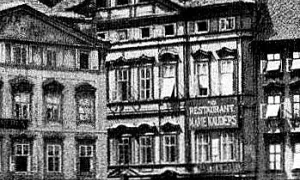
Drag the slider to compare how the landmark may have looked when it was built with the view today.
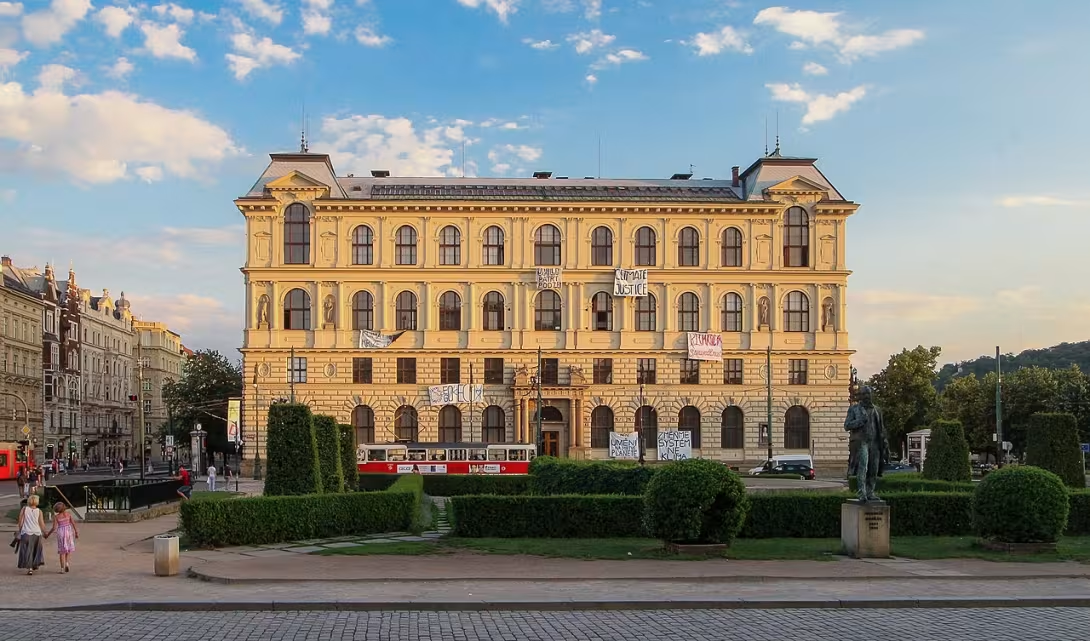
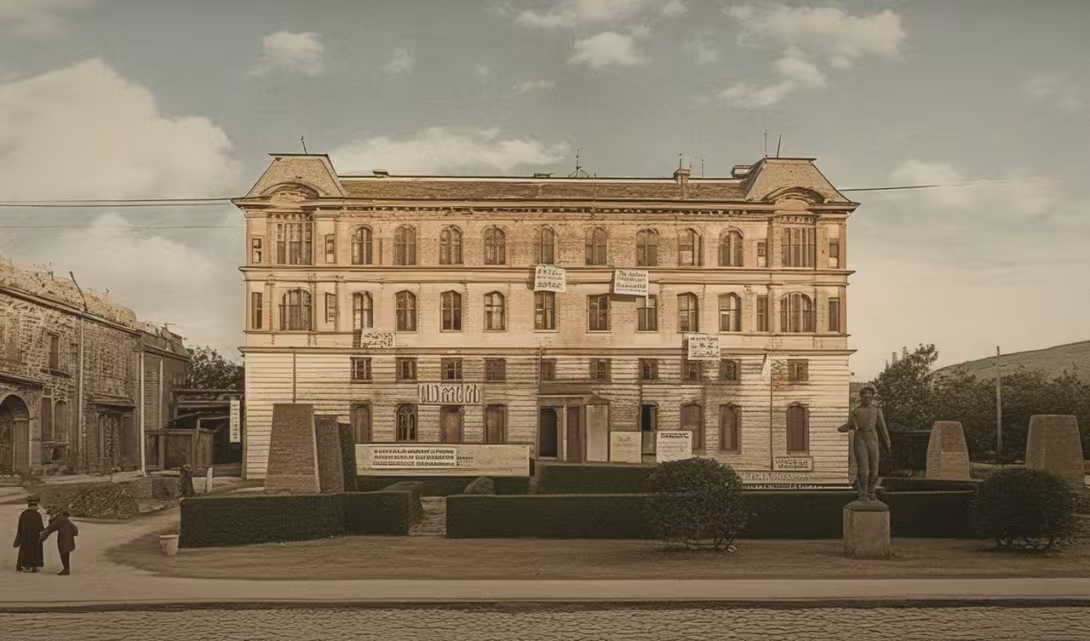
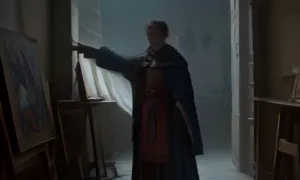
The historical appearance on the left is an AI-generated visualisation and serves as inspiration only.
Historical milestones
- 1885
- The Foundation of the Arts and Industry School in Prague (UPS), which became the first state art school in Bohemia.
- 1900
- The represented Czech art at the Paris World Exhibition and won the Grand Prix.
Architectural development
Initially established as an institution for the education of artists for industry and education, UMPRUM developed architecturally and pedagogically over time. This moved the focus on practical art after the recognition of the State of the Academy of Fine Arts in 1896. The school adopted Art Nouveau influences at the turn of the century and later incorporated modernist styles as constructivism and functionalism.
Historical events
In 1885, UMPRUM was founded as an Art and Industrial School in Prague (UPS), which became the first state art school in Bohemia.
At the turn of the century he became the center of the Art Nouveau Movement and represented Czech art at the Paris Fair in 1900, where he won the Grand Prix.
Points of interest
- The Academy of Fine Arts in Prague was originally founded as an Art-Industrial School in Prague (UPS) in order to train artists for industrial purposes, which reflects a wider European trend towards specialized artistic education during this period.
- After 1896 UMPRUM moved away from fine arts thanks to the nationalization of the Academy of Fine Arts which led him to focus more on applied art and design disciplines.
Guide
This guide is narrated by a synthetic voice generated by artificial intelligence.
Show guide text
This text was created by artificial intelligence and has not been editorially reviewed. It may contain inaccuracies.
Welcome to the historical site Vysoká škola uměleckoprůmyslová v Praze, commonly known as UMPRUM. You are standing in the heart of the Prague Staré Město, surrounded by a rich tapestry of history and culture that shaped this remarkable institution.
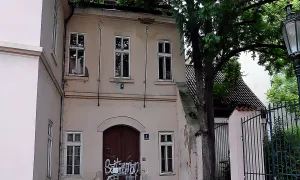
As you look at his facade, imagine a step back to 1885 when it was founded as an Art-Industrial School in Prague (UPS). This meant the start of the first state art school in Bohemia. Its establishment focused on training qualified artists for industry and teachers for teaching art - a reflection of a wider European trend towards specialised artistic education during this period.
The architecture around you is full of history, even though its creators remain unknown. When you walk through the roads, note how the design harmonises with the historical setting of Prague, which calls for contemplation of its past importance as the centre of the Art Nouveau movement and its role in Czech cultural development.
Now we're going to immerse ourselves in some key numbers associated with UMPRUM. Among them are František Schmoranz mladší, whose influence is evident in the early years of school, and Josef Václav Myslbek, a renowned sculptor who contributed to his artistic heritage. Other prominent personalities include Jakub Schikaneder, Celda Klouček, Felix Jenewein, Friedrich Ohmann, Antonín Helméssen, Karel Vítězslav Mašek and Emanuel Krescenc Liška. Each of these individuals played a key role in shaping the direction and impact of the institution.
One fascinating aspect of UMPRUM is its representation at the World Fair in Paris in 1900, where it was exhibited Czech art and won the Grand Prix. This success not only highlighted the top of the school, but also firmly placed it on the international stage as a beacon of artistic innovation.
As you continue your research, consider how this institution has evolved over time while maintaining its basic mission to inspire creativity and perfection in art and design. The stories inside these walls are proof of the lingering spirit of those who have come here before.
We invite you to dive deeper into the rich history of UMPRUM as you explore further. You will learn more about how it continues to affect artists today and supports new generations of talent. Thank you for joining us on this journey of time and creativity in one of Prague's most revered cultural monuments.
Tips for visitors
The best time to visit Vysoká škola uměleckoprůmyslová v Praze or UMPRUM is at the end of spring or early autumn months. During this time the Prague weather is pleasant, so it is ideal for exploring the university and the surrounding area in Staré Město. In addition, a visit outside the top tourist season means that you will probably experience fewer crowds, which will allow for a more intimate survey of campus and its exhibitions.
You can easily drive to UMPRUM by public transport or by car. The university is accessible through several tram tracks that stop at Staré Město, which is convenient for those who travel from other parts of Prague. If you drive, parking is available in the area, although the spaces can be filled quickly during busy times. It is advisable to check the current traffic and parking information online before your visit.
When visiting UMPRUM, consider bringing a camera or smartphone with a good camera to capture the architectural beauty of campus and its artistic exhibits. Comfortable walking shoes are also recommended because you will probably explore different parts of the university area. Moreover, thanks to the variable weather in Prague, it is wise to wear a light jacket.
For photo lovers, UMPRUM offers several picturesque places, especially during the golden hour, when the sun illuminates the historic buildings and artistic installations beautifully. The campus's blend of modern and traditional architecture provides a unique background for photos. Watch out for light conditions because they can dramatically change the mood and appearance of the images.
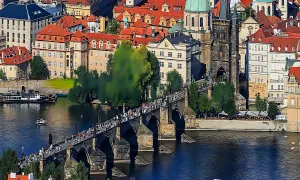
The nearby attractions within a 30-minute walk or short public transport include Prague Castle, Charles Bridge and Old Town Square. These iconic pages offer a view of Prague's rich history and are ideal for extending your visit outside UMPRUM. Each location provides its own unique charm and is worth exploring.
For families with children who visit UMPRUM, there are active activities that satisfy younger audiences such as interactive art exhibits and workshops. The university often hosts events to inspire creativity in children, making it a family destination. The surrounding area of Staré Město has also several parks and playgrounds where children can enjoy outdoor entertainment.
Businesses nearby
Events nearby

Zdroj akcí: otevřená data měst a obcí ČR (Národní katalog otevřených dat) a kalendář akcí Národního památkového ústavu.
Nearby
XXXHistorical monuments (1628)
- Jan Koterax 0.0 km
- Markus Flesch 0.1 km
- Ely Leo Flesch 0.1 km
- Berta Fischer 0.1 km
- Fryda Flesch 0.1 km
- Josef Flesch 0.1 km
- Shooting at the Faculty of Arts UK 0.1 km
- Antonín Dvořák 0.1 km
- Mikolas Aleš 0.1 km
- Rozena Vack 0.1 km
- Jan Palach 0.1 km
- Wilhelm Steinitz 0.1 km
- Josef Mánes 0.1 km
- FRANTIŠEK RÖSCHEL 0.2 km
- Gabriela Bloch 0.2 km
- Eva S. BendaxZ4ZX 0.2 km
- Zuzana Steinervez4ZX 0.2 km
- Hedvika Steinervej 0.2 km
- Gallery Rudolfinum 0.2 km + 420 227 059 205
- Pinkasova synagoga 0.2 km U Old Schools 141 / 1 + 420 222 749 460
kind of food (5392)
- U Rudolfina 0.1 km Cross 10 + 420 222 328 758
- Marina ristorante 0.1 km Alš waterfront 10 + 420 605 454 020
- Five Rivers 0.1 km Cross 10 + 420 222 312 513
- Cottocrudo 0.1 km Veleslavín 2a + 420 221 426 880
- Café Manes 0.1 km
- Bistro Between rows 0.1 km Jana Palach 1 + 420734319677
- PUB Restaurant 0.1 km Veleslavín 3 + 420 222 312 296
- Muc Dong 0.1 km Cross 97 / 8 + 420777895333
- Mistral Caffé 0.1 km Valentinská 56 / 11 + 420 222 317 737
- ramcraft 0.1 km
- Hany Bany 0.1 km Veleslavín 5 + 420 222 327 602
- U Parlament 0.1 km Valentinská 52 / 8 + 420 721 415 747
- SOVA Restaurant 0.1 km Veleslavínova 93 / 10 + 420728134380
- Kozlovna Apropos 0.1 km Platnerian 7 + 420 607748917
- Bageterie Boulevard 0.1 km Kaprova 20 / 3 + 420 734 683 749
- Coffee & Houskax 0.1 km + 420 728 665 413
- Pizzeria Donna 0.2 km Veleslavínova 93 / 10 + 420 222 321 937
- Potrefená husa 0.2 km Platnerian 88 / 9 + 420 266311497
- LibericA 0.2 km
- Coffee & Waffles 0.2 km Valentine + 420 725 827 727
Accommodation (810)
- Quentin Prague Hotel 0.1 km
- Four Seasons Hotel Prague 0.1 km Veleslavin 1098 / 2a + 420 221 427 000
- My House Apartments 0.3 km
- Apartments Kaprova 0.3 km Kaprova 14 / 13
- Hostel Franz Kafka 0.3 km Kaprova 13 + 420 222 333 116
- The Emblem Hotel 0.3 km
- Pension Karlovy Vary 0.3 km Karlova 186 / 8 + 420 777 735 549
- Hostel Bridge 0.3 km Karlov 10 + 420603290915
- U Golden tree 0.3 km Karlov 6 + 420 222 220 441
- Hotel Aurus 0.3 km Karlov 3
- Clementin Old Town 0.3 km Seminar 4
- Ritchie's hostel & hotel 0.3 km Karlov 9 + 420222221
- Golden Eagle 0.3 km Karlov 5
- Pension U Lilie 0.3 km Lilio 15
- Charles Bridge Apartments 0.3 km Brick 3
- Apartment house Anenská 0.3 km Anen 7
- Herget Palace 0.3 km Brick 2
- Hotel Liliva 0.3 km Lili 18 + 420 226 808 200
- U Three Drums 0.3 km U Town Hall 8- 10 + 420 224 214 855
- Tcalcis Court 0.4 km U Lusatian Seminar 28
▶ Rental and Sport (543)
- Club Sunflower 0.2 km Maisel 7
- Asoss 0.4 km Wide 15
- Health Club & Spa InterContinental 0.4 km Paris 30
- HUDYsport 0.6 km Na Persian 355 / 14 + 420 224 218 600
- Ultraant 0.6 km
- Finebike 0.6 km
- Prahabike 0.7 km Long 708 / 24 + 420 732388880
- Rock Point 0.7 km Martinská 360 / 2 + 420 224 228 045
- Fitness Vagon 0.7 km National 25
- Contours Fitness 0.7 km National 25
- Euro Segway Prague 0.7 km + 420 731 731 013
- Squash Haštal 0.8 km Haštalská 20
- Citybike 0.8 km
- Pool Tyršova house 0.9 km
- Honzovs 0.9 km + 420 777 493 182
- S. P.L.A.V. 0.9 km
- Center Services Pre 0.9 km
- PRAGUE BY E-BIKE 0.9 km
- U Kotvy 0.9 km
- BUGABOO snow & sk8 0.9 km + 420 257 317 172
© Tourism and Nature (477)
- Mirror caple 0.2 km
- Baroque library hall 0.2 km
- Old Jewish Cemetery 0.2 km
- Outlook Maleni 0.3 km
- Cross Square 0.3 km
- Park Cihelná 0.3 km
- Park on KlárovexZ4ZX 0.4 km
- Wine plant Certovka 0.4 km Wine bar
- Certova 0.4 km
- The narrowest alley in Praze 0.4 km
- Charles Bridge and Castle Viewpoint 0.4 km
- Old Town Hall 0.4 km
- Old Town Orloj 0.5 km
- Vojan Sets 0.5 km
- Council tower 0.5 km
- Prague Meridian 0.5 km
- Leten profil 0.5 km
- Park Pigeon 0.6 km
- Round Grand Priory Mill 0.6 km
- Malostran bridge tower 0.6 km + 420 607 050 434
Accommodation nearby
Trips and activities nearby
Guided tours, tickets and activities nearby from GetYourGuide
Affiliate link: if you buy from the partner, we may receive a commission. The price for you does not change.
Search tours and activities →Themed route
Thematic production: Vysoká škola uměleckoprůmyslová v Praze
1. Main item: University of Technology in Prague - Type: University - Proc stands behind the scenes: This prestigious university is a castle architectural majestic and rich history dating back to 1885. The moving building in Baroque style with modernization interior is encouraged to use in a unique market and determine a new batch.
2. Circuit: Tyn over Vltavou - Type: Historical church - Proc stands behind the appearance: St. Nicholas Church is an important example of gothic architecture and is known for its own height and history. The bell tower offers the whole Prague, which is an ideal bridge for the attentive history and culture of the region.
3. Surround: Teaching the monastery - Type: Monastic complex - It is worth fulfilling: This monastery complex is designed for history and architecture. It is a place where they can deal with available information about the life of the Benedict monks in Prague and explore the quiet interiors.
4. Circuit: National Republic - Type: Historical mission - It is worth the effort: This centralised law is the court of Old Town and offers a rich history which is postponed in its architecture and public spaces. It is an ideal place for a common local culture and atmosphere.
5. Around: Old Town Square - Type: Historical mission This iconic theme is a well-known large statue, ancient houses and history. It is the centre of the cultural heritage of Old Town, where they can make demanding products of traditional Czech architecture and atmosphere.
This track offers combined historical and artistic experiences in the judges of Old Town, which are attached to the legwork of the cultural industry in Prague.
Seasonal recommendations
Spring: Vysoká škola uměleckoprůmyslová v Praze offers one-way experiences in the spring store, which are added and care for counting. The sun rays illuminate the historical architectural style of the monument, which from another ideal topic for photophysics with lively colors and calm atmosphere. The intruders can expect small temperatures, so it is advisable to dress in the first siege that can be used to reduce the number of temperatures. Spring is an ideal task for determining the quantity to be allocated is not in the case of State aid.
Summer: The summer is Vysoká škola uměleckoprůmyslová v Praze full of life and warmth. Sunshine days intensify regardless of whether architecture is detail, which means that action must be taken. However, with the early summer weather, the number of tourists is established, so it is delivered in early dawn or at the end of the day so that monuments can be used without obstacles to the crowd. The warm rounded and sun protection are tricky for the use of rights in this sector. In addition, it may be useful to howl with you to drink, because no interiors may help sufficient coldness.
Autumn: Autumn of the exact gold and yellow color to the Old Town of Prague, which is a romantic and quiet atmosphere around the College of Fine Arts. The sunny days are still the same, but in fact they are quickly cold, which is locked, that it is significant that they are State aid within the meaning of Article 107 (1) of the Treaty. This season is ideal for those who influence resting conditions without a superior crowd of tourists trying to achieve better conditions. The historical architecture, as well as the beautiful arrival and mild weather, is also enhanced in the business environment.
Winter: Winter offers the University of Physics in Prague a challenging view with possible reduced costs and still life, which can have magical capacity of Telé rounded is persistent for comforts that are in cold condition, especially because there are no changes. It is therefore established that this measure does not comply with the legislation or at the end of the day. Despite the cold, this season offers a single instrumentation activity, which takes historical projects in a specific and peaceful environment to be carried out.
Visualizations and artistic views


The visualisations are generated by artificial intelligence and serve as inspiration.
Photos from the area
Real photos taken near the monument

Zdroj a licence jsou uvedeny u každého snímku.
Tips from visitors
No tips yet. Be the first!
Log in and add your tip.
Sources and literature
Fotografie: VitVit / CC BY-SA 4.0 — Wikimedia Commons. The author and licence also appear when you hover over the image.
Faktickým podkladem tohoto textu byl článek na Wikipedii, jehož autory jsou přispěvatelé Wikipedie. Článek je dostupný pod licencí CC BY-SA 4.0.
Location on the map

Příběhy a pověsti
Legendy, pověsti a příběhy spjaté s touto památkou
Fotografie návštěvníků
Zatím žádné fotografie. Buďte první, kdo přidá fotografii z návštěvy!
Přihlaste se a přidejte svou fotografii nebo hodnoťte.
Za ověřenou návštěvu v aplikaci získáte víc bodů — poznáme podle GPS, že jste na místě.
Reviews and comments