



Zámek Chotěboř Chateau
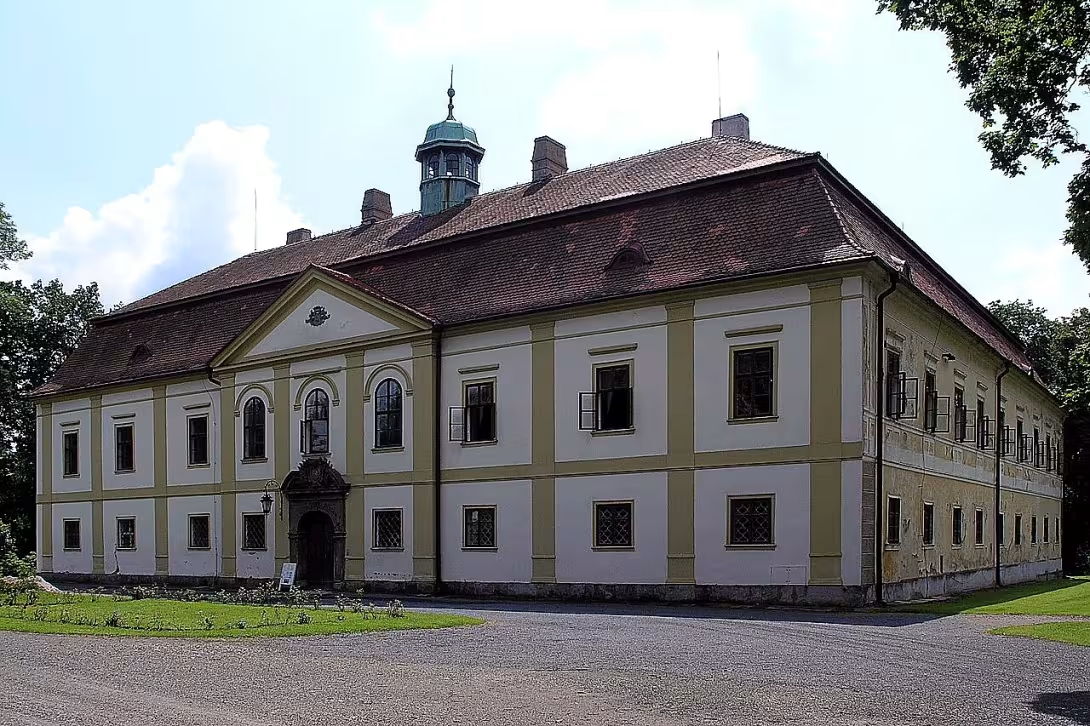
Zámek Chotěboř is located on the north edge of the city of Chotěboř in the district of Havlíčkův Brod, approximately 14 kilometres northeast of Havlickov Brod. It is an early Baroque building from the beginning of the eighteenth century, which has been declared a cultural monument since 1963.
The city of Chotěboř was first mentioned in 1265 and its importance increased in the 14th century. In 1329 he was bought by King Jan Lucemburský and in 1331 he was promoted to city. In the place of the current castle, it is assumed that in the second half of the 14th century a Gothic fortress was built, which is confirmed by archaeological surveys. In the middle of the seventeenth century, the fortress gradually desolate and was probably destroyed by the fire of 1692. The renewal brought about the change of owner: in 1698 the estate acquired rod Kinských. He built a new early Baroque castle with the chapel of the Holy Trinity on the foundations of the old fortress from 1701 to 1702.
The fatal change in the history of the castle came in 1836 when Jan Josef Dobrzenský married Maria Wanczur from Rzehnic to the estate. Since then it has been owned by the Dobřenský family, except for the years 1948 to 1992. In the 19th century the castle had extensive modernization: in 1865-1870 a new Renaissance reconstruction of part of the first floor was carried out, in 1870-1875 an English landscape park was established. After the fire in 1927 the castle was reconstructed and acquired a characteristic bell above the north wing. In 1948 Jan Maximilian emigrated with his family and the castle was taken over by the state. Since 1952, the City Museum has been based there. In 1992 the castle was returned to the Dobřenský family and the museum continued until the end of 2019.
Architecturally, it's a four-story four-story building with a mansard roof. The north facade is nine-axis with central risalite in which the passage to the arcade courtyard is located. From the south side there is a terrace with a two-arm staircase equipped with a balustrade to the garden. The Castle Chapel of the Holy Trinity in the East Wing preserved its Baroque character with a portal, fresco and stucco decoration from the 18th century. The same wing contains Gothic cellars from the old fort.
The castle is surrounded by a landscape park of approximately 15 hectares with two ponds and a lime alley. In the park there are protected sculptures: Classicist tombstone from 1813, sandstone fountain from the first half of the 19th century, Baroque statue of St. John Nepomuk from 1720 and statue of St. Elizabeth Durynská from sculptor Jan Kalous. A classic one-storey building called a castle is part of the complex.
Zámek Chotěboř represents a valuable example of baroque architecture growing from Gothic foundations. Its rich history, architectural elements from different periods and collection of sculptures make it a significant piece of Czech cultural heritage.
Then and now
Drag the slider to compare how the landmark may have looked when it was built with the view today.
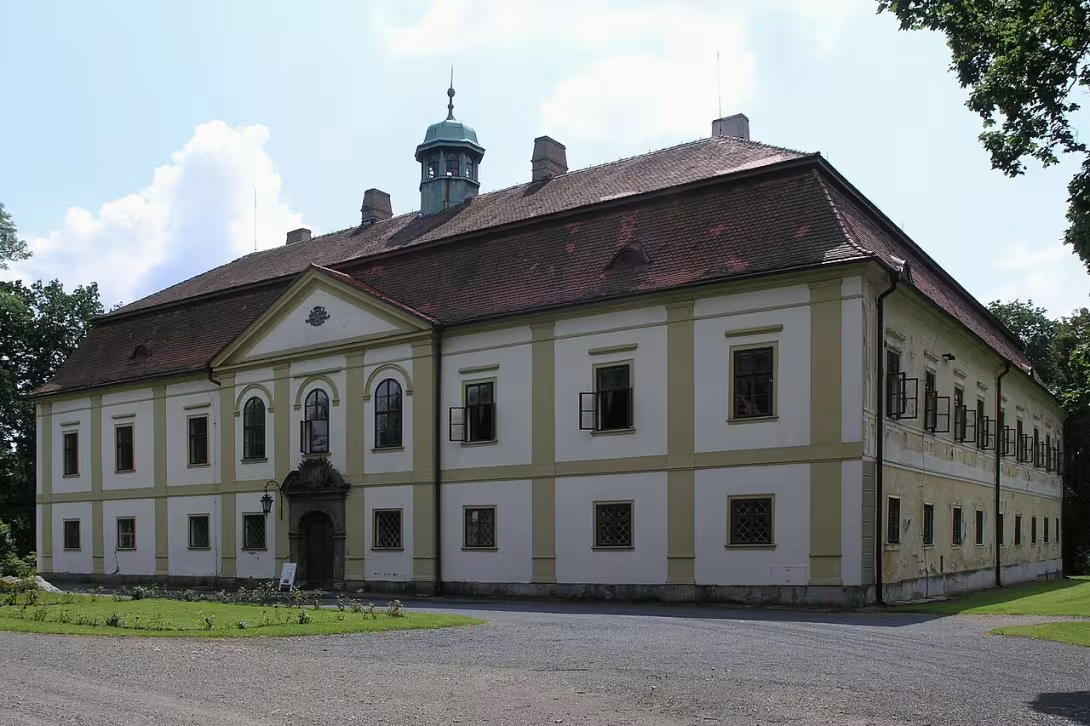

The historical appearance on the left is an AI-generated visualisation and serves as inspiration only.
Historical milestones
- 1701
- The beginning of the early Baroque castle.
- 1692
- The destruction of the original fortress by fire.
Architectural development
The original Gothic fortress built in the second half of the 14th century, destroyed in 1692 and then replaced by an early Baroque castle in 1701- 1702. During the years there have been minor modifications, such as the neo-Renaissance reconstruction in 1865-1870 and reconstruction after the fire in 1927.
Historical events
- 1265
- First mention of Chotěboři.
- 1692
- The original fort probably destroyed by a fire.
- 1963
- The castle was declared a cultural monument.
Owners
1329: king of Jan Lucemburský; 1331: promotion to the city; 1698: rod Kinských; 1836: Jan Josef Dobrzenský marriage to Maria Wanczur from Rzehnic; 1948-1992: State; since 1992: family Dobřenských
Points of interest
- Zámek Chotěboř is an early Baroque building from the beginning of the eighteenth century. - In the place of the current castle it is assumed that a Gothic fortress was built in the second half of the 14th century. - In 1698 the estate acquired rod Kinských and from 1701 to 1702 on the foundations of the old fortress built a new early Baroque castle with chapel of the Holy Trinity. - In 1927 the castle was reconstructed after the fire and acquired a characteristic bell above the north wing. - The castle is surrounded by a landscape park with two ponds, a lime alley and protected sculptures as a classical tombstone from 1813 and a Baroque statue of St. John Nepomuk from 1720.
Guide
This guide is narrated by a synthetic voice generated by artificial intelligence.
Show guide text
This text was created by artificial intelligence and has not been editorially reviewed. It may contain inaccuracies.
The Castle Chotěboř stands on the northern edge of the town of Chotěboř, approximately fourteen kilometres northeast of Havlíčkův Brod. It is an early Baroque structure from the beginning of the eighteenth century and has been a cultural monument since nineteen sixty-three.
Chotěboř is first mentioned in twelve sixty-five. There were silver mines in the area and the town lay at the crossroads of major routes. Therefore, King John of Luxembourg purchased the settlement in thirteen twenty-nine and two years later elevated it to town status. On the site of today's castle stood a Gothic fortress, which archaeologists have documented. Who built it is unknown, most likely it was in the second half of the fourteenth century. It served mainly the economy and the administration of the estate, less so as a residence for the owners. By the middle of the seventeenth century it was deteriorating and in sixteen ninety-two it was probably destroyed by fire.
In sixteen ninety-eight the Kinský family acquired the estate. Between seventeen hundred and one and seventeen hundred and two a new castle with the Chapel of the Holy Trinity was built on the foundations of the fortress. The owners changed frequently afterwards, but the castle underwent only minor modifications. In eighteen thirty-six Jan Josef Dobrzenský acquired the estate through marriage. Since then the castle has belonged to the House of Dobřenský z Dobřenic, except for a break between nineteen forty-eight and nineteen ninety-two. In the second half of the nineteenth century, part of the first floor received a Neo-Renaissance appearance and an extensive English park was created. After a fire in nineteen twenty-seven the castle was restored and then acquired a small bell tower above the north wing. When the family emigrated in nineteen forty-eight, the state took over the castle. From nineteen fifty-two a municipal museum was housed in it until the end of twenty nineteen. The Dobřenský family received the castle back in nineteen ninety-two.
The castle is a single-storey four-winged building with a mansard roof. A nine-axis northern façade leads through a passage to an arcaded courtyard. From the south side a terrace with a double-flight staircase leads into the garden. The eastern wing has thicker walls and Gothic cellars which remained from the original fortress. It also contains the Chapel of the Holy Trinity, preserved in its eighteenth-century form, with a Baroque portal, frescoes and stucco decoration.
Around the castle extends a landscaped park covering approximately fifteen hectares. In it you will find the Upper and Lower Castle ponds and a lime tree avenue. There also stands a Classical manor house and several protected sculptural works. These include the tombstone of Knight Jan Pavel from Brachfeld and his wife Johana from eighteen thirteen and a sandstone fountain with a semi-figure of a man bearing a bowl. Further a Baroque statue of Saint John of Nepomuk from seventeen twenty, transferred from the village of Jilem, and a statue of Saint Elizabeth of Thuringia by the Chrudim sculptor Jan Kalouse. The park is completed by a cast-iron cross with the Dobřenský coat of arms and the date eighteen seventy-two.
Tips for visitors
The best time to visit the castle Chotěboř is in the spring or autumn season when the weather is pleasant and less visitors. This time of year also offers a beautiful opportunity to photograph the castle in an ideal light.
The castle can also be reached by public transport; Check the search engine for the latest connection information.
When planning your visit, bring your sunglasses, blankets and a guide. If you have an intention to photograph, it may be useful to bring a telelens to capture the details of architecture.
For families with children, the Chotěboř Castle is an interesting place where they can not only see the historical building, but also look at exhibitions or events aimed at children. It is advisable to check the current program before visiting.
In the vicinity of the castle you can visit the historical centre of Chotěboř, which offers a beautiful view of the ancient architecture. For nature lovers there is also an opportunity to explore surrounding forests and green areas.
Frequently asked questions
Can the monument be visited?
Some buildings of this kind are open for guided tours, others serve another purpose or are privately owned. We have not verified whether and when this monument is open – please ask the operator.
What are the opening hours and admission?
We have not verified the opening hours or admission. Current information is published by the operator.
Where is the monument?
Location: Riegrova 1, Chotěboř, Kraj Vysočina. The map on this page shows the exact spot.
Why is the monument protected?
It is listed in the Central List of Cultural Monuments of the Czech Republic as a cultural monument (register no. 21432/6-211).
For kids
Imagine going back to the past when the Chotěboř Castle was still young and full of life. This time, it was not an ordinary house, but the true seat of the nobility of the Dobřenice family.
It's like living in a fairy tale. The Dobřín family has built its own world here, full of beauty and magic. They were people who loved nature, music and art. There was a big party at the castle where the violin was played and danced until late night.
Businesses nearby
Do you run a restaurant, accommodation, shop, museum, rental, wellness or other visitor service near this monument? Show yourself directly to the people heading to it — this is how they will see you in the app and on the web:
Events nearby
Zdroj akcí: otevřená data měst a obcí ČR (Národní katalog otevřených dat) a kalendář akcí Národního památkového ústavu.
Nearby
ITEX Show interactive overview of the surroundings - restaurants, accommodation, rentals and other places within a 15 km radius.
Data: OpenStreetMap contributors, 15 km radius.
‡ Historical monuments
- Zámek Chotěboř (0.0 km)
- sv Elizabeth Thuringian (0.4 km)
- Marian column (0.6 km)
- Jindřich Roob (1.5 km)
- Oheb (12.1 km)
- Victims fascism (12.4 km)
- Vildštejn (12.5 km)
- Karel Havlicek Borovský (12.6 km)
Restaurant and catering
- Restaurant Fantasie (0.1 km)
- Guesthouse White (4.7 km - 53)
- Salash Hájez (6.5 km)
- Filippi (9.8 km - Station 69)
- U Spa (10.6 km - Brodská 25)
- Restaurant at the barn (10.9 km)
- Fast food on Tobolkás (11.2 km)
- Restaurant U Kovár Matìje (12.2 km - 59)
Accommodation
- Hotel Fantasie (0.1 km)
- Vysočina (0.7 km)
- Guesthouse Piln statek (3.3 km)
- Guesthouse (4.3 km)
- Vacation Centre Tesla (9.8 km)
- Hotel Capital (10.6 km)
- YACHTCLUB Pardubice (10.6 km)
- Jezerka (10.7 km)
› Rental and sports
- Arena Chotěboř (0.8 km)
- Kaba Sport - Riding car (1.1 km)
- Sport complex Kamen (11.0 km)
- Paddleboards Seč (11.2 km - ev.390)
- Vacation services
- - Swimming pool Havlíčkův Brod (13.8 km)
- Sportisimo (14.0 km)
- Bowling Club Bar (14.2 km - Prague 2970)
© Tourism and nature
- Upper mill (1.9 km)
- Rotary vortex (2.4 km)
- Sokolohrad (3.1 km)
- Above the Devil's Table (3.1 km)
- Čertova stolek (3.1 km)
- Under the Devil's Table (3.1 km)
- Pod Sokolohrady (3.1 km)
- concessions (10.7 km)
Accommodation nearby
Themed route
Route: Chotěboř and surroundings
1. Zámek Chotěboř (main objective) Zámek Chotěboř is worth visiting thanks to its unique architecture and rich history. It is one of the few preserved Renaissance locks in the Czech Republic.
2. Church of the Assumption of the Virgin Mary (1.5 km from the castle) The Church of the Assumption of the Virgin Mary stands at the village in the centre of the village Chotěboř. It is a beautiful parish church with rich history and interesting architecture.
3. St. John Nepomuk Chapel (0.8 km from the church) The chapel of St. John Nepomuk is a small but beautiful chapel, which stands on the edge of the village Chotěboř. It is a quiet and romantic place where you can stop and relax.
4. Pond bench (1.2 km from the chapel) The pond bench is a small park where there is a pond and several benches. It's the perfect place to sit and relax in a quiet environment.
5. Memorial of the fallen in World War I (1.5 km from the bench) A monument to the fallen in World War I is a small monument that resembles the victims of World War I. It's a place where you can stop and think about the history and the victims that happened here.
Seasonal recommendations
Spring: Spring is the perfect time to visit the castle Chotěboř. The atmosphere is quiet and sunny, allowing you to view the interior and exterior easily. In this period is also open gardening where you can see flowering flowers and trees. The best time to visit is from April to May when the weather is sunny and warm.
Summer: The Chotěboř Castle is very popular in summer, so it is good to come early to avoid large crowds. The garden with a pond is open in summer and it is possible to relax by the water. The best time to visit is from June to August when the weather is warm and sunny.
Autumn: The Chotěboř Castle is surrounded by beautiful nature in autumn. The woods are green and the air is full of the scent of falling leaves. The atmosphere is calm and tolerable, therefore it is an ideal time to visit. The best time to visit is from September to October, when the weather is colder but still pleasant.
Winter: Winter season is ideal for visiting castle Chotěboř with children. The castle is open in less time and there is a possibility to sit by the fireplace. The atmosphere is calm and tolerable, therefore it is an ideal time to visit. The best time to visit is from December to February when the weather is cold and snow.
Visualizations and artistic views


The visualisations are generated by artificial intelligence and serve as inspiration.
Photos from the area
Real photos taken near the monument


Zdroj a licence jsou uvedeny u každého snímku.
View from the area
This animation was generated by artificial intelligence from a real photograph of the surroundings. The motion and details are not real footage of the location.
Tips from visitors
No tips yet. Be the first!
Log in and add your tip.
Sources and literature
Photos: Matěj Baťha / CC BY-SA 3.0 — Wikimedia Commons. The author and licence also appear when you hover over the image.
Faktickým podkladem tohoto textu byl článek na Wikipedii, jehož autory jsou přispěvatelé Wikipedie. Článek je dostupný pod licencí CC BY-SA 4.0.
Location on the map


Příběhy a pověsti
Legendy, pověsti a příběhy spjaté s touto památkou
Fotografie návštěvníků
Zatím žádné fotografie. Buďte první, kdo přidá fotografii z návštěvy!
Log in a přidejte svou fotografii nebo hodnoťte.
Za ověřenou návštěvu v aplikaci získáte víc bodů — poznáme podle GPS, že jste na místě.
Reviews and comments