



Bozkovského dům House
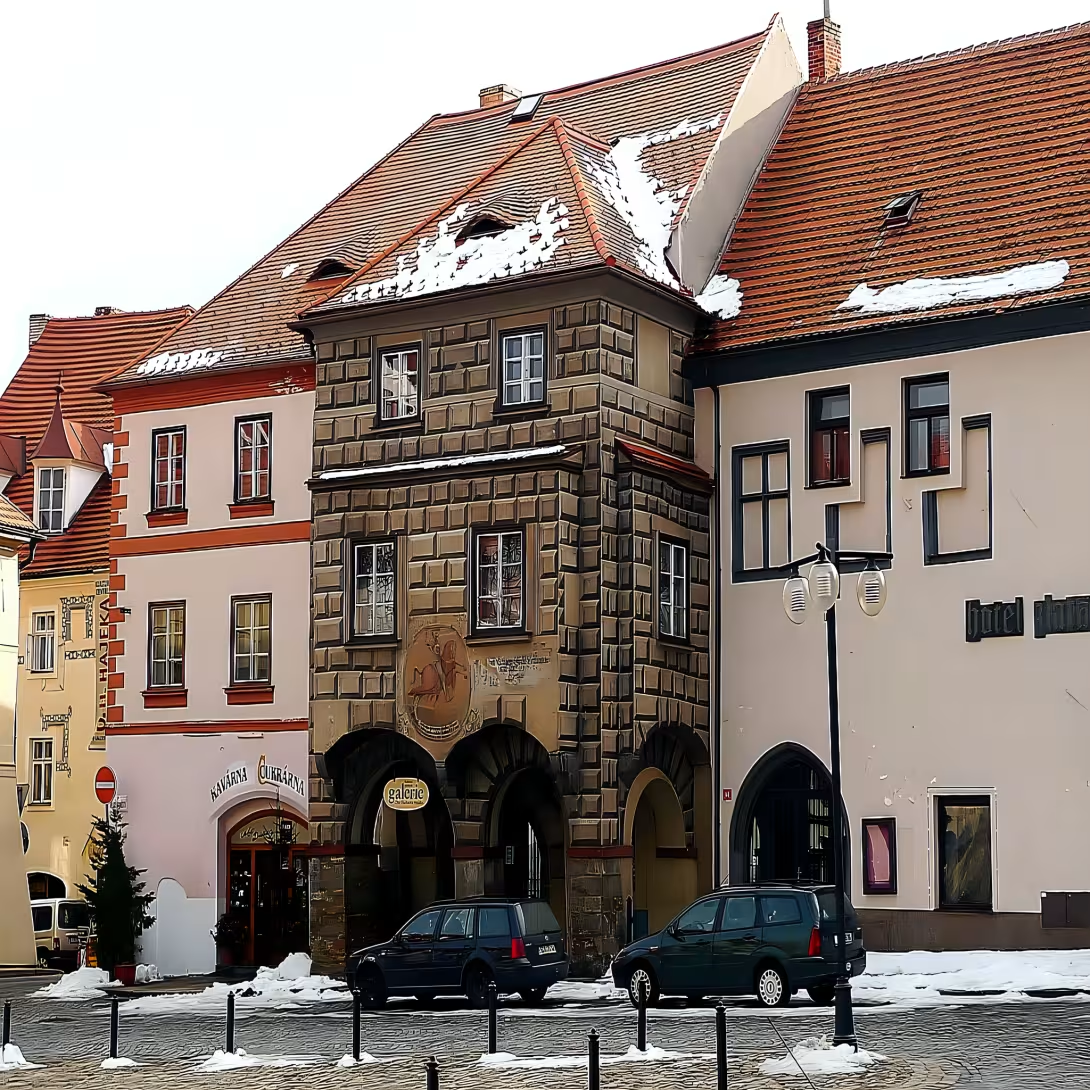
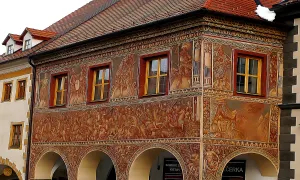
Bozkovského dům (no. 184) in Prachatice is originally a late Gothic townhouse, which was remodeled in 1573. The object is particularly remarkable with a massive risalite with a painting of the Rozberg rider and rich decoration in the arch. It is one of the most valuable buildings of the city's monument reservation and has been a protected cultural monument since 1958.
The current form of the house dates back to the end of the 15th or the beginning of the 16th century. It's probably connected to a city fire from 1501. Jiří Janček and Pavel Mokrý were the first documented owners in 1551 and in 1562. The fundamental Renaissance reconstruction was carried out in 1573 by Jiřík Bozkovský, originally from the Moravian Boskovice. In 1559, the house was married to the widow Catherine after the township Mathes.
The construction consists of a complex comprising a front house near the Grand Square, a central wing with a courtyard and arcades to the Salt Street and a rear house in the Upper Street. The dominant feature of the facade to the square is the massive pillars of the rizalite with the arches on the crackers. The area of the rizality is decorated with painted illusory quacking by chiaroscura and wall painting of the Rozberg rider. This is based on the design of Wilhelm from Rožmberk, 1557. At the top of the medallion is the inscription Whilhelmus Rosenberg. The arch risality is encapsulated by two arches of cross arches with nails and contains a late Gothic arched entrance portal.
The facade to Salt Street is five axes; There were originally eight entrances to meat shops on the ground floor. The facade to the Grand Square is triple-edged with a smooth classical stucco, cordon robes and a profiled crown ledge with a Fabion. In the building there are preserved gothic structures, for example cellars in front, perimeter wall ground floor and floors of the western tract. From the Renaissance period come cellars in the back, vaults above the ground floor and first floor, rizalite and painting decoration. Also valuable are the stoneware elements of the dusthatic diorite, especially the entrance portals and consoles of the arches.
In addition to painting by the rider, the decoration from 1611 is painted in the arcade. It contains the family coats of arms of the richest townspeople in laurel wreaths with accompanying motts in Latin and old Czech. Details like red roses refer to the House of Rožmberks. Under one of the coats of arms is a sign that some owners of the painters did not pay for the work. The similarity of the technique and the composition of the plaster with the Old Town Hall building suggests that the same builders worked on both buildings.
The ownership of the house has changed over the centuries among personalities such as Lukáš Bohauf, Stepan Petrhanzl, Matej Ubermesser, Stepan Vajmon, Kaspar Stögbauer and Felix Spinka. After the fire in 1832, a Renaissance aetika with shield attachments was brought down. Another repair took place in 1868. Meat shops on the ground floor of the corner house were in the possession of butcher families until 1893. They were then bought by the husband and wife Jakub and Marie Hrbk and set up the café Caffe restaurant Habsburg, run by the Vienna Hanz Paupie. Between 1882 and 1885, there was a Czech school in the house.
The interesting thing is that on the corner of the house to Salt Street was previously placed an iron lighting basket on a moving shoulder. The basket was filled with lit stools that illuminated the street and the square. This item is today stored in the City Museum.
The cultural centre of Otto Herbert Hajek is currently located in the building, since 1962 the town ceremonial hall has been located here. The house presents a unique combination of Gothic foundations and Renaissance aesthetics with elements of later classicism. The visit to this building offers a direct insight into the history of the rich town and influence of the family Rožmberk in the region.
Historical milestones
- around 1500
- The foundation of the house in late Gothic style
- 1573
- Essential Renaissance reconstruction of the house Jiřík Bozkovský
- 1611
- Paint decoration with family coat of arms in the archway
- 1832
- Enabling Renaissance atics after fire
- 1893
- Establishment of a cafe in the premises of former meat shops
- 1958
- The building was declared a protected cultural monument
Architectural development
Originally a late Gothic house with preserved cellars and masonry, which was rebuilt into Renaissance style in 1573. The facade of risality shows an illusionous quacking technique of chiaroscura and elements from the dustchatic diorite. Later, classical modifications of stucco facade were made to the Grand Square.
Historical events
1573: essential Renaissance reconstruction of the house Jiřík Bozkovsky; 1832: repair of the house after the fire in which the Renaissance aetika was brought; 1958: Declaration for a protected cultural monument.
Owners
Jiří Janček (1551), Pavel Mokrý (1562), Jiřík Bozkovský (1559), Lukáš Bohauf (until 1594), Stepan Petrhanzl (from 1594), Matej Ubermesser (until 1640), Stephen Vajmon (from 1640), Kaspar Stögbauer (1685), Felix Spinka (1829)
Points of interest
- The house is remarkable with a massive risalite with a painting of a Rozberg rider and rich decoration in the arch. - There's a sign in the arcade that some of the owners didn't pay for the work. - There were originally eight entrances to meat shops on the ground floor. - Between 1882 and 1885, the Czech school was housed in the house. - An iron lighting basket on a moving shoulder was previously placed on the corner of the house to Salt Street.
Tips for visitors
The best time to visit is morning or late afternoon time when the sun falls at an angle and the details of the Renaissance facade and the massive output element of the wall stand out better.
We recommend that you wear shoes suitable for walking on historic tiles. Since the house is only viewed from the outside, you need comfortable clothes and possibly a guide around the city.
For the best photos, stand at sufficient distance in the Grand Square to capture the entire height of the house and its risalites. The most interesting pictures come in clear weather, when you can see details of late Gothic and Renaissance elements.
Families with children can use a visit to search for old architectural details on the facades of houses, which makes the city centre visit a playful game in space.
Frequently asked questions
Can the monument be visited?
This is a residential or farm building, not a museum with opening hours. Please view it from public space and respect the owners' privacy. We have no information about access to the interior.
Where is the monument?
Location: Prachatice I. The map on this page shows the exact spot.
Why is the monument protected?
It is listed in the Central List of Cultural Monuments of the Czech Republic as a cultural monument (register no. 1000130596).
Businesses nearby
Do you run a restaurant, accommodation, shop, museum, rental, wellness or other visitor service near this monument? Show yourself directly to the people heading to it — this is how they will see you in the app and on the web:
Nearby
Velké náměstí v Prachaticích, městská památková rezervace Prachatice.
Accommodation nearby
Themed route
1. Great square in Prachatice, square. This place is the heart of the city and offers a view of its historical architecture. 2. city conservation of Prachatice, historical territory. Walk this area will allow you to see ancient buildings and alleys. 3. Bozkov house, a monument. This object represents the main destination of your tour.
Seasonal recommendations
In spring, the surroundings of the house are awakened into colours and the fresh sun gently illuminates the facade. It is an ideal time for walks when the air is fresh and nature begins to bloom around. We recommend shoes suitable for wet terrain and visit in the morning when the light is the cleanest.
Summer brings intense brightness and hot air that highlights the details of the construction. The atmosphere is full of life and the surrounding green is in full bloom. Due to high temperatures and more people on the streets, it is best to leave early in the morning or at dusk in light and breathable clothes.
The autumn is dominated by golden light and falling leaves, which gives the place a nostalgic touch. The colors of the surroundings turn into orange and brown tones, creating a beautiful contrast to the house. It is practical to carry a lighter jacket or a wind coat and choose days with bright skies.
Zimą works in quiet and quiet, often accompanied by freezing air and grey. If a piece of snow covers the roofs, the place gets a cozy and fabulous look. It is necessary to choose warm winter clothes and visit schedule until the short day in order to be able to see the house even in daylight.
Visualizations and artistic views

The visualisations are generated by artificial intelligence and serve as inspiration.
Photos from the area
Real photos taken near the monument


Zdroj a licence jsou uvedeny u každého snímku.
Tips from visitors
No tips yet. Be the first!
Log in and add your tip.
Sources and literature
Photos: H2k4 / CC BY-SA 3.0, rozlišení zvýšeno umělou inteligencí — Wikimedia Commons. The author and licence also appear when you hover over the image.
Faktickým podkladem tohoto textu byl článek na Wikipedii, jehož autory jsou přispěvatelé Wikipedie. Článek je dostupný pod licencí CC BY-SA 4.0.
Location on the map
More monuments – Prachatice I
Show all in the municipality

Příběhy a pověsti
Legendy, pověsti a příběhy spjaté s touto památkou
Fotografie návštěvníků
Zatím žádné fotografie. Buďte první, kdo přidá fotografii z návštěvy!
Log in a přidejte svou fotografii nebo hodnoťte.
Za ověřenou návštěvu v aplikaci získáte víc bodů — poznáme podle GPS, že jste na místě.
Reviews and comments