






Eggertova vila Villa
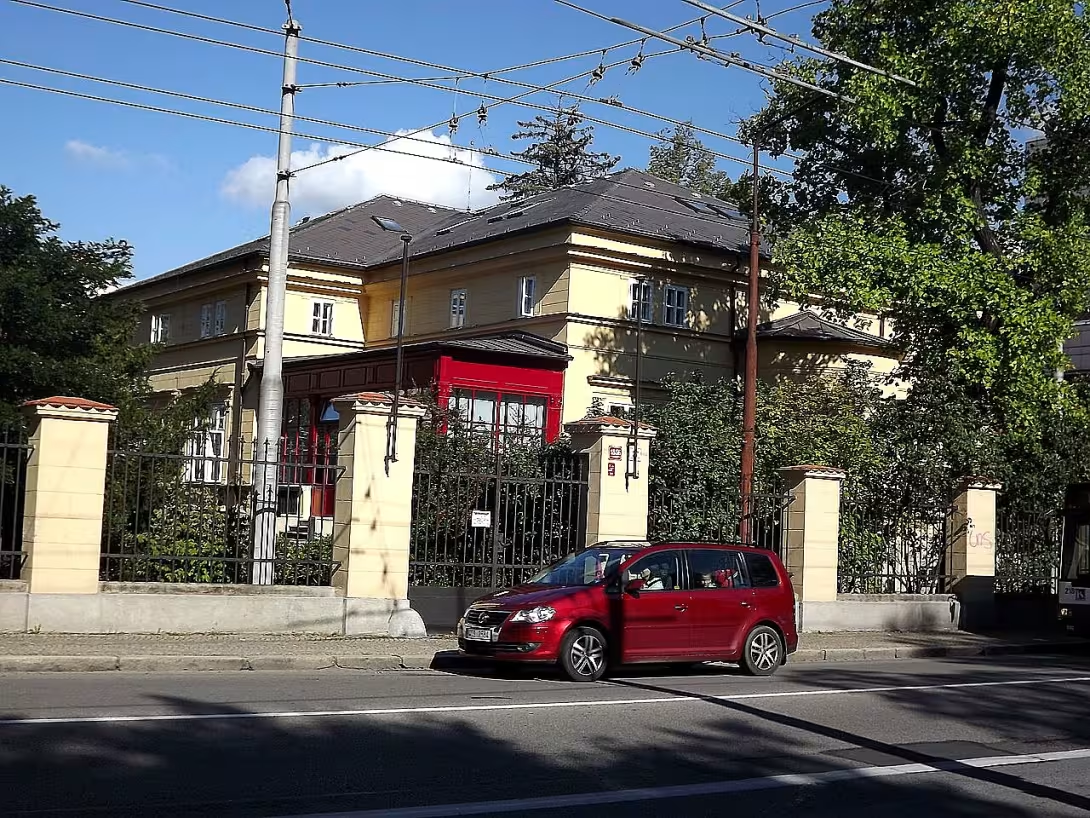
Eggertova vila, located in České Budějovice 3 on the street Na Sady number descriptive 1856 / 27, is the oldest preserved Empire villa of architectural type in the city. This monument-protected building was built in 1859-1860 for the townsman and businessman Anton Eggert, owner of graphite mines in the Mokré. Since 1946, it has served as a seat of the South Bohemian Scientific Library.
It was created during Bach absolutism in the Austrian Empire, Eggertova vila represents architectural progress and a change in the lifestyle of the township. At this time, wealthier inhabitants began to leave dense medieval cores for the fringes, where villas with gardens were built. Architect Josef Sandner is considered to be the author of the project of this villa, which was built on the site of the disturbed outer band of city walls.
It is an architectural pavilion building with a floor plan in the shape of "T," a storey and finely bared facade. There is a five-sided bay in the south facade, with terraces on the sides. The roof is low, which gives the building a characteristic empirical character.
After the death of Anton Eggert in 1875 and his wife Johanna in 1905, the villa became the property of the Chamber of Commerce and Industry. In the following decades, it passed through the hands of the Czech Stock Brewery, the České Budějovice Reserve and during the Protectorate it served as the seat of German courts. In 1946, the South Bohemia Scientific Library was moved to the villa, the ceremonial opening of which took place on 2 May 1948.
The villa was included in the list of cultural monuments in 1958, and between 1997- 1999, complex reconstruction work was carried out to ensure its preservation for future generations. In 2011, the reconstruction of the monument-protected garden of Na Saddy was carried out, although the original empire composition was destroyed in the 1970s when the property was modified for the summer reading room.
Today Eggertova vila stands as a witness to the historical and cultural heritage of České Budějovice. Its architectural beauty and rich history make it necessary to visit anyone interested in local monuments. The villa is open to the public as a seat of the South Bohemian scientific library and offers a unique view of the past of this area.
Eggertova vila not only captures the spirit of the era in which it was built, but also represents a key part of the cultural and historical context of České Budějovice. It is a place where visitors can learn about the past of the city and appreciate its architectural development. Visiting this monument is not only a way into history, but also an opportunity to honor the artistic and cultural values that this villa represents.
Then and now
Drag the slider to compare how the landmark may have looked when it was built with the view today.
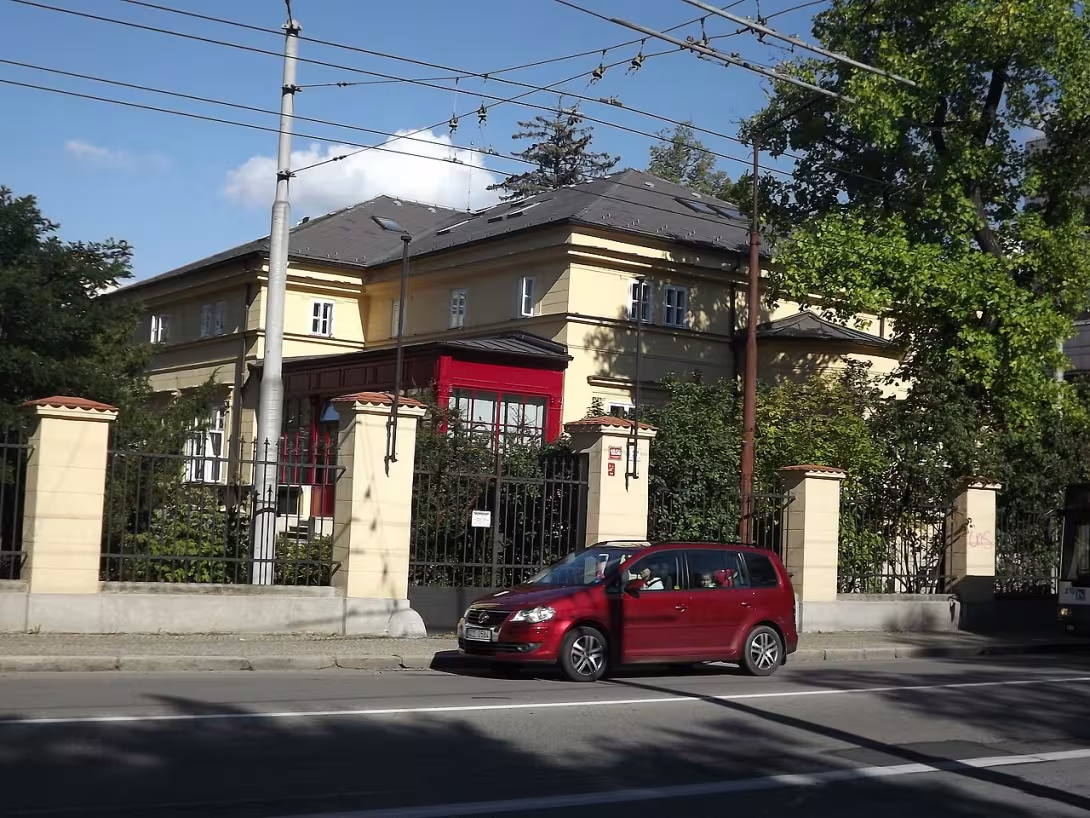
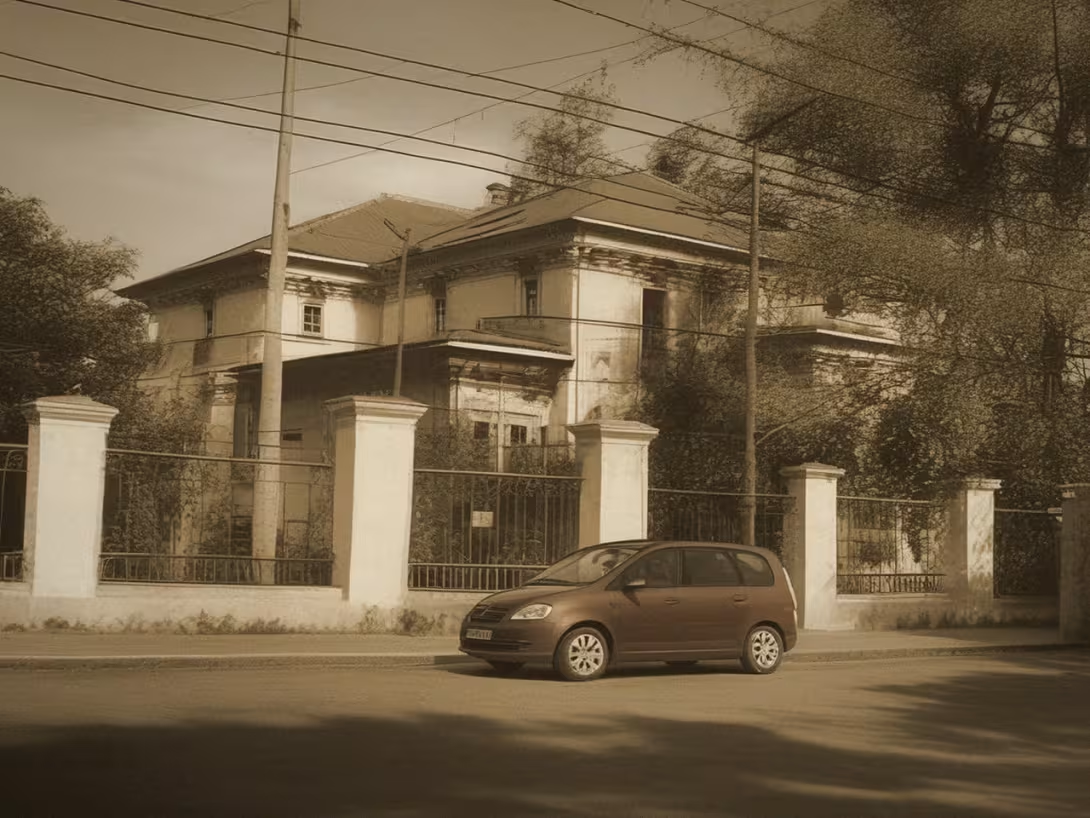
The historical appearance on the left is an AI-generated visualisation and serves as inspiration only.
Historical milestones
- 1859-1860
- Construction of the villa for Anton Eggert according to the Josef Sandner project
- 1875
- The deaths of Anton Eggert
- 1905
- The deaths of Johanna Eggert, the transfer of the villa of the Chamber of Commerce and Industry
- 1920
- Owning the Czech Stock Brewery
- 1930
- Owning a Czech-Budějovice Reserve
- 1939-1945
- The seat of the German Administrative Court (Amtsgericht) and the branch of the Regional Court (Landgericht)
- 1946
- Moving South Bohemian Scientific Library to Villa
- 1948
- Opening ceremony of the library on 2nd May
- 1958
- Entry into the list of cultural monuments
- 1997- 1999
- Comprehensive reconstruction of the villa by Českobudějovice building
- 2011
- Reconstruction of the monument protected garden on Sady
Historical events
Construction of the villa (1859-1860), death of Anton Eggert (1875), takeover of the Chamber (1905), establishment of German courts (1939-1945), transfer of the South Bohemian scientific library (1946), ceremonial opening of the library (1948), registration in the list of cultural monuments (1958), comprehensive reconstruction (1997- 1999), reconstruction of the garden (2011).
Owners
Anton Eggert (1859- 1875), Johanna Eggertová (1875- 1905), Chamber of Commerce and Industry (after 1905), Czech Stock Brewery (20th Year of the 20th Century), Czech Budejovice Reserve (30th Year of the 20th Century), German Courts (Protectorate), South Bohemia Scientific Library (since 1946)
Points of interest
- Eggertova vila is the oldest preserved empire villa of architectural type in the town of České Budějovice. - It was created during Bach's absolutism in the Austrian Empire and represents a change in the lifestyle of the township. - Architect Josef Sandner is considered to be the author of the project of this villa, which was built on the site of the disturbed outer band of city walls. - The villa was included in the list of cultural monuments in 1958 and between 1997- 1999 there were complex reconstruction works. - Today it serves as a seat of the South Czech Scientific Library and is open to the public.
Guide
Show guide text
This text was created by artificial intelligence and has not been editorially reviewed. It may contain inaccuracies.
Welcome. You are standing in front of one of the most important and oldest historic buildings in our city. In front of your eyes is Eggertova vila, an object that carries an incredible variety of fates and ages. Before we take a deeper tour, allow me to introduce you to the atmosphere of where history touches the present. If you look around now, you may realize you're standing in a very special place. This villa was not built on an empty surface. Its foundations and its very existence are firmly linked to the history of this city, because it was built right where the original city walls once stood. Imagine the change - from the fortification that the city was supposed to protect from the enemy, it became a place to serve comfort, culture and knowledge.
Let us now return to the time when this story began to be written. We are in the middle of the nineteenth century, exactly between 1859 and 1860. In the Austrian Empire there was a period known as Bach's absolutism. It was a time of strong power, but also a time when people's lives began to change. It was then, thanks to the growing wealth and new possibilities, that the townspeople began to demand a different, more representative lifestyle. And for this new world, Eggertova vila was created. Its owner was Anton Eggert, a successful townsman and businessman who wished for a house that reflected its position and success. The project was prepared for him by the renowned architect Josef Sandner, whose vision gave the construction its unmistakable character.
Now pay attention to the construction itself, which is right in front of you. Look at her face and feel her empirical style. This style is known for its dignity and balance. If you could imagine the layout of this building, you would see that it is the shape of the letter T. This pavilion character of the building is very specific and gives it ease, although it looks very firm and stable. Notice the facade. It's not just a plain smooth wall. It is equipped with fine bossings. This means that the surface of the walls has its structure, its depth and its texture, which creates a beautiful game of light and shadow depending on how the sun changes after a day. The villa is oriented towards the south to make the best use of natural light. Also look at the roof - it is low, which is typical of this architectural direction and allows the construction to act harmonically in the surrounding environment.
When you look at this building, you can't miss out on the stories of the people who lived here. Anton Eggert built his home here until he left the world in 1875. After his death, his wife, Johanna Eggertová, stayed here. Her life's journey with this villa was also important. When she died in 1905, the villa went into the hands of the Chamber of Commerce and Industry. From this moment on, the character of the place began to change - from a private home he gradually became an object with a more public touch.
Over the next decade, ownership of the villa was constantly changing, reflecting economic and political upheaval in our region. In 1920 the building became part of the property of the Czech stock brewery. Ten years later, in 1930, it was taken over by a Czech-Budějovice reserve. Each of these owners brought a piece of their own history to the villa. However, the period between 1939 and 1945 was very difficult for this object. During the war, the villa served as the seat of the German official court and also as a branch of the court. In these years there was a quite different, much stricter and more serious atmosphere than when entrepreneurs and their families lived here.
You might find this interesting: Eggertova vila is not just any old building. It is the oldest preserved villa of this architectural type in the whole of České Budějovice. It's living proof of how our city was supposed to evolve in the nineteenth century. It is a monument to the transformation from fortified city to modern, expanding urban space.
So how did this villa become what it is today? Since 1946, it has served as a seat of the South Bohemian Scientific Library. This is perhaps the most beautiful return to its importance. The place where rich people once lived and judges later decided is now home to thousands of books, knowledge, study, and anyone looking for answers. The place that once protected the city with its walls now protects human thoughts and history in the form of written words.
Now, please, continue your walk. Look at the facade from other angles, feel the atmosphere of this place and try to imagine what sounds and voices were heard here hundreds of years ago. Eggertova vila is waiting for you to discover it again and again. Thank you for your journey and I wish you a pleasant continuation in discovering the beauty of our city.
Tips for visitors
The best time to visit Eggert's villa is early spring or autumn when it is quieter and nature offers beautiful colors. In addition, in days without sunlight you can focus better on architectural details.
Parking in the vicinity of Eggert's villa can be found in Přemysla Otakar II or in nearby streets. For those who prefer public transport, buses and trams are available; the specific connection should be verified prior to the visit.
When visiting Eggert's villa, take a camera or a mobile phone to capture the beauty of the pavilion and its surroundings. In addition, it may be useful to carry a hat or sun bookmark, especially in the summer months.
Photography of Eggert's villa is best in the early morning or evening, when light is softer and shadows are given the opportunity to discover the beauty of architecture. Also remember the panoramic view from the surrounding streets.
Close to Eggert's villa, you can visit the historical centre of České Budějovice, where the Square of Přemysla Otakar II is located, the Black Tower and the Cathedral of St. Nicholas. These places are ideal for families with children who can enjoy a view of historical monuments and possibly visit the Dominican monastery.
Businesses nearby
Do you run a restaurant, accommodation, shop, museum, rental, wellness or other visitor service near this monument? Show yourself directly to the people heading to it — this is how they will see you in the app and on the web:
Events nearby
Zdroj akcí: otevřená data měst a obcí ČR (Národní katalog otevřených dat) a kalendář akcí Národního památkového ústavu.
Nearby
Historické centrum Českých Budějovic s náměstím Přemysla Otakara II., Černou věží, katedrálou sv. Mikuláše a dominikánským kláštem v blízkosti ulice Na Sadech.
Accommodation nearby
Trips and activities nearby
Guided tours, tickets and activities nearby from GetYourGuide
Affiliate link: if you buy from the partner, we may receive a commission. The price for you does not change.
Search tours and activities →Themed route
Thematic cruise route "Historical center of České Budějovice"
1. The Square of Mohysl Otakar II. - Start your trip to this historically important square, which is the center of the city and hosts the beautiful statue of Přemysl Otakar II. The square offers beautiful views of the surrounding architecture and is an ideal place for understanding the historical development of České Budějovice.
2. Black Tower (Tower) - About 5 minutes walk from the square is located the Black Tower, one of the oldest sights of the city. Built at the end of the 13th century, it is a significant part of the former castle and provides views of the entire center. It is an ideal place to stop and enjoy panoramic views.
3. St. Nicholas Cathedral (church) - Shortly from the Black Tower is the Cathedral of St. Nicholas, the most important sacral monument of the city. Its Gothic interior and history make it a fascinating goal for visitors interested in spiritual and architectural aspects.
4. Dominican monastery (monastery complex) - About 10 minutes' walk from the cathedral is a Dominican monastery, which is famous for its history and architecture. The monastery offers a view of the lifestyle of monks from past times and its area is suitable for relaxation in peace.
5.Eggertova vila (villa) - The final destination of the route is Eggertova vila, located on the street Na Saddy. This villa is an example of Baroque architecture and its history is closely linked to local events. It is an ideal place to think about the cultural heritage of České Budějovice.
This route offers a view of the key historical and architectural monuments of the city, allowing a deeper understanding of its rich past.
Seasonal recommendations
Spring: In the spring season Eggertova vila appears in a new light, when the sun's rays illuminate historical architectural elements and green nature is blooming around. Parks and surrounding gardens take on life with flowering bushes and trees, creating a cozy atmosphere for visitors. At this time the opening hours may be longer than in winter, but it is advisable to visit early in the morning to avoid possible crowds especially on weekend days. Clothes should be mild, with the possibility of adding a warm layer for a cooler morning or evening.
Summer: In summer Eggertova vila gets its full bloom. Sun day and warm weather attract many visitors who enjoy the beauty of outdoor areas and gardens nearby. It is advisable to visit earlier on the day to avoid the largest crowd of tourists who often visit the memory during the summer months. Clothes should be light and light, with sun protection as a tie or hat to prevent pairing.
Autumn: In autumn the Eggertova vila becomes melancholy and calm. Tree leaves colour parks and surroundings, providing a beautiful opportunity for photo and relaxation. Autumn weather can be variable, so it is advisable to dress in layered style with the possibility to add a warm shirt or cape for colder days. Opening hours may be shorter, so it is good to check the current opening times.
Winter: Winter Eggertova vila offers a unique view with snow-covered architecture and calm atmosphere. Snow veils may add a romantic touch, but the weather is variable and can be cold. It is important to dress warm, with resistant shoes for snow conditions. The opening times of the monument may be shorter or even shortened in cold days, so it is good to check the current information before visiting.
Visualizations and artistic views


The visualisations are generated by artificial intelligence and serve as inspiration.
Photos from the area
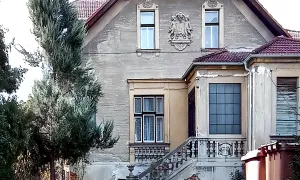
Real photos taken near the monument


Zdroj a licence jsou uvedeny u každého snímku.
Tips from visitors
No tips yet. Be the first!
Log in and add your tip.
Sources and literature
Photos: JAn Dudík / CC BY-SA 3.0 — Wikimedia Commons. The author and licence also appear when you hover over the image.
Faktickým podkladem tohoto textu byl článek na Wikipedii, jehož autory jsou přispěvatelé Wikipedie. Článek je dostupný pod licencí CC BY-SA 4.0.
Location on the map


Příběhy a pověsti
Legendy, pověsti a příběhy spjaté s touto památkou
Fotografie návštěvníků
Zatím žádné fotografie. Buďte první, kdo přidá fotografii z návštěvy!
Log in a přidejte svou fotografii nebo hodnoťte.
Za ověřenou návštěvu v aplikaci získáte víc bodů — poznáme podle GPS, že jste na místě.
Reviews and comments