






Klášter augustiniánů v Mělníku Monastery
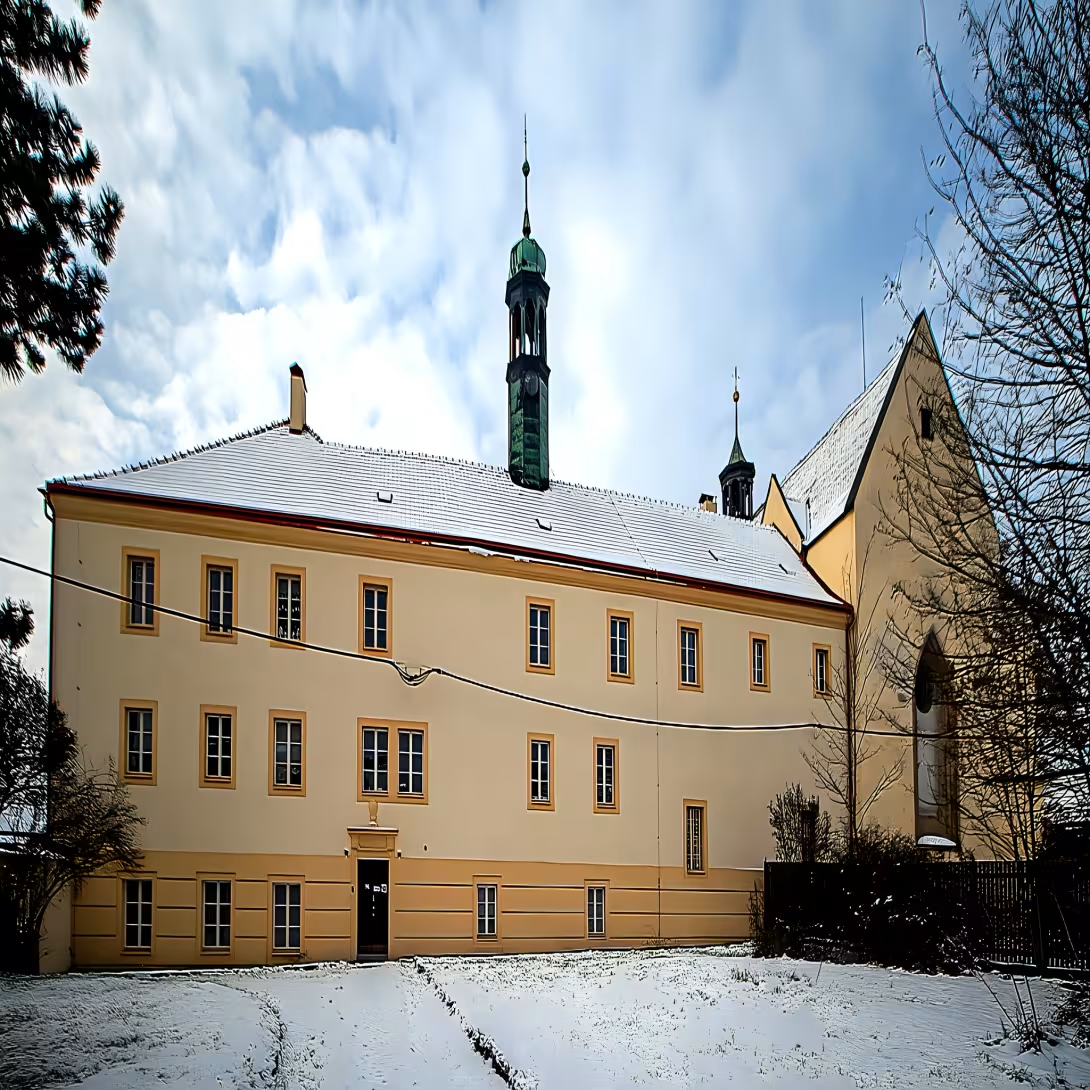
The Augustinian monastery was built in 1263 by the brothers Pavel of Lusnice and Smila of Etitov, by which they were also his first donors. The monks came here from a monastery in Pivona. The convention church of St. Lawrence was consecrated by Bishop John III of Dražice. Already in 1268 King Přemysl Otakar II confirmed the rich talent of this new monastery from its founders. During the 14th century the monastery continued to grow - in 1328 it received revenue from Sjrem and owned abundant land. In 1373, however, a dispute broke out between the monastery and Mělník himself over the boundaries of their property.
The biggest crisis was the monastery in the Hussite wars. On 18 March 1421 Hussite was burned, with 26 members of the Convention either killed or forced to leave the monastery. The religious life was restored only in 1484, but soon afterwards the institution was affected by a permanent crisis - discipline among monks fell sharply and many monks of Italian origin settled in the monastery. During the Czech State uprising, the monastery and its estate became property of the city Mělníka. The last Prior before the rebellion was Gabriel from Mount Ulma since 1615. In 1619, the state army ambushed the monastery, shut it down from physical security and used its resources for military purposes. Only in 1620, when Mělník bought the monastery area from the states, the beacons could repopulate several rooms. The restoration dates back to 1640, when the monastery and church went through Baroque reconstruction. In decorating the main altar, the famous baroque painter Karel Šcreta participated. During this period, the Greeks also performed spiritual administration of the surrounding parishes, for example in Upper Vidima.
Religious reforms of emperor Joseph II brought further intervention - in 1789 the monastery was abolished. At that time there were fifteen religious people in the monastery, which needed to be moved to other institutions: parts went to St. Thomas in Prague, to Belé pod Bezdez or to Saint Dobrotivé near Hořovice. Augustinian Marek Blažej became the first vicar of the newly established parish in Pšovka, while the conventional church of St. Lawrence was declared a parish temple. The monastery and its farmhouse were then bought by Marie Ludmila of Lobkovic, who set up the offices of the Chief Administration of the Lobkowski Manor Mělník. In the 1980s, the building served as an apprenticeship school.
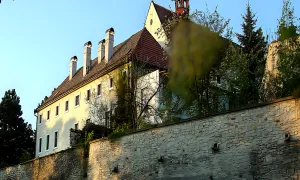
The building consists of a four-wing two-storey building around a rectangular courtyard with ambition. St. Lawrence's Church is on the north side of the complex. The ground floor areas are glassware by rolling with lunettes or a cross nail vault. South of the church there are two rectangular spaces with cross ribs, one of which serves as a sacristy. In the ambition of the original arcades that were walled up in 1866, a marble tombstone from 1574 is preserved. The church kept a gothic rectangular presbytery; a simple flat-ceiling ship was added later.
Since 2019, the monastery has served as a home for elderly people with social services. The cultural monument run by Senlife became the winner of the Special Prize of the Best of Realty competition in 2021.
Then and now
Drag the slider to compare how the landmark may have looked when it was built with the view today.
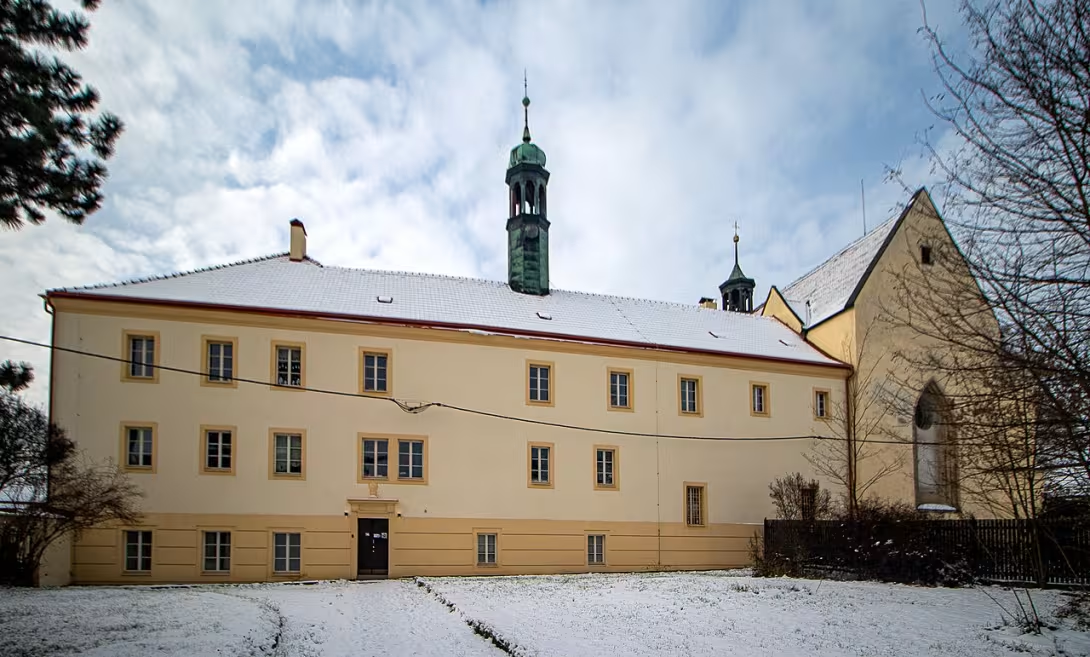
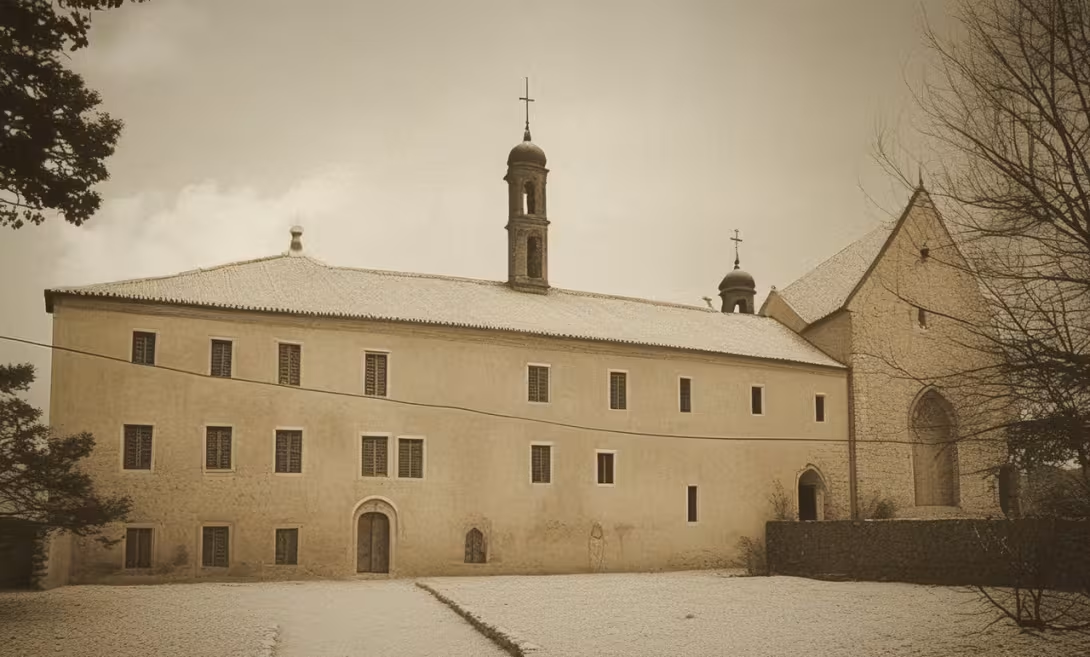
The historical appearance on the left is an AI-generated visualisation and serves as inspiration only.
Historical milestones
- 1263
- The founding of the monastery brothers Pavel from Lusnice and Smil from Cítov, the first goblins came from Pivona
- 1268
- Confirmation of the monastery by the king Premohmi Otakar II with rich foundations
- 1484
- Restoring Greek life after Hussite wars
- 1640
- Baroque reconstruction of the monastery and church, decoration of the main altar by Karel Škretou
- 1966
- Writing the monastery into the list of cultural monuments
Architectural development
The original Gothic monastery from the 13th century was rebuilt in the 17th century in a Baroque style. The church of St. Lawrence was preserved by a Gothic presbytery, the boat was built with a flat ceiling. In the 19th century, the arcades of ambition were walled up. The buildings are glazed with vaulted and cross vaults, with marble tombstones from the 16th century. The current 2019 adjustment respects the historical nature of the site.
Historical events
- 1421
- The destruction of the monastery of Hussite, 26 religious people killed or escaped
- 1619
- Confiscation of the monastery by insurgent states, religious people forced to live only on the floor
- 1789
- Josephine's abrogation of the monastery, survivors of the monasteries sent to other monasteries
- 2019
- Rebuilding to home for seniors, current function
Points of interest
- The monastery was founded in 1263 by the brothers Pavel of Lusnice and Smila of Cítov, who were also his first donors.
- The convention church of St. Lawrence was consecrated by Bishop John III of Dražice.
- In 1421, the monastery was burned by geese, killing or forced to banish 26 members of the Convention.
- During the Baroque reconstruction in 1640, the painter Karel Šcreta participated in the decoration of the main altar.
- In the ambition of the monastery is preserved marble tombstone from 1574.
Guide
This guide is narrated by a synthetic voice generated by artificial intelligence.
Show guide text
This text was created by artificial intelligence and has not been editorially reviewed. It may contain inaccuracies.
Welcome to Mělník, a place where history touches peace and where every wall tells a story over seven centuries old. You are standing in front of one of the most important medieval units of this region - the monastery of the Augustinian people in Pšovka. Before you go any further, stop for a moment and feel the atmosphere of this place. In front of your eyes, a massive, quadruple building, whose rectangular floor plan creates a closed and harmonious space, forms before your eyes. Although at first glance you may seem to be looking at a baroque work, know that under this layer is a much older, Gothic soul.
Let's go back deep into the past together, to the year one thousand two hundred sixty-three. Imagine then a landscape that was much wilder and quieter than today's Mělníka surroundings. It was at that time that two brothers, Pavel of Lusnice and Smil of Etitov, decided to lay the foundations of this monastery. They were not just ordinary founders, but the first rebels who came from Pivona and decided to dedicate themselves to divine service. Their efforts were unknown to even powerful rulers. Five years later, in the year two hundred and sixty-eight, a fundamental confirmation came when King Přemysl Otakar II acknowledged the monastery and gave it to rich foundations. This meant that this place became not only a spiritual centre, but also a significant property, which had the strength to face the storms that followed.
Now pay attention to the construction itself that surrounds you. When you look around the premises, notice how different epochs intersect. The monastery is today mainly a Baroque building, which by its form is based on a reconstruction from the seventeenth century. This architecture adds a whole nobility and order. However, if you look more closely at the church of St. Lawrence, which is the heart of the whole monastery complex, you will realize that its core is Gothic. This invisible but tangible link between the medieval fortress and the Baroque elegance is what makes this complex so special. It's like in one layer of time, you see two different periods that complement each other.
But the history of this place wasn't always about peace and prayer. We must prepare ourselves for the darker chapters that took place at the time of the greatest unrest. In a thousand and four hundred twenty-one, the monastery found itself in the fire of Hussite wars. It was a tragic period that left a deep mark in the soul of this place. At that time, the monastery was burned and in the chaos that followed, twenty-six members of the Convention were killed or forced to be expelled. Imagine the horror and emptiness that they left behind. The monastery then had to seek its way again for many years before in the year one thousand four hundred and eighty-four it was possible to restore the Greek life fully.
Although the monastery was on the verge of extinction several times, especially during the uprising of the states or during the time of the Josephine abolition of the monasteries, it was always able to be reborn. In the seventeenth century, about a thousand six hundred forty, there was a great baroque reconstruction that gave the monastery the look that you see right now. At this time there were also fascinating events associated with important personalities. Here we can remember Bishop John the third of the Dražice, who consecrated the church of St. Lawrence and declared it a holy place for the divine presence.
There were people in these areas who had the power to change history. In the seventeenth century, Gabriel worked here from Mount Ulma, whose name is linked to the last great coup before the uprising. And when the monastery became a private property after the abolition of Greek life, for example, it belonged in the eighteenth century to the imprinted Marie Ludmile of Lobkovice. Every name you hear here is one of the pillars on which this place stands.
If you now focus on the interior of the church, especially the main altar, you should be aware of the artistic value that Master Karel Šcreta has put in it. His work from the Baroque reconstruction gave the place spiritual depth and visual richness, which can still impress you today. Šcreta was not only a painter, he was a creator who was able to capture both nobility and human emotions, which perfectly suited the complexity of this monastery space.
You may now wonder how this place has changed in modern times. It is fascinating that the place that once served as a refuge for monks and instead of constant prayer now serves a completely different but equally important function. The monastery has become a modern home for seniors. This transformation is proof of the incredible resilience of this building. The monastery survived wars, fires, and political upheavals, and today it provides security and peace to the people who find their new home in it. It's a beautiful story about continuing life within old walls.
A place has spread before you, which has been included in the list of cultural monuments since the year one thousand nine hundred sixty-six, as proof of its immortality. Every stone, every line in a rectangular plan, and every baroque detail is a witness of the centuries that have passed here.
I now urge you to go on another survey. Take a look at the premises, feel the silence that exists here, and try to imagine the brothers who first started their journey here seven centuries ago. Let yourself be consumed by the atmosphere of this place, which is a living bridge between the Middle Ages and the present. Thank you for sharing this story with us. We wish you a pleasant walk in history.
Tips for visitors
{'paragraph': 'The best time to visit the monastery is in the summer months, especially in June and July, when the weather is pleasant and the sun illuminates the interior of the monastery so that the frescoes and Gothic architecture appear in full glory. The morning in the morning or afternoon after the 15th hour is also ideal because there are fewer visitors and you can see the monastery more calmly. In winter the visit is interesting thanks to the holidays and Christmas atmosphere, but some parts of the monastery can be closed at this time.'}
{'paragraph': 'The monastery is available by car and public transport. If you arrive by car, it is recommended to find a parking lot near the historic core of the city, which is only one kilometre away. For current information on parking and parking possibilities, please visit the official website of Mělníka. If you prefer public transport, stops are well available in the vicinity, but check the exact connection in the traffic search engine.'}
{'paragraph': 'When visiting the monastery, wear comfortable clothes and shoes, as you will move here on the stone corridors and stairs. It may be cold in the interior, so you will bring a light sweater or sweater. For convenience, also take a map or brochure with a monastery plan that you can get at the entrance. Also remember to pack plenty of water and perhaps even refreshments, because there are no catering facilities available in the monastery.'}
{'paragraph': 'Photography is permitted in the monastery, but it is necessary to ensure respect for the rules. The best places for photography are the exterior of the monastery, especially its Gothic facade and monastery garden, where there is pleasant light and natural background. In the interior, photography is restricted, but you can take beautiful pictures of the chapel and fresco in good light. It is recommended to photograph the monastery in the morning or afternoon light, when shadows are softer and colors are more vivid.'}
{'paragraph': 'In the vicinity of the monastery there are several interesting places worth visiting. The first of these is the historical core of the city Mělníka, which is only one kilometre away. Here you can walk on ancient streets, admire the Gothic Town Hall and visit chateau Mělník, which dominates over the Elbe. Another interesting thing is the Church of St. Nicholas, located about 1.5 km from the monastery. This Gothic church with late Baroque adaptations offers rich history and beautiful architecture.'}
{'paragraph': 'If you visit the monastery with children, prepare for them several activities to improve their experience. You can visit the monastery garden and talk about the history of the place or play a game on steps and stone corridors. In the vicinity of the monastery there is also the possibility to visit the chateau Mělník, where children can see medieval weapons and siege machines. It can be interesting for children of older age to visit the Church of St. Nicholas, where you can learn more about the history and architecture of the church.'}
Frequently asked questions
Is Klášter augustiniánů v Mělníku open to the public?
Yes, the monastery is open to the public. The opening hours are 9: 00 to 5: 00.
How do I get to the place by car / public transport?
The monastery is available by bus No. 342 from Prague or Mělník. By car you can arrive on I / 16 and then continue on local roads.
How much is the entrance fee and is it paid on the spot?
Payment shall be made on the spot in the form of cash or credit card.
Is the tour suitable for children and seniors?
Yes, the tour is also suitable for families with children. There are special tours for children that are available after previous booking.
How long does the tour take?
The tour takes approximately 1 hour and 30 minutes. Depending on the number of visitors, the tour may be shorter or longer.
What are the opening times and booking is required?
The monastery is open from Monday to Friday from 9: 00 to 5: 00. Reservation of the tour is not mandatory, but we recommend it especially during school holidays.
What's interesting in the immediate vicinity?
In the immediate surroundings you can visit Mělnická Town Hall and St. Nicholas Church. There is also a park nearby where you can relax or take a walk.
For kids
Imagine going back 763 years to the time of the Augustinian monastery in Mělníku. That was a time of life and religious effort. The monastery was home to monks who lived here, prayed and studied.
It was like a small town with buildings, gardens and baths. The monks were engaged in agriculture, animal husbandry and equipment production. In the monastery there was also a large library archive where valuable books and documents were stored.
Businesses nearby
Do you run a restaurant, accommodation, shop, museum, rental, wellness or other visitor service near this monument? Show yourself directly to the people heading to it — this is how they will see you in the app and on the web:
Nearby
- Old town with chateau Mělník, which dominates over the Elbe, and Gothic Town Hall.
- Gothic church with late Baroque style, important for its architecture.
- Elbe Valley with possibilities for tourists, including cycling routes and educational paths.
- Baroque chateau with extensive gardens, today the seat of the city museum.
Accommodation nearby
Themed route
Thematic cruise route: Augustinian monastery in Mělník and its historical surroundings
1. Augustinian monastery in Mělník * Type: Monastic complex * The only preserved monastery of Augustinian people in Bohemia, founded in the 13th century. Its Gothic core and later Baroque adaptations form a unique example of medieval and Renaissance architecture. In the interior there are valuable frescos and historical equipment that uncover the rich spiritual history of the region.
2. Historical Core Mělníka (Monument Zone) * Type: Old Town * It lies only a short walk from the monastery and offers a picturesque atmosphere of the medieval city. The dominant is the chateau Mělník, which stands above the Elbe, and the Gothic Town Hall with a tower, symbolizing the city's self-government. Alleys with stone houses and bridge over the Elbe complement an authentic view of Czech history.
3. Church of St. Nicholas in Mělník * Type: Sacral landmark * The Gothic church with a distinctive late Baroque facade is located near the monastery. Its interior with rich decoration and organ is an important example of sacral architecture. The church is also associated with the legends of St. Prokop, which adds a spiritual dimension to the place.
4. Elbe Valley (natural landscape) * Type: Landscape item * A short journey from the centre leads to the Elbe where the picturesque valley with meadows and vineyards is situated. It is an ideal place to walk along the river where natural beauty is mixed with historical impressions. The view of the Elbe and surrounding hills offers peace and inspiration for photography.
Seasonal recommendations
Spring Spring in Mělník brings fine lighting to the monastery - the sun illuminates the Gothic vaults through blooming trees in the surrounding area that begin to dress in green and pink shades. The atmosphere is full of air, where the first summer fragrance of flower intertwine between the stone walls of the monastery and the damp air after the rain gives the place magical silence. In this period nature is around the monastery in full bloom, especially near the Elbe River, where meadows with primordial and sun rays break on the water surface. The ideal time for visiting is morning or afternoon when you avoid morning fog and later summer heat. Light clothes are recommended, but with the possibility of covering the shoulders - the monastery is often visited by families with children who enjoy walking around in the morning. The entry gates are opened longer than in winter in the spring months, and visitors can also see the gardens that begin to awaken with life.
Summer Summer in Mělník offers a golden light to the monastery, which is reflected from stone walls and creates playful shadows in corridors and chapel. The atmosphere is lively but calm - among tourists intertwine the air sounds of birds and the rustling of leaves, while near the Elbe river the smell of sunflowers and grass is smelled. The warm days attract long walks through the monastery gardens, where shady alleys and terraces with views of the city are spread. The best time to visit is early morning, when it is still cold and the crowds have not yet started. Light, but sun-proof clothing - a hat or scarf is recommended to protect themselves from direct sun inspections. In the main summer season, the entrance to the monastery is often overcrowded, so it is advisable to check the opening times in advance and possibly secure online entry tickets. The evenings are pleasant and visitors often enjoy quiet moments on the monastery terraces overlooking Mělník.
Autumn Autumn Mělník surrounds the monastery with golden and red shades of leaves that are reflected in the sun from gothic windows and create a magical, almost freezing atmosphere in the halls of the monastery. The air is clean and refreshing, with the scent of fallen leaves and the first cold rains that supply the place with mysterious poetry. Nature around the monastery becomes a colorful collage, especially near the Elbe, where trees with glossy leaves spread out on the shore. The best time to visit is in the quiet morning, when there is still enough light out and the crowds have not yet started. It is recommended to wear warmer clothes - a sweater or sweater with long sleeves because autumn days are variable and evenings are cold. The entry gates are open in full length during this period, but visitors can enjoy a quieter atmosphere without summer crowds. A tour of the monastery in the autumn months is like traveling to another world where stone walls of the monastery become part of the natural theatre.
Winter Winter Mělník surrounds the monastery with a white cover of snow, which is reflected from stone walls and creates a calm, cold atmosphere in corridors and chapel. The atmosphere is quiet and thoughtful, where the sounds of snow steps and the rustling of the breeze are intertwined among visitors, which brings the smell of needles and wooden structures. Nature around the monastery is covered with a white blanket that gives the place mysterious beauty, especially near the Elbe River, where the light of the sun is reflected on the water and creates silver reflections on the snow. The best time to visit is in the quiet morning, when there is still enough light out and the crowds have not yet started. Hot clothes - sweatpants, hats and gloves are recommended to protect themselves from cold wind. The entry gates are open for shorter periods in the winter months, so it is advisable to check the opening times in advance. The winter visit to the monastery is like traveling to another world where the stone walls of the monastery become part of the winter fairy tale.
Visualizations and artistic views


The visualisations are generated by artificial intelligence and serve as inspiration.
Photos from the area
Real photos taken near the monument


Zdroj a licence jsou uvedeny u každého snímku.
Tips from visitors
No tips yet. Be the first!
Log in and add your tip.
Sources and literature
Fotografie: VitVit / CC BY-SA 4.0, rozlišení zvýšeno umělou inteligencí — Wikimedia Commons. The author and licence also appear when you hover over the image.
Faktickým podkladem tohoto textu byl článek na Wikipedii, jehož autory jsou přispěvatelé Wikipedie. Článek je dostupný pod licencí CC BY-SA 4.0.
Location on the map
Příběhy a pověsti
Legendy, pověsti a příběhy spjaté s touto památkou
Fotografie návštěvníků
Zatím žádné fotografie. Buďte první, kdo přidá fotografii z návštěvy!
Přihlaste se a přidejte svou fotografii nebo hodnoťte.
Za ověřenou návštěvu v aplikaci získáte víc bodů — poznáme podle GPS, že jste na místě.
Reviews and comments