






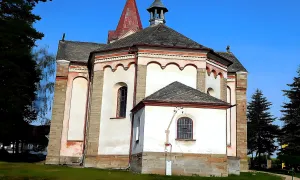
Kostel Nanebevzetí Panny Marie (Chotěborky) Church
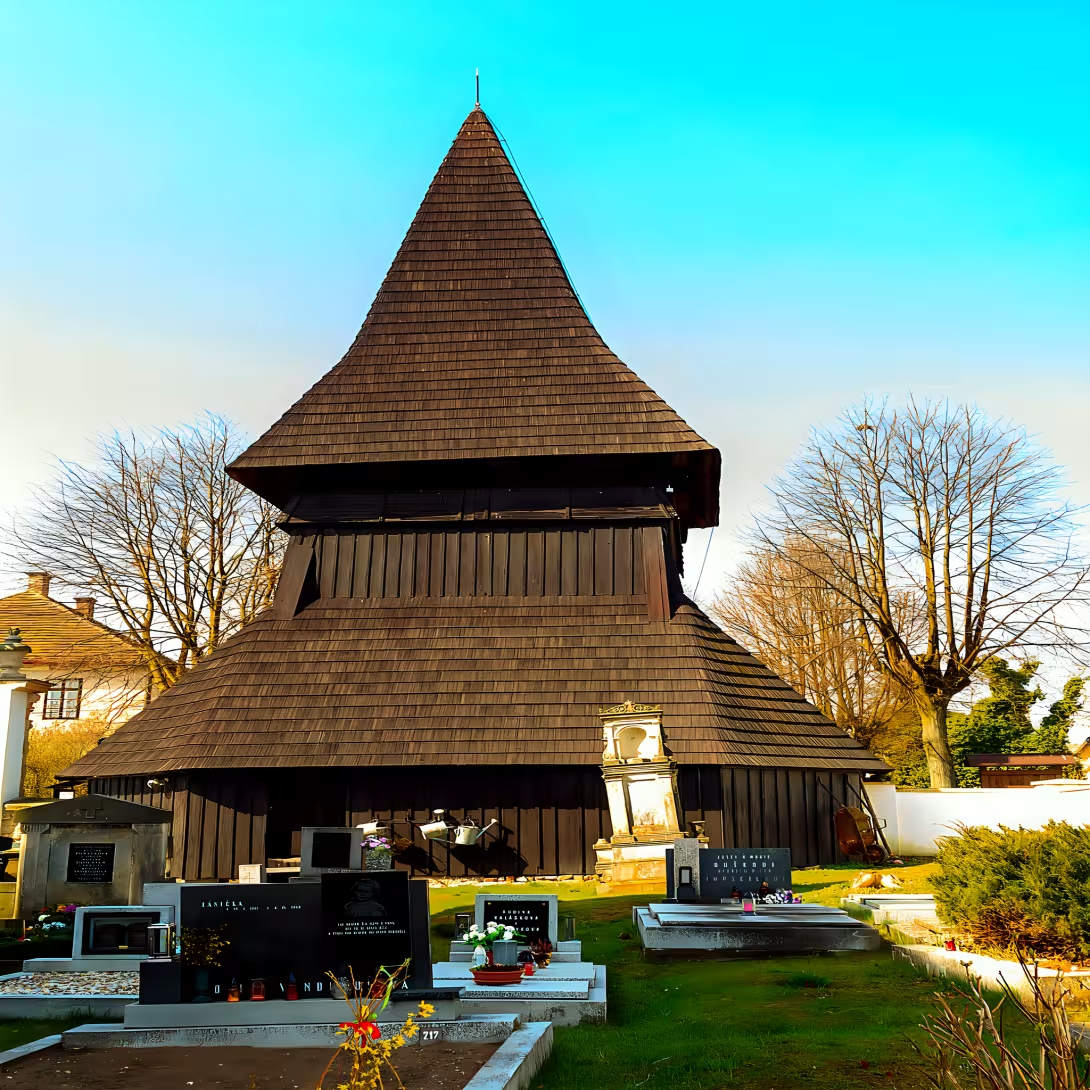
The Church of the Assumption of the Virgin Mary in Chotěborky is a remarkable historical monument located in the village of Chotěborky. It belongs to the municipality of Vilantice, within Královéhradecký kraj. This Roman Catholic filial church originally served as the parish church for the now-defunct parish of Chotěborky. Its architecture evolved from Gothic origins to later Baroque modifications. Recognized as a cultural heritage site in the Czech Republic, it is significant for its blend of historical styles and features such as the southern portal from the early 14th century and the emblem of the Rýzmburk family.
The church's history dates back to at least 1348 when Ales z Rýzmburka and Vojek ze Vřešťova established a new altar. Originally built on the site of an older wooden chapel within a fortified settlement, it was rebuilt after a fire. Gothic architecture is evident in elements like the southern portal from the first half of the 14th century. During the Hussite Wars in the 15th century, the church suffered looting but was later restored and underwent significant Baroque renovations in the early 18th century.
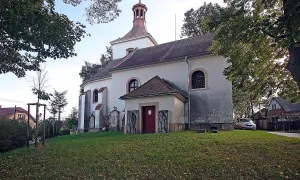
Architecturally, the Church of the Assumption features a single-nave structure with an apse offset to the south, where the sacristy is also located. The western facade includes a porch, while its foundation is made of stone. Its windows are lunette-shaped with flat arches and tiled roofs. A notable feature is the bell tower, added at the end of the 16th century, which stands independently near the church. This tower is unique in the Czech Republic for its upward-sloping corner supports.
Throughout its history, the church has been associated with significant figures such as Ales z Rýzmburka and Vojek ze Vřešťova, who played roles in its early development. The emblem of the Rýzmburk family above the southern portal is a testament to their influence. Over time, the church's interior has been enriched with various artworks, including a baroque main altar from 1876 and polychromed wooden sculptures of Saint Roch and Saint John the Baptist from the mid-18th century.
Today, the Church of the Assumption remains an active site for worship, with services held every Sunday at 8:00 AM. Its historical significance is further highlighted by nearby features such as a late Gothic bell tower and a Baroque column dedicated to Saint John Nepomucene, both protected as cultural heritage sites. The surrounding area includes several tombstones with heraldic symbols, reflecting the historical importance of local noble families.
Visitors to Chotěborky can appreciate not only the church's architectural beauty but also its rich history that reflects broader religious and cultural shifts in medieval Bohemia. Its preservation as a cultural monument ensures that future generations will continue to explore and learn from this unique blend of Gothic and Baroque styles, making it a worthwhile destination for those interested in historical architecture and heritage.
Then and now
Drag the slider to compare how the landmark may have looked when it was built with the view today.
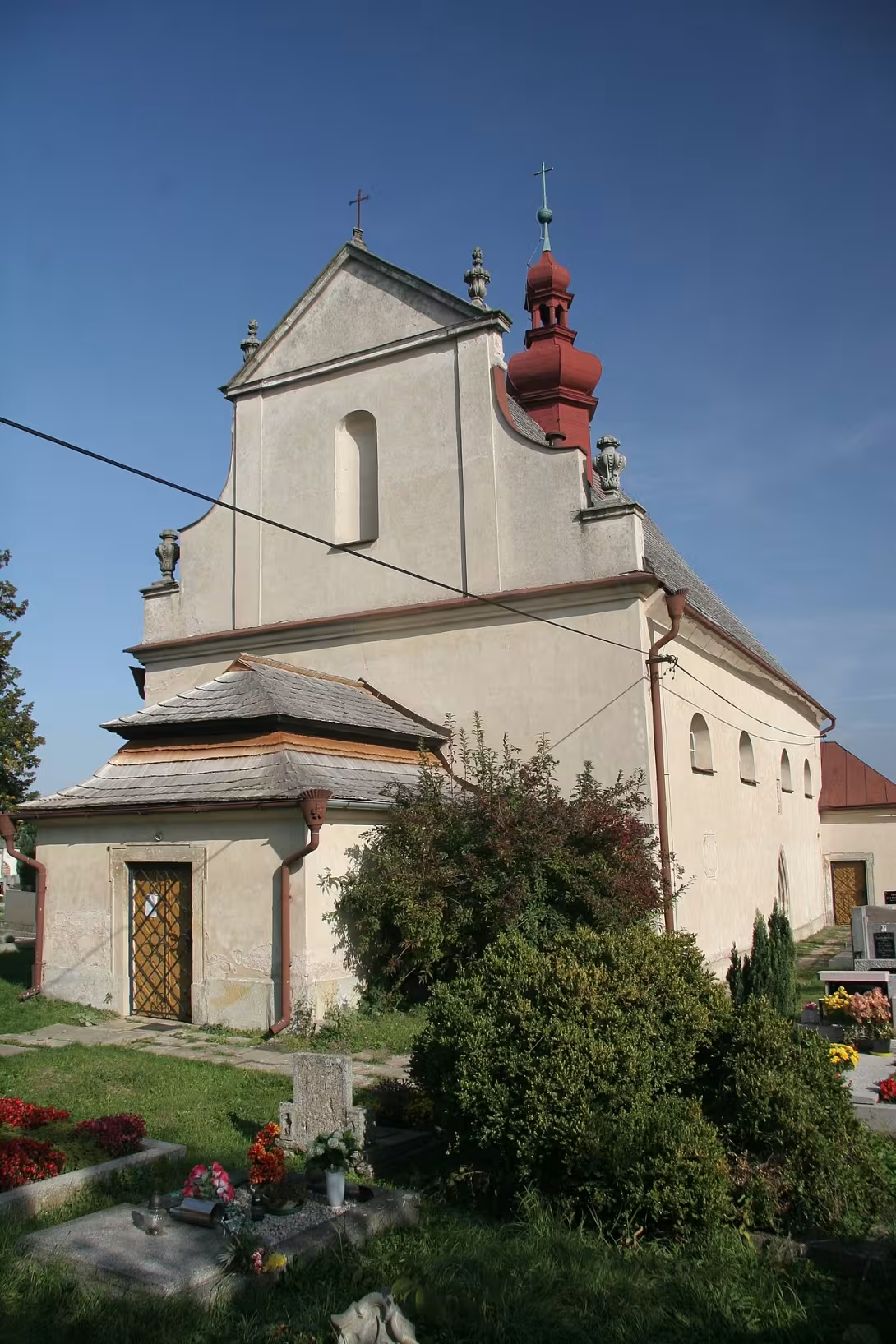

The historical appearance on the left is an AI-generated visualisation and serves as inspiration only.
Historical milestones
- 1348
- A new altar was established by Ales z Rýzmburka and Vojek ze Vřešťova.
Architectural development
Originally a Gothic structure, the Church of the Assumption underwent significant Baroque renovations in the early 18th century. The southern portal and emblem from the Rýzmburk family date back to the first half of the 14th century. A notable feature is the bell tower with its unique construction, added at the end of the 16th century.
Historical events
- 1348
- A new altar was established by Ales z Rýzmburka and Vojek ze Vřešťova.
- 16th century
- The church suffered looting during the Hussite Wars.
Points of interest
- The Church of the Assumption of the Virgin Mary in Chotěborky features a unique bell tower with upward-sloping corner supports, a distinctive architectural element not commonly found elsewhere in the Czech Republic.
- Originally constructed on the site of an older wooden chapel within a fortified settlement, the church was rebuilt after being destroyed by fire, showcasing resilience and adaptation over centuries.
- The southern portal of the church, dating back to the early 14th century, bears the emblem of the Rýzmburk family, highlighting their historical influence and connection to the site's development.
- During the tumultuous Hussite Wars in the 15th century, the church was looted but later restored, reflecting its enduring significance amidst regional conflicts and religious upheaval.
- The interior of the church includes polychromed wooden sculptures of Saint Roch and Saint John the Baptist from the mid-18th century, illustrating the rich artistic heritage preserved within its walls.
Guide
This guide is narrated by a synthetic voice generated by artificial intelligence.
Show guide text
This text was created by artificial intelligence and has not been editorially reviewed. It may contain inaccuracies.
The Church of the Assumption of the Virgin Mary in Chotěborky, a part of the Vilantice municipality, used to be a parish church. The Chotěborky parish ceased to exist and since the middle of 2006 the church has belonged to the parish of Dvůr Králové nad Labem. It is protected as a cultural monument.
The Gothic church was built on the site of an older wooden chapel. That chapel stood inside a hillfort fortification and burned down. The church is documented in writing from the year 1348, when Aleš z Rýzmburka together with Vojkem ze Vřešťova founded a new altar and a chaplaincy. During the Hussite Wars the church was plundered and later repaired. It acquired its present Baroque appearance in the first half of the eighteenth century.
From the Gothic period there remains a southern stone portal with a pointed arch from the first half of the fourteenth century. Its frame consists of three round mouldings. Above it is the coat of arms of the Rýzmborks, a golden stirrup in a blue shield. The church is single-naved and its chancel is offset to the south from the axis of the nave. A sanctus bell turret with an onion dome, lantern and balls rises above the nave. The shingled roof was renovated in the year two thousand.
The gallery is supported by two Tuscan columns. One of them stands on the tombstone of Václav Kordule and his three wives from fifteen fifty-nine. The high altar has its form from eighteen seventy-six, but the painting of the Assumption of the Virgin Mary is older, from around seventeen hundred. In the chancel there stand painted wooden statues of Saint Rochus and Saint John the Baptist from the middle of the eighteenth century. A stone baptismal font is covered with a wooden lid decorated with a relief of the Baptism of Christ from seventeen hundred. The church also owns a painting of Saint John of Nepomuk by Petr Brandl.
Next to the church stands a separate log-built bell tower from the end of the sixteenth century, one of the most precious in Bohemia. As the only one in Bohemia it has four corner supporting columns which converge upwards. The lower part is octagonal and a high pyramidal roof is covered with shingles. Bells from fifteen forty-eight, fifteen fifty-five and sixteen eighteen were confiscated during both world wars. Today a larger bell from fifteen seventy-six and a passing bell from nineteen twenty-eight hang here.
In the cemetery wall there is a Baroque portal with a relief of the Assumption of the Virgin Mary from around seventeen forty from the workshop of the Pacák brothers. The wall also bears eleven tombstones, mostly with the coats of arms of the owners of Vřešťov castle and the Kordulů ze Sloupna, who were buried here. The tombstones were originally in the church, the oldest dates from fifteen forty-six. On the green in front of the church stands a column of Saint John of Nepomuk from around seventeen thirty. It was created by Matěj Bernard Braun or his workshop.
Frequently asked questions
Can the monument be visited?
Religious buildings are usually open mainly during services; at other times a visit is normally arranged with the parish or the operator. We have not verified specific times.
Where is the monument?
Location: Chotěborky, Královéhradecký kraj. The map on this page shows the exact spot.
Why is the monument protected?
It is listed in the Central List of Cultural Monuments of the Czech Republic as a cultural monument (register no. 34144/6-1915).
Businesses nearby
Do you run a restaurant, accommodation, shop, museum, rental, wellness or other visitor service near this monument? Show yourself directly to the people heading to it — this is how they will see you in the app and on the web:
Events nearby
Zdroj akcí: otevřená data měst a obcí ČR (Národní katalog otevřených dat) a kalendář akcí Národního památkového ústavu.
Nearby
Near the church stands a late Gothic bell tower and a Baroque column dedicated to Saint John Nepomucene. The surrounding area includes several tombstones with heraldic symbols, reflecting the historical significance of local noble families.
Accommodation nearby
Themed route
Thematic Walking Tour: Chotěborky Church and Its Historical Surroundings
1. Kostel Nanebevzetí Panny Marie (Chotěborky) - Type: Church - Why Visit: This stunning church, dating back to the late Gothic period, is a centerpiece of Chotěborky's cultural and religious heritage. Its architecture reflects centuries-old traditions and offers visitors a glimpse into the spiritual life of the region.
2. Late Gothic Bell Tower - Type: Architectural Structure - Why Visit: Standing adjacent to the church, this bell tower is an exemplary piece of late Gothic design. It provides not only a historical perspective on architectural evolution but also offers panoramic views of Chotěborky and its surroundings.
3. Baroque Column Dedicated to Saint John Nepomucene - Type: Sculpture - Why Visit: This Baroque column is dedicated to Saint John Nepomucene, a revered figure known for his martyrdom. The intricate details and artistic craftsmanship make it an important cultural artifact that highlights the religious devotion of past centuries.
4. Heraldic Tombstones - Type: Historical Markers - Why Visit: Scattered around the church are several tombstones adorned with heraldic symbols, each telling a story about the local noble families who once played significant roles in the region's history. These markers offer insights into genealogical and social structures of the past.
This tour provides an enriching journey through Chotěborky’s historical landscape, focusing on its religious architecture and heritage symbols.
Seasonal recommendations
Spring: Visiting the Church of the Assumption of the Blessed Virgin Mary in Chotěborky during spring offers a unique experience as nature comes to life with blooming flowers and lush greenery surrounding the historic site. The soft, natural light enhances the church's architectural details, creating an inviting atmosphere for photography enthusiasts. As temperatures begin to rise, it's advisable to wear layers that can be adjusted throughout your visit. Although spring is generally less crowded than summer, weekends may see increased visitor numbers due to local interest in the rejuvenating season.
Summer: The summer months bring vibrant energy and longer daylight hours to Chotěborky, making it an ideal time for exploring the Church of the Assumption of the Blessed Virgin Mary. The warm weather encourages visitors to spend more time outdoors, appreciating both the church's architecture and the surrounding natural landscape. However, this is also the peak tourist season; arriving early in the morning can help avoid larger crowds. Comfortable walking shoes and light clothing are recommended, along with sun protection such as hats or sunglasses.
Autumn: Autumn in Chotěborky provides a picturesque setting for visiting the church, with rich foliage creating a warm tapestry of colors around the historic structure. The softer, golden sunlight during this season adds to the serene atmosphere, making it perfect for leisurely exploration and photography. As temperatures begin to cool, wearing layers is advisable to stay comfortable throughout your visit. While autumn attracts fewer tourists than summer, weekends can still be busy, so planning a weekday visit might offer a more tranquil experience.
Winter: The winter season transforms Chotěborky into a quiet, enchanting destination for visiting the Church of the Assumption of the Blessed Virgin Mary. Snow-covered landscapes and shorter daylight hours create a magical atmosphere, with the church's architecture standing out beautifully against the white backdrop. It's important to dress warmly in layers, including hats, gloves, and thermal wear, as temperatures can be quite low. While fewer visitors are expected compared to other seasons, it provides a peaceful opportunity for reflection and appreciation of the site's historical significance.
Visualizations and artistic views


The visualisations are generated by artificial intelligence and serve as inspiration.
Photos from the area
Real photos taken near the monument


Zdroj a licence jsou uvedeny u každého snímku.
Tips from visitors
No tips yet. Be the first!
Log in and add your tip.
Sources and literature
Photos: Petr1888 / CC BY-SA 3.0, rozlišení zvýšeno umělou inteligencí — Wikimedia Commons. The author and licence also appear when you hover over the image.
Faktickým podkladem tohoto textu byl článek na Wikipedii, jehož autory jsou přispěvatelé Wikipedie. Článek je dostupný pod licencí CC BY-SA 4.0.
Location on the map

Příběhy a pověsti
Legendy, pověsti a příběhy spjaté s touto památkou

Fotografie návštěvníků
Zatím žádné fotografie. Buďte první, kdo přidá fotografii z návštěvy!
Log in a přidejte svou fotografii nebo hodnoťte.
Za ověřenou návštěvu v aplikaci získáte víc bodů — poznáme podle GPS, že jste na místě.
Reviews and comments