



Kostel Proměnění Páně (Velichovky) Church
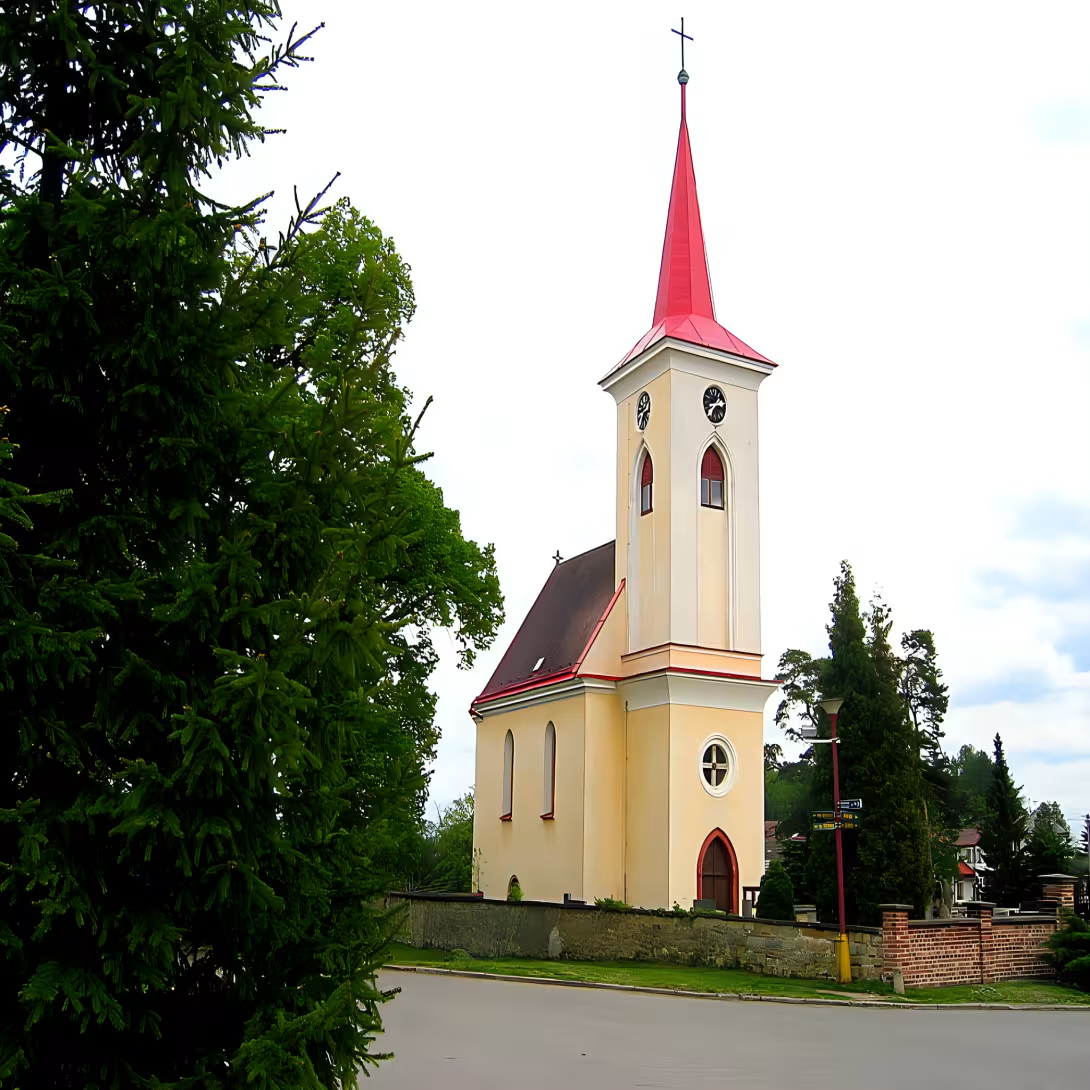
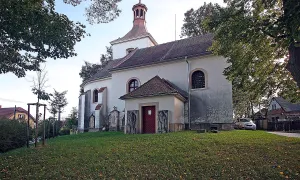
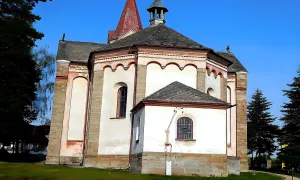
Church Transformation The Lord stands on the side of the spa town Velichovky in the local cemetery. It is a Renaissance building founded in 1616 by Hanibal of Valdštejna. The architectural design of the building is attributed to Czech-Italian architect Carl Valmadi. The construction is single-boat, smooth-edged, with a tower in the facade and sacristy attached to the priesthood in the south. The windows are clipboard and smooth palleted, the roof is made up of a valve crover covered with red etternite templates.
The tower is french and single storey with rich architectural decoration. On the west side is dominated by a late Gothic sandstone portal with a sharp shape, which includes two semi-columns with smooth heads. There is a circular window with a profile of the champagne over the portal. On the top of the tower you can see on each side a thick window with a profile champagne and a clock dial. The tower closes the tin tent.
Especially remarkable is the stone epitaph of Jan Pacalt on the outer south side of the tower. This half-life relief depicts the deceased with his family. Above the relief stands an attachment with two consoles carrying the reich, and at the top an obelisk with a sign ended by a vase. The inscription in the Czech-German language resembles Jan Pacalt of Adelschwunt, who died on 28 January 1793 at the age of 68.
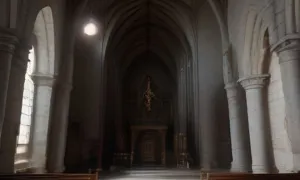
The priest shall measure 4,50 × 4,60 metres and shall be closed by five sides of the octagonal. One field of cross vaults with stucco bands on the edges is sealed. The arches are dominated by paintings: the imperial eagle with a Czech lion on its chest and the characters of the noble families of Mladoty, Berk, Vančur and Valdštejn. The ship is oblong (9,20 × 6,80 m) lit by four sharp windows and glazed with two arches. A characteristic element is a stone circle mounted on two Tuscan columns and three arches.
The interior is decorated in the second half of the 18th century in Baroque-rococo style. The main altar is a rococo with a frame and a rotating tabernacle in a tuma, at the top of which stands statues of St. Joseph and Helena. The painting part of the altar represents Christ on Mount Tabor. Two side altars with canopy decorated with angels bear images of the Virgin Mary and Ecce homo, which is based on Rubens' pattern. The Ecclesiastes with a hanging loudspeaker and the figure of Good Shepherd come from the middle of the 18th century. The organ also complements the sacral space of the rococo style.
The church presents an interesting connection of Renaissance building with later baroque-rococo decoration, which shows the continuous interest of the local community in the maintenance and artistic treatment of its sacral space.
Then and now
Drag the slider to compare how the landmark may have looked when it was built with the view today.
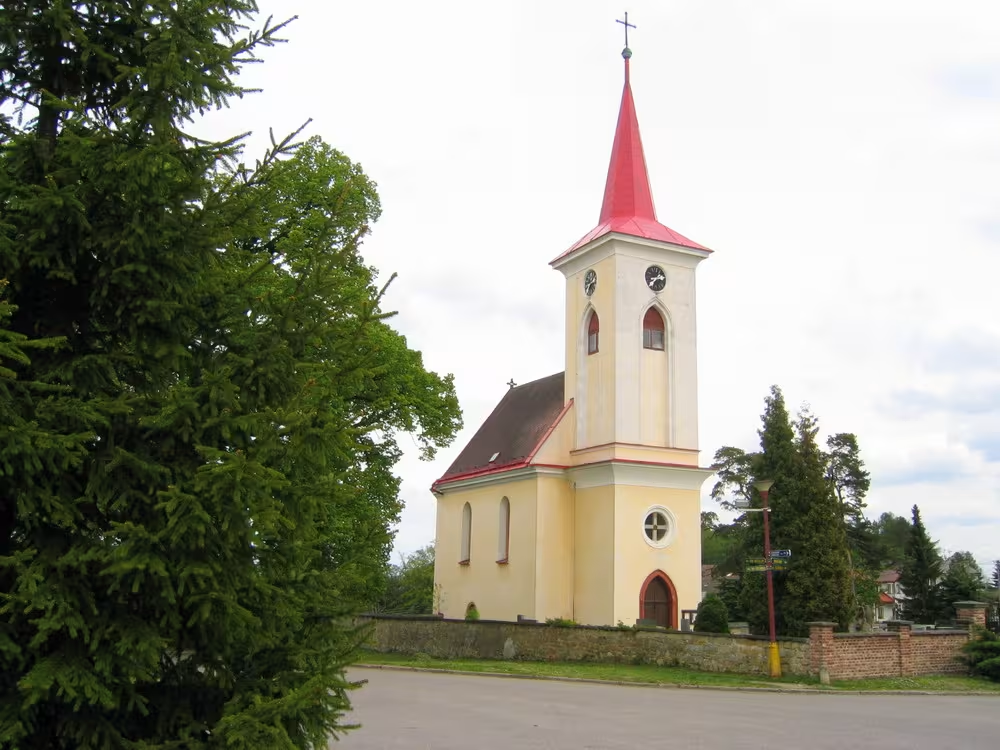

The historical appearance on the left is an AI-generated visualisation and serves as inspiration only.
Historical milestones
- 1616
- The establishment of the Church of the Transformation of the Lord Hanibal of Valdštejn as a Renaissance building.
- Around 1616-1620
- Completion of basic construction work and architectural design of Carl Valmadie.
- 1793
- Location of stone epitaph of Jan Pacalt from Adelschwunt on the church tower.
- Second half of the 18th century
- Creation of baroque-rococo interior decoration, including altars and pulpit.
- Around 1750-1770
- Complete the organ and pulpit in rococo style.
Architectural development
The church was built in 1616 in Renaissance style with later Baroque adjustments in the interior (altar, pulpit, organ) from the second half of the 18th century. The outside facade is smooth with Gothic elements (portal, windows) and a tower with stone epitaph. Jewelry are cross with stucco decoration and paintings with heraldic characters.
Historical events
- 1616
- The establishment of the church by Hanibal of Valdštejn as part of the cultural development of the region.
- 1793
- The location of Jan Pacalt's epitaph, a prominent local nobleman, on the church tower.
Owners
Hanibal z Valdštejna
Points of interest
- The church was founded in 1616 by Hanibal of Valdštejn.
- Architectural design of the church is attributed to Czech-Italian architect Carl Valmadi.
- The church tower is prismatic with a late Gothic sandstone portal and a circular window above it.
- On the outside of the tower is stone epitaph Jan Pacalt from Adelschwunt with relief and inscription in Czech-German language.
- The priestess is enshrouded by a cross vault with paintings of the imperial eagle and the characters of the noble families of Mladoty, Berk, Vančur and Valdštejn.
Guide
This guide is narrated by a synthetic voice generated by artificial intelligence.
Show guide text
This text was created by artificial intelligence and has not been editorially reviewed. It may contain inaccuracies.
The Church of the Transfiguration stands in the cemetery on a slope above the spa town of Velichovky. It was founded in 1616 by Hanibal of Valdštejn. The architectural design is attributed to the Czech-Italian architect Carlo Valmadi.
It is a Renaissance single-nave building with smooth plasterwork. A tower stands in the front facade and a sacristy adjoins the chancel from the south side. The windows are pointed, that is, terminated by a broken arch, and the church is covered with a hip roof.
The tower is prismatic, has one storey and a sheet metal pyramidal roof. A late Gothic sandstone portal leads into it from the west, also broken, with two half-columns in the jambs. Above the portal is a round window. In the storey, there is a pointed window on each side and above it is a clock face.
In a niche on the south side of the tower is a stone epitaph of Jan Pacalt of Adelschwuntu. In high relief it depicts the deceased with his family, the figures are roughly half life-size. At the top is an obelisk with a coat of arms, topped with a vase. The inscription is in German and below it is its Czech translation. It recalls that Jan Pacalt died on the twenty-eighth of January 1793 at the age of 68.
The nave is rectangular, roughly nine metres long, and vaulted with two fields of cross vaults. At the back is a stone gallery on two Tuscan columns. The entrance from the vestibule into the nave has a semicircular arch and in its corners are cherub heads. The chancel is short and is closed by five sides of an octagon. On its vault is painted the imperial eagle with a Czech lion on its breast. Around it are coats of arms of the Mladota family of Solopysk, the Berk family of Dubá, the Vančura family of Řehnice and the Valdštejn family of Kolovrat and one unidentified coat of arms.
The furnishings are mostly from the second half of the eighteenth century. The Rococo main altar has a rotating tabernacle and a painting of Christ on Mount Tabor, above which is a statue of God the Father. On the sides stand statues of Saint Joseph and Saint Helena. On the side altars are paintings of the Virgin Mary and Ecce Homo. The second of these is an old copy after Rubens. The pulpit from the mid-eighteenth century bears a relief of the prophet Jonah and on its canopy a statuette of the Good Shepherd. The church also has simple Rococo organs.
Tips for visitors
The best time to visit the Church of the Lord's Change in Velichovky is during the morning hours when light is mild and pleasant for photography. The ideal period is spring or autumn, when there is a pleasant temperature outside and the surrounding nature is full of beauty. In summer you can visit the church too, but in hot days avoid the noon hours when the inside of the building can be quite stuffy.
It is recommended to arrive by car as public transport to the municipality is not very frequent. The church is just a few minutes' walk from the centre of the spa town.
When visiting the church, take comfortable clothes and shoes because they are located on the side and the path to the church can be slightly steep. Don't forget to wear suitable clothes according to the weather as it can be cold in nature even on a sunny day.
Photography within the church is permitted, but it is appropriate to take care to respect the quiet environment and not to touch historical elements. The best places for photography are the entrance part of the church, the tower in the facade and the interior with Renaissance elements. For quality images it is ideal to use natural light during morning or afternoon hours when light falls favourably on façade and interior.
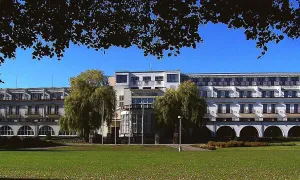
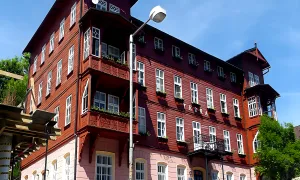
Around the church is worth visiting the spa town Velichovky with its historic spa buildings from the 19th century. These buildings are typical of their architectural style and offer the possibility of walking on picturesque streets.
For families with children, a visit to the Church of the Transformation of the Lord is interesting because of its historical importance and picturesque location over the spa town. Children can see the church interior and learn about its history. It is also advisable for children to visit spa buildings where they can observe historical architecture and perhaps learn the history of the spa.
Frequently asked questions
Can the monument be visited?
Religious buildings are usually open mainly during services; at other times a visit is normally arranged with the parish or the operator. We have not verified specific times.
Where is the monument?
Location: Velichovky, Královéhradecký kraj. The map on this page shows the exact spot.
Why is the monument protected?
It is listed in the Central List of Cultural Monuments of the Czech Republic as a cultural monument (register no. 31207/6-1911).
For kids
Imagine going back 410 years, until the Church of the Transformed Lord was still young and full of life. It was like a game where heroes and their adventures played.
At that time, the people around Velichovky lived in small villages and towns. They were farmers, shepherds or craftsmen. The village was full of life, music and singing. People gathered in markets and festels, sharing joys and worries.
Businesses nearby
Do you run a restaurant, accommodation, shop, museum, rental, wellness or other visitor service near this monument? Show yourself directly to the people heading to it — this is how they will see you in the app and on the web:
Events nearby
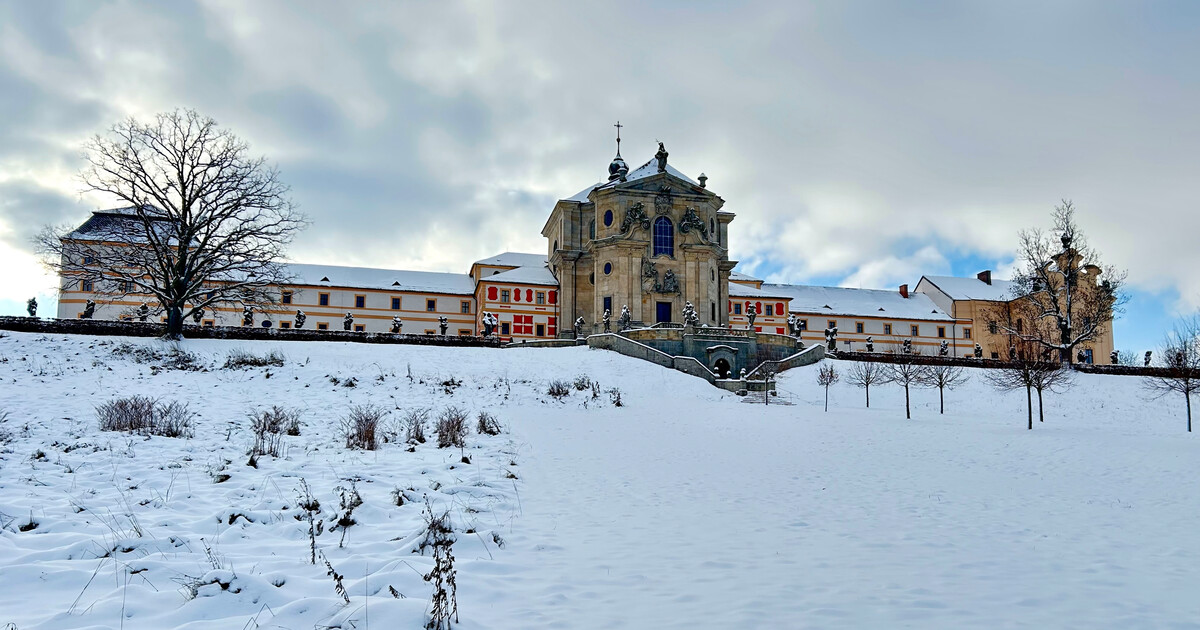
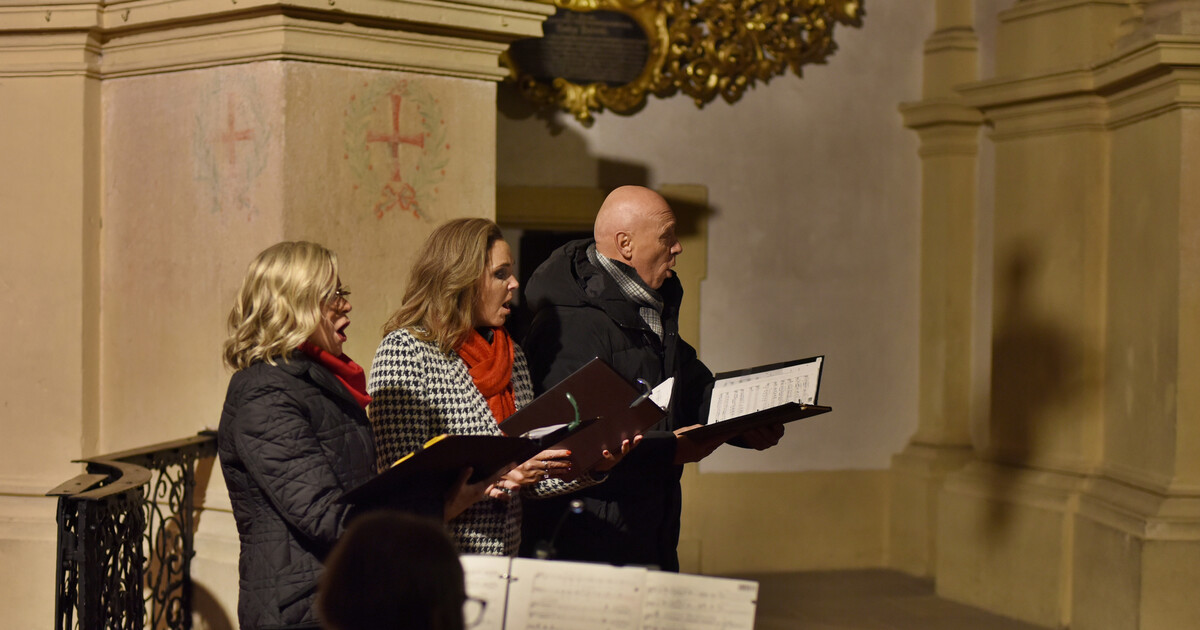
Zdroj akcí: otevřená data měst a obcí ČR (Národní katalog otevřených dat) a kalendář akcí Národního památkového ústavu.
Nearby
- The church is situated on the side of the spa area with historical spa buildings from the 19th century.
- Natural reservation with beech forests and rock formations, about 3 km south-east.
Accommodation nearby
Themed route
Thematic cruise route: Historical and natural beauty Velichovek
1.Kostel Proměnění Páně (Velichovky) * Type: Sacral landmark * A unique church in a neo-gothic style with rich decoration and picturesque location on the side. Its architecture and quiet surroundings offer not only spiritual but also photographic atmosphere.
2. Spa Town Velichovky * Type: Historical development * A walk between well-preserved 19th century spa buildings will reveal a period atmosphere. The town served as a spa centre whose monuments still show its importance.
3. National Nature Reservation Bouda * Type: Protected nature * Beech forests and rock formations of the reservation attract tourism and nature observation. The journey here is short, but the reward is untouched landscapes with rich fauna and flora.
* The route is closed, the return to Velichovka is the same way. *
Seasonal recommendations
Spring The Spring in the Church of the Transformation of the Lord offers a unique atmosphere, where the interior is filled with a wave light through blooming trees and field flowers that surround the area. Sun rays penetrate through the church windows and create fine shadows on the stone walls that highlight detailed carvings and frescoes. Nature is awakening to life - meadows are green, birds are echoing in the woods and the air smells of wet ground and first flowers. In this period the church is surrounded by a fine, almost magical light that creates contrast with dark stone elements. The ideal time for a visit is in the morning when it is still cold and the crowds are less. Light clothing is recommended, but also prepare a coat for possible rain that is not unusual in spring months. If you want to enjoy peace, avoid weekends and especially St. Catherine's Day, where there are smaller pilgrims in the area.
Summer Summer brings hot, sunny days to the Church of the Lord, when its stone walls become pleasantly warm to touch. The sun shines directly into the interior, illuminates the stained glass and creates a playing game of light and shadows on the floor. The church's surroundings are turned into a green oasis, where fields, forests and pastures are decomposed to attract walks. The atmosphere is lively and full of sounds - the roaring of leaves, the singing of onions and the distant sounds of nature. In the main summer season, however, larger crowds are needed, especially in the morning when families and children come here. The best time to visit is early morning or in the afternoon when the heat is milder. Light, airy clothes are recommended, but don't forget the hat or sunglasses because the sun can be very intense here. For visiting with children it is advisable to bring a drink and perhaps a shading tarp if you choose to walk around the church.
Autumn Autumn visit to the Church of the Transformation of the Lord is like traveling to another world, when golden and red shades of leaves come into the interior, which converge at the entrance and window parapets. The sun is no longer so intense, but its rays are reflected from fallen leaves and create fine, golden reflections on the stone walls. The atmosphere is calm and reflexible, as time slowly stands. Nature changes around here - trees dress up in coloured clothing, fields become golden seas, and air smells of burnt leaves and first rains. In this period the church is surrounded by a quiet, almost meditative environment that is ideal for relaxation and contemplation. It is advisable to plan the visit for late afternoon, when the light is the softest and the crowds are less. It is recommended to wear warmer clothes because autumn days can be cold, and don't forget to take an umbrella because the rains are frequent in this period. If you want to experience a real autumn atmosphere, avoid weekends where there are often smaller events associated with harvests or handcuffs.
Winter Winter visit to the Church of the Transformation of the Lord offers a unique atmosphere where the interior of the wave shadows and light from small, dark window holes, which are often covered by snow. Outside the church there is a white landscape where snowflakes settle on stone elements and form fine, crystalline formations. The atmosphere is calm and quiet, as if time stood still. In advent time, Christmas spirit waves into the church when Christmas decorations are lit up in the surroundings and people come here to rest and pray. It is recommended that warm, layered clothes, because outside can be very cold, and remember to wear warm gloves and hat. The best time to visit is early morning or in the afternoon, when there are fewer crowds outside and the light is the softest. If you want to experience a real winter atmosphere, go visit St. Lucia's Day or before Christmas when the church is often lit and decorated.
Visualizations and artistic views


The visualisations are generated by artificial intelligence and serve as inspiration.
Photos from the area
Real photos taken near the monument


Zdroj a licence jsou uvedeny u každého snímku.
Atmosphere of the place
This atmospheric visualisation of the place and period was generated by artificial intelligence. It is not real footage of the location.
Tips from visitors
No tips yet. Be the first!
Log in and add your tip.
Sources and literature
Photos: Karpac at Czech Wikipedia (Original text: Karpac) / CC BY-SA 3.0, rozlišení zvýšeno umělou inteligencí — Wikimedia Commons. The author and licence also appear when you hover over the image.
Faktickým podkladem tohoto textu byl článek na Wikipedii, jehož autory jsou přispěvatelé Wikipedie. Článek je dostupný pod licencí CC BY-SA 4.0.
Location on the map
Příběhy a pověsti
Legendy, pověsti a příběhy spjaté s touto památkou
Fotografie návštěvníků
Zatím žádné fotografie. Buďte první, kdo přidá fotografii z návštěvy!
Log in a přidejte svou fotografii nebo hodnoťte.
Za ověřenou návštěvu v aplikaci získáte víc bodů — poznáme podle GPS, že jste na místě.
Reviews and comments