



Kostel svatého Jakuba Staršího (Želnava) Church
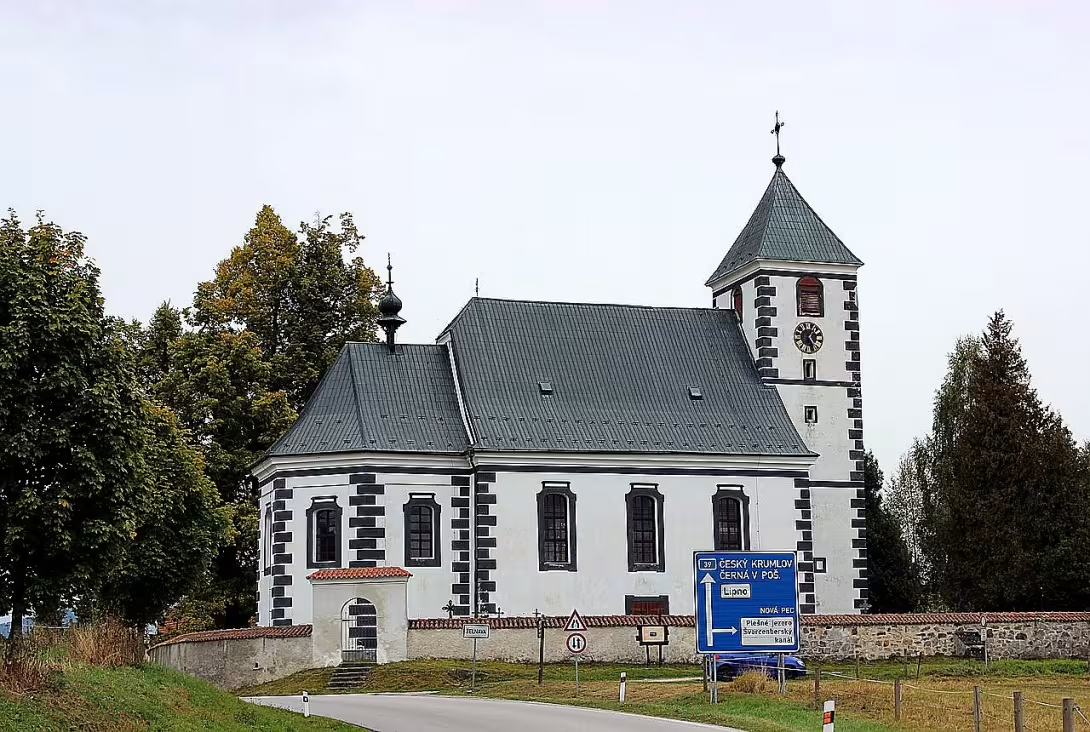
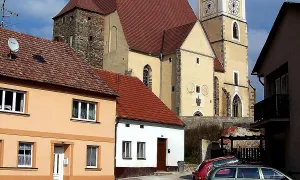
The church of St. James the Elder is an oriented one-ship building with a five-sided presbytery, which is explained by its architectural layers about its long history. The first written mention of the church dates back to 1395, when Želnava, after a protracted dispute with the Vyšehrad Probostna, was returned to the property of the Golden Horus monastery. Only the lower part of the church tower is probably preserved from this Gothic period - the remaining elements are the result of subsequent repairs and reconstructions.
The gradual changes reflected the changing needs of the parish. In 1686, sacristy was added to the presbytery and two years later the tower was first increased. However, the biggest change was brought about by the years 1708 to 1712, when the church was expanded baroque and significantly rebuilt. The builder kept the original available, but increased the windows and increased the tower again. The new construction was consecrated on 19 February 1713 by the Czech Krumlov prelate Siegmund Hübner. In 1772 the tower reached a further increase while in the 19th century maintenance interventions were carried out - in 1892 the ceiling of the ship and the roof was repaired, the church was drained, and in 1902 the stairs to the second empire were built in the tower.
The construction features architectural simplicity in exterior and interior. The boat is 14.3 metres long and 11 metres high, with a flat ceiling decorated with stucco. The preservation of the wooden bark, which carries two wooden columns and which is rare in such preserved condition, is exceptional. The presbytery is a well-arched building with sections, and the sacristy has a cross arch. The façades remained simple and smooth, decorated only by a corner of a color highlighted by the brass.
The church's inner furnishings tell us about its historical wealth. The main altar of St. James dates back to 1724, its columns with windstorm-shrouded sticks are characteristic elements of the portal architecture. In the presbytery there are the opposite statues of St. Peter and Paul, which are torsions of twelve statues of apostles from the second half of the 17th century. The north altar contains a copy of the late-looking Madonna from the second quarter of the 15th century. Exceptional is a gothic panel painting called The Kneeling of the Kings of Želnavsko from around 1420, which is now located in the National Gallery in Prague. The Granite Baptist from 1723 has a carved wooden lid, the pulpit is decorated with paintings of Western church fathers. Of the four bells mentioned in 1918, only one of the years 1624 or 1644 survived since Heinrich Ableitner of Pasov. The organ installed in 1811 replaced the tool older from 1727.
The church also has a cemetery surrounded by a wall. Since 1981, it has gradually transformed into a unique collection of artistic secular cast iron. More than two hundred cast iron crosses and plastic were preserved and supplemented with additional pieces from nearby cemeteries. This project, which was born in the early 1980s, could have been implemented here, in the place where the original villagers were displaced after 1945, and which gradually became a collection of semамятки stone craft.
Then and now
Drag the slider to compare how the landmark may have looked when it was built with the view today.
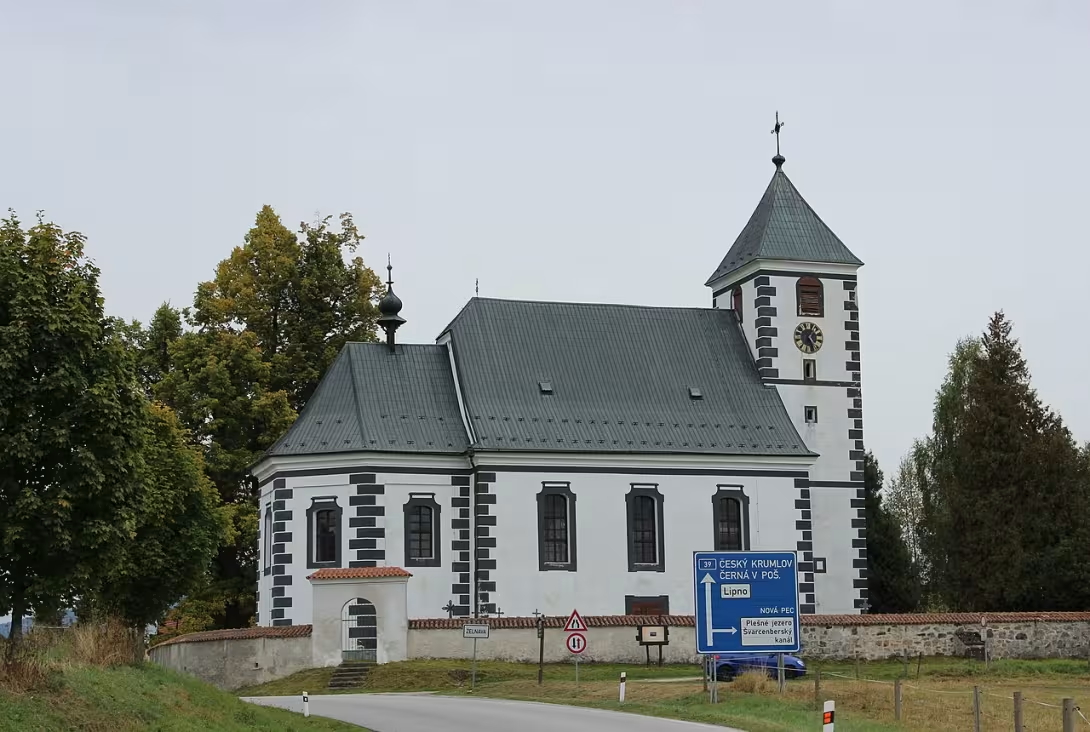

The historical appearance on the left is an AI-generated visualisation and serves as inspiration only.
Historical milestones
- 1395
- The first written mention of the church in connection with the property dispute of Vysehrad and the golden monastery.
- 1686
- Adding the sacristy and the first tower increase.
- 1713
- The consecration of the baroque rebuilt church by Siegmund Hübner.
- 1772
- Another tower increase.
- 1892
- Fixing the ceiling of the ship, the roof and the drainage of the church.
- 1918
- The mention of four bells, only one of which was preserved in 1624 / 1644.
Architectural development
The original Gothic church from the 14th-15th century was preserved only in the lower part of the tower. In 1686-1688 the sacristy was added and the tower increased. During the years 1708-1712, extensive Baroque reconstruction took place while maintaining the layout elements, including window enlargement and tower increase. In the 19th century the ceilings and roof were repaired, in 1892 the church was drained and the steps to the empore were built in the tower.
Historical events
- 1395
- The first written mention of the church in connection with the return of the Želnava to the property of the Golden Monastery after the dispute with Vysehrad.
- 1713
- The consecration of the baroque rebuilt church by Siegmund Hübner.
- 1981
- The start of the project to transform the cemetery into a collection of artistic secular cast iron.
Points of interest
- The church of St. Jacob the Elder is an oriented one-ship building with a five-sided presbytery, whose architectural layers reveal a long history from the Gothic period.
- The first written mention of the church dates back to 1395, when the Želnava was returned to the property of the golden monastery after a dispute with the Vyšehrad Provost.
- Only the lower part of the church tower is probably preserved from the Gothic period, the rest is the result of subsequent repairs.
- The church underwent Baroque reconstruction between 1708 and 1712, when it was extended and the tower increased, while the original disposition was preserved.
- In the interior there was a rare storey wooden bark with two wooden columns, which is very rare in such preserved condition.
- In the cemetery of the church there is a unique collection of artistic secular cast iron which was created after the displacement of the original population after 1945.
Guide
This guide is narrated by a synthetic voice generated by artificial intelligence.
Show guide text
This text was created by artificial intelligence and has not been editorially reviewed. It may contain inaccuracies.
The Church of Saint James the Greater in Želnava is an originally Gothic structure that was significantly remodeled during the Baroque period. Today it serves as a branch church of the Roman Catholic parish of Volary. Until the end of 2019, it was the parish church of Želnava parish, which subsequently ceased to exist. The cemetery enclosed by a boundary wall is also designated as a cultural monument.
The first written mention of the church dates back to 1395. At that time, Želnava returned to the property of the Zlatá Koruna monastery after a prolonged dispute with the Vyšehrad provostry. From the Gothic church, apparently only the lower part of the tower was preserved. In 1686, a sacristy was added, and two years later the tower was heightened. The main reconstruction took place between 1708 and 1712. The church was enlarged, the windows enlarged, and the tower heightened again, though the original layout remained. The new construction was consecrated on February 19, 1713 by Siegmund Hübner, prelate of Český Krumlov. The tower was heightened once more in 1772.
It is an oriented single-nave structure with a pentagonal choir. A prismatic tower rises before the western façade, a sacristy and small vestibule adjoin the south side. The nave is 14.3 meters long and 11 meters wide. It has a flat ceiling with a stucco mirror. In its western section, a rare two-story wooden gallery carried by two wooden columns has been preserved. The façades are smooth, decorated only by color-highlighted rustication at the corners.
The main altar of Saint James with columns featuring twisted shafts dates from 1724. The statues of Saint Peter and Paul in the choir remain from the original twelve apostle statues from the second half of the seventeenth century. From the same period comes the pulpit with images of Western Church Fathers. A granite baptismal font with an elaborately carved wooden lid bears the date 1723. The church also contains a Gothic panel painting of the Adoration of the Magi from Želnava from around 1420. Today it is housed in the National Gallery in Prague. Of four bells mentioned in 1918, only one survives, cast by the Passau bell founder Heinrich Ableitner. The organ by Franz Jentschke dates from 1811.
The original inhabitants of Želnava were expelled after 1945, and the cemetery ceased to be maintained. In the early eighties of the twentieth century, the idea arose to transform one country cemetery into a collection of artistic cast iron tombstones. Želnava was chosen, where there were over two hundred cast iron crosses and sculptures. Since 1981, specialists have conserved them and supplemented the collection with cast iron brought from surrounding cemeteries.
Tips for visitors
The best time to visit St. Jacob the Elder's church is during the morning hours when the sun is favourably illuminated by the facade and interior. The Baroque details and Gothic elements work best in mild light, which is typical of the time around nine in the morning. In summer it is advisable to avoid the noon hours when the church can be too hot in the interior. If you want to experience a quiet atmosphere without crowds, visit the church on Monday or in time outside the main tourist season.
It is recommended to use public transport if you come from larger cities. Find out the current connection in the traffic search engine.
Take comfortable clothes and shoes when visiting the church because it is a historic building with stone steps and uneven surface. It may be cold in the interior, so bring a light sweater or sweater. For convenience, you can also take a small towel or cloth to clean your shoes if there is a tile in the church that can be wet. Also remember your mobile phone with sufficient charge for shooting.
The most suitable places for photography are the exterior facade of the church, especially in the morning or afternoon light, when the golden colors of baroque elements are reflected. In the interior is the most interesting presbytery with its five-sided finish and original Gothic part of the tower. Please know that in some historical churches there are restrictions on professional cameras, so be sure to check with staff before starting photography. The best light for detailed images is in the morning or shortly before sunset.
This location offers picturesque forest trails and picturesque watercourses, ideal for a short walk or picnic. Another interesting thing is the historical core of Volary, which is approximately five kilometres away. Here you will find baroque and classicist buildings that are typical of the architecture of this area. It is also advisable for nature lovers to visit the surrounding forests and mountain masses of Šumava.
For families with children, a visit to St. Jacob's Elder church is a great opportunity to get acquainted with historical monuments. Children can see the Gothic architecture and baroque modifications that fascinate them. In the vicinity of the church you can play in the open area or take a walk along the surrounding roads. It is also interesting for children to visit Volary and see historical buildings there.
Frequently asked questions
Can the monument be visited?
Religious buildings are usually open mainly during services; at other times a visit is normally arranged with the parish or the operator. We have not verified specific times.
Where is the monument?
Location: Želnava, Jihočeský kraj. The map on this page shows the exact spot.
Why is the monument protected?
It is listed in the Central List of Cultural Monuments of the Czech Republic as a cultural monument (register no. 41672/3-3936).
For kids
Imagine going back to the past, when the village Želnava was still a young town. The church of St. Jacob the Elder was still Gothic and its surroundings were full of life.
Who lived here? Fishermen who farm nearby ponds, livestock farmers who pasture their herds in fields. The city Želnava was the centre of the area and many people came here to trade or visit local markets.
Businesses nearby
Do you run a restaurant, accommodation, shop, museum, rental, wellness or other visitor service near this monument? Show yourself directly to the people heading to it — this is how they will see you in the app and on the web:
Accommodation nearby
Trips and activities nearby
Guided tours, tickets and activities nearby from GetYourGuide
Affiliate link: if you buy from the partner, we may receive a commission. The price for you does not change.
Search tours and activities →Themed route
Thematic cruise route from the Turtle
1.Kostel svatého Jakuba Staršího (Želnava) * Type: * Historical landmark This church is the oldest building work of the village, which dates back to the 13th century. It is a leading example of Gothic architecture in the region and offers visitors a view of the rich history of the local church.
2. Natural Reservation * Devil's Mill * * Type: * Natural landmark This reservation is famous for its unique landscape beauty and nature. It is an ideal place to relax and explore the wild, with the possibility of walking between the forests and the mountain masses of Šumava.
3. The historical core of the village Volary * Type: * Historical location The core of Volary is rich in baroque and classical architecture, which attracts visitors with its beauty and historical significance. Explore the streets with historic houses and explore the most famous sights of the city.
This route offers visitors the opportunity to become acquainted with the rich history and natural beauty of the region of South Bohemia.
Seasonal recommendations
Spring: In the spring period, the church of St. James the Elder in Želnava lights up with sunlight, which shines on the red-brown facade and adds a wonderful shiny effect to the space. Green leaves of ancient trees around the church offer a cosy and lively atmosphere that is ideal for relaxing walks around. Visitors are advised to wear clothes suitable for mild temperatures because in the morning they can be colder and during the day the temperature usually rises. It is best to come at an early afternoon time when the crowds are the least intense and can enjoy a quiet viewing of the church.
Summer: Summer offers long sunny days with warm nights, which provides ideal conditions for visiting St. Jacob the Elder's church. The sun illuminates architectural details and creates an attractive contrast with the green vegetation of the surrounding fields. In the main summer season it is recommended to visit the memory of the previous afternoon in order to avoid the biggest crowds and enjoy quieter moments. Don't forget the protective sunglasses and plenty of drinking water, because the temperature can be considerable.
Autumn: In autumn the church of St. Jacob the Elder is transformed into a colored kaleidoscope. Leaves of trees go into hot colors that give space a romantic and cozy atmosphere. Due to the smaller number of visitors, this time is ideal for peaceful viewing of the sights without stress from crowd pressure. Visitors are advised to wear warmer clothes because autumn weather can be variable and colder day and night. It is best to visit the church in the early afternoon time, when the sun's rays shine on shiny leaves of trees.
Winter: Winter brings a calm and quiet atmosphere to the church of St. James the Elder. The sun illuminates the snowy landscape around the monument, creating views full of mild calm. Visitors are advised to wear warm clothes and protective shoes because winter weather can be cold and wet. The church may have shorter opening times, so it is advisable to inform about the exact times before the visit. It is best to visit the memory at noon, when the sunlight can illuminate and warm the space a little more, allowing you to enjoy a quiet moment without the risk of cold.
Visualizations and artistic views


The visualisations are generated by artificial intelligence and serve as inspiration.
Photos from the area
Real photos taken near the monument


Zdroj a licence jsou uvedeny u každého snímku.
Atmosphere of the place
This atmospheric visualisation of the place and period was generated by artificial intelligence. It is not real footage of the location.
Tips from visitors
No tips yet. Be the first!
Log in and add your tip.
Sources and literature
Photos: Richenza / CC BY-SA 3.0 — Wikimedia Commons. The author and licence also appear when you hover over the image.
Faktickým podkladem tohoto textu byl článek na Wikipedii, jehož autory jsou přispěvatelé Wikipedie. Článek je dostupný pod licencí CC BY-SA 4.0.
Location on the map



Příběhy a pověsti
Legendy, pověsti a příběhy spjaté s touto památkou
Fotografie návštěvníků
Zatím žádné fotografie. Buďte první, kdo přidá fotografii z návštěvy!
Log in a přidejte svou fotografii nebo hodnoťte.
Za ověřenou návštěvu v aplikaci získáte víc bodů — poznáme podle GPS, že jste na místě.
Reviews and comments