



Kostel svatého Jiljí (Budislavice) Church
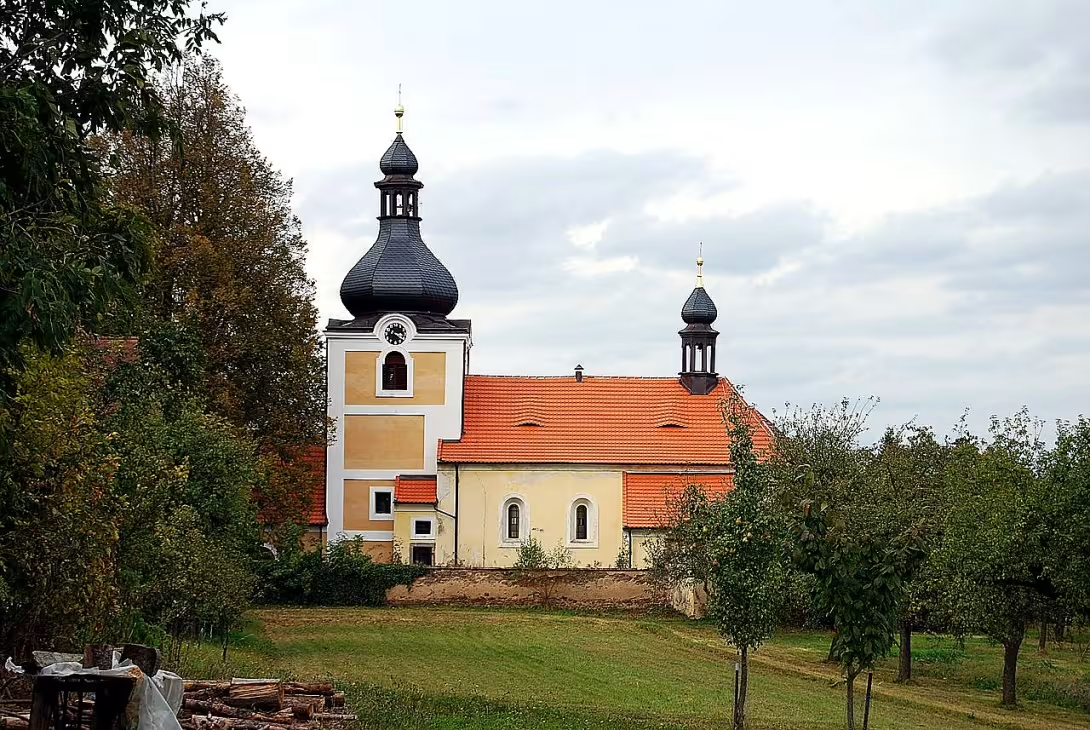
Holy Church Jilji stands in the southern part of the village Budislavice, which is part of the village Young Smolivec in the district Plzeň-jih. It is a filial church of the Roman Catholic parish Kasejovice, protected as a cultural monument. It is located at the highest point in the local territory, in a relatively flat terrain where it forms an architectural dominant landscape.
The construction dates back to the end of the 13th century. Its founder was a younger branch of the Czech House of Buzice, owners of adjacent estates. A member of this family named Budislav received Tremshín and the territory west of it. The church became parochial in 1365, and since 1370 the sons of Philip and Jaroslav represented it as patrons. During its duration, the construction has undergone several substantial architectural changes. The most significant was the Baroque reconstruction carried out between 1723 and 1726 by the builder Jan Václav Vančura of Řehnic. Another major adjustment took place in 1797 and then again in the second half of the 19th century. From 1747 to 1924, it was patronized by the Prague Grand Priory of the Order of Maltese Knights, which held property with extensive field and forest land. During its existence the object burned down several times; a significant fire was detected in 1791. Restaurant works took place between 1913 and 1914. The First World War had a major impact - the church was consected in 1921. The parish gradually increased its importance: plebania was documented in 1356, but promotion to the deanery took place only in 1897. The matrices have been kept since 1646.
From an architectural point of view, the church is made up of a rectangular boat and a tripod closed by a priesthood. There's a sacristy on his east side. The presbytery is a glass with a gothic beam that resembles the original gothic concept of the construction. During the Baroque reconstruction, the church acquired typical elements of this style - richly decorated altar, stucco decoration and characteristic shaping of windows and portals. The western facade is decorated with a tower with onion fighting and a hall from 1723. Near the church stands a classicist parish from the supposed first half of the 19th century, which with the temple forms a harmonious architectural whole.
Out of the three original bells, only the bell from 1550 was preserved, created by Pilsen bell maker Nicholas Konvář. The remaining bells were restored during the First World War for military purposes. In front of the church stands a memorial cross from 1851 with a decorated plinth. In the interior, the church keeps the Rococo main altar from the second half of the 18th century with a picture from Prague artist Josef Scheiwl from 1859. The artistic painting of the Virgin Mary Rosary was painted by Josef Mathauser in 1904. The organ was built in 1866 by organist Johann Fischer of Susice.
At present, church services are held only once a month. The parish is managed by ex currendo of Kasejovice under the Archdekony of Nepomuk, which falls under the Czech Budejovice diocese.
Then and now
Drag the slider to compare how the landmark may have looked when it was built with the view today.
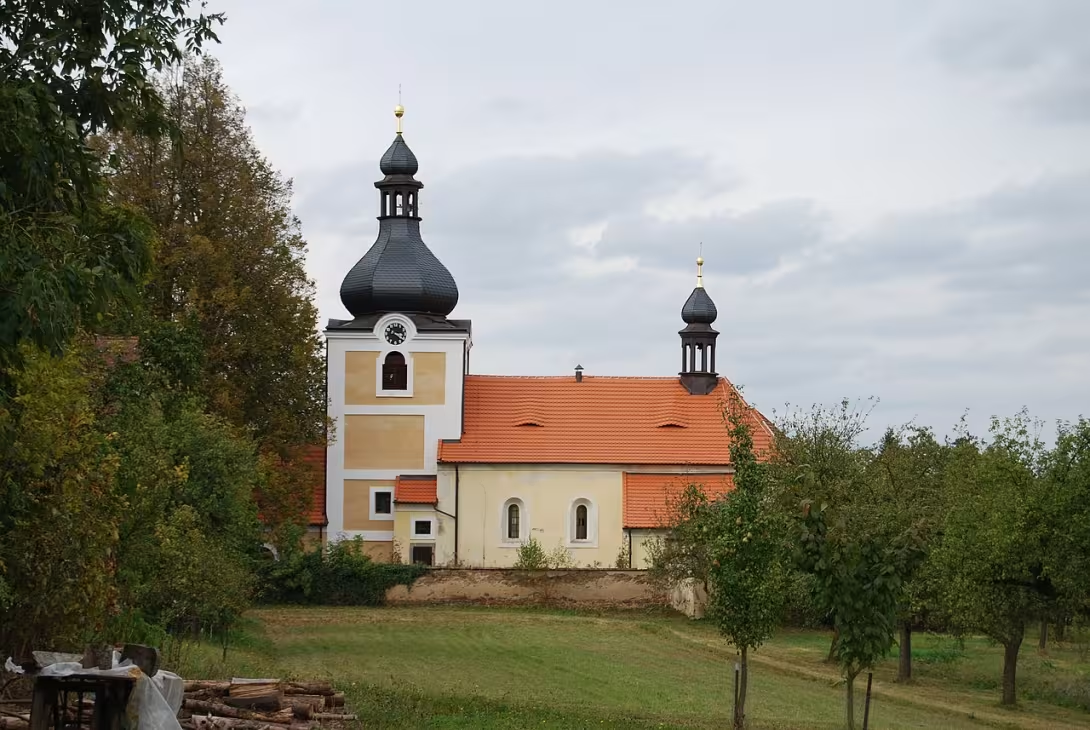
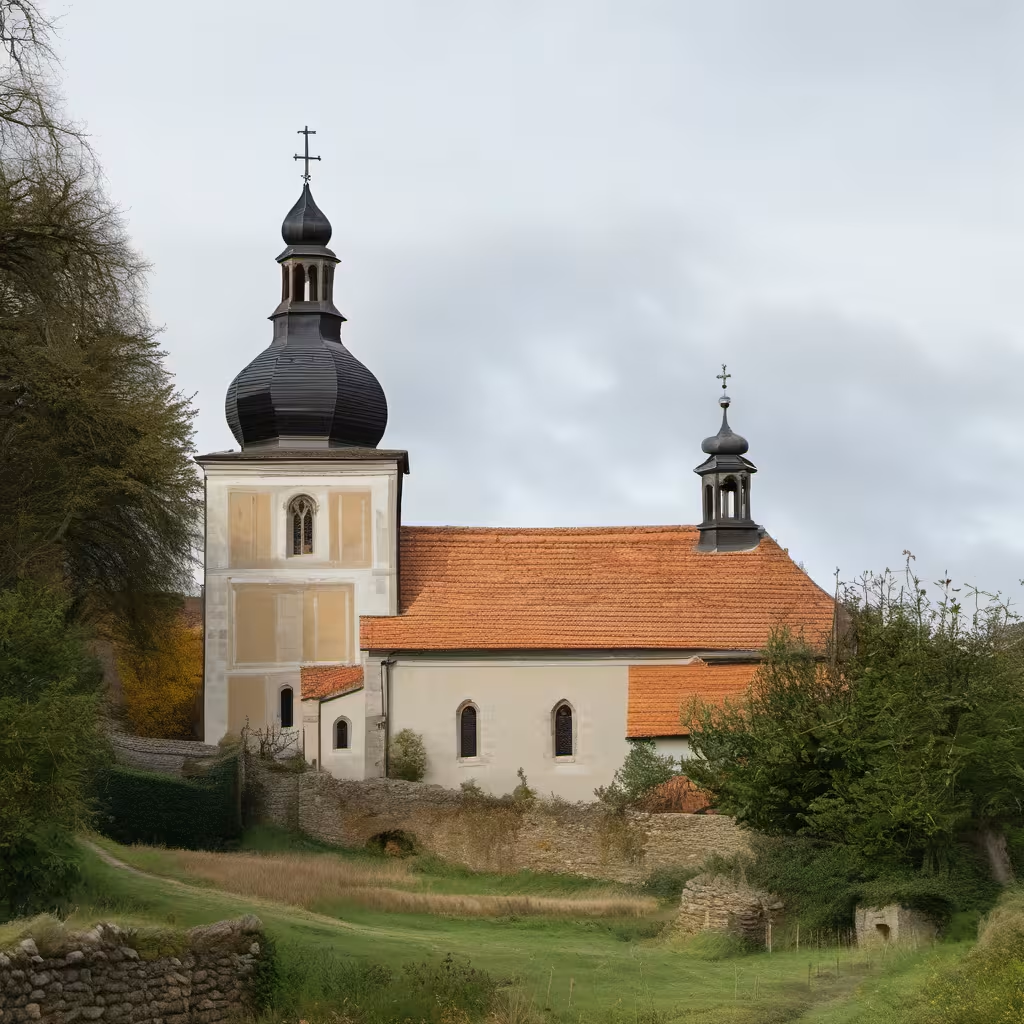
The historical appearance on the left is an AI-generated visualisation and serves as inspiration only.
Historical milestones
- 1264
- Establishing the church in an early Gothic style at the command of the House of Buzice
- 1356
- Findings of plebania (Lower Parish Office)
- 1723-1726
- Baroque reconstruction under the leadership of Jan Václav Vančura from Řehnic
- 1897
- Parish promotion to the dean
Architectural development
The original early Gothic building from the end of the 13th century had a simple rectangular ship and a radiant vault in the presbytery. In 1723-1726, a Baroque reconstruction took place, which brought a new tower with onion-shaped dancing, hall and rich stucco decoration. There were minor modifications in the 19th century, including classical reconstruction of the rectory. The original building elements have been preserved by the Gothic vaults and some Gothic elements in the construction.
Historical events
- 1264
- Establishing an original early Gothic church at the command of members of the House of Buzice
- 1365
- The church became parochial, patronage won by the sons of Budislav - Philip and Jaroslav
- 1791
- A devastating fire that damaged part of the interior and exterior
- 1921
- Consecration of church after postponement caused by the First World War
Owners
1365-1924 – The Prague Grand Priory of the Order of Maltese Knights (except for the period when the church was held by local patrons of the House of Buzic); since 1924 – The Roman Catholic Church (České Budějovice Diocese, Archdeacon of Nepomuk).
Points of interest
- The church of St. Gilji was built at the end of the 13th century as a parish church of the younger branches of the House of Buzice, who owned the estate.
- In 1365 he became a parish church and since 1370 he was represented as patrons by the sons of Budislav, Philip and Jaroslav.
- The building underwent Baroque reconstruction between 1723 and 1726 to order the Prague Grand Priory of Maltese Knights, which held the property from 1747 to 1924.
- The church burned down in 1791 and other major modifications took place in 1797 and in the second half of the 19th century.
- The only preserved bell is the bell from 1550 from Pilsen's bell man Nicholas Konvář, the other two were recited during the First World War.
Guide
This guide is narrated by a synthetic voice generated by artificial intelligence.
Show guide text
This text was created by artificial intelligence and has not been editorially reviewed. It may contain inaccuracies.
The Church of Saint Giles stands in the southern part of Budislavice, at the highest point of the village, in relatively flat terrain. Budislavice belongs to the municipality of Mladý Smolivec in the Plzeň region. The church is a branch church, falls under the parish of Kasejovice, and is protected as a cultural monument.
Originally it was an early Gothic single-nave church, whose construction is dated to the year 1264, thus to the thirteenth century. It was founded by members of the younger branch of the Buzic family, who had seats in Blatná, in Březnice, and in Rožmitál. One of them, Budislav, acquired Třemšín and the region to the west of it. His sons Filip and Jaroslav are mentioned in the year 1370 as patrons of this church. A lower parish office, or pleban's office, is documented here as early as 1356, and in 1365 the church became a parish church. The parish was elevated to a deanery only in 1897. Parish records have been kept here since 1646.
The church burned down several times over the centuries, with a major fire recorded in 1791. Between 1723 and 1726, it was rebuilt in the Baroque style by Jan Václav Vančura from Řehnice. Another renovation came in 1797, and alterations continued in the second half of the nineteenth century. From 1747 to 1924, the church's patrons were the Knights of Malta. Their Prague Grand Priory held the local and surrounding estates until the land reform of the First Republic. In 1913 and 1914, the church was restored, but due to the First World War it was not consecrated until 1921.
The structure consists of a rectangular nave and an equally wide choir, closed off on three sides. The choir has a Gothic fan vault. A sacristy adjoins it on the east, and on the west stands a tower with an onion-shaped cupola and a vestibule from 1723.
The main altar is Rococo, dating from the second half of the eighteenth century, and bears a painting by the Prague painter Josef Scheiwal from 1859. A votive painting of Our Lady of the Rosary was painted in 1904 by Josef Mathauser. The organ was built in 1866 by organ builder Johann Fischpera from Sušice. Of the three bells, only one remains, cast in 1550 by the Plzeň bell founder Mikuláš Konvář. The other bells were confiscated during the First World War for military purposes.
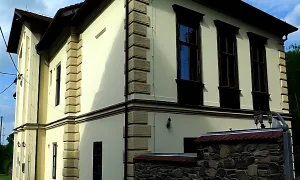
Right next to the church stands a classicist rectory, probably built in the first half of the nineteenth century. It has a symmetrical façade and a triangular gable and forms one unit with the church. In front of the church stands a commemorative cross from 1851 on a decorated base.
Tips for visitors
The best time to visit the church of St. Gilji is in the morning or early afternoon. In these times it is quiet in the church and you can see the interior without disturbing crowd. If you want to avoid rain, travel in the summer months when the weather is most stable. Early Gothic architecture and historical elements in the interior are then best visible in the pleasant light that penetrates the windows of the church.
It is recommended to use public transport when a connection to Budislavice is available. Check the current connection and time schedules in the traffic search engine.
When visiting the church, wear comfortable clothes and shoes as it is a historic building with a stone base that can be cold even in the summer months. It is often cold in the interior, so bring a light sweater or sweater. Children can take a small laptop or drawing block to draw or note something during the visit.
For photography is the most suitable place in front of the church where it is well lit and you can capture a general view of the building. In the interior there is the most beautiful light in the morning, when the sun's rays illuminate the stained glass and historical elements. If you want to photograph detailed parts such as Gothic vaults or stone statues, use natural light from windows. Remember, there are rules about photography in the church, so check with the staff in advance.
In the vicinity of the church of St. Jilje, it is worth visiting a classicist rectory which forms an architectural complex with a church. It is built probably in the first half of the 19th century and offers an interesting view of historical architecture. Near the church there is also a memorial cross from 1851, which stands in front of the church and is decorated with a plinth with relief. This cross is an ideal stop for a short walk and rest.
For families with children, a visit to the church of St. Gilji is an excellent opportunity to learn about history and architecture. Children can look at Gothic elements such as arches and stone statues, and find out what the construction looked like hundreds of years ago. There is also enough space around the church for a short walk and a game. If you are interested in nature, you can go on a short journey to the nearby forest, located around the village.
Frequently asked questions
Can the monument be visited?
Religious buildings are usually open mainly during services; at other times a visit is normally arranged with the parish or the operator. We have not verified specific times.
Where is the monument?
Location: Budislavice, Plzeňský kraj. The map on this page shows the exact spot.
Why is the monument protected?
It is listed in the Central List of Cultural Monuments of the Czech Republic as a cultural monument (register no. 25564/4-369).
For kids
Imagine coming back 676 years, until the church of St. Gilya was still young and beautiful in Budislavice. It's like there's some amazing adventure going on!
At that time, there were people who were passionate about agriculture, business and God. The church was their sanctuary, where religious ceremonies took place and where people from the neighborhood met.
Businesses nearby
Do you run a restaurant, accommodation, shop, museum, rental, wellness or other visitor service near this monument? Show yourself directly to the people heading to it — this is how they will see you in the app and on the web:
Accommodation nearby
Themed route
Thematic cruise route Budislavice
1.Kostel svatého Jiljí (Budislavice) * Type: * Historical landmark * Why is it worth visiting: * This Baroque church is not only the spiritual centre of the village, but also an architectural and historical miracle. Its richly decorated interior and distinctive tower are an attraction for lovers of history and art.
2. Classicist rectory * Type: * Architectural landmark * Why is it worth a visit: * Fara, built probably in the first half of the 19th century, forms a harmonious architectural complex with the church of St. Jilje. It is an example of classical architecture and its history is closely linked to the spiritual life of the village.
3. Memorial Cross from 1851 * Type: * Historical memorial * Why is it worth visiting: * This memorial cross, located in front of the church, is decorated with a plinth with relief. It's an important place to understand local history and traditions. Its inscription and location offer insight into the past of the village.
4. Landscape of Tremshín * Type: * Natural landscape * Why is it worth exploring: * Although it is outside the direct surroundings of the church, the beautiful landscape with forests and field corners offers peaceful moments for relaxation. It was held by the House of Buzice and its history is rooted in local traditions, which brings an interesting cultural context.
This route offers a combination of spiritual enrichment, architectural amazement and natural tranquility, making it ideal for visitors seeking deeper knowledge of local history and culture.
Seasonal recommendations
Spring: In the spring season, the church of St. Jilje in Budislavice shows itself in a generally green breath when flowering shrubs and trees celebrate the arrival of heat. The sun reflects its rays on the plaster of the church, creating nicely scattered patterns. At this time the atmosphere is calm and friendly, ideal for a relaxed visit without excessive crowds. It is recommended to visit at dawn or late afternoon when the temperature is moderate and the sun is still present, but not too strong. Good clothes for this season are light clothes or jackets with ties that allow you to relax in warm days and protect against cold wounds.
Summer: In the summer period the church of St. Jilje is a shining place to visit when the sun is high above the head and illuminates every detail of architecture. Nature is at the top of its beauty, with fully developed trees providing a natural shading zone. The atmosphere is lively and visitors often use this place for quiet moments or photographs. It is advisable to visit the early afternoon to avoid the midday heat and great crowds. Don't forget the sunglasses, the protective tie and enough drinking water.
Autumn: In the autumn season, the church of St. Jilje is surrounded by a colorful palette of falling leaves, which adds a romantic touch to the place. The sun is becoming milder and long wests create beautiful light effects on the facades of buildings. The atmosphere is calm, which makes this time ideal for visiting without worrying about the excessive rest of people. The best time to visit is in the afternoon, when the temperature starts to cool and the sunlight creates comfortable conditions. It is recommended to wear top clothes with a tie or jacket to protect against cold evenings.
Winter: In the winter season, the church of St. Jilje offers a unique view under the sheets of snow, where its structure appears to be a place of peace and quiet. The sun above the horizon lights up a room with cool colors of the west. The atmosphere is calm and visitors are often few, allowing relaxed tours without the risk of crowd fatigue. The best time to visit is in the afternoon when the temperature is tempered and the sun's rays are still creating comfortable conditions. It is important to wear warm clothes such as jackets with ties, and protection against cold mornings and evenings.
Visualizations and artistic views


The visualisations are generated by artificial intelligence and serve as inspiration.
Photos from the area
Real photos taken near the monument


Zdroj a licence jsou uvedeny u každého snímku.
Atmosphere of the place
This atmospheric visualisation of the place and period was generated by artificial intelligence. It is not real footage of the location.
Tips from visitors
No tips yet. Be the first!
Log in and add your tip.
Sources and literature
Photos: Chmee2 / CC BY-SA 3.0 — Wikimedia Commons. The author and licence also appear when you hover over the image.
Faktickým podkladem tohoto textu byl článek na Wikipedii, jehož autory jsou přispěvatelé Wikipedie. Článek je dostupný pod licencí CC BY-SA 4.0.
Location on the map
More monuments – Budislavice
Show all in the municipality


Příběhy a pověsti
Legendy, pověsti a příběhy spjaté s touto památkou
Fotografie návštěvníků
Zatím žádné fotografie. Buďte první, kdo přidá fotografii z návštěvy!
Log in a přidejte svou fotografii nebo hodnoťte.
Za ověřenou návštěvu v aplikaci získáte víc bodů — poznáme podle GPS, že jste na místě.
Reviews and comments