



Krucifix (Fryštát) Crucifix
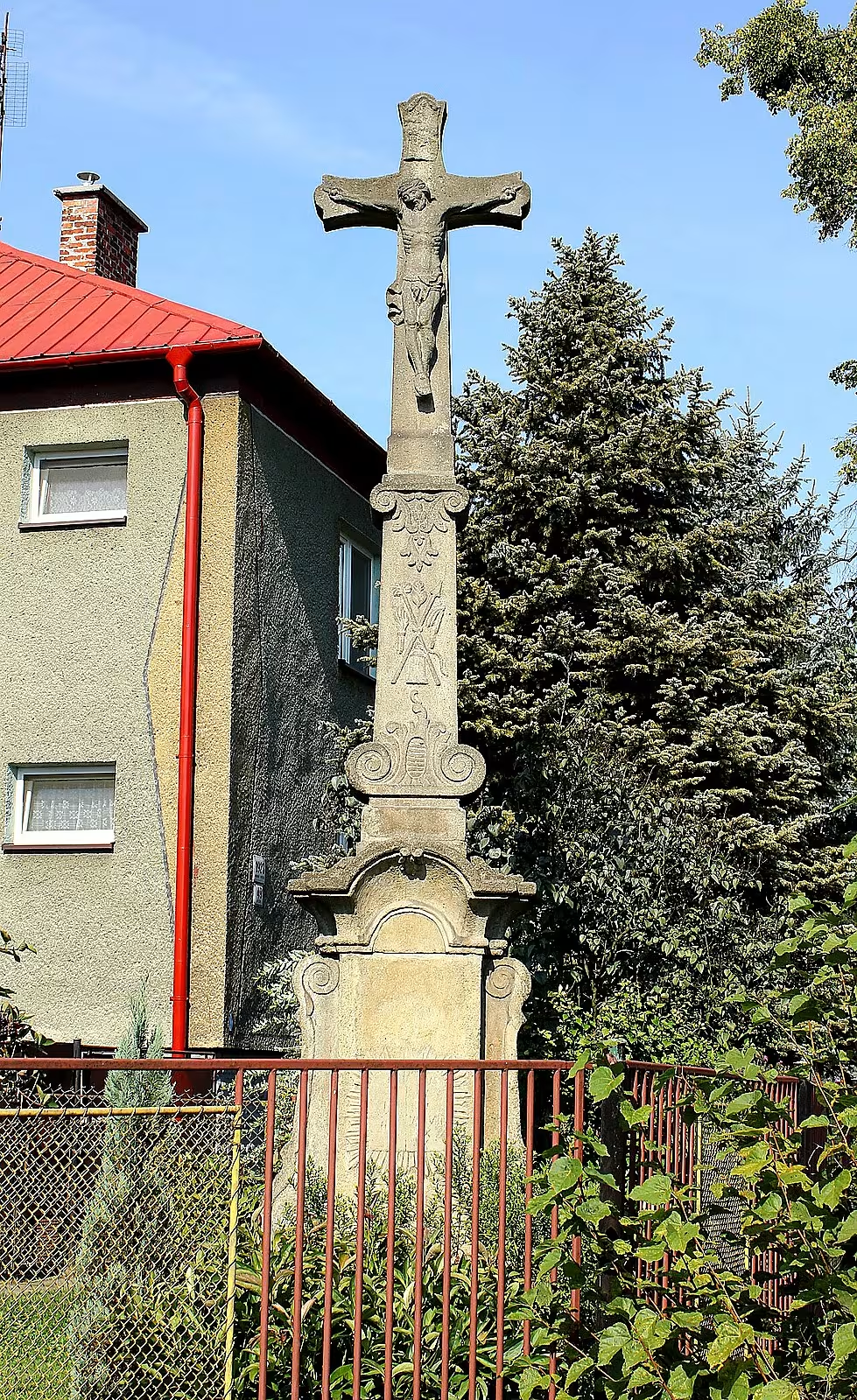
Neo-Baroque sandstone crucifix from 1870 is a cultural monument of the Czech Republic. Today it is located in the private garden of the family house in Svatopluka street Bohemia in Fryštát. The building is remarkable from its origin from the extinct village of Solca as well as rich sculpture decoration, which illustrates the period tilt towards historical forms.
The cross was established around 1870, during the intensive industrial development of Austria-Hungary and the expansion of coal mining in Karvinsko. The then architecture was dominated by historism returning to the Baroque elements, which was also reflected in this sacral work.
The monument is approximately five metres long and is made of rough grain sandstone. It consists of a high four-sided base with a cover plate, with volute wings on the sides. On the front side of the pedestal there is a relief of Moses plates. The upper part of the cross is decorated with an elaborate figure of crucified Christ, while the lower part of the vertical bosom decor the relief of the symbols of Christ's torture.
The fate of the Cross is closely linked to the transformation of the region as a result of the mining industry. Originally he stood in the village of Solca, which in the past disappeared precisely because of the development of mining. After the transfer to Fryštát, the monument found itself in an untraditional environment of a private garden. A significant milestone in the modern history of the building was its repair in 1973.
Today the crucifix is a protected cultural monument, which resembles the extinct village of Solca and the aesthetic feeling of the 19th century. Visitors to Karviné-Fryštát can see this object during a tour of the wider surroundings, including the historical centre of the city, the castle Fryštát or Božena Nemcová Park. The preservation of this monument in private space is indicative of the care of small sacral structures which form an integral part of the historical identity of the region.
Historical milestones
- 1870
- The creation of a Neo-baroany piscove crucifix in Solca.
- around 1950
- Zanik village Solca in consequence of the development of the thesebni industry.
- 1973
- Repairs of memory after its premiere to Frystat.
Architectural development
The cross is made of rough-grained sandstone in a neo-Baroque style. It consists of a high four-sided pedestal with a cover plate and volute wings. The upper part is a sophisticated figure of crucified Christ.
Historical events
The creation of the cross around 1870 in Solca. To repair the monument in 1973.
Points of interest
- Krucifix comes from the extinct village of Solca which was destroyed due to the development of coal mining. - The monument is located in the private garden of the family house in Svatopluka street Bohemia. - The object is approximately five metres tall and is made from rough sand. - On the pedestal there is a relief of Moses' plates and the lower part of the cross is decorated with symbols of Christ's torture. - An important milestone in the history of this monument was its repair in 1973.
Guide
Show guide text
This text was created by artificial intelligence and has not been editorially reviewed. It may contain inaccuracies.
Welcome. You're standing in front of one of those quiet, but extremely powerful time witnesses who help us understand how the world changes around us. Right in front of your eyes, there is a monumental sandstone crucifix that immediately attracts the attention of anyone who approaches it at a height of approximately five metres. Even if it is situated in the quiet private garden, its presence is very dominant and affects us with its rich form and depth of expression. Please feel this atmosphere of peace that exists here, and allow us to lead you through its story, which is far deeper than it may seem.
Let us now return together in time and try to understand where this monument really comes from. This crucifix wasn't always here, in this part of Fryštát. His journey is a fascinating, albeit sad story about the changes that have brought about human progress and industrial development. It originated in a thousand eight hundred seventy in a village called Solca. Please imagine living in that village at that time, living with the rhythm of nature and tradition. Solca was a living place, a community of people who lived here, worked and believed. But the fate of this village was relentless. Around the year a thousand and nine hundred and fifty, this village began to disappear and eventually completely disappeared. This was not a natural disaster but a development of the mining industry. The need to get black coal, the black gold that drove the world back then, required huge spaces and changed the face of this whole country. The entire village of Solca was destroyed in order to grow mining activity. But this crucifix is one of the few remnants left of the world back then. It's like a silent memorial who survived the end of the world and who today reminds us of the people who once lived in Solco. In order for this object to survive, it had to be moved here, to Fryštát, and in the year one thousand nine hundred and seventy it had undergone an important repair that allowed it to remain in such good condition for us as well.
Now pay attention to the details you have right in front of you. Look at the material from which this work is carved. It's rough sandstone. Notice its texture, the kind of roughness that gives the whole crucifix a sense of stability and eternity. Sandstone is a stone that carries a trace of time in each of its grains. Now please take a look below, on the very foundation, on the base on which this whole thing stands. See those beautiful, corrugated shapes that decorate the bottom of it? They're called volute elements. These curves are typical of the style of the new Baroque in which this crucifix was created. These shapes provide the whole movement, elegance and certain dynamic sounds that contradict the weight of the stone itself. If you look even closer at the pedestal, you will encounter a very important relief. It's Moses' records. This detail is a very powerful symbol that refers to the old laws and a deep spiritual tradition. It's like the cornerstone on which all this sculpture work is built.
Only now have you watched the lower parts of the work, but now raise your eyes above, along the vertical plank of the cross. This whole structure is richly decorated. You can see the various symbols that represent Christ's torture at the very front. These characters are not just decoration, they're visual stories about suffering, about the victim, and about the deep faith the sculptor wanted to carve right into this sandstone. Every detail has been carefully thought out so that it can induce emotion in a person and make them think. So this entire five-metre structure is not only a sculpture piece, but also a visual prayer that was created at a time when faith was a fixed point in human life.
It's very interesting how the history of this place intertwines with today's present. This monument, which was once a public symbol of the entire village of Solca, is now part of the private space. Located in the garden of the family house in Svatopluka street Bohemia. This contrast between its magnificent historical significance and today's calm in a private garden creates a very unique atmosphere. It's like this crucifix has found its new home where it can rest in silence and be protected from the constant movement of the modern world. It is a fascinating idea that the thing that survived the demise of the entire village now stands in peace between the trees and the houses in Karviné- Fryštát.
I hope that this brief insight into the past that we have just offered you has enriched you and helped you better perceive the beauty and weight of this place. This crucifix is more than just a stone statue; It's a bond between a world that no longer exists and a world that you're standing in right now. It's a reminder of how much our surroundings can change, but at the same time how strong things can be that we can keep. Please continue your next walk and pay attention to other details of your surroundings. Perhaps elsewhere in this country you will find traces of the past waiting for you. Thank you for your time and reading this story. Goodbye.
Tips for visitors
The best time to visit is during the sunny morning, when natural light beautifully highlights the details of sandstone material and the neo-Baroque elements of crucifix. Due to the location in the private garden we recommend planning a visit at a time when the monument is well visible from public places.
Transport to the place is possible by car and public transport.
For photography we recommend to use a wide-angle lens that captures the entire height of a five-metre object. The best lighting conditions for detailed images of statues and reliefs are when side lighting creates interesting shadows in sandstone folds.
In the vicinity of the monument you can visit the historical centre of Karviné-Fryštát, which offers a unique atmosphere. The Fryštát castle and Božena Nemcová adjacent park are ideal for a longer walk, where you will find a quiet environment suitable for relaxation after sightseeing.
Tips for families with children: Walking through the historical centre and the Božena Nemcová park is easy and suitable for strollers. Children can discover natural corners in the park, while parents appreciate the historical importance of the place. Don't forget to pack your snacks and drinks because there are plenty of seats in the park.
Frequently asked questions
Can the monument be visited?
This is a structure in a public space that can usually be seen from outside free of charge. We have not verified that this particular one is freely accessible.
Where is the monument?
Location: Fryštát. The map on this page shows the exact spot.
Why is the monument protected?
It is listed in the Central List of Cultural Monuments of the Czech Republic as a cultural monument (register no. 1000128349).
Businesses nearby
Do you run a restaurant, accommodation, shop, museum, rental, wellness or other visitor service near this monument? Show yourself directly to the people heading to it — this is how they will see you in the app and on the web:
Nearby
Historické centrum Karviné-Fryštátu, zámek Fryštát, park Boženy Němcové.
Accommodation nearby
Themed route
Thematic cruise route Fryštát
1. Historical Centre Karviné-Fryštát - Type: Historical areas and streets. - Why is it worth a visit: This part of town offers a view of architecturally interesting buildings from when Fryštát prospered as an important business and cultural centre. Explore the streets with rich history and imagine life in the past.
2. Castle Fryštát - Type: Historical residential building. - Why it is worth a visit: The castle is one of the oldest and most important buildings in the region that testifies to the rich history of noble families. Its beautiful architectural elements and interiors are real pearls for lovers of history.
3. Božena Germans Park - Type: City park. - Why it is worth a visit: The park is an ideal place to relax and relax, offering beautiful green spaces and views of the surrounding countryside. It is named after the famous Czech writer Boženka Germans, which adds to its cultural importance.
4.Krucifix (Fryštát) - Type: Religious monument. - Why is it worth a visit: Krucifix is one of the oldest and most distinctive sculptures in the region that attracts attention with its historical value and artistic performance. It's a key part of Fryštát's cultural heritage.
This route offers a combination of history, culture and nature, allowing you to deeply understand the rich past and beauty of the village Fryštát.
Seasonal recommendations
Spring: In the spring season the atmosphere in Krucifix in Fryštata is full of new life and green colors when nature wakes up from its winter holiday. The sun's rays illuminate the statue and surroundings with fine gold lighting, creating unique views. Flowers begin to bloom around the monument, adding landscape colored accents. During this period it is recommended to visit in the morning or evening to avoid moderate sunlight and possible crowds in the afternoon. Clothes should be suitable for mild weather - a flying jacket or sweater with a curtain to help with the morning cold or evening hair.
Summer: In the summer period, Krucifix in Fryštata is a popular place for visitors looking for an escape from city interference. The sunny days and warm weather offer ideal conditions for long walks in the landscape around the sights. The natural green of trees and shrubs is at its peak, providing a pleasant shade for rest. Due to the large number of visitors in the main summer season, it is recommended to visit in the morning or late evening to avoid the hottest hours and crowds. Clothes should be light - short gloves, wide caps for sun protection and plenty of drinking water.
Autumn: In the autumn period Krucifix offers a view of the landscape pearl in Fryštata when tree leaves change colour and fall. Sunrise colors the statue and surroundings in various nuances from orange to red and yellow, creating a beautiful atmosphere. The temperature gradually decreases so that visitors can enjoy quiet walks without excessive heat. In this period it is advisable to visit the memory at noon, when the temperature is pleasant and the leaves falling highlight the beauty of the surrounding forests. Clothes should be mild - sweater or jacket to protect against cold winds.
Winter: During winter, Krucifix in Fryštata offers a completely different atmosphere where the statue and its surroundings turn into ice beauty. The sun's dawn lights up the snow blanket, and the shining cold morning adds magic to the visit. The temperature is usually cold, so the visitors are advised to wear thorough clothing - a warm coat with a waterproof layer, gloves and hats.
Visualizations and artistic views

The visualisations are generated by artificial intelligence and serve as inspiration.
Photos from the area
Real photos taken near the monument

Zdroj a licence jsou uvedeny u každého snímku.
Tips from visitors
No tips yet. Be the first!
Log in and add your tip.
Sources and literature
Photos: Hellooo / CC0 — Wikimedia Commons. The author and licence also appear when you hover over the image.
Faktickým podkladem tohoto textu byl článek na Wikipedii, jehož autory jsou přispěvatelé Wikipedie. Článek je dostupný pod licencí CC BY-SA 4.0.
Location on the map
Příběhy a pověsti
Legendy, pověsti a příběhy spjaté s touto památkou
Fotografie návštěvníků
Zatím žádné fotografie. Buďte první, kdo přidá fotografii z návštěvy!
Log in a přidejte svou fotografii nebo hodnoťte.
Za ověřenou návštěvu v aplikaci získáte víc bodů — poznáme podle GPS, že jste na místě.
Reviews and comments