



lázeňský dům Housova mlýna Other
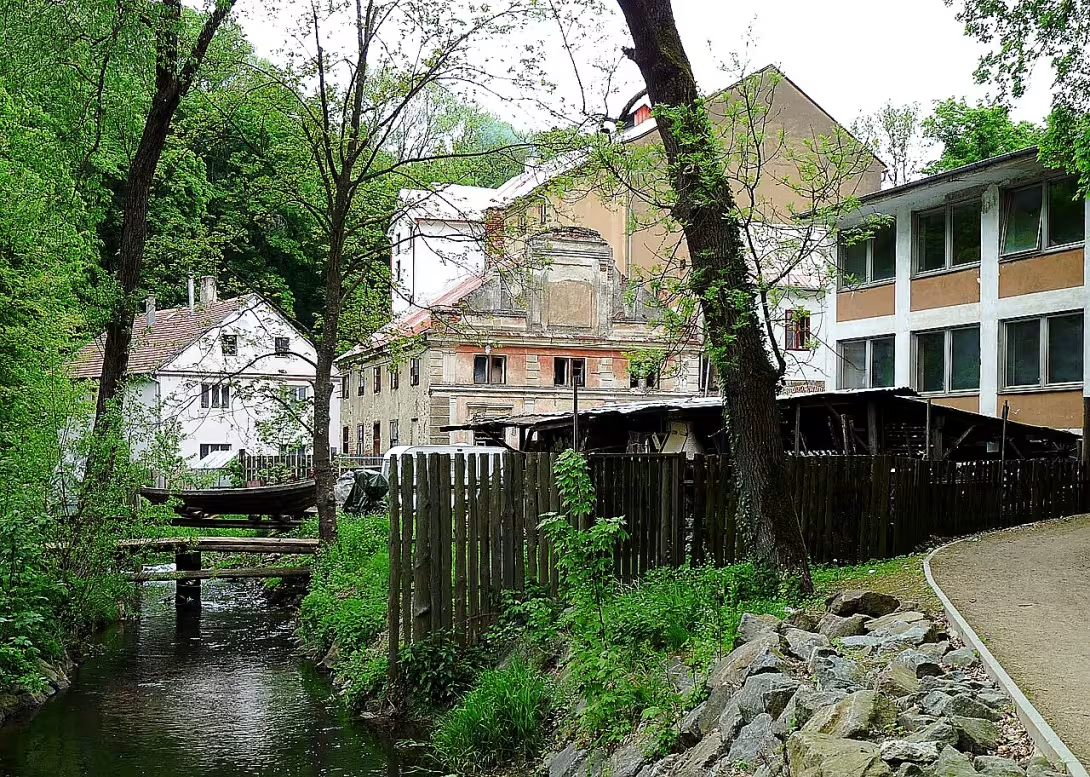
The spa house in Tábor is a historical building in the House Mill area, built between 1888 and 1895. It was used as a spa service. It is remarkable by its architectural breakdown and connection with other objects in the complex.
Spa services were provided at the House Mill site in the 18th century, long before the construction of the present house. The building was created during the expansion of industrial architecture and development of the Czech spa industry. This trend is confirmed by the fact that by 1895 at the latest, a steam-powered mill was added to the complex.
The building with rectangular plan is built from burnt bricks and covered with a saddle roof. The south shield facade contains the main entrance and windows on the ground floor, which decorate the champagne and straight suprafenestry. The ground floor separates the ledge from the atica with three square windows. The upper part is a stucco decoration shield, which is now badly damaged. Side facade is five-axis with smooth facade and roof ledge. The least significant is the northern shield facade with a side entrance. The connection between the spa house and the adjoining mill is provided by the built Prague.
The building presents a concrete example of the historical architecture of the late 19th century in Tábore. Its value lies in preserving the original structure and details of the facade, despite the progressive degradation of stucco decoration.
The building is proof of the long tradition of the spa in the premises of House Mill. For those interested in industrial architecture and the history of local crafts, this house represents a valuable goal.
Historical milestones
- around 1750
- Beginning of the provision of spa services on the premises of House Mill
- 1888
- Construction of the historical spa house
- 1895
- Completion of construction of the house and addition of the steam engine mill
Architectural development
The building is walled from burnt bricks on a rectangular plan with a saddle roof. The ground floor is supplemented with an increased atician section and a stucco decoration shield. At a later stage, no later than 1895, a steam engine mill was added to the premises.
Points of interest
- The building was built between 1888 and 1895 and served as a spa service. - Spa services were provided at House Mill in the 18th century. - A steam-powered mill was added to the premises by 1895 at the latest. - The connection between the spa house and the adjoining mill is provided by the built Prague. - The building is built from burnt bricks and its shield has stucco decoration, which is badly damaged today.
Guide
Show guide text
This text was created by artificial intelligence and has not been editorially reviewed. It may contain inaccuracies.
Welcome to the Tábors, a place where history binds with the calm of water. You're standing in front of a building that tells the story of health care and the expansion of industry. The lázeňský dům Housova mlýna stands before you. The first impression of this building is a sense of stability and craftsmanship precision. It's a place that carries the atmosphere of the late nineteenth century, a time when people were looking for a way out of the city's hustle and bustle to relax in the healing waters. Let us now look together at how this building was created and what its historical context is. Although the building you see looks relatively young, the spa tradition in this area goes much deeper. In fact, in the middle of the eighteenth century, about seven hundred and fifty, spa services started to be provided here. People came here for health and regeneration, which shows that House's mill was valued decades ago. However, with the arrival of the new century and increasing demands for comfort, it was necessary to build a more modern facility. That is why the construction of the present house started in the year eight hundred and eighty-eight. The construction lasted several years and was completed in the year of tyre eight hundred and ninety-five. This period marked the transition to a new era where simple baths became organized operation in a representative building. Now pay attention to the architecture itself and to what you can see right in front of you. Look at the walls of the building. Note that it is walled from burnt bricks, which was the standard for quality and durable buildings at the time. The whole object shows elements of historical style. Historism was very popular at the time because it returned to the tested patterns from the past and combined them with the technical possibilities at the time. Look at the facade and feel the rhythm of the windows and the overall balance of the building. It is an architecture that was supposed to emit credibility and purity, which was absolutely crucial for spa operations. But if you look a little bit more at the side, notice one very interesting detail. The spa house is not isolated in the area. It's connected to the next mill. This connection is used by a prampouch, i.e. a covered transition, which allows the transition from one building to another without having to come out. This element is not only practical, but gives the whole area a unique character. It's fascinating to think how two completely different activities intertwined in this space. On one side you have peace, quiet and relaxation in the spa, and on the other side the noise and dynamics of the mill. And this is where we get to the part that might seem surprising. Note that the mill that is connected to the house was not just a simple water-powered mill. By the year eight hundred and ninety-five a steam engine mill was added to the area. That was the top of the line at the time. Imagine the contrast: in one part of the building, people calmed down in spa treatments and only a few metres away from them, behind the wall of the rainbow, a steam engine was rumbling to power the mill mechanism. This combination of health facilities and industrial operations within one site is now very unusual and shows how flexible the use of space was at that time. Even though today we don't know the names of the particular architects who drew plans for this house, or the specific personalities who would leave their signature in the form of legends, the building itself is a living witness to the epoch. It is a monument to the time when progress, technology and the power of nature and water were believed. The mystery remains how exactly the interaction between the spa visitors and the mill workers took place. whether the quiet noise of water in the spa met with the rhythmic beat of the steam engine and how the guests responded to this contrast. Today, when you look at this bed of history in Tábor, see it as a symbol of the balance between work and rest. House Mill Spa House is not just a pile of bricks, but a reminder of the time when body care was transported by technical development of the surroundings. It's where time stopped and where you can feel the spirit of the late nineteenth century. We now invite you to look around in peace, perhaps once again look at the connecting pipe and imagine how people once walked through here in their period clothes. Explore the surrounding area and perceive the atmosphere of this unique place that connects water, health and industry. Thank you for spending time with us at this historic house. We wish you a pleasant further journey by the city of Tábor and many new discoveries. Goodbye.
Tips for visitors
The best time to visit is late spring or autumn, when the surrounding nature around the mill excels beautifully and temperatures are pleasant for walks. You can reach the premises by car and public transport, check for specific connections in the current search engines.
On the way we recommend to wear comfortable shoes suitable for outdoor terrain and plenty of water. Since it is a historic building from the late nineteenth century, it is interesting to follow the details of its facade.
For the best photos we recommend to come to the morning or late afternoon lights that highlight the architecture of the building. Ideal angles for pictures are from around the area where you can see the connection of the spa house with the surrounding environment.
For families with children, a visit is an interesting way to bring the history of the spa and mill in practice to children.
Frequently asked questions
Can the monument be visited?
We have not verified whether this monument is accessible. Please ask the owner or operator, or the local municipal office.
Where is the monument?
Location: Tábor. The map on this page shows the exact spot.
Why is the monument protected?
It is listed in the Central List of Cultural Monuments of the Czech Republic as a cultural monument (register no. 2000002699_0002).
Businesses nearby
Do you run a restaurant, accommodation, shop, museum, rental, wellness or other visitor service near this monument? Show yourself directly to the people heading to it — this is how they will see you in the app and on the web:
Nearby
Památka se nachází v rámci obce Tábor v blízkosti Housova mlýna.
Accommodation nearby
Themed route
Here is the route design:
1. House Mill - Construction. Walk around this place serves as an entrance to the area. 2. House Mill Spa House - the main monument. A unique building with history, which is the main point of the whole trip.
Seasonal recommendations
In the spring, the surroundings awaken to life and nature around the building begins to grow green. Soft spring light is ideal for observing facade details. We recommend shoes suitable for wet terrain and light coating of clothing, because the wounds can still be cold. The best place to visit is in the morning when the air is the cleanest.
Summer brings a radiant sun and a hot atmosphere that highlights the colors of the historic building. There are lush greenery and intense lighting around the house. It is advisable to choose light, breathable substances and not forget the hat against the sun. Due to high temperatures, we recommend planning a trip to early morning or late evening hours.
In autumn, the landscape around the monument is colored in golden and brown tones, creating a nostalgic mood. The light is softer in this period and radiates with a golden touch. It's practical to bring a waterproof coat or a solid sweater for colder days. The ideal time for a walk is in the afternoon when the colours of the leaves are the most distinctive.
Zimą is surrounded by peace and quiet, which can be accompanied by snow covering the landscape. The atmosphere is rough and cold, with days short and the shadow coming soon. Hot clothes, fat socks and shoes with anti-slip soles are essential. We recommend a visit at noon to make use of maximum daylight.
Visualizations and artistic views

The visualisations are generated by artificial intelligence and serve as inspiration.
Photos from the area
Real photos taken near the monument


Zdroj a licence jsou uvedeny u každého snímku.
Tips from visitors
No tips yet. Be the first!
Log in and add your tip.
Sources and literature
Photos: Czeva / CC BY-SA 3.0 — Wikimedia Commons. The author and licence also appear when you hover over the image.
Faktickým podkladem tohoto textu byl článek na Wikipedii, jehož autory jsou přispěvatelé Wikipedie. Článek je dostupný pod licencí CC BY-SA 4.0.
Location on the map


Příběhy a pověsti
Legendy, pověsti a příběhy spjaté s touto památkou

Fotografie návštěvníků
Zatím žádné fotografie. Buďte první, kdo přidá fotografii z návštěvy!
Log in a přidejte svou fotografii nebo hodnoťte.
Za ověřenou návštěvu v aplikaci získáte víc bodů — poznáme podle GPS, že jste na místě.
Reviews and comments