



Mariánská kasárna Barracks
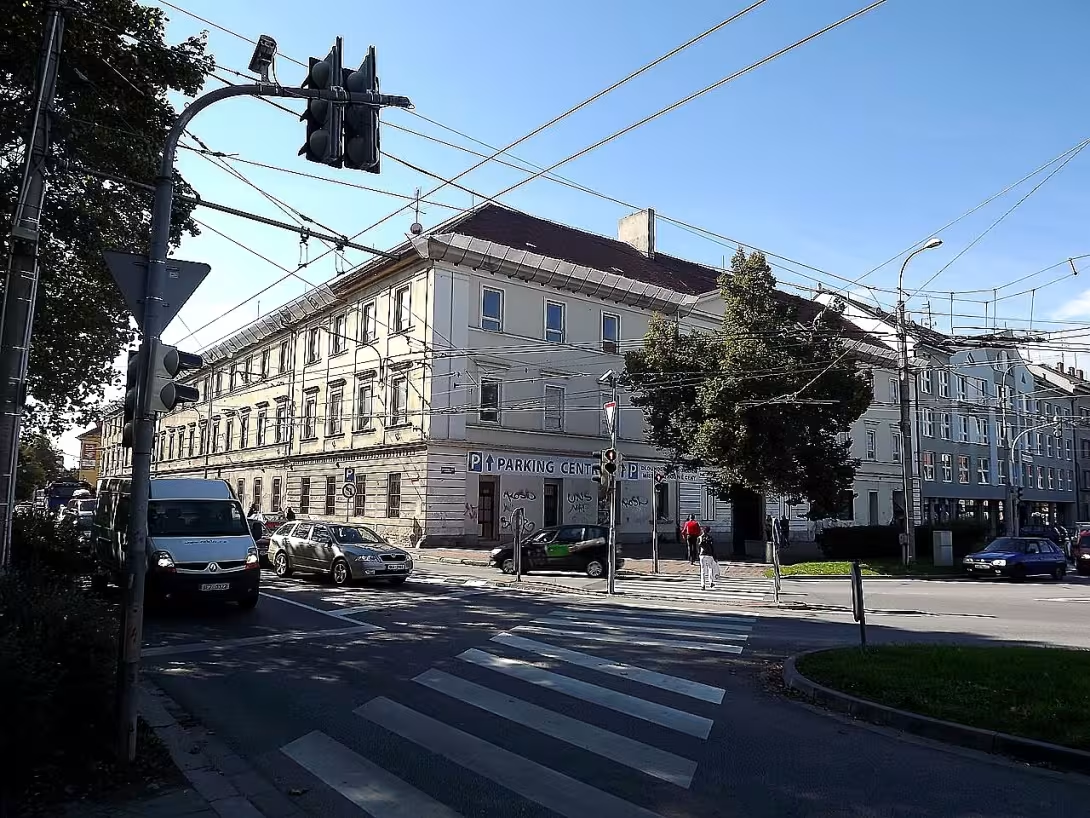
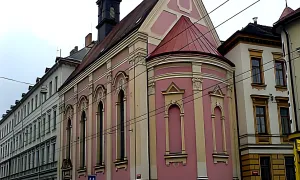
Mariánská kasárna in České Budějovice are a late-classicist building built in the middle of the 19th century, which originally served as the seat of the 91st Infantry Regiment and Crew Prison. Since 2005, this monument has been recorded in the records of cultural monuments due to its architecture and history associated with several important personalities.
The construction was built between 1843 and 1844 on Mariánska Square, specifically on the corner of Prague and Hus. The original owners were Czech-Budějovice law-enforcement townspeople who invested in their own space in order to get rid of the obligation to accommodate and feed soldiers in their homes. Subsequently, the barracks were leased to the State.
The project was designed by architect Josef Sandner in late classical style. It is a two-storey, two-wing L-shaped building.
After completion, the state rented it and between 1883 and 1918 there was a 91st Infantry Regiment. After 1918, the barracks were called the Sveca barracks, where a replacement battalion of Infantry Regiment 1 was located. In the 1930s, the headquarters of the 5th Automotive Company and the School for the Education of Petty Officers of the Artillery of the Occupation. During the German occupation, the barracks were occupied by the German army. After 1950, the building was renamed Jan Sverma's Castilla. In the last decade of the 20th century, they lost their original military purpose and, after 2010, they underwent construction adaptation for new applications.
The history of the object is associated with many events and personalities. There was a crew prison in the barracks, where until 1901 there were executions in their courtyard. One of them was the execution of the 75th Infantry Regiment on 11 March 1901, who was sentenced to death by a rope for shooting a Petty Officer in Trebon. In 1905, the poet Fráňa Šrámek was imprisoned for his anti-militaristic attitudes. In 1915 the writer Jaroslav Hasek enlisted, whose stay in the building resembles a monument plate. There is also a literary meeting between Švezek and Mark from Jaroslav Haška. The military figures who served here included, for example, Vinzenz Sagner, Jan Evangelista Eybl, Gustav Jungbauer and Jan Rafael Schuster. During the years 1957- 1959, Václav Havel also served here.
Today, the building serves business, gastronomic and residential purposes. On the ground floor there are shops, services, restaurants and galleries of Mariánská. The building also includes residential apartments and parking.
Mariánská kasárna is an important historical point in the architecture of České Budějovice, which is suitable for visiting their rich history and architecture.
Historical milestones
- 1843
- The beginning of the barracks.
- 1883
- The 91st Infantry Regiment.
- 1905
- Prisoner of the poet Fran Šračka.
- 1915
- Recruiting Jaroslav Hasek to the 91st Regiment.
- 1957
- Václav Havel military service in barracks.
- 2005
- Registration of cultural monuments.
Architectural development
The building was built in 1843-1844 in late classical style according to the plans of Josef Sandner. It is a two-storey, two-wing, L-shaped structure. After 2010, the building was adapted for new use.
Historical events
1843-1844: Construction of barracks. 1883-1918: The seat of the 91st Infantry Regiment. 1957-1959: Václav Havel Military Service. 2005: Announcement for cultural heritage.
Owners
České Budějovice lawyer townspeople (original owners), state (tenant).
Points of interest
- Mariánská kasárna is a late-classicist building built in the middle of the 19th century. - Originally served as the headquarters of the 91st Infantry Regiment and Crew Prison. - Since 2005 this monument has been registered in the records of cultural monuments due to its architecture and history associated with several important personalities. - There was a garrison prison in the barracks, where until 1901 there were executions in their courtyard. - The military figures that served here included, for example, Vinzenz Sagner, Jan Evangelista Eybl, Gustav Jungbauer and Jan Rafael Schuster.
Guide
Show guide text
This text was created by artificial intelligence and has not been editorially reviewed. It may contain inaccuracies.
Welcome to the beautiful town of České Budějovice. You are now facing one of the most important buildings in this part of town, which immediately affects you with its size and presence. The Mariánská kasárna stands before your eyes. Even though this building may seem to you as a solid and still part of the urban landscape, its walls carry the incredible power of time. Feel the atmosphere of a place that has witnessed both strict military discipline and profound human suffering and unexpected creative inspiration for centuries. Stop for a moment, perceive this space and let yourself be carried away by the stories that have been written here in every stone.
Let us now return together to a deep past, namely in the middle of the nineteenth century, so that you can understand why this place was created. Imagine living in that town. At the time, there was a rule that today's residents probably can't imagine. The townspeople had a legal obligation to accommodate soldiers in their own homes. Imagine the inconvenience, the constant movement of strangers in the privacy of families, noise and disturbance of peace in every household. It is precisely in order to remove people from this heavy obligation that they have decided to build this separate headquarters for the military. The construction work started in a thousand eight hundred forty-three. This created a place to separate military life from civilian life, and it became an inherent pillar of the city. This effort for peace for citizens has led to the creation of a monumental object that still dominates its surroundings.
Now pay attention to the very form of the building that you now see. Look at her face and see her structure. It's a work of late classical architecture. This style is characterized by some balance, order and peace that you can feel in the overall form of the building. Mr Josef Sandner, an important creator of the time, was behind this whole proposal, which was able to inhale this massive construction elegance. Although the building appears to be very firm and stationary, its lines and shapes were designed to express stability and strength. Feel the harmony the architect brought into this great work. Although time has changed and the building has undergone various modifications, its basic character, which defined Sandner's proposal, remains apparent and gives this place its unmistakable appearance. Take a look at her facade and see how architecture tries to express the dignity that the barracks should have radiated at that time.
Let us now move on to the people who inhabited these walls, because the history of this place is not just the history of stone and mortar, but above all the history of living destinies. The history of this place is not only the history of military power, but also of human destiny. In the year of a thousand eight hundred eighty-three, the ninety-first foot regiment settled here. This meant that the barracks became the warmth of military life, the place of exercise, training and strict rules. But not everything was about military glory and order. This place also had a dark and hard side, for it also served as a crew prison.
In the year one thousand nine hundred and five there was a very difficult time the famous poet Fráňa Šrámek. Imagine him in those times, as he must have sought inspiration in these walls even in the moments of his isolation and imprisonment. These walls witnessed his anxiety and his creative power. Ten years later, in the year one thousand nine hundred fifteen, another fascinating story took place here. Jaroslav Hašek was accepted into the ranks of the ninety-first regiment. A man whose name we know today because of his incredible sense of humor and his ability to describe human nature, had to attend his military service here. Perhaps it was these experiences of military life, of rigor and chaos that he later used in his most famous works.
And if you expect history to end in the last century, we have to mention another big name that is very close to all of us. In the year of a thousand and nine hundred and fifty-seven here he performed his military service Václav Havel. Imagine this - a man who has become a symbol of freedom and later a president, has experienced parts of his youth and duty to the state here. In such an incredible way, this building combines generations of people who have fundamentally influenced our culture, literature and political life. From a poet to a funny writer to a world-class statesman - it all happened here.
It's fascinating how different and conflicting fates meet in one place. From soldiers in uniforms, to prisoners looking for a way to freedom, to world personalities. Perhaps you'll be interested in what these walls actually heard. They witnessed strict military discipline, but also the silent breath of a poet or the laughter of a man who later became a legend. Thanks to its rich history and unique architecture, this monument was officially entered into the records of cultural monuments in the year two thousand and five. It means that its value is not only in its dimensions, but in everything it carries and tells us about human nature.
Now you can move on and continue your search of the area. I hope that this brief insight into the past has helped you better understand the importance of the Marian barracks and that this story will remain in your memory. Don't forget to stop and look at this building again, this time with the knowledge of all the human destinies that lived in it. I wish you a nice walk through the city and many other interesting discoveries. Goodbye.
Tips for visitors
The best time to visit Marian barracks is in the spring or autumn season when the weather is pleasant and fewer visitors. This historical object offers a quiet atmosphere for the beauty of architecture without the noise of summer classes.
We recommend checking the current route information before departure.
When visiting, take a suitable costume to protect against uncomfortable weather conditions. It is also important to have a camera or mobile phone to capture the beauty of the barracks and surroundings, especially in the sunlight.
For photography are ideal times in the morning or in the evening when the light is softer. The best places for photography include Mariánska Square and surrounding streets which offer different views of barracks.
It is possible to visit the historical Husova grade or walk around Prague. These places offer an interesting view of local architecture and culture. For families with children it is advisable to visit the square where children can relax and explore the surroundings.
Frequently asked questions
Can the monument be visited?
The building is in use (offices, a school, shops and the like). The interior is generally accessible only during operating hours and tours are not usually offered; we have not verified the details. You can see the exterior from the street.
Where is the monument?
Location: České Budějovice 3. The map on this page shows the exact spot.
Why is the monument protected?
It is listed in the Central List of Cultural Monuments of the Czech Republic as a cultural monument (register no. 1354338881).
Businesses nearby
Do you run a restaurant, accommodation, shop, museum, rental, wellness or other visitor service near this monument? Show yourself directly to the people heading to it — this is how they will see you in the app and on the web:
Events nearby
Zdroj akcí: otevřená data měst a obcí ČR (Národní katalog otevřených dat) a kalendář akcí Národního památkového ústavu.
Nearby
Mariánské náměstí, Pražská třída, Husova třída.
Accommodation nearby
Trips and activities nearby
Guided tours, tickets and activities nearby from GetYourGuide
Affiliate link: if you buy from the partner, we may receive a commission. The price for you does not change.
Search tours and activities →Themed route
Thematic cruise route: Mariánská kasárna and surroundings
1.Mariánská kasárna (Monuments) - This historic building is an important architectural monument in České Budějovice, which was originally built as military barracks. It is known for its Baroque style and rich history. Worth a visit for lovers of history and architecture who want to discover the unique character of this place.
2. Mariánska Square (Square) - This central square is an ideal place to relax and tour the Mariánska barracks. It is famous for its beautiful environment, which includes ancient architecture and quiet green spaces. Visit him for a view of historical buildings and for moments of rest.
3. Prague class (Class) - This street is one of the main commercial centers of the city, which connects Mariánska Square with other historical parts. It is famous for its rich offer of shops and restaurants. It is worth a walk for those who want to familiarise themselves with the modern life of the city even after visiting historical monuments.
4. Hus Class (Class) - This street is another important element of urban nature that will lead you to other historical and cultural monuments. It is famous for its architectural diversity and beautiful street spaces. Visit it for a view of diverse buildings and for a further understanding of the history of the city.
This route will allow you to discover not only the Marian barracks, but also its surroundings full of historical and cultural attractions.
Seasonal recommendations
In spring, the surrounding greenery awaken to life and soft light highlights the details of the facades. The atmosphere is fresh and full of hope for the awakening of nature. We recommend wearing more layers of clothing because the weather is very variable in this period. The best is to come in the morning, when the air is cleaner and the surroundings are quieter.
The summer season brings sharp sun and rich colors that make the monuments a clear point in the urban landscape. There's noise and traffic in the streets. To avoid the biggest crowds and the highest heat, we recommend a visit first thing in the morning. Remember light summer clothes and plenty of fluids with you.
In autumn, the surroundings turn into golden tones, and morning fog gives the place a mysterious, slightly melancholy touch. The light is softer and the shadows become longer. Moisture resistant shoes and a warm sweater are suitable. The ideal time for a walk is the late afternoon when the mood in the area is most relaxed.
In winter, the barracks operate monumentally, especially if they are covered by a layer of snow and freezing air. The atmosphere is quiet and makes it feel like stopping in time. Due to short days and limited light, plan to arrive by noon. Hot shoes, gloves and hats are essential to keep you cold during the tour.
Visualizations and artistic views

The visualisations are generated by artificial intelligence and serve as inspiration.
Photos from the area
Real photos taken near the monument


Zdroj a licence jsou uvedeny u každého snímku.
Tips from visitors
No tips yet. Be the first!
Log in and add your tip.
Sources and literature
Photos: JAn Dudík / CC BY-SA 3.0 — Wikimedia Commons. The author and licence also appear when you hover over the image.
Faktickým podkladem tohoto textu byl článek na Wikipedii, jehož autory jsou přispěvatelé Wikipedie. Článek je dostupný pod licencí CC BY-SA 4.0.
Location on the map


Příběhy a pověsti
Legendy, pověsti a příběhy spjaté s touto památkou
Fotografie návštěvníků
Zatím žádné fotografie. Buďte první, kdo přidá fotografii z návštěvy!
Log in a přidejte svou fotografii nebo hodnoťte.
Za ověřenou návštěvu v aplikaci získáte víc bodů — poznáme podle GPS, že jste na místě.
Reviews and comments