



Moravský most s jezem a elektrárnou Bridge
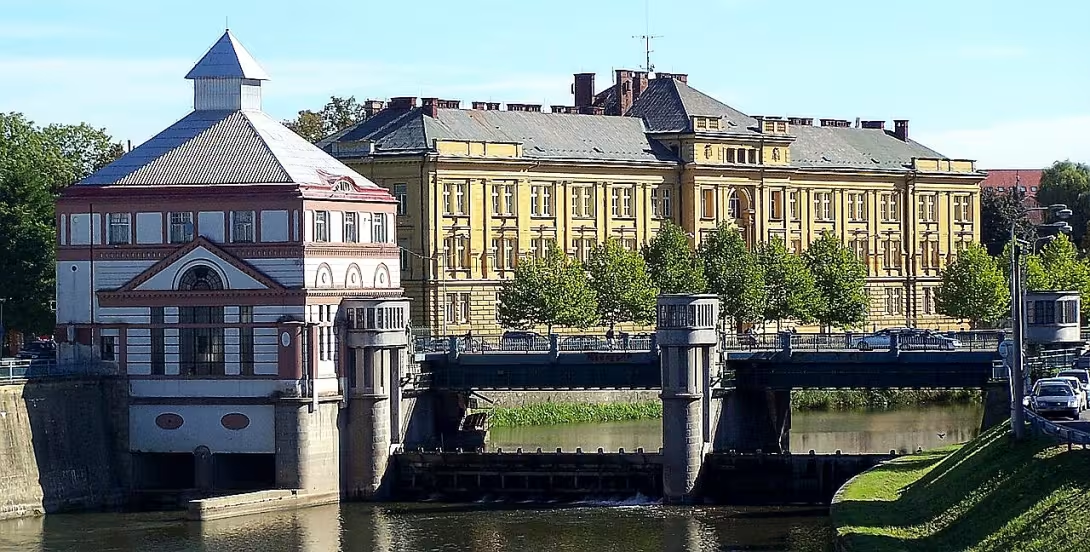
On the River Orlici in Hradec Kralove, just a short time before her encounter with the Elbe, stands the Moravian Bridge. However, it is not just a common communication across the river - it is part of a complex water work, which includes a rolling structure and a power plant. The whole area is one of the cultural protected monuments and tells the story of military strategy, engineering courage and industrial progress.
The beginnings of the Moravian Bridge go back to the time when the fortress stood in Hradec Králové. The stone fortress bridge, also called Orlický, was built in 1766-1769 from sandstone and had three massive pillars of a width of three metres. The bridge had four fields of 10,5 meters. An interesting part was the Dutch floodgates inserted into the grooves on the pillars - when the water flow was blocked, the contained water flooded the surrounding moats and boilers. This converted bridge served as one of the fortress's defence mechanisms.
After the cancellation of the fort and during the systematic regulation of the river Orlice (1908-1914), the old bridge proved to be an obstacle. It was demolished because it delayed the flow of water. A new road bridge built in 1910-1914 was immediately established in its place. In 1913-1914, an interesting innovation was incorporated directly into the construction of the hydroelectric power plant. The new bridge had three fields - one was occupied soon after the construction of the power plant, the other two filled the stavid systems with six-handed pairs of husks and vore release.
Technically, it is a steel full-bodied bridge set on two half-pillars in the shore and two prismatic pillars, which were half-circled and covered with stone blocks. The wagon is asphalt, the bridge has two walkways with cast iron railing. The construction was carried out by the Hradec firm Ruston-Bromovský and the United Engineering of the Prášile brothers from Libna. Water treatment was carried out by the Prague Kress & Bernard.
Moravský eatery at 2.76 metres was created following the construction of the bridge (1912- 1915). However, the floods in 1926 damaged the floodgates, which resisted and clogged the hedges. The manual controls so far proved insufficient. General reconstruction took place only after World War II, in the years 1951-1956, put into operation in December 1956. The structure became more reliable and more manageable.
The next intervention was in 1994, when it was extended by 2.5 metres upstream of the river to increase its capacity and capacity. The reconstruction lasted 8.5 months and preserved its original appearance. It cost CZK 16.5 million.
The visitor sees a construction that has been perfecting and fulfilling its purpose for over a hundred years, coloring the castle's industrial history to the present day.
Then and now
Drag the slider to compare how the landmark may have looked when it was built with the view today.
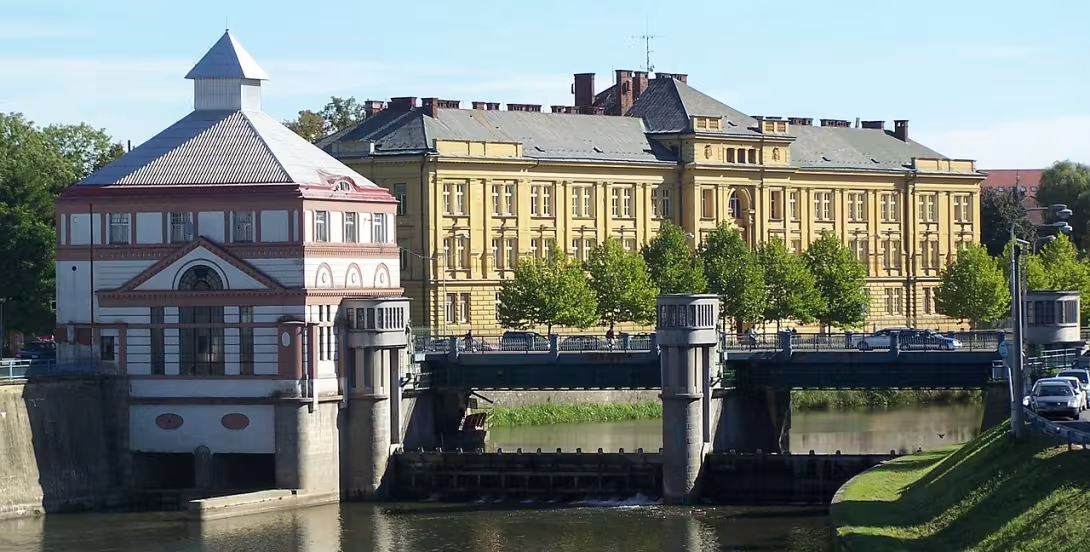
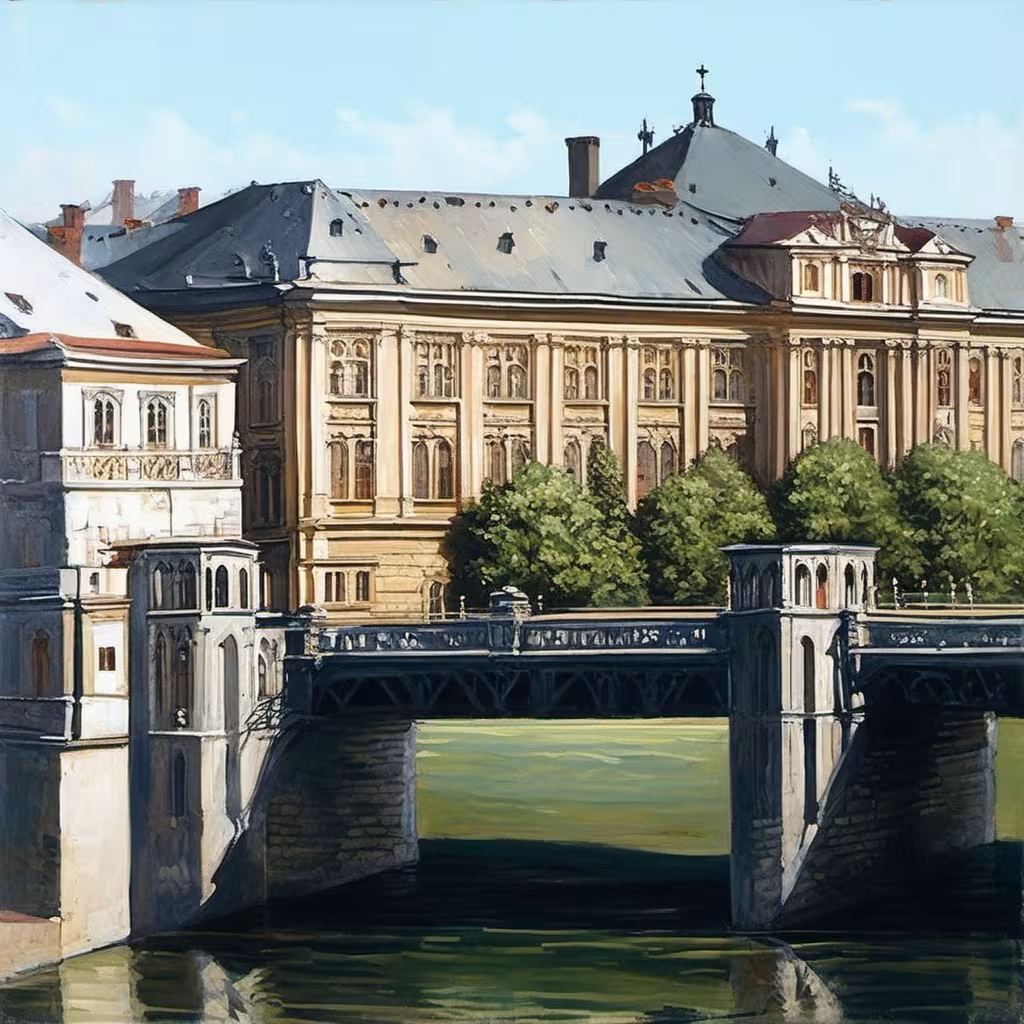
The historical appearance on the left is an AI-generated visualisation and serves as inspiration only.
Historical milestones
- 1766-1769
- The position of stone fortress bridge from sandstone with defensive functions for castle fort, including ledolas and water retention stalls.
- 1910-1914
- Basic construction of a new road bridge with a horse and power plant during the regulation of the river Orlice.
- 1913-1914
- Starting operation of the hydroelectric power plant integrated into the bridge structure.
- 1951-1956
- The reconstruction of the post-World War II weir to wear the sluice caps.
- 1994
- Expansion of the bridge by 2.5 metres to increase capacity and capacity.
Architectural development
The original 18th century fortress bridge was demolished to regulate the river flow. The new bridge from 1910-1914 is steel filler with asphalt road and cast iron railing. Jez and the power plant were integrated into the bridge construction. In 1994 the bridge was expanded by 2.5 metres without significant changes in its original appearance. The bridge is built on four pillars, two of which are prisms and lined with stone blocks.
Historical events
1766-1769: Position of the original stone fortress bridge from sandstone with defensive functions for castle fort.
1910-1914: Reconstruction of the river Orlice and construction of a new road bridge with integrated slope and power plant.
1951-1956: Reconstruction of the weir after World War II due to wear of the sluice caps.
1994: Extension of the bridge by 2.5 metres to increase capacity and capacity.
Owners
City of Hradec Králové (from origin, without precise years ownership)
Points of interest
- The bridge was originally part of the strength system and served as a defence mechanism because it flooded the surrounding moats and boilers when blocking the water flow.
- In 1913-1914 a hydroelectric power plant was integrated into the construction of the bridge, which was a technical innovation at the time.
- The construction of the bridge and power plant took place at the same time as the regulation of the River Orlice in 1908-1914.
- After the flood in 1926, the manual control of the floodgates failed, which led to their general reconstruction only after World War II (1951-1956).
- In 1994 the bridge was extended by 2.5 metres while maintaining its original appearance.
Guide
This guide is narrated by a synthetic voice generated by artificial intelligence.
Show guide text
This text was created by artificial intelligence and has not been editorially reviewed. It may contain inaccuracies.
On the Orlice River in Hradec Králové, just before its confluence with the Elbe, stands a heritage-protected area consisting of the Moravský bridge, weir and hydroelectric power plant. The weir with the power plant is usually simply called Moravský weir.
At the time when Hradec Králové was a fortress, there stood a stone Moravský fortress bridge at this location, also called Orlický. It was built in the second half of the sixties in the eighteenth century and led to the former Moravian Gate. It was built from sandstone, had three piers and four spans, each with a width of ten point five meters. The piers were protected by oak ice breakers. But most importantly, they had grooves into which you could insert so-called Dutch gates. These stopped the flow of water and the bridge became a dam. Water then flooded the ditches and basins around the city and served as one of the defensive parts of the fortress. After the fortress was abolished, the bridge merely unnecessarily slowed the flow of the river, and so it was demolished during the regulation of the Orlice.
A new road bridge was built between nineteen ten and nineteen fourteen. During construction, a temporary wooden footbridge served as a replacement, which was removed after the bridge was completed. The new bridge had three spans. Into one of them, between nineteen thirteen and nineteen fourteen, a run-of-river hydroelectric power plant was incorporated. The remaining two spans were filled with gates and a timber sluice, which was removed during reconstruction in the nineteen sixties. The bridge is steel and rests on two piers lined with stone blocks. It has cast-iron railings. The steel structure was supplied by the Hradec company Ruston – Bromovský and the machine shops of the Prášil brothers from Libně. In nineteen ninety-four the bridge was widened by two point five meters upstream to handle greater traffic. The original appearance was preserved in the process.
The weir is two point seventy-six meters high and has two spans of twenty meters each. For reasons of economy, it was built directly into the structure of the new bridge. It survived the nineteen twenty-two flood without major problems. However, during the nineteen twenty-six flood, several gates became stuck and blocked the weir openings, so water flooded the surrounding area. The problem was that the gates were operated slowly and manually, pulled by chains under the bridge. A reconstruction project was designed, but due to lack of funds and the subsequent war, it remained unfinished. The weir finally underwent reconstruction between nineteen fifty-one and nineteen fifty-six. The old gates were no longer reliable, in winter they could not be used at all and their operation was dangerous. The reconstruction significantly changed the appearance of the entire structure as well.
Frequently asked questions
Can the monument be visited?
This is a structure in a public space that can usually be seen from outside free of charge. We have not verified that this particular one is freely accessible.
Where is the monument?
Location: Hradec Králové, Královéhradecký kraj. The map on this page shows the exact spot.
Why is the monument protected?
It is listed in the Central List of Cultural Monuments of the Czech Republic as a cultural monument (register no. 29446/6-4538).
For kids
Imagine going back to the past, when Moravia was still a young king among Czech countries. On one side of the river Moravia stood a small village where people lived in harmony with nature. And on the other side of the river, where the Moravský most s jezem a elektrárnou stands today, there was only a tapestry of water.
Who lived here? They were fishermen who used to fish and hunt birds. They were merchants who brought goods from other countries and sold it to local residents. And they were also witches looking for secrets in the river Moravia.
Businesses nearby
Do you run a restaurant, accommodation, shop, museum, rental, wellness or other visitor service near this monument? Show yourself directly to the people heading to it — this is how they will see you in the app and on the web:
Nearby
There is a confluence of the rivers Orlice and Elbe, which forms a natural landscape with park areas. The historical centre of Hradec Králové with other cultural monuments such as Hradec Castle or Holy Spirit Church is also nearby.
Accommodation nearby
Themed route
Daily cruise route to the Moravian Bridge and the surroundings of Hradec Králové
1.Moravský most s jezem a elektrárnou The seaside bridge with its historic slope and power plant is a technical and architectural monument. The local combination of engineering and energy equipment offers a fascinating view of the past and present region.
2. Soutok rivers Orlice and Labe Above the bridge is a natural landscape where two rivers meet. Here is the possibility to observe the water flow, diverse birds and quiet park spaces near the river.
3. Historical Centre Hradec Králové The distance to the center is approximately 15 minutes walking distance. Here it is worth visiting Hradec Castle with panoramic views and the Church of the Holy Spirit, which is an example of Gothic architecture.
4.Parks and surrounding The surrounding areas of the park are located where you can relax and view the surrounding countryside. It is also convenient to visit the local marketplace or enjoy local specialities in one of the local cafés.
End of route After visiting the sights, it is possible to go back to the center where to enjoy relaxation in nature or see other attractions of the city.
Seasonal recommendations
Spring Spring on the Moravian Bridge offers a unique combination of flowering surroundings and changing weather that creates a mysterious atmosphere. The sun illuminates the stone elements of the monument with a golden reflection, while the water under the course begins to melt and reveals underwater vegetation. The air is saturated with the scent of the first flowers and moisture from the melted snow, which gives the place a magical touch. The contrast between quiet days and sudden rain showers, which turn the surrounding meadows into green mosaics, is most common here. Practical advice: It is advisable to wear lightweight but multi-component clothing that allows you to adapt to temperature fluctuations. The best time to visit is in the morning when the monument is still quiet and the crowds have not yet grown. Avoid the rainy season when the bridge can be slippery and access to the power plant restricted.
Summer Summer brings sunny days of life energy to the Moravian Bridge, when the surrounding landscape turns into a green oasis. The sun is reflected in the afternoon from the water level beneath the ride, creating mirror effects that give the place almost mythical character. Warm evenings attract you to sit at the water level where birds and insects often appear. The atmosphere is alive, but also calm - depending on whether you are going to visit in the main summer season or in calmer weeks. Practical advice: It is recommended to come as early as possible in the morning to avoid crowds of tourists gathering here during the morning. Don't forget the sun protection and light clothes, but also enough water, because temperatures often exceed 30 degrees. In the summer months it is also possible that some parts of the power plant will be closed for maintenance.
Autumn Autumn on the Moravian Bridge is a time when nature turns into a palette of yellow, red and orange shades, which are reflected in the calm water of the venom. The sun is no longer so high, so long shadows appear on the stone elements of the monument, which give the place a dramatic touch. The air is colder and saturated with the smell of fallen leaves, while the water under the course begins to cool. The atmosphere is quiet, almost meditative, ideal for walking without crowds. Practical advice: It is advisable to wear warmer but comfortable clothes that protect against the wind storms that often occur during this period. The best time to visit is early in the morning or late in the afternoon, when the light is softest and the crowds are minimal. Watch out for slippery surfaces that can be dangerous due to rain and leaves.
Winter Winter Moravian Bridge is a place where history and nature unite in a unique scenery. The snow blanket on the stones and the hedgehog creates a crystalline atmosphere, while the ice on the water surface gives the place a mysterious shine. The sun is reflected from white snow, creating magical reflections that illuminate the memory. The air is clean and cold, saturated with the smell of winter and wood from fires that often burn in nearby cottages. The atmosphere is quiet and almost hermit, ideal for those seeking escape from the bustle. Practical advice: Do not forget warm clothes, including suitable shoes on snow, because some parts of the bridge can be covered with ice. The best time to visit is in the morning when the light is softest and the crowds are minimal.
Visualizations and artistic views


The visualisations are generated by artificial intelligence and serve as inspiration.
Photos from the area
Real photos taken near the monument


Zdroj a licence jsou uvedeny u každého snímku.
Tips from visitors
No tips yet. Be the first!
Log in and add your tip.
Sources and literature
Photos: Kixx / CC BY-SA 3.0 — Wikimedia Commons. The author and licence also appear when you hover over the image.
Faktickým podkladem tohoto textu byl článek na Wikipedii, jehož autory jsou přispěvatelé Wikipedie. Článek je dostupný pod licencí CC BY-SA 4.0.
Location on the map
More monuments – Hradec Králové
Show all in the municipality

Příběhy a pověsti
Legendy, pověsti a příběhy spjaté s touto památkou

Fotografie návštěvníků
Zatím žádné fotografie. Buďte první, kdo přidá fotografii z návštěvy!
Log in a přidejte svou fotografii nebo hodnoťte.
Za ověřenou návštěvu v aplikaci získáte víc bodů — poznáme podle GPS, že jste na místě.
Reviews and comments