



Palác Aventin Palace
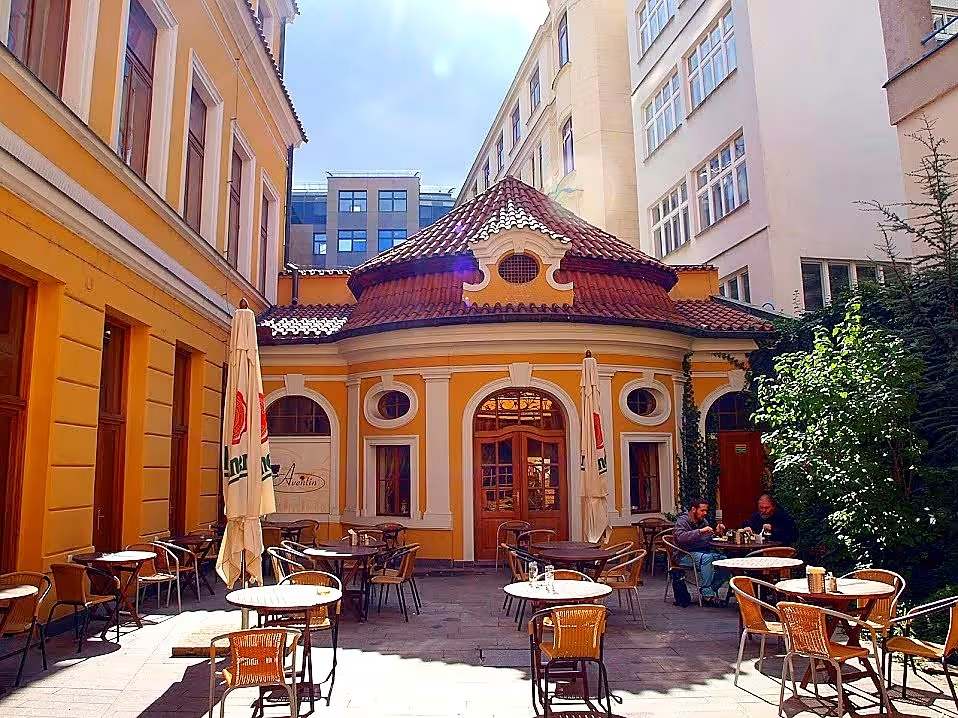
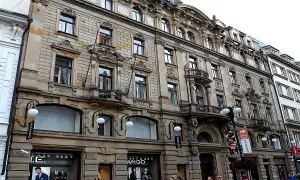
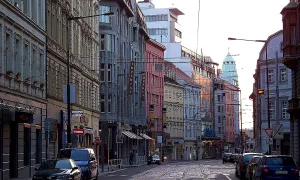
Palác Aventin stands in Purkinov Street on New Town of Prague and is also known as Zedwitz Palace or Zedtwitz Palace. The name Aventinum bears according to the publishing house, which was based here among the world's wars and left a mark in the awareness of the Prague cultural public.
The history of the building dates back to the 15th century, when there was a medieval house in the immediate vicinity of the former Jewish cemetery. Over the centuries, the construction has undergone successive reconstructions corresponding to changes in architectural styles - Renaissance, Baroque and later classical modifications. In 1707, a reference to the above-ground part, built by Karel Arnešt von Bissinger, appeared for the first time in the written records. A more fundamental change came in 1803, when the construction had a complete reconstruction according to the design of architect Ignác Palliardi.
By 1814, the shape of the period springs were crystallized. It was a well-built house with two floors. There was a basement in the ground floor, on the ground floor there was a room for the janitor, a road and a stable for two horses, a master's kitchen and a shed. The first floor had six rooms and two rooms, the second floor had five Mansard rooms. Part of the construction was supposed to be a semi-circular gazebo called a chapel or a gloriette, which was probably part of Palliardi's architecture.
In 1911, the house became the property of the lawyer JUDr. Zikmund, who adapted it to his needs and arranged it as an office connected by a bunk bed. Among the world's wars, there was the Aventinum Publishing House, which also made the palace a cultural centre. The exhibition hall called the Aventine Mansard, which hosted the personalities of the Czech art avant-garde and became an important meeting place for the creators.
In the 1980s, the Slovak Culture Centre in Prague was located here. In 1989, the new owner Vladimir Malínský took the house, under which the construction underwent several minor repairs. A substantial reconstruction and modernization took place between 2006 and 2007, while maintaining the original baroque spatial solution and a number of Gothic elements that survived from the depths of years. The building remains part of the dense surrounding building of the New Town and represents a typical example of Prague architecture with its layered history.
Then and now
Drag the slider to compare how the landmark may have looked when it was built with the view today.
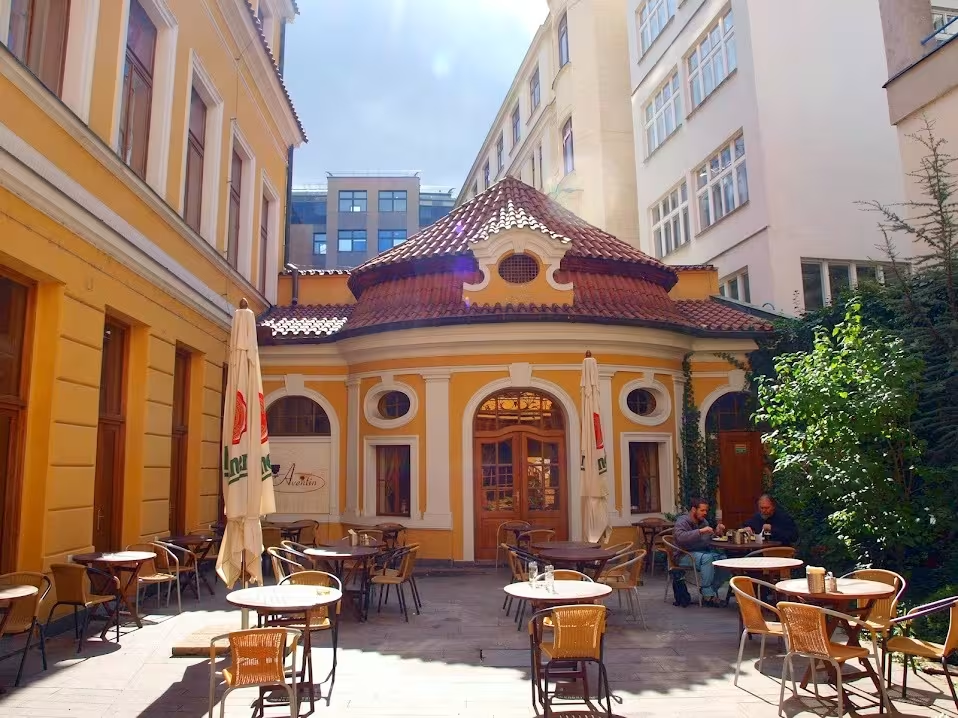

The historical appearance on the left is an AI-generated visualisation and serves as inspiration only.
Historical milestones
- 1707
- Built baroque above ground on the cellars of the original Gothic house
- 1803
- Classicist reconstruction according to Ignác Palliardi, including interiors and cellars
- 1911
- Buying the house by JUDr. Zikmund and editing the office with a bunk bed
- 2006-2007
- Reconstruction with preservation of historical elements
Architectural development
The original Gothic cellars from the 15th century were covered in the 17th century by the Baroque extension of Karl Arnošt von Bissinger. Another reconstruction took place in 1730, and subsequently in 1803 Ignác Palliardi carried out extensive classicist modifications, which included a semi-circular gazebo. In 1894 a neo-Baroque wing was added. The Gothic cellars are preserved and still visible.
Historical events
- 1707
- Built above ground part of the Baroque palace on the cellars of the original Gothic house
- 1803
- Total classical reconstruction according to Ignác Palliardi, including cellars and interiors
- 1911-1945
- The Palace served as the headquarters of the Aventinum publishing house and exhibition hall of Czech art avant-garde
- 2006-2007
- Reconstruction with preservation of original Baroque layout and Gothic elements
Owners
1707 – Karol Arnošt von Bissinger; 1803 – Ignác Palliardi (architectural adaptations); 1911 – JUDr. Zikmund; 1989 – Vladimir Malinský; 2006-2007 – reconstruction' (owner not mentioned but probably private owner).
Points of interest
- Palác Aventin is also known as Zedwitz Palace or Zedtwitz Palace.
- The building was built in a medieval house near the former Jewish cemetery and underwent gradual reconstruction in Renaissance, Baroque and classical style.
- In 1707, Karel Arnešt von Bissinger had the above-ground part of the building built as an encapsulation of the original medieval court.
- In 1803 the palace underwent a complete reconstruction according to architect Ignác Palliardi, who probably also designed a semi-circular gazebo called a chapel or a glorietta.
- The Aventinum publishing house, which was based here among the world wars, turned the palace into a cultural centre with the Aventine Mansard Exhibition Hall, which hosted representatives of the Czech artistic avant-garde.
Guide
This guide is narrated by a synthetic voice generated by artificial intelligence.
Show guide text
This text was created by artificial intelligence and has not been editorially reviewed. It may contain inaccuracies.
The Palác Aventin, also called the Zedtwitz Palace or Aventinum Publishing House, is a Baroque palace on Purkyňova Street in the New Town of Prague. It does not stand alone but is incorporated into the dense surrounding development.
A medieval house once stood on this site, with a history dating back to the fifteenth century. It was located in the immediate vicinity of the former Jewish cemetery. Over the centuries, it underwent Renaissance, Baroque, and Neoclassical renovations.
A written record from seventeen hundred and seven describes the above-ground part of the medieval enclosed courtyard, which was built by Karel Arnošt von Bissinger. In eighteen hundred and three, a complete reconstruction followed according to a design by architect Ignác Palliardi. His work is also probably the semicircular pavilion, which was called a chapel or glorieta.
Sources from eighteen hundred and fourteen already describe a well-built two-story house. In the basement there was a cellar. On the ground floor, there was a caretaker's room and a carriage house, stables for two horses, a manor kitchen, and a storage room. The first floor consisted of six rooms and two studies, and on the second floor there were five mansard rooms.
In nineteen eleven, the house was acquired by Doctor of Law Zikmund and he converted it into offices, which he connected by a gallery. Between the world wars, the Aventinum publishing house was based here, and it is after this publishing house that the palace takes its name. It also included the exhibition hall Aventinská mansarda, where a number of personalities of the Czech artistic avant-garde presented their work.
In the nineteen eighties, a center of Slovak culture in Prague was active in the palace. In nineteen eighty-nine, Vladimír Malínský became the owner of the building and the building underwent several minor modifications. A fundamental reconstruction and modernization came in two thousand and six and two thousand and seven. During this work, the original Baroque spatial layout and a number of Gothic elements were preserved.
Frequently asked questions
Can the monument be visited?
Some buildings of this kind are open for guided tours, others serve another purpose or are privately owned. We have not verified whether and when this monument is open – please ask the operator.
What are the opening hours and admission?
We have not verified the opening hours or admission. Current information is published by the operator.
Where is the monument?
Location: Purkyňova 53/4, Nové Město, Praha, Hlavní město Praha. The map on this page shows the exact spot.
Why is the monument protected?
It is listed in the Central List of Cultural Monuments of the Czech Republic as a cultural monument (register no. 39854/1-1065).
For kids
Imagine going back to the past and finding yourself in the heart of Prague! The city is still young and full of energy, but it already has its own respectable sights. One of them is Palác Aventin, which today stands in the middle of a dense development.
It was like in a game where the pencil and the arrow connect into one continuous chain. This is how Palác Aventin integrated into the surrounding building to be part of the Prague estate. Who would have thought this place would be known as the Aventinum Publishing House or the Zedwitz Palace one century later?
Businesses nearby
Do you run a restaurant, accommodation, shop, museum, rental, wellness or other visitor service near this monument? Show yourself directly to the people heading to it — this is how they will see you in the app and on the web:
Events nearby


Zdroj akcí: otevřená data měst a obcí ČR (Národní katalog otevřených dat) a kalendář akcí Národního památkového ústavu.
Accommodation nearby
Trips and activities nearby
Guided tours, tickets and activities nearby from GetYourGuide
Affiliate link: if you buy from the partner, we may receive a commission. The price for you does not change.
Search tours and activities →Themed route
Thematic cruise route Palác Aventin
1.Palác Aventin - * Type: * Historical Palace - * Why is it worth visiting: * Palác Aventin, located in the heart of New Town, is an example of architectural elegance and history. Its elegant facade and rich history make it an essential visitor material for anyone interested in the cultural heritage of Prague.
2. Church of St. Nicholas - * Type: * Gothic Church - * Why is it worth visiting: * Church of St. Nicholas, located near the Palace of Aventina (about 300 metres), is one of the oldest and most important Gothic monuments of New Town. Its history dates back to the 14th century, making it an ideal place for the spiritual and architectural wealth of the area.
3. Jewish cemetery in Olšany - * Type: * Historical Jewish cemetery - * Why is it worth visiting: * This nail, located approximately 500 metres from the Aventine Palace, is one of the oldest Jewish burial sites in Prague. Its historical graves and monuments testify to the rich cultural and spiritual tradition of the Jewish community in the city.
4. National Museum - * Type: * Historicist building - * Why is it worth visiting: * The National Museum, located approximately 800 metres from the Aventine Palace, is not only the architectural pearl of Prague, but also home to rich collections and exhibitions. Its history and location offer a valuable view of the cultural development of the Czech nation.
This route offers a comprehensive view of the cultural and historical richness of New Town, each of the visited places contributing to an overall understanding of the spiritual and architectural tradition of the area.
Seasonal recommendations
In spring the palace will surround the awakening greenery and the first flowers that give the surroundings a fresh look. Soft spring light is ideal for observing facade details. We recommend wearing more layers of clothing because the weather is variable. The best thing is to visit the memory in the morning when the roads are less crowded.
The summer season brings a radiant sun and dense shade of trees that creates a pleasant contrast with the hot surface of the roads. The atmosphere is full of energy and vibrancy. Due to the high season and large crowds of visitors, please come right at the opening. Don't forget light, breathable clothes and plenty of fluids.
In autumn, the gardens around the palace turn into golden and red tones, creating a nostalgic and calm mood. Frequent morning fog gives the place mystery. It's practical to have a waterproof jacket with you. The ideal time to visit is late afternoon, when the low sun will highlight architecture beautifully.
In winter, the monument is elegant, especially if it is covered by a layer of snow. There is peace and quiet, which contrasts with the noise of the centre. Due to the frost, warm clothes and solid shoes are essential. In advent time, count on shorter opening times, so plan to arrive before dark.
Visualizations and artistic views


The visualisations are generated by artificial intelligence and serve as inspiration.
Photos from the area
Real photos taken near the monument


Zdroj a licence jsou uvedeny u každého snímku.
Atmosphere of the place
This atmospheric visualisation of the place and period was generated by artificial intelligence. It is not real footage of the location.
Tips from visitors
No tips yet. Be the first!
Log in and add your tip.
Sources and literature
Photos: VitVit / CC BY-SA 4.0 — Wikimedia Commons. The author and licence also appear when you hover over the image.
Faktickým podkladem tohoto textu byl článek na Wikipedii, jehož autory jsou přispěvatelé Wikipedie. Článek je dostupný pod licencí CC BY-SA 4.0.
Location on the map
More monuments – Nové Město
Show all in the municipality


Příběhy a pověsti
Legendy, pověsti a příběhy spjaté s touto památkou
Fotografie návštěvníků
Zatím žádné fotografie. Buďte první, kdo přidá fotografii z návštěvy!
Log in a přidejte svou fotografii nebo hodnoťte.
Za ověřenou návštěvu v aplikaci získáte víc bodů — poznáme podle GPS, že jste na místě.
Reviews and comments