



Šimkův mlýn Water mill
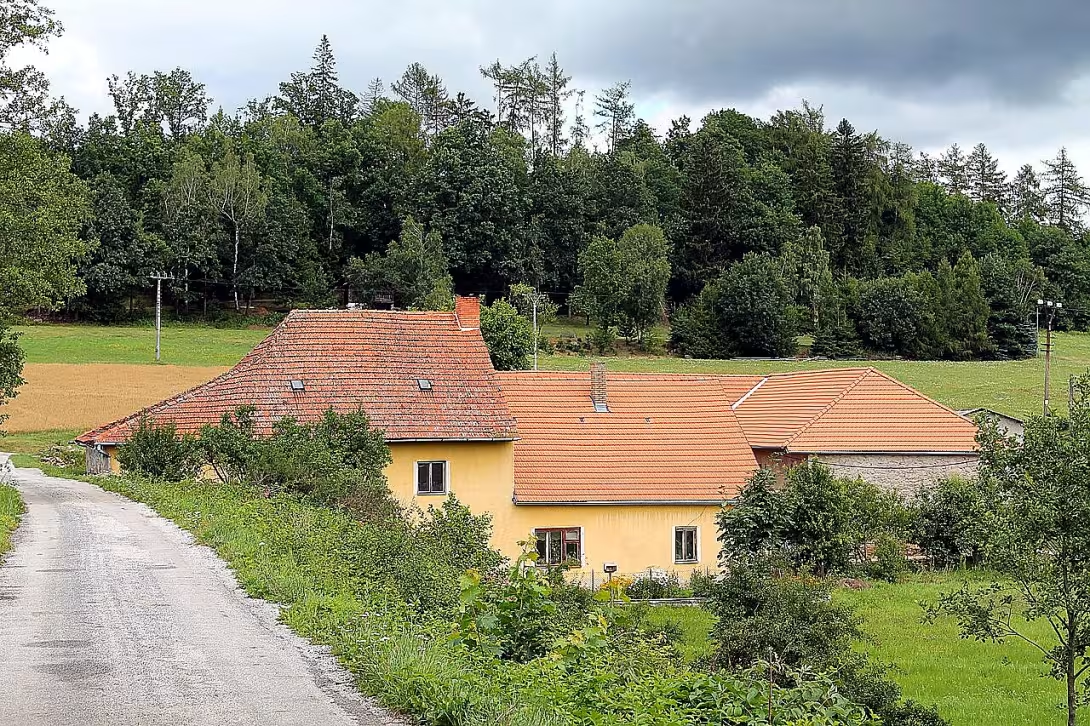
Šimkův mlýn in Vanov in Jihlava is a classic water mill situated under the dam of the Smrk pond on the Telč creek. This technical monument dates back to the first half of the 19th century. It stands out for a unique disposition solution that allows for effective handling of cereals directly from the dam or driveway level.
The history of the building is linked to the first half of the 19th century, when the Baroque style was born in Czech countries and classicism started. The company was then undergoing a national revival and industrial revolution. These influences were reflected in architecture, which emphasized moderation and functionality. Around 1800, there was a divide between the Baroque and Classicist phases of the mill construction.
The area consists of buildings arranged around a square yard, covered with saddle roofs. The mill itself is a walled one-story building. The construction was designed from the beginning as a three-storey, which was sufficient for the operation at the time. Thanks to the generous spatial solution, it was not necessary to increase the building in any way during later modernization to artistic composition. A large part of the inner space was probably used for long-term storage of grain.
Technical interest is the method of transporting grain, which used the height difference between the pond dam and the grinding floor. The water for the mill wheel drive was brought directly from the Smrk pond. The interior has been preserved by a French grinding stone, which was manufactured by the company Gabriel Žižka from Prague Vinohrad.
The building is currently protected as a real-estate cultural monument of the Czech Republic. Due to its location near the historic Telč kernel, which is included in the UNESCO World Heritage List, it represents an important objective for interested people in technical monuments. The visit to the Šimkova Mill offers the opportunity to look into the history of the mill craft and appreciate the ingenuity of the 19th century construction solutions.
Then and now
Drag the slider to compare how the landmark may have looked when it was built with the view today.
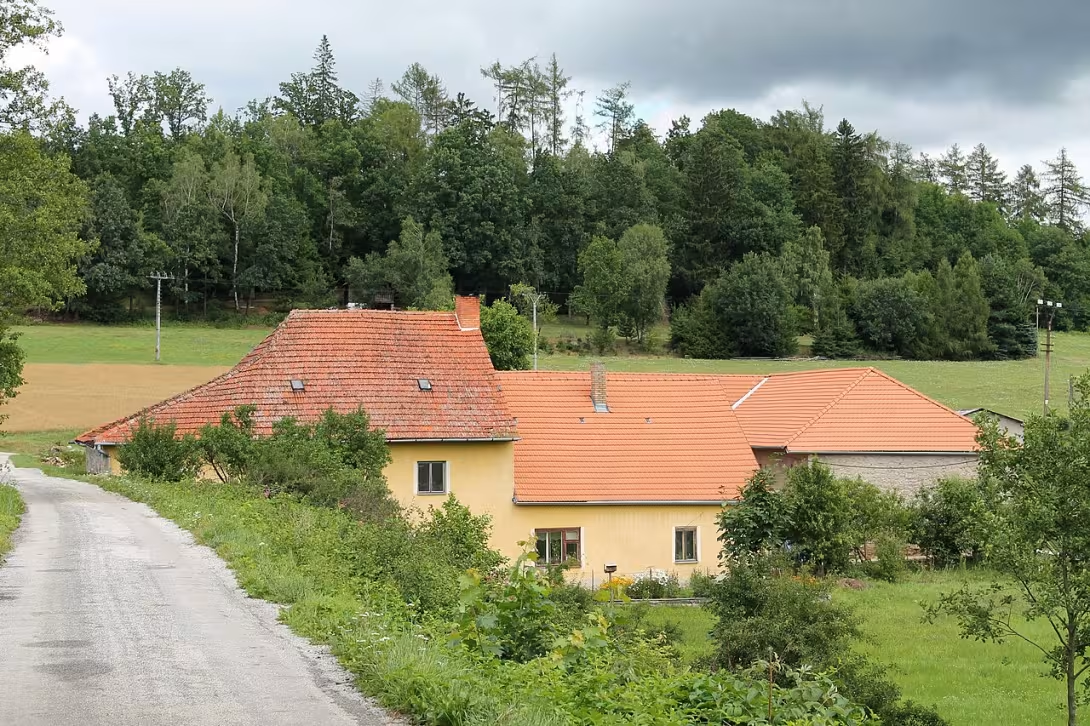

The historical appearance on the left is an AI-generated visualisation and serves as inspiration only.
Historical milestones
- Around 1800
- Divide between the Baroque and Classicist phases of the construction of the mill.
- 1801-1850
- Construction of a classical water mill in the first half of the 19th century.
- 1851-1900
- Modernization of the mill to artistic composition.
- 20th century
- Entry of the building into the list of real cultural monuments of the Czech Republic.
Architectural development
The original Baroque building was later rebuilt in a classical spirit. The mill was designed from the beginning as a three-storey, allowing its modernization to the artistic composition without the need to increase the building.
Points of interest
- Šimkův mlýn is a classic water mill situated under the dam of the Pond of Smrk on the Telč stream. - The unique layout allows for effective handling of cereals directly from the level of the dam or driveway. - The area consists of buildings arranged around the square courtyard, which are covered with saddle roofs. - The interior was preserved by a French grinding stone, which was manufactured by the company Gabriel Žižka from Prague Vinohrad. - The construction of the mill was designed from the beginning as a three-storey, which enabled later modernization without the need to increase the building.
Guide
Show guide text
This text was created by artificial intelligence and has not been editorially reviewed. It may contain inaccuracies.
Welcome to the Shimkov Mill in Vanov. Stop for a moment, take a breath and feel the atmosphere of this place. You are standing in front of an important technical monument that is closely linked to the landscape and water. If you look around you, you will see that the mill is situated in the ideal position, right under the dam of the Pond of Smrk on the Telč stream. This water has been a source of energy and life for centuries. In front of you, there is a space that retains the history of human labour, craft championships and technical development from when the mill was the heart of the local economy.
Let us now look together at how the mill has come to this form. The history of this place is a fascinating story of transformation. Around 1800, there was a major turning point, which we refer to in architecture as the prior between the Baroque and Classicist stages of construction. It is a time when older, more decorative baroque shapes began to give way to cleaner and more moderate lines of classicism. Just in the first half of the nineteenth century, specifically between 1801 and 1850, the classic water mill that you see today was built. It was a time of flowering when technical constructions began to be designed with greater emphasis on efficiency and functionality, but at the same time with a certain nobility that classicism brought.
Now pay attention to the architecture itself and to what you see right in front of you. Notice how the whole area is thought out. Buildings are not distributed randomly, but form a set of structures arranged around a square yard. This enclosed area of the yard created a safe and organized space for all operations where the paths of the grain wagons and the movement of the mills crossed. Look up at the roof. Note that all the buildings on the premises are covered with saddle roofs. This type of roof was typical and practical at the time, because it allowed for effective precipitation, which was crucial for their long life near the water.
The main object of the mill is a walled one-story building. Her walls tell of stability and durability. It is fascinating to realize that this object is today protected by a monument because of its original technical equipment. Even though the mill is no longer used to grind grain for the whole village, inside it still breathes the history of machines and mechanisms that used to work loudly and turn grains into flour. In the second half of the nineteenth century, between 1851 and 1900, the mill underwent further modernization. Adjustments were made to the so-called artistic composition at the time, which means that more modern technical elements were involved, which increased performance and quality of grinding.
When we think about this place, we can't ignore the people who worked here. The history of the Šimkov Mill is connected, for example, to Gabriel Žižka. Imagine these people, who spent days and nights here, listening to the noise of water from the Smrk pond and taking care of complex machines. The mill wasn't just a craft, it was a responsibility for food security around here. Each of them brought his own story, his own diligence and his knowledge to this area, which passed down from generation to generation. Thanks to their care and subsequent recognition in the twentieth century, the building was included in the list of real cultural monuments of the Czech Republic, which provided protection for future generations.
Now I want to impress you with one fact that makes the Šimko Mill a real one. If you look at the position of the mill against the pond dam and the driveway, you may not see anything unusual at first sight. But in this particular detail is the genius engineering of the time. The mill has a unique layout solution. It was designed to allow efficient handling of cereals directly from the dam level or from the driveway. Imagine those heavy bags of grain that didn't have to be carried along difficult paths, but thanks to the smart layout of the spaces and the use of the terrain, the material could be transported much easier. It was basically an early prototype of logistical optimization that saved time and human strength. It's a detail we can easily overlook, but it shows how deeply the builders at the time were focused on the practical use of space.
Šimkův mlýn is not just a set of walls and roofs, it is a monument to a time when man lived in a much closer connection with nature and its elements. The water from the Telč creek, which powered the mill wheel, was a silent partner in every grain of flour. When you stand in this silence today, try to imagine the contrast from the past: the noise of millstones, the tearing of cars in the yard, the calling of people and the constant, rhythmic sound of flowing water.
Now that you know the story of this place, its architecture and its technical uniquities, I encourage you to take a closer look at the site. Take a walk around the buildings, see the texture of the walls, and think about how the time changed from baroque beginnings to classical flowering to the modernization of the late nineteenth century. Let yourself be filled with the peace of this place under the dam of the Srk pond.
Thank you for accompanying me on this short journey through the history of the Šimkov Mill. I hope you are interested in this view of the past and that you will take away a sense of respect for human work and the technical joke of our ancestors. I wish you a pleasant continuation in discovering the beauty of our landscape. Goodbye.
Tips for visitors
The best time to visit is late spring or early autumn, when the surroundings of the Smrk pond are the most picturesque and the weather wishes to walk around the technical monument without the deadly summer heat.
By public transport you can get close to the surrounding villages, please check the current connection in the traffic locator.
We recommend to take fixed shoes suitable for movement in the area with historical tiles and in the surrounding terrain under the pond dam. Don't forget the camera, especially for capturing the details of the technical equipment of the mill.
The best light for shooting the mill is in the morning when the sun beautifully illuminates the square courtyard and facades of buildings. Interesting pictures can also be taken from the dam of the Smrk pond, where there is a nice general view of the resort.
For families with children the location is ideal for easy walks in nature. In the vicinity we recommend visiting the Smrk pond and the historic heart of Telč, which is listed on the UNESCO list and offers many suggestions for small and large visitors.
Frequently asked questions
Can the monument be visited?
This is a technical monument. Some are open as exhibitions, others are out of use or on private land. We have not verified whether this one is accessible.
What are the opening hours and admission?
We have not verified the opening hours or admission. Current information is published by the operator.
Where is the monument?
Location: Kraj Vysočina. The map on this page shows the exact spot.
Why is the monument protected?
It is listed in the Central List of Cultural Monuments of the Czech Republic as a cultural monument (register no. 1000131830).
Businesses nearby
Do you run a restaurant, accommodation, shop, museum, rental, wellness or other visitor service near this monument? Show yourself directly to the people heading to it — this is how they will see you in the app and on the web:
Events nearby
Zdroj akcí: otevřená data měst a obcí ČR (Národní katalog otevřených dat) a kalendář akcí Národního památkového ústavu.
Nearby
Pond of Smrk, the city of Telč with a historical core listed on the UNESCO list.
Accommodation nearby
Trips and activities nearby
Guided tours, tickets and activities nearby from GetYourGuide
Affiliate link: if you buy from the partner, we may receive a commission. The price for you does not change.
Search tours and activities →Themed route
1. Rybník Smrk, natural location. Walk around the water offers a quiet environment. 2. Šimkův mlýn, mill. The main destination of the trip, which represents a unique technical monument. 3. City Telč, historical core. A tour of the unique World Heritage Center.
Seasonal recommendations
Spring: In the spring season Šimkův mlýn offers unforgettable experiences with the return of flowers and heather breath that weave the whole landscape. Sun rays penetrate through fresh leaf trees, creating attractive lighting for photography and walks. This is also the time when the first hint of sunny noon or mild rains may appear, which adds a specific atmosphere to the trip. We recommend visiting the mill at the beginning of the day when there are even fewer visitors and nature is in its brightest form.
Summer: Summer brings Šimkův mlýn full of blood with long days and warm sunlight, which highlights every detail of this historic place. Nature is in the best condition, with full leaves of trees and flowering bushes, making the surrounding green spaces ideal for relaxation. However, due to the large number of visitors it is advisable to come early in the morning or in the shade of the afternoon. Don't forget the sun protection and enough drinking to avoid dehydration.
Autumn: In the autumn Šimkův mlýn offers unique experiences thanks to the colour palette of the leaf tree and mild heat, making the walk comfortable. The sunny morning and quiet afternoon are ideal for relaxing in nature, while the beautiful atmosphere of the autumn day can be unforgettable. This period is also suitable for photography when the illuminating colour of the leaves is reflected in the historical architecture of the mill. We recommend visiting this place in the early afternoon to enjoy a quieter visit and the beauty of the autumn day.
Winter: Winter visit Šimkův mlýn offers a completely different atmosphere where quiet and quiet green spaces pass into the snow blanket. The shadow of trees creates dramatic lighting on historical buildings, which is ideal for photography and peaceful walks. Due to shorter daylight and cold temperatures, it is important to come up with warm clothes and suitable shoes because the local equipment may not be fully functional. The best time to visit is in the shady half of the day when there are fewer people and a quieter atmosphere offers an escape from winter happiness.
Visualizations and artistic views


The visualisations are generated by artificial intelligence and serve as inspiration.
Photos from the area
Real photos taken near the monument


Zdroj a licence jsou uvedeny u každého snímku.
Tips from visitors
No tips yet. Be the first!
Log in and add your tip.
Sources and literature
Photos: Harold / CC BY-SA 3.0 — Wikimedia Commons. The author and licence also appear when you hover over the image.
Faktickým podkladem tohoto textu byl článek na Wikipedii, jehož autory jsou přispěvatelé Wikipedie. Článek je dostupný pod licencí CC BY-SA 4.0.
Location on the map


Příběhy a pověsti
Legendy, pověsti a příběhy spjaté s touto památkou

Fotografie návštěvníků
Zatím žádné fotografie. Buďte první, kdo přidá fotografii z návštěvy!
Log in a přidejte svou fotografii nebo hodnoťte.
Za ověřenou návštěvu v aplikaci získáte víc bodů — poznáme podle GPS, že jste na místě.
Reviews and comments