



Socha svatého Jana Nepomuckého 1747 Statue
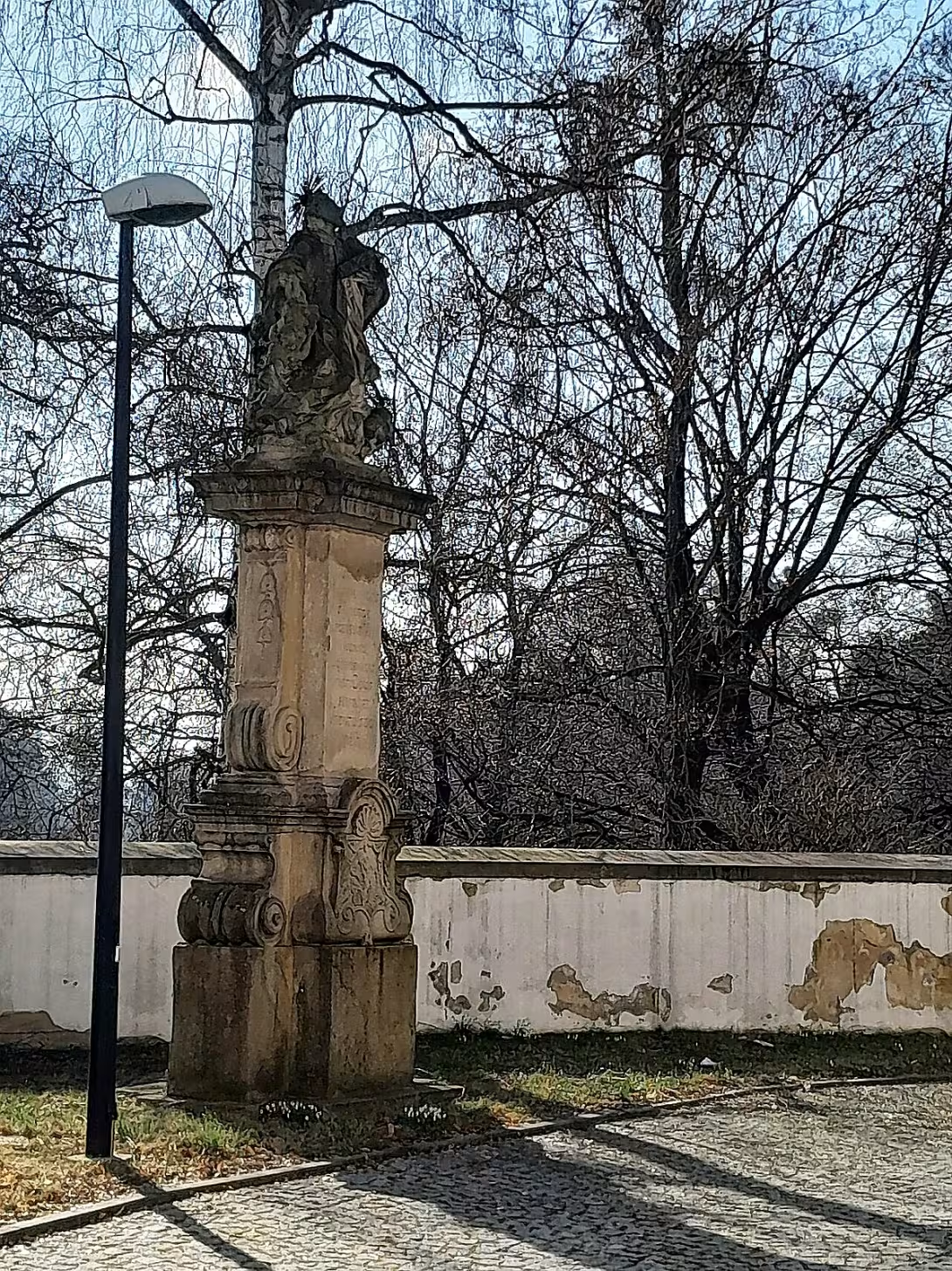
The statue of St. John Nepomuk from 1747, located in the village Fryštát near Karviné, is a Baroque cultural monument with significant historical and aesthetic value. This statue stands on the grounds of the Church of the Ascension of the Holy Cross and is protected as a cultural monument. Its location in Fryštát, a former city with a rich history, adds another layer to its importance.
The statue of St. John Nepomuk was created in 1747 by the Midsummer Brotherhood in Fryštát. This timeframe is linked to the period of Baroque art, which has expanded and influenced many aspects of culture and architecture in Europe. In Czech countries, this period was characterised by political changes under the Habsburg government, which contributed to the development of art and religious life. The statue of St. John Nepomuk is important not only as a work of art, but also as a symbol of the time.
The architecture of the statue of St. John Nepomuk is typical of Baroque style. Its sandstone structure creates a figure above life size, decorated with angel heads. The statue stands on a three-metre high quadruple with a smooth plinth and reliefs of Confession and Kneeling Priest before the cross, which decorate its sides. These elements are surrounded by volutes and shell, which is a common feature of Baroque decoration. The base of the statue is decorated with a profile plate, which gives the whole part a distinctive and impressive character.
The history of the statue of St. John Nepomuk includes several key events. It was originally built in the square Fryštát, where it was repaired in 1865 by the Father Karel Hudzietz. This adjustment meant an important moment in preserving the monument. Later, the statue was moved to the parish garden of the Holy Cross, where it stands beside the statue of Our Lady of Pain. There was another repair in 1973, which indicates permanent care for this historical object.
The statue of St. John Nepomuk is today a protected cultural monument and stands as an important element of the Church of the Elevation of the Holy Cross. Its historical value lies not only in visual impression, but also in reminiscing of the history of Fryštát and its religious tradition. For tourists, the statue is an attractive place to visit, offering a view of the rich history of the region.
Visiting the statue of St. John Nepomuk in Fryštát offers the opportunity to become acquainted with the Baroque art and history of the local community. It is an opportunity to appreciate the historical value of the monument and its aesthetic appearance which has remained preserved for centuries. The statue of St. John Nepomuk is not only an important cultural monument, but also a symbol of endurance and tradition in Fryštát.
Then and now
Drag the slider to compare how the landmark may have looked when it was built with the view today.
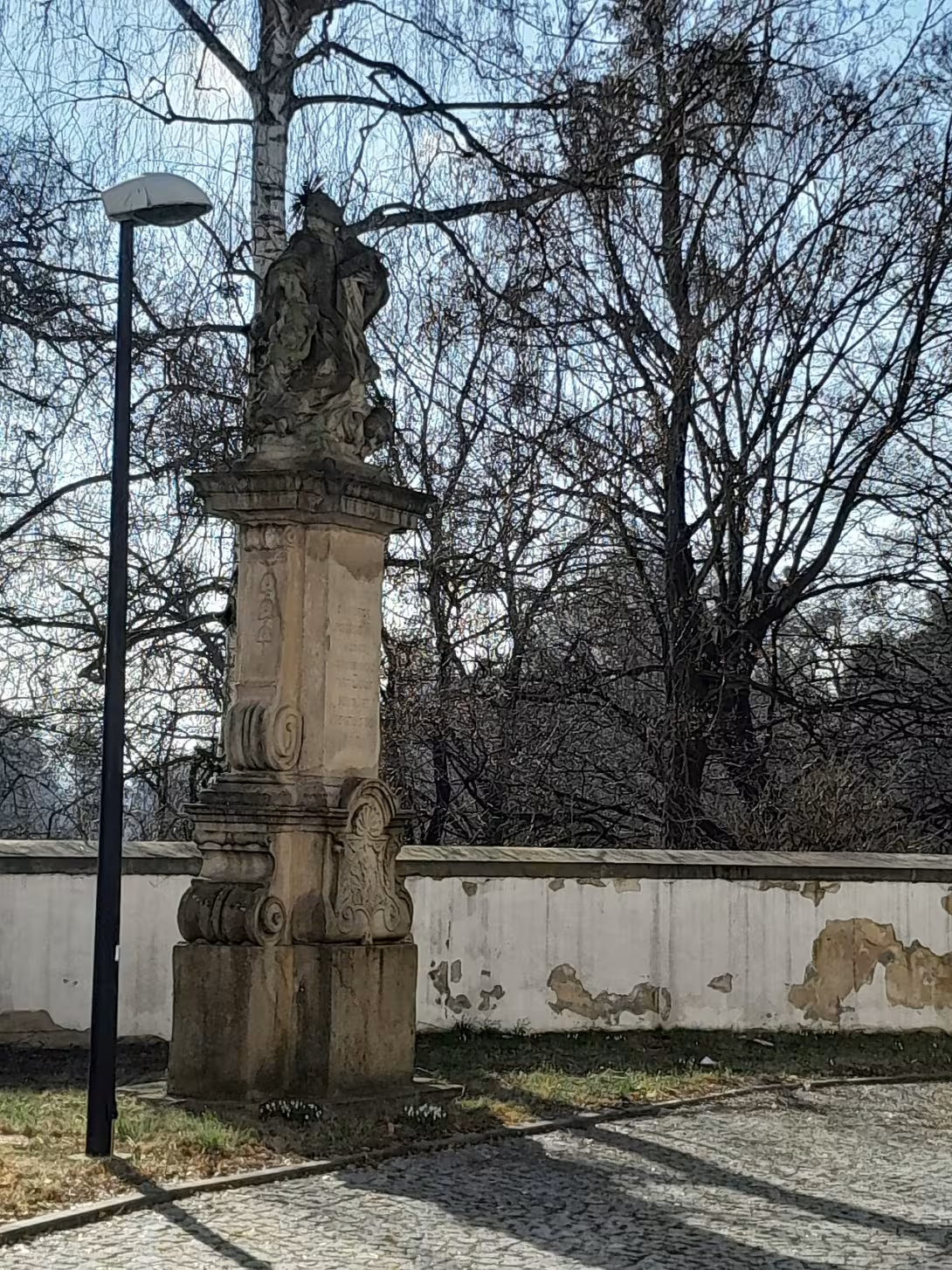

The historical appearance on the left is an AI-generated visualisation and serves as inspiration only.
Historical milestones
- 1747
- The creation of the statue of St. John Nepomuk.
- 1865
- Correction made by Father Karl Hudzietz.
- 1973
- The statue has been repaired.
Architectural development
Baroque statue with reliefs Confession and Kneeling Priest in front of the cross, decorated with volutes and shell. The base is reinforced with a profile plate.
Historical events
- 1747
- The statue was created by the Midsummer Brotherhood.
- 1865
- Correction made by Father Karl Hudzietz.
- 1973
- The statue was repaired in March.
Points of interest
- The statue of St. John Nepomuk from 1747 is a Baroque cultural monument with significant historical and aesthetic value. - It was created by the Midsummer Brotherhood in Fryštát in 1747, which relates to the Baroque period under the rule of the Habsburgs. - The architecture of the statue is typical of Baroque style, sandstone construction above life size with angel heads and reliefs Confession and Kneeling Priest before the cross. - Originally built on the square Fryštát, in 1865 repaired by Father Karel Hudzietz, later moved to the parish garden of the Holy Cross. - It is a protected cultural monument and stands as an important element of the Church of the Holy Cross, reminiscent of the history of Fryštát and its religious tradition.
Guide
Show guide text
This text was created by artificial intelligence and has not been editorially reviewed. It may contain inaccuracies.
Welcome to one of the most important historical monuments in our city. You are standing right now in front of the statue of St. John Nepomuk in Fryštát, who stands before you as a witness of ancient times. Take off your inner haste for a moment, look around you and let yourself breathe the atmosphere of the place where art is bound and the deep respect of past generations. If you look ahead, you will see the monumental sandstone sculpture of this saint, which was created in the year one thousand seven hundred forty-seven. The figure is greater than the common man, which gives it dignity and nobility, and this whole beauty is sensitively incorporated into the wider church of the Holy Cross.
Let us now look deeper into history and discover how this monument actually arose and at what time it was imprinted in stone. It is the year of a thousand seven hundred forty-seven, and the entire county is ruled by the mighty House of Habsburg, whose shadow is developed by the rich artistic expression of the time. It was this year that the community of local believers, called the Midsummer Brotherhood in Fryštát, decided to leave a permanent mark and pay tribute to their favorite saint. This brotherhood has given an incentive to create a work that we now admire as a valuable cultural monument with a high historical and aesthetic value. The exact name of the creator has not been preserved until today, but the artistic manuscript of the anonymous master is quite obvious in every detail of the stone and carries the typical features of its epoch.
Now pay attention to the architecture itself and the details that are right in front of your eyes. The statue of St. John Nepomuk stands on a massive, approximately three metres high four-sided pedestal, which forms a solid and stable base of the entire work. When you slide your eyes over the walls of this pedestal, notice carefully made reliefs and inscriptions in the historical scripture that carry a message for future generations. The sandstone figure of a saint in life size looks down on the passer-by with a calm and conciliatory expression. Feel the texture of the stone, into which the signature was engraved not only by the hands of an old art master, but also by the very time.
Every important monument has its stories and human destinies that have intertwined with it over the centuries, and our statue is no exception. The protection and care of this place did not end on the day of its discovery, but continued through the efforts of people who cared about the fate of the monument. A significant chapter in the history of the statue is the year of the thousand eight hundred and sixty-five, when a thorough repair was carried out under the guidance of a clergyman whose name remained written in chronicles as the Father Karel Hudzietz. This priest took care of the holy place for his own and ensured that the statue could continue to serve its purpose and enjoy the views of the locals. Another necessary recovery took place in the year of a thousand nine hundred seventy-three, when the experts again bowed over the sandstone pedestal and the figure to cleanse it from the teeth of time and preserve it for generations to come.
If you think about how many generations of people have passed this place, you might think about what the statue has experienced and what secrets it carries. It is fascinating to realize that the community that built it has long since wasted time, but their work here stands firmly in place as a silent witness to the transformation of Fryštát. The statue of St. John Nepomuk survived wars, changes in regimes, city changes, and still stands here to remind us of values that persist for centuries. The sandstone from which it is made carries not only the artistic intention of the baroque creator, but also the story of the constant human effort to protect what is beautiful and sacred.
We are approaching the conclusion of our meeting today at this admirable monument. I hope that for you the view of the sandstone figure and its richly decorated base was rewarding and that you took a new look at the history of Fryštát. The area of the Holy Cross Church, the statue of which is an integral part, contains many other stories and beautiful corners worth exploring. When you go on another trip through town, let your curiosity guide your steps and discover further traces of the past. Thank you for your attention, I bid you farewell and wish you a beautiful rest of the day full of nice experiences.
Tips for visitors
A tour of this historical sandstone sculpture is recommended in daylight, when the details of the reliefs on the high pedestal best stand out. The location is located in the public area, so you can see it at any time of the day.
You can use a passenger car or local public transport to travel to your place, and you can easily verify the exact connections in the online travel order search engine. Bring comfortable shoes for walking around and possibly umbrella according to current weather.
To photograph this baroque life-size figure, the most appropriate light is offered in the morning when the sun lights up the front of a four-sided pedestal with Latin inscriptions. For interesting compositions, try shooting with a slight view to capture the total height of the monument from a thousand seven hundred forty-seven.
Since there are no other recommended sites in the immediate vicinity, focus your attention on discovering other historical attractions in the historical core of the city of Fryštát.
Families with children can connect visitors with a quiet walk outside. You can show the children ancient sculpture art and explain to them what decorative reliefs mean on a stone pedestal.
Frequently asked questions
Can the monument be visited?
This is a structure in a public space that can usually be seen from outside free of charge. We have not verified that this particular one is freely accessible.
Where is the monument?
Location: Fryštát. The map on this page shows the exact spot.
Why is the monument protected?
It is listed in the Central List of Cultural Monuments of the Czech Republic as a cultural monument (register no. 1000138241_0004). It is protected as part of a larger listed ensemble.
Businesses nearby
Do you run a restaurant, accommodation, shop, museum, rental, wellness or other visitor service near this monument? Show yourself directly to the people heading to it — this is how they will see you in the app and on the web:
Nearby
🏰 Historic sites (199)
- sv. Jan Nepomucký 0.0 km
- sv. Patrik 0.0 km
- Panna Maria Bolestná 0.0 km
- Kostel Povýšení sv. Kříže 0.0 km
- sv. Jan Nepomucký 0.0 km
- Zámek v Karviné-Fryštátě 0.1 km web
- Madona 0.1 km
- Socha TGM 0.1 km
- Obětem 1. a 2. světové války 1.2 km
- Zdar Buh! Sześć Boże! 2.3 km
- 1914-1918 2.3 km
- Socha svatého Jana Nepomuckého 4.0 km
- Socha Panny Marie 4.2 km
- Kościół pw. Podwyższenia Krzyża Świętego w Kaczycach 4.3 km Ludowa 7
- Valtr Elsner 4.4 km
- Hermína Elsnerová 4.4 km
- Pomník horníkům 4.5 km
- KWK Morcinek – Zostali na wiecznej szychcie 4.7 km
- Pomnik św. Jana Nepomucena 4.9 km
- 1924-1918 + 1939-1945 5.3 km
🍽️ Restaurants and dining (461)
- Elektra 0.1 km Masarykovo nám. 5/4
- U Koplíků 0.1 km
- cafe BB bar 0.1 km
- Restaurace Baron 0.1 km
- Venezia 0.1 km
- Rest&rt 0.1 km
- Bok of Ka 0.2 km Svatováclavská 33/2
- Vanilla 0.2 km web
- Antalya Kebab 0.2 km
- Restaurace Zlaté časy 0.3 km
- DLOUHÉ VIDLE, s.r.o. 0.3 km
- Dinos Restaurant 0.5 km +420 774 002 162 web
- Panda 0.9 km
- Delikana 0.9 km web
- Adamo Restaurace 1.0 km
- Majaček 1.1 km
- Le Café 1.1 km
- Občerstvení u kruháče 1.2 km
- Společenský dům Lázní Darkov 1.3 km
- Kino Centrum Café 1.3 km tř. Těreškovové 2234/24
🏨 Accommodation (58)
- Apartmany BB 0.1 km
- Koleje Slezká univerzita 1.9 km Na Vyhlídce 1079/1
- Lázně Darkov, a.s. 2.2 km Čsl. armády 2954/3 +420596372210 web
- Country Motorest 7.1 km
- Nasz Folwark 7.8 km
- Hotel Sport 8.2 km web
- Vulture 8.5 km U Pošty 371/4 web
- Hotel Impuls 8.8 km U Hřiště 1324/13b web
- Penzion Urban 9.6 km +420603783554 web
- Penzion Pod Zámkem 9.7 km +420 725 178 819
- U Jelena 10.1 km +420 608 751 517 web
- Penzion Amerika 10.3 km +420 736 627 315 web
- Penzion U Popelků 10.3 km +420 724 200 838 web
- Resort Těrlicko 10.4 km +420 724 387 666 web
- Restaurace a penzion U Lesa 10.5 km +420 732 595 205 web
- Hotel "Dąbrówka" 10.6 km
- Willa "Dąbrówka" 10.6 km
- Willa "Dąbrówka" II 10.7 km
- Hostel Dzika Kaczka 11.2 km +48 730 888 240 web
- Boršičanka 11.2 km
🚲 Rentals and sport (94)
- STaRS Karviná - víceúčelová hala 0.3 km
- Sportisimo 0.8 km
- Tipsport 0.8 km
- Hala házené 1.2 km
- Bazén Stars 1.4 km
- Modelářské letiště Hohenegger 5.8 km
- KKS Spójnia Zebrzydowice 5.9 km
- Petrovická kotlina 6.0 km Dolní Marklovice 253 +420 608712504 web
- Spójnia zebrzydowice 6.2 km
- Boisko Kończyce Małe 6.5 km
- Sportovní hala 6.8 km
- LKS OLZA Pogwizdów 7.3 km
- Sportovní centrum Na Císařství 7.3 km web
- Sportovní hala Horní Suchá 7.5 km
- Kola Go 7.5 km
- Letní koupaliště 7.8 km
- sportovní areál 8.0 km
- Klub Sportowy LKS Błyskawica 8.2 km
- Sportisimo 8.2 km web
- Squash centrum 8.7 km
🥾 Hiking and nature (98)
- Sad Boženy Němcové 0.4 km
- sady Bedřicha Smetany 0.4 km
- Univerzitní park 0.5 km
- Vrchlického sady 1.0 km
- Lázeňský park 1.2 km
- Lázeňský park, Lázně Darkov 2.4 km
- Kostel Nanebevstoupení Páně 4.8 km
- zámecký park 5.4 km
- Park Rudolfa Kolaczka 5.9 km
- Drewniany kościół św. Anny 7.1 km
- pingwin 7.5 km
- Zespół pałacowy 7.5 km
- lesopark 7.8 km
- Něbrojův kopec 7.8 km
- Lazy 7.9 km
- Zámecký park 7.9 km
- Park Ludowy 8.2 km
- Pastuchovka 8.6 km
- Volontérská studánka 8.8 km
- Stacja Szotkowice 8.9 km
Accommodation nearby
Themed route
Here is a proposed cruise route in the village Fryštát and its immediate surroundings. Since other surrounding areas are missing in the entry, this route leads directly to the main site and its vicinity.
1.Socha svatého Jana Nepomuckého 1747 Type: Statue Why is it worth a visit: This historic Baroque statue from the year seventeen hundred forty seven forms the main destination of our trip and represents an important artistic and spiritual monument to the centre of the village.
2. Castle courtyard in Fryštát Type: Tanks Why is it worth a visit: The immediate surroundings of the statue offer a peaceful area of the historical courtyard, which will draw the visitor into the old days of the castle life.
3. Castle Park in Fryštát Type: Park Why is it worth a visit: The large green area connecting to the historical core provides a pleasant environment for a peaceful walk in nature directly in the village.
4. Church of Holy Cross Ascension in Fryštát Type: Church Why is it worth a visit: This sacral building located close to the main destination complements the spiritual atmosphere of the entire historical place.
Seasonal recommendations
Spring in Fryštát awakens the surrounding natural greenery to a new life, with the rays of the sun falling on an ancient stone and creating fine shadows in the folds of this historic gem from the mid-eighteenth century. In this period you will appreciate a lighter coat or sweater because spring wind bursts can be cold, but a walk through the historical center is very pleasant without crowds of people. The best time to stop and contemplate the monument is in the morning, when the morning fog slowly retreats and the sunlight ideally illuminates the details of the sculpture for your photographic images.
During the main summer season, the statue of St. John Nepomuk is surrounded by lush leafy greenery of the surrounding trees, which provide a welcome shadow during the hot noon hours, while the atmosphere of the city is vibrating with tourism. The ideal time for a visit is either early in the morning, when there is total calm, or on the late evening, when the setting sun paints the sky in warm tones and gives the place a remarkable charm.
Autumn moons bring a melancholy mood to Fryštát, underlining the carpet from the colorful, fallen leaves lining the site, while the dim light of the autumn day highlights the plasticity of the old stone. At this time, warm waterproof shoes and a waterproof jacket are suitable for outdoor standing, as the weather is usually variable and often dry. The most appropriate moment for examining the details of the work of a thousand seven hundred forty-seven is the afternoon when the sun boils to the horizon and creates soft side lighting without sharp contrasts.
The winter season shrouds Fryštát into silence, which sometimes only disrupts the snow crunch under its feet, while the white blanket on the hat and the shrine's shoulder creates a unique contrast with a dark historical stone. For outdoor tours in freezing weather it is necessary to wear a high-quality winter coat, a warm hat, gloves and solid shoes, as the area around the sights can slide. The best time to visit is during the short winter day around noon, when the low sun can illuminate the snowy surroundings and offer a clean view of this work of art.
Visualizations and artistic views


The visualisations are generated by artificial intelligence and serve as inspiration.
Photos from the area
Real photos taken near the monument

Zdroj a licence jsou uvedeny u každého snímku.
Tips from visitors
No tips yet. Be the first!
Log in and add your tip.
Sources and literature
Photos: Ikcur / CC BY-SA 4.0 — Wikimedia Commons. The author and licence also appear when you hover over the image.
Faktickým podkladem tohoto textu byl článek na Wikipedii, jehož autory jsou přispěvatelé Wikipedie. Článek je dostupný pod licencí CC BY-SA 4.0.
Location on the map
Příběhy a pověsti
Legendy, pověsti a příběhy spjaté s touto památkou
Fotografie návštěvníků
Zatím žádné fotografie. Buďte první, kdo přidá fotografii z návštěvy!
Log in a přidejte svou fotografii nebo hodnoťte.
Za ověřenou návštěvu v aplikaci získáte víc bodů — poznáme podle GPS, že jste na místě.
Reviews and comments