



Sousoší Kalvárie (Týn nad Vltavou) Sculptural group
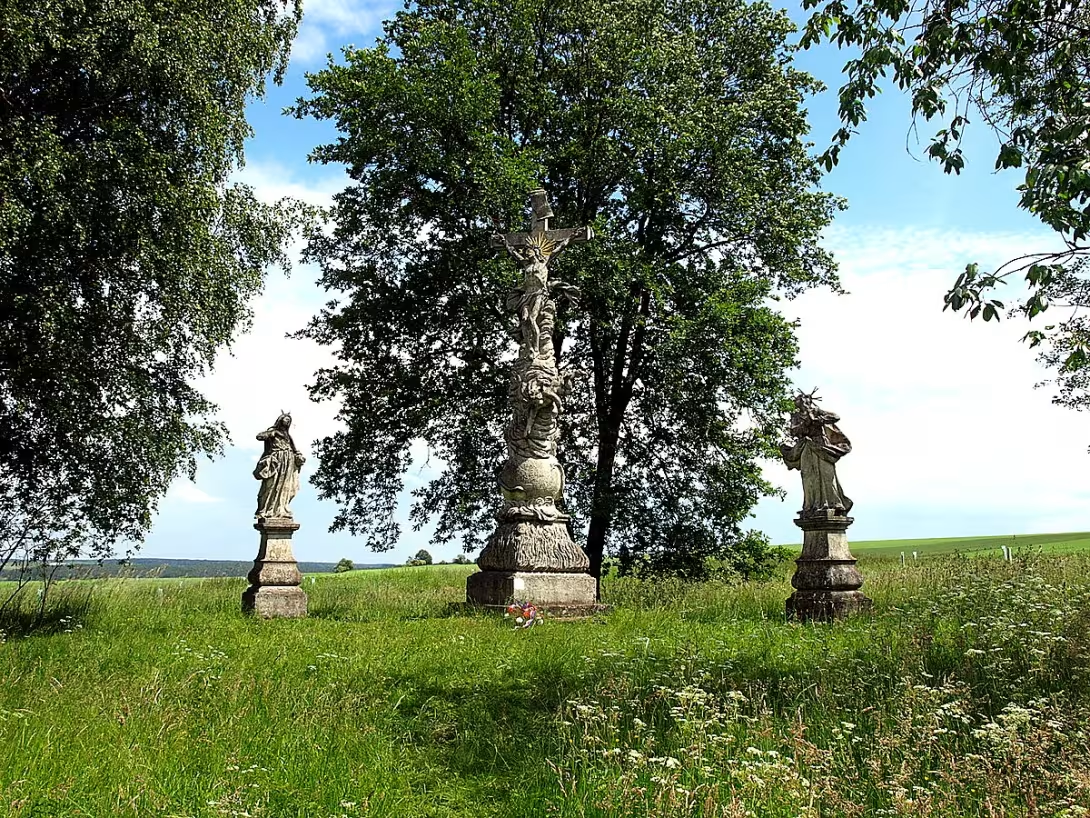
The late Baroque sculpture of Calvary from the second half of the 18th century stands above the village Týn nad Vltavou on the site of the former artillery training ground. The monument resembles a tragic explosion in a 1753 munitions warehouse. This is a significant sandstone work under a monument protection.
The history of the site is linked to the reform of artillery, which was entrusted in 1744 by Empress Marie Terezie Marshal Prince Josef Václav of Liechtenstein. He built a training ground here in 1749. The tragic event occurred on June 20, 1753 at 6:30 a.m. In preparation for fireworks for the Empress, flammable substances ignited. The explosion destroyed two workshops, killed 43 people and injured 48 others.
Sandstone sculpture, also known as the Great Depot, reaches a height of up to 8 metres. It consists of three statues on an architectural plinth. The dominant is the monumental crucifix with the crucified, which grows out of the world wrapped around the snake. Underneath it is a display of purgatory with three faces on fire. On the sides of the crucifix stands on the same sculptures of the statue of Our Lady of the Seven Painful and Saint John Evangelist, both 3.5 metres tall. The authors of works are attributed to the pupils of Matyas Bernard Braun or Ferdinand Maximilian Brokoff.
The question of the exact time of origin remains open. On the back of the crucifix is carved in 1750, which prevents the explosion itself. The use of previously manufactured sculptures is therefore expected or incorrect dating at a later restaurant. The local legends state that the statue was built by the appalled Empress Marie Terezie, but the court office denied the existence of documented documents in 1745.
There were other legends around the Empress. One of them claims that Marie Terezie arrived in Týna incognito disguised as a milkman for fear of assassination. Others say she was held up by a broken carriage. The historical sources confirm, however, that it arrived on the training ground on 6 August 1753, i.e. 40 days after the disaster.
After the dismantling of the training grounds until 1866, the Imperial Votajas were housed here, from which the name Great Depot came. Most of the premises were later leveled. Today, in addition to the sculpture, two settlements, the solitude of the Great Depot and the Bída, survived here in the forest of the Šance and the torso of the Element at the solitude of the Širočina.
The park was modified around the sculpture at the end of the 19th century. At the time of the first republic the maintenance of the monument was entrusted to the Czechoslovak Tourist Department from Týna nad Vltavou. After a long period of decaying, the work underwent extensive renovation in 1994 and followed by a restaurant in 2020. Both works were done by academic sculptor Ivan Tášek.
The sculpture of Calvary presents a unique combination of baroque art and tragic military history. Visiting this place offers the opportunity to observe rare sandstone sculptures and recall events that once hit this site.
Then and now
Drag the slider to compare how the landmark may have looked when it was built with the view today.
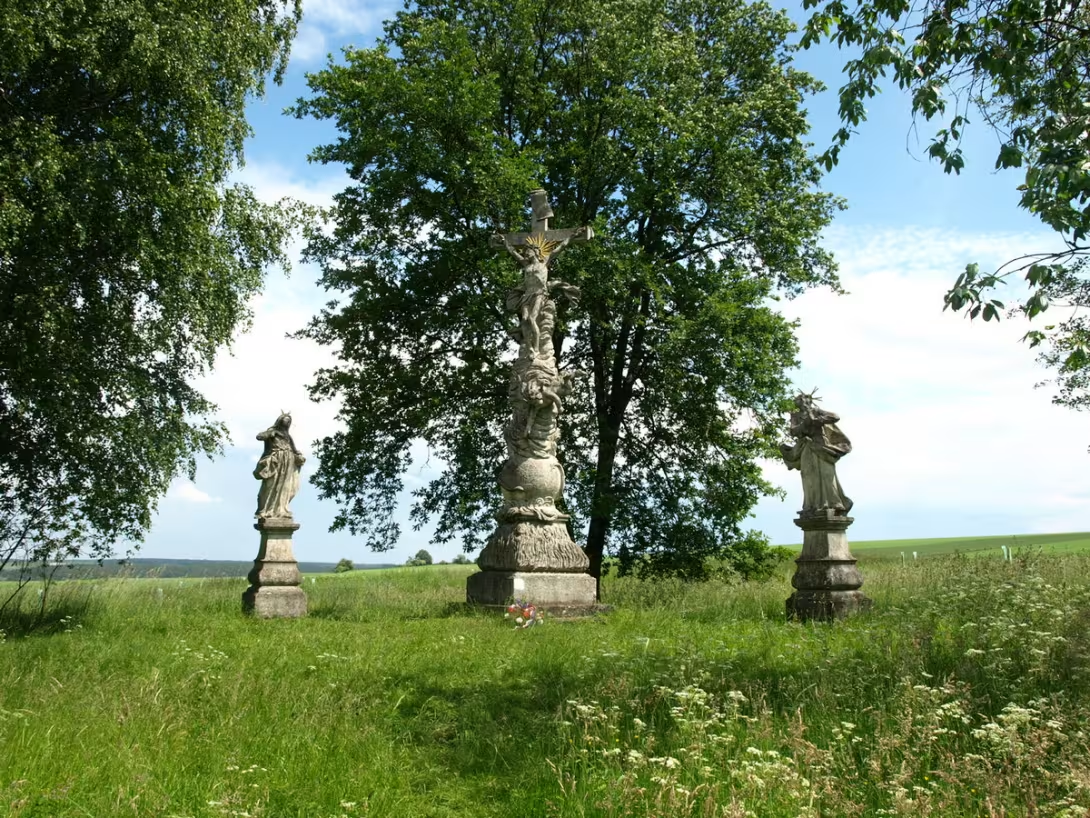
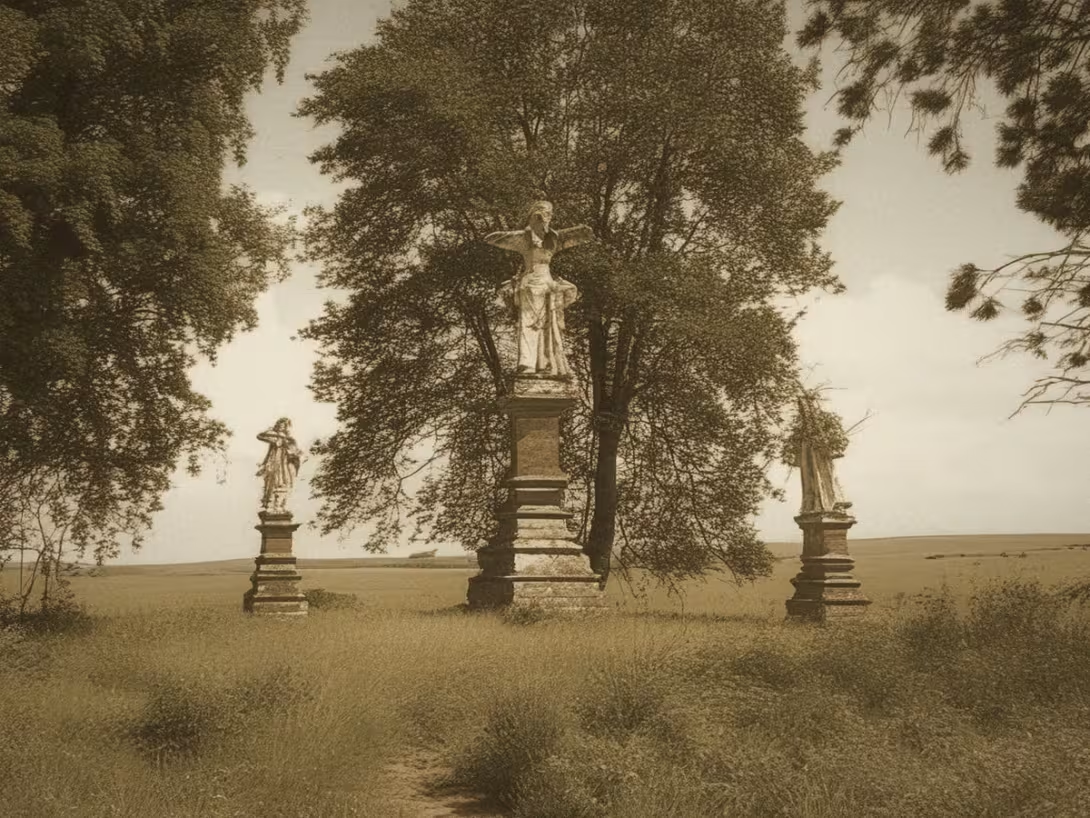
The historical appearance on the left is an AI-generated visualisation and serves as inspiration only.
Historical milestones
- 1750
- The number carved on the back of the crucifix.
- 1753
- Tragic explosion in the munitions warehouse at the artillery training site.
- 1994
- Renovation of demented statues by academic sculptor Ivan Tášek.
- 2020
- Last restoration repair of the sculpture.
Architectural development
It is a sandstone sculpture with monumental crucifix and statues of the Seven Painful and Saint John Evangelist. The author is speculatively attributed to the pupils F. M. Brokoff or M. B. Braun. In 1994 and then in 2020, restoration repairs were carried out in the performance of Ivan Tlašek.
Historical events
on june 20, 1753, there was a massive explosion of flammable fireworks that killed 43 people and injured 48 others.
Points of interest
- The late Baroque sandstone sculpture stands at the site of the former artillery training site and resembles an explosion in the munitions warehouse of 1753. - The work is up to 8 meters tall and contains crucifix on the globe with a snake, depiction of purgatory and statue of the Virgin Mary and Saint John. - The name Great Depot dates back to the time of 1866 when the Imperial Votajas were based here. - The back of the crucifix is carved in 1750, which is before the explosion itself. - The authors of statues are attributed to the students of Matyas Bernard Braun or Ferdinand Maximilian Brokoff.
Guide
Show guide text
This text was created by artificial intelligence and has not been editorially reviewed. It may contain inaccuracies.
Welcome to Týn nad Vltava. Right now, you're facing one of the most striking and moving places in the city. In front of you is the sandstone sculpture of Calvary, which immediately attracts the attention of everyone who comes here with its strength and symbolism. Feel this moment of peace and look at these stone figures standing here as silent witnesses to the past. It's a place where faith, art, and deep sadness over the tragedy that once took place here.
Let us now look together at why this place was created and what its historical context is. To understand the meaning of this sculpture, we must go back more than two centuries in time. You are standing in a place that is very peaceful today, but in the past there was a very different atmosphere. This is where the artillery training ground was located. In the eighteenth century, this area was at the heart of military action, but it was this military presence that brought seven hundred and fifty-three incredible disasters in the year. There was a devastating explosion in the munitions warehouse where the ammunition and powder were stored. It was a tragedy of an unimaginable magnitude in which 43 people were killed. It was this event that became the main reason why this religious monument was later built here. It was supposed to be a reminder of the victims and instead of praying for their souls.
Now pay attention to the appearance of the monument itself and the details that you can see right in front of you. The whole sculpture is performed in the late Baroque style and is made of sandstone. The dominant feature of the entire complex is the high cross, which rises almost eight meters to the height. Look carefully at the base of this cross. Note that the cross grows not directly from the ground, but from the model of the globe. And if you look any closer, you'll see that this globe is surrounded by a snake. It's a powerful symbolic image of good fighting evil. But looking down is even more dramatic. Underneath the earth itself is a depiction of purgatory, where you can see flames that symbolize suffering and cleansing souls. Next to the main cross on the plinth you will find two other statues that accompany this scene, and they are the Virgin Mary and Saint John. The whole area is closed within a memorable space that allows visitors to think in peace about the fleeting life.
When we look at the personalities associated with this place, we must mention the then influential people and monarchs. Although the particular authors of the statues remain unknown, the creation of the monument during this period was closely related to the reign of the monarch Marie Terezie and the influence of the nobles, such as Josef Václav from Liechtenstein. These people shaped the form of the region at the time, and their influence was also evident in the way that it was treated to commemorate such great tragedies. It's fascinating to think how powerful people at the time felt the need to build such a monumental work, so that the pain of the explosion in the munitions warehouse would not outweigh hope for a resurrection.
Here's one interesting thing for you to do to help you better understand the history of this particular corner. You might have heard the name Big Depot somewhere. This name comes from a time when there were military warehouses and training grounds. It is a reminder of the time when this site was a strategically important military point, which is in sharp contrast to today's spiritual atmosphere of Calvary. Another interesting detail is the year. If you had a chance to look at the back of the crucifix, you would see a number of seven hundred and fifty carved. This gives us an exact timeframe for the creation of the essential elements of this work.
But it is important to remember that time is also an enemy to sandstone. The memory has suffered and passed over the centuries. In order to admire her today in such good condition, she had to go through several rescue interventions. In the year one thousand nine hundred ninety-four, an academic sculptor Ivan Tášek set out to restore the fallen statues, who put a great deal of effort into returning the statues to their original face and dignity. And since care for such sensitive material never ends, the last restoration was carried out relatively recently, in the year two thousand twenty. Thanks to these works, we can now see the details of the flames of purgatory or the expression of characters in such clarity.
Now, if you look again at the overall sculpture, try to perceive the contrast between the material hardness of the stone and the spiritual fragility of the topic that is shown here. From the military training ground and the thunder of the explosion to the silent sandstone and prayer. It's a path from destruction to reconciliation.
I hope this short trip to history has helped you better understand the importance of this place. Now you can go through the whole area in peace, think about the fate of the people who lived here centuries ago, and suck up the atmosphere of Týn nad Vltavou. If you're interested in other history of the city, I suggest you continue to explore the surroundings and look for other clues of the past that carry this picturesque place. Thank you for your attention and I wish you the rest of the day to discover the beauty of this region.
Tips for visitors
The best time to visit is late spring or autumn, when surrounding nature complements the sandstone shapes of the sculpture and temperatures are pleasant to walk up the hill. You can reach Týna nad Vltavou by car or public transport; Check the current connection in the travel search engines.
For the trip we recommend to wear comfortable shoes suitable for the field, as the monument stands in the hilly terrain above the city. Since it is an object in public space, which is viewed from the outside, we recommend to take also a bottle of water and a sun hat.
For the best photos we recommend to come in the morning or late afternoon light, which will highlight the details of the Baroque sandstone. Ideal angles are from low positions that emphasize the height of sculptures against the sky.
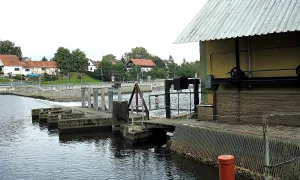
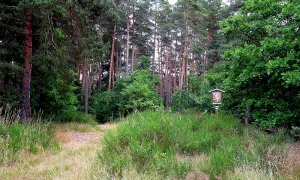
During the visit, you can visit the woods in the forest Na Šance, the remnants of the fortifications at the Širočina solitude or the Great Depot estate and Bída. For families with children, it is ideal to combine a tour of the sculpture with a walk in the surrounding forest where children can discover historical walls.
Frequently asked questions
Can the monument be visited?
This is a structure in a public space that can usually be seen from outside free of charge. We have not verified that this particular one is freely accessible.
Where is the monument?
Location: Týn nad Vltavou. The map on this page shows the exact spot.
Why is the monument protected?
It is listed in the Central List of Cultural Monuments of the Czech Republic as a cultural monument (register no. 1000131429).
Businesses nearby
Do you run a restaurant, accommodation, shop, museum, rental, wellness or other visitor service near this monument? Show yourself directly to the people heading to it — this is how they will see you in the app and on the web:
Nearby
V okolí se nacházejí valy v lesíku Na Šancích, torzo epolementu u samoty Širočiny a usedlosti Velký Depot a Bída.
Accommodation nearby
Trips and activities nearby
Guided tours, tickets and activities nearby from GetYourGuide
Affiliate link: if you buy from the partner, we may receive a commission. The price for you does not change.
Search tours and activities →Themed route
Here is the design of the thematic route:
1. The sculpture of Calvary (religious monument) - The main destination of the trip, where you can admire the spiritual art and atmosphere of the place. 2. On Shanky (fortification) - Walk through the forest, where there are historical walls. 3. Broad (military element) - A stop at the solitude where you can see the remains of an old fortified castle. 4. Great Depot and Bída (homestead) - Visit historical buildings that complement the picture of local architecture.
Seasonal recommendations
In spring, the surrounding nature awakens into life and the fresh green creates a gentle contrast to the historical stone. Light is soft and pleasant in this period, which is ideal for observing details of sculptures. We recommend shoes suitable for wet terrain and visit in the morning when the air is the cleanest.
Summer brings bright sun and rich colors of the landscape, which underline the monumental nature of the whole set. Thanks to long days, the memory can be admired even in the late afternoon, when shadows are longest and dramatic. It is advisable to choose light clothes, a sun hat and plan a journey outside the greatest noon heat.
In autumn, the surroundings turn into golden and brown tones, which gives the place a melancholy and deep atmosphere. Fogs that often float over Vltava can create a mysterious framework for visible works from the outside. It's practical to have a waterproof jacket and take advantage of the time before sunset for the best photos.
Zimą acts as a sculpture in silence and calm, while snow can highlight the shape of the statues and give them a new form. The atmosphere is cramped and humble, typical of cold moons. Hot clothes and fixed shoes with anti-slip soles are essential to keep movement in space safe.
Visualizations and artistic views


The visualisations are generated by artificial intelligence and serve as inspiration.
Photos from the area
Real photos taken near the monument


Zdroj a licence jsou uvedeny u každého snímku.
Tips from visitors
No tips yet. Be the first!
Log in and add your tip.
Sources and literature
Photos: Noe / CC0 — Wikimedia Commons. The author and licence also appear when you hover over the image.
Faktickým podkladem tohoto textu byl článek na Wikipedii, jehož autory jsou přispěvatelé Wikipedie. Článek je dostupný pod licencí CC BY-SA 4.0.
Location on the map

Příběhy a pověsti
Legendy, pověsti a příběhy spjaté s touto památkou
Fotografie návštěvníků
Zatím žádné fotografie. Buďte první, kdo přidá fotografii z návštěvy!
Log in a přidejte svou fotografii nebo hodnoťte.
Za ověřenou návštěvu v aplikaci získáte víc bodů — poznáme podle GPS, že jste na místě.
Reviews and comments