



Tři věže vápenných pecí Limestone
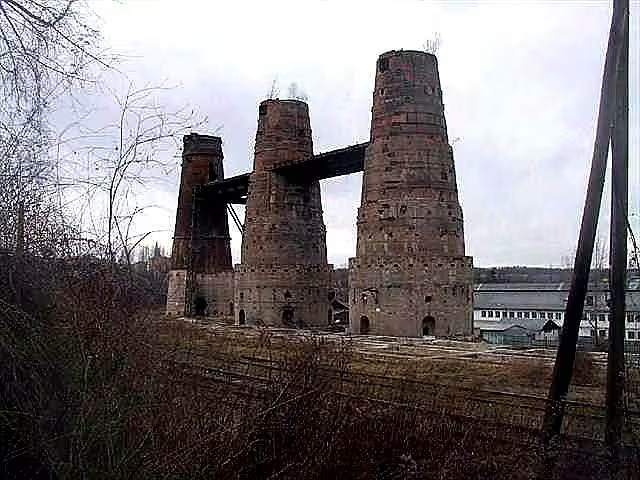
Torza The three towers of the limestone furnaces number III, IV and V., which stand on the cadastral territory of Kročehlavy and Kladno, represent an important technical monument to industrial architecture from the period of the first republic. These shaft furnaces were built between 1927 and 1929 on the southern edge of the Vojtěšské huti according to the design by Professor Henry Šárek for the Prague Iron Society. Their overall height of more than 30 metres and unique technical solutions served to burn limestone, which was necessary for the efficient production of pig iron.
This monument and its specific technological functions are closely linked to the interwar period when Kladno experienced intense modernisation efforts in the heavy industry and steel industry. In the high furnaces of the Vojtěšské huti there was the use of Nucchi iron ore. Her meltdown required a large amount of limestone. The dissociation of limestone into calcium oxide and carbon dioxide is a strong endothermic reaction, with approximately 500 kg of coke required per tonne of limestone. Professor Jindřich Šárek proposed to reduce the consumption of coke by delivering a certain amount of burnt limestone to the pass. Cheap blast furnace gas was used to burn him in the shaft furnace. After a successful verification in a small shaft furnace and operational tests, the Prague Iron Company joined the construction of four large shaft furnaces. The project was developed by Oberschleisische-Industrie-Bau A.G. from Gleiwitz and the construction was carried out by the Prague company Pittel & Brausewitter. With the gradual expansion of the production of pig iron, another shaft furnace was added in 1940.
From the point of view of the construction, the complex consisted of massive iron concrete pads and own cylindrical furnaces. The hoppers were placed below the field wave. Their iron-concrete concrete chambers were 12 metres long and 10.6 metres wide in the crown, each having a volume of 284 cubic metres. There were tracks through the bunkers that made the limestone spill directly from the wagons. The calcareous furnaces are based on a common reinforced concrete base. The cylindrical monolithic reinforced concrete base of each kiln is measured at a height of 8,63 metres and consists of six supports connected at the top of the ring. The base is mounted by a cylindrical part and on it four cylindrical chamber cones, which gradually shrink. The total height of the furnace is 31,430 metres, the inner shaft has a diameter of six metres and the volume of the furnace was 264 cubic metres. The inside of the kiln was embossed with chamotte bricks and the outside was a burnt red brick bell. The external wall is in several places withdrawn by steel belts. The operation also included a self-contained elevator system, where the filled basket went up to the hip, and it came out here. The blast furnace gas was introduced into the circular gas channel at a height of 13 metres and the lime burning area was distributed through the vents, while the air was flowing through the openings on the outside of the furnace above the gas vents.
The whole facility was owned by the Prague Iron Company. The operation of this industry was directly linked to the operation of the Kladno smelters until 1975. The production of pig iron in Kladno was stopped and the production of burnt limestone ended. There have been major changes in the area over the next few years. The limestone kilns number I and II have been demolished. The remaining three furnaces gradually lost their technological equipment, bridges and stands until 1997.
The historical importance of the building is underlined by key years. The year 1927 brought the start of construction of four large shaft furnaces, which were completed in 1929 according to the design by Professor Henry Šárek. The fifth kiln grew in 1940, the production of limestone was quiet in 1975 and in 2008 the Ministry of Culture of the Czech Republic declared the remaining torso of limestone kilns number III., IV and V. by cultural monuments of the Czech Republic.
Today, these torsos are located on the southern edge of the Vojtěšské huti in close proximity to the Kladenskodic railway station. Although it lost its original technological equipment, it constitutes a unique and monumental proof of the advanced industrial architecture of the interwar period. Visiting this place offers an educational insight into the history of Czech metallurgy and engineering art, which in the past formed the economic backbone of the region.
Historical milestones
- 1927
- Starting construction of four large limestone burning shaft furnaces.
- 1929
- Finishing the construction of the shaft furnaces according to the design of Professor Henry Šárek.
- 1940
- The fifth shaft furnace was built to expand the production of pig iron.
- 1975
- Stopping the production of pig iron in Kladno and ending the operation of limestone furnaces.
- 2008
- Torso of limestone furnaces number III., IV. and V. declared by the Ministry of Culture by cultural monuments.
Architectural development
The complex consisted of massive iron concrete pads and own cylindrical furnaces with chamotte lining and an outer casing made of burnt red bricks of bells. The external masonry was reinforced in several places by steel belts and the operation also included an automatic lift system. By 1997, the remaining three furnaces were gradually removed from the original technological equipment, bridges and stands.
Historical events
The construction of four large shaft furnaces was carried out from 1927 to 1929 according to the design of Professor Henry Šárek. In 1940 another shaft furnace was added with the gradual expansion of production. The production of burnt limestone was stopped in Kladno in 1975. In 2008, the remaining furnaces were declared by the Ministry of Culture of the Czech Republic by cultural monuments.
Owners
Prague Iron Company
Points of interest
- Torza Three Limestone furnaces towers number three, four and five represent an important technical monument to industrial architecture from the period of the first republic. - These shaft furnaces were built between a thousand and nine hundred and twenty-seven to a thousand and nine hundred and twenty-nine on the southern edge of the Vojtěšské huti according to the design by Professor Henry Šarka for the Prague Iron Society. - The total kiln height exceeds 30 metres and was used to burn the limestone necessary for the production of pig iron. - With the gradual expansion of production, in the year a thousand and nine hundred forty added another shaft furnace. - The entire facility was owned by the Prague Iron Company and the operation was connected to the operation of the Kladno smelters until the year one thousand nine hundred seventy-five.
Guide
Show guide text
This text was created by artificial intelligence and has not been editorially reviewed. It may contain inaccuracies.
Welcome to the place with the rich history that we are dealing with today - you are standing in front of the three towers of the lime kilns, which are a real witness to the industrial past of Krochechek. These structures, built from stone and concrete, stand as monumental monuments of the first republic when technology and architecture joined forces.
These towers were built between 1927 and 1929 on the basis of the design of Professor Henry Šárek. The aim of the construction was to reduce the consumption of coke in the blast furnaces, which represented a great advance for the period. The implementation of this ambitious project fell on the Prague firm Pittel & Brausewitter, which worked for the Prague Iron Society.
Let's move closer and look up. These towers have a unique shape and design that are both functional and aesthetic. Notice their robustness and the elegant way in which they stand in the sky. Although today it is only a shadow of the past, at that time these shaft furnaces were technological innovation.
The main architect of the project was Oberschleisische-Industrie-Bau A.G. from Gleiwitz. Their work in Kročehlavů is proof of how international cooperation has contributed to the development of Czech industry.
Jindřich Šárek, whose design is behind this construction, was an important figure of the time. His ideas and innovations had a major impact on industrial buildings in Czechoslovakia.
The interesting thing is that although the production of pig iron in Kladno was finished in 1975 and the operation of the furnaces ceased, these structures remained a monument. In 2008 the Torza of the Three Tower number III, IV and V. was declared a cultural monument by the Ministry of Culture of the Czech Republic, which is a recognition of their historical and architectural importance.
Now, let's stop for a moment and look at the overall composition of this tower. They seem not only to be a structural work, but also an artistic creation that resembles the time when industrial development was at its peak.
Allow me to invite you to further explore Krochechek and his rich history. There are many other attractions waiting to be discovered. I hope you'll feel at home here and find inspiration in these ancient building sites. When we meet again, have a good day and many new discoveries.
Tips for visitors
A tour of the historic furnaces in Kročehlavy is recommended for the morning hours, when the sunlight ideally radiates brick and stone masonry of these industrial ruins. The most suitable period for visiting is autumn or early spring, when the surrounding vegetation does not cover the view of the whole torso of buildings. The location can be conveniently reached by car or local transport, the best way to find it in advance in maps. For movement on the premises of the decaying industrial architecture, bring with you fixed footwear with anti-slip sole and suitable clothes that can withstand any dust or dirt. When photographing these shaft kilns, the best pictures come from the south side, where the monumental nature of the entire work built in the late 1920s stands out. In the immediate vicinity is also worth the attention of the nearby historical Vojtěšská smelter and remains of the Kladen-nučice railway, which together create a comprehensive view of the old industrial history of the region. As these are free-standing historical ruins in an industrial environment, this site is not primarily adapted for young children and requires constant adult vigilance.
Frequently asked questions
Can the monument be visited?
This is a ruin. Such sites are often freely accessible, but some can only be visited with a guide or are closed for safety reasons. We have not verified the current situation – take care and respect any restrictions.
Where is the monument?
Location: Kročehlavy. The map on this page shows the exact spot.
Why is the monument protected?
It is listed in the Central List of Cultural Monuments of the Czech Republic as a cultural monument (register no. 1114274417).
Businesses nearby
Do you run a restaurant, accommodation, shop, museum, rental, wellness or other visitor service near this monument? Show yourself directly to the people heading to it — this is how they will see you in the app and on the web:
Nearby
Vojtěšská huť, Kladensko-nučická dráha
Accommodation nearby
Trips and activities nearby
Guided tours, tickets and activities nearby from GetYourGuide
Affiliate link: if you buy from the partner, we may receive a commission. The price for you does not change.
Search tours and activities →Themed route
1.Tři věže vápenných pecí Type: Historical industrial monument Why is it worth a visit: The impressive triplets of old furnaces in the village Kročehlavy presents a unique example of our industrial past and former construction production. These buildings attract lovers of technical monuments with their preserved architecture.
2. Vojteštěšský smelt Type: Historical industrial site Why it is worth a visit: This important company is closely linked to the development of heavy industry and the processing of raw materials in the region. The place breathes the history of the former fame of the local metallurgy and working craft.
3. The Kladen-Pushy Way Type: Historical railway line Why is worth a visit: The old transport artery used to be used to transport extracted mineral wealth and building materials from local mines and quarry. Today it resembles an important network that connected the surrounding industrial sites.
Seasonal recommendations
Spring awakens nature around extinct industrial buildings into lush green, which contrasts with brushed grey plaster and old masonry. Sun rays penetrate thin crowns of surrounding trees and create interesting shadows on the stone walls, ideal for lovers of industrial photography. As access to these old furnaces is not officially confirmed, it is necessary to move very carefully in the field. Wear fixed shoes with anti-slip soles because spring thaw and frequent rains can turn adjacent paths into muddy sections. The morning fog quickly retreats and the morning time offers the finest natural lighting to discover the details of the old architecture.
Summer months cover this historic ruin in the dense bottlenecks of lush vegetation, which almost swallows the perimeter walls and gives a sense of how powerful nature can be. Due to the growing weeds and nettles, it is recommended to wear long pants and tight closed shoes to protect you from scratching. The best time to visit is the late-evening hours when temperatures drop and the low sun paints warm colours on the ground wall, which gives the place a melancholy atmosphere.
Autumn brings a melancholy mood to the surrounding towers, underlining by leaves coloured in yellow and brown shades falling from the surrounding trees. The colder wind weather requires warmer clothes, ideally laminated windbreaker and solid footwear, which can handle a slippery surface formed by falling leaves and fallen branches. Thanks to earlier dimming it is the best time to visit around noon when daylight reaches its maximum and lights up the dark corners of the interior. In these months you will not meet crowds of tourists, so you can enjoy the complete peace of mind over the history of former limestone production.
Winter hides the ruin under a layer of snow, which softens the sharp contours of the decayed masonry and creates a clean, almost fairytale landscape. The low sun radiates the frozen surroundings only a short part of the day, which requires careful timing for lunch hours if you want to see the place in broad daylight. The key to safe walking is warm winter clothes, strong gloves and non-slip shoes with a deep sample because frozen soil and hidden ice pose a considerable risk. The silence of snowy nature amplifies the abandonment of the entire complex and offers an unrepeatable view of the industrial past in the harsh winter's robes.
Visualizations and artistic views

The visualisations are generated by artificial intelligence and serve as inspiration.
Photos from the area
Real photos taken near the monument


Zdroj a licence jsou uvedeny u každého snímku.
Tips from visitors
No tips yet. Be the first!
Log in and add your tip.
Sources and literature
Photos: Miaow Miaow / Public domain — Wikimedia Commons. The author and licence also appear when you hover over the image.
Faktickým podkladem tohoto textu byl článek na Wikipedii, jehož autory jsou přispěvatelé Wikipedie. Článek je dostupný pod licencí CC BY-SA 4.0.
Location on the map





Příběhy a pověsti
Legendy, pověsti a příběhy spjaté s touto památkou

Fotografie návštěvníků
Zatím žádné fotografie. Buďte první, kdo přidá fotografii z návštěvy!
Log in a přidejte svou fotografii nebo hodnoťte.
Za ověřenou návštěvu v aplikaci získáte víc bodů — poznáme podle GPS, že jste na místě.
Reviews and comments