



Vila Barrandovská 60 Villa
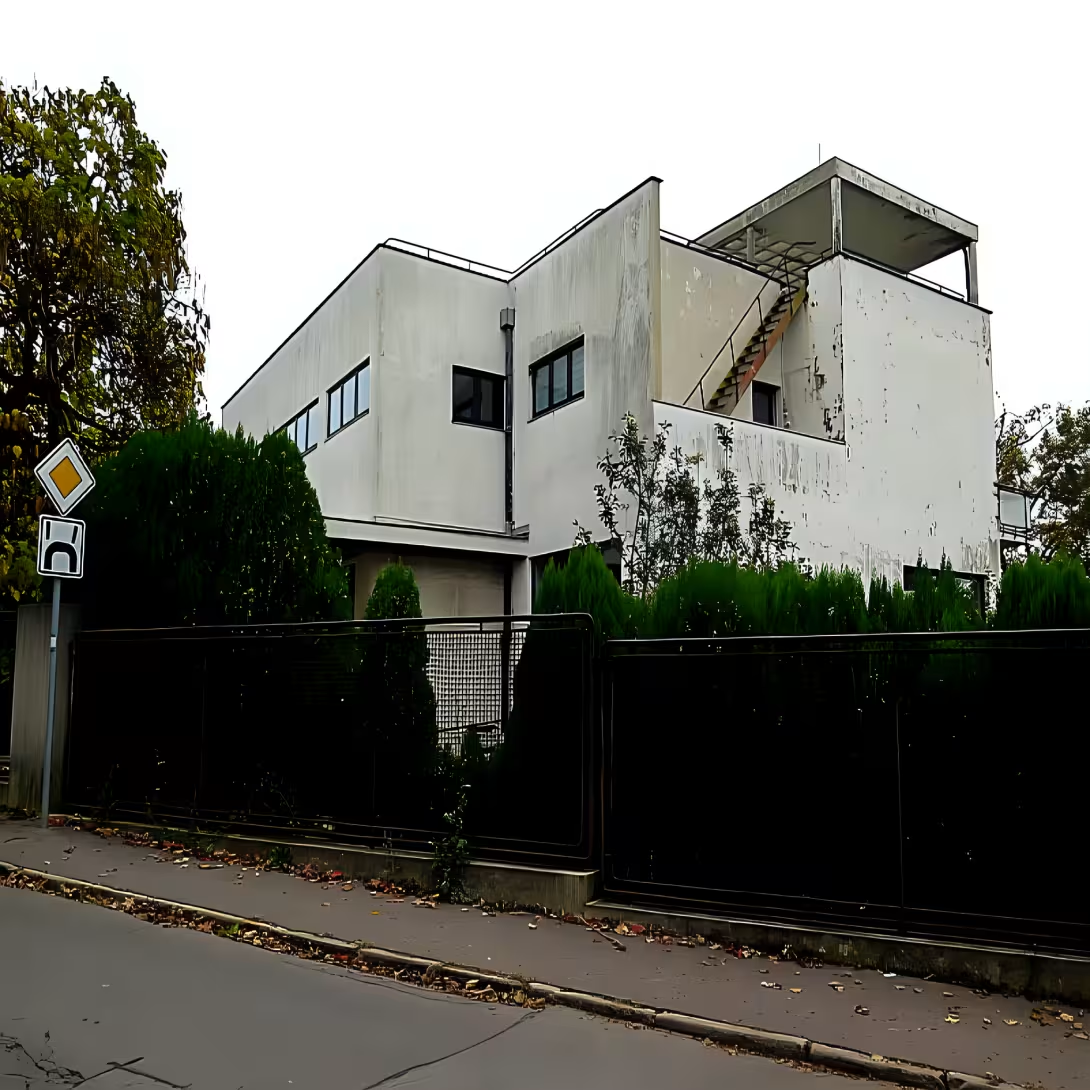
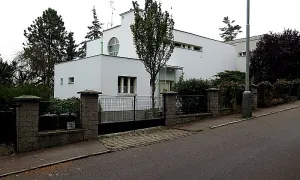
The villa of Josef Auerbach is an important functionalist building in Prague's Hlučepích, specifically in the residential district of Barrandov. The house from 1933 served as a family residence and a representative space for the film company. Since 1992 it has been listed on the list of cultural monuments of the Czech Republic.
The history of the building began on October 24, 1932, when the Board of Directors of Elektafilm decided to purchase two building plots in Barrandova. The company paid CZK 278 491 for the land and then merged it into one whole. The decision to build the villa was taken on 25 April 1933. The building was designed as a combination of the private housing of the main shareholder Josef Auerbach with family and representative space for foreign business partners.
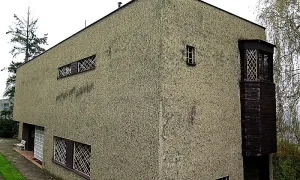
Architecturally, the villa is one of purist functionalism. The construction on a rectangular plan uses the vertical terrain; In the direction of the street it acts as a two-storey, while in the garden it has three floors. The facade excels with cleanliness, belt windows on the ground floor and first floor and travertine tiles, which decorate the base of the house and surrounding the main entrance covered by the awning. The terraces system and the spindle staircase with railing and wire fields are used to connect the interior with the garden. The flat roof is partly used as a residential terrace with a pergola. Until today, the object has retained most of the original elements, including metal frames of windows and doors, fittings, ventilation grids or fencing.
The owner of the villa was Elektafilm from the beginning, while the rental contract for the residential part was issued to the wife of Josef Auerbach, Olga Auerbach. The family lived here until 1939 when Josef Auerbach sold the property after the occupation of Czechoslovakia and emigrated with the family to the United States of America.
During the mobilization in 1938, the roof of the villa served as an artillery observatory. The object also entered the history of Czech cinematography when it became the scene of the famous film Kristian in 1939. In these premises, the actors Adina Mandlová and Oldřich Nový represented a married couple before Jaroslav Marvan.
The villa of Josef Auerbach is an authentic document of the architecture of the first republic and the flowering of the Barrando villa district. For people interested in modern architecture and Czech film, this object is a valuable example of the connection of functionalist housing with period social life. Visiting the site offers the opportunity to see this monument in the context of surrounding buildings and nearby Barrandov rocks.
Historical milestones
- 1932
- Elektafilm purchased building plots for building a villa.
- 1933
- The opening of the building of the villa in Barrando.
- 1938
- The roof of the house used as an artillery observer during mobilization.
- 1992
- Villa registered to the list of cultural monuments of the Czech Republic.
Architectural development
The building on a rectangular plan uses a narrow terrain, making it two floors from the street and three from the garden. The facade is decorated with travertine tiles and belt windows. Most of the original elements were preserved, including metal window frames, terraces railing and fencing.
Historical events
In 1938, the roof of the villa served as an artillery observatory. In 1939, there were scenes of the film Kristian. In 1992 the villa was declared a cultural monument.
Owners
Elektafilm (1932- 1939), family of Josef Auerbach (until 1939).
Points of interest
- The 1933 building served as a family residence and as a representative space for the film company. - The building uses the sloping terrain, so it acts as a two-storey to the street, while the garden has level three. - During mobilization in 1938, the roof of the villa was used as an artillery observatory. - In 1939 the villa became the scene of the film Kristian, where the actors Adina Mandlová, Oldřich Nový and Jaroslav Marvan performed. - The object has until today retained most of the original elements such as metal windows, doors, fittings, ventilation grids or fencing.
Guide
Show guide text
This text was created by artificial intelligence and has not been editorially reviewed. It may contain inaccuracies.
Welcome to Hlučepy, one of Prague's most beautiful and most important residential districts. Stop for a moment, take a breath and look in front of you. You're standing in front of a building with an address of Barrandova 60, which is Josef Auerbach's villa. The first impression you probably perceive of her is a sense of peace, order and incredible purity of lines. It's a house that doesn't scream, but with its elegance and simplicity, it tightens attention. Notice how the building is inserted into the surroundings and how it acts in its appearance, which is typical of its time. Now let's go back almost a century together. It is the year nine hundred thirty-two, and Elektafilm, which was in control of the film world at that time, purchased the building plots right here on Barrando. A year later, nine hundred thirty-three years later, this villa was completed. Its owner was Josef Auerbach, the main shareholder of the aforementioned film company. Why was this building so important? Because at the time, it wasn't just a private home for the Auerbach family, it was a place of representation. Imagine that the most important people of the time, foreign film partners and creators who came here from all over the world, met in these areas. The villa was intended to serve as a business card for the success, modernity and openness of Czech film towards the world. Now pay attention to the architecture itself. The building is one of the major representatives of functionalism. If you don't know exactly how to connect this to a particular painting, try looking at the facade. It's puristically pure, which means you won't find any unnecessary ornaments, no invented Roman columns, or complex ornaments. Everything here is practical, logical and clear. Look up on the roof. It is flat, which was at the time a bold and modern element, which optically closed the house while giving it the appearance of a modern living machine. The interesting detail you can observe is the way architecture works with the terrain. Note that we are located in a narrow area. This creates a fascinating optical effect. If you're looking at a house from the street, it looks like a two-story building. It's a perception that's very quiet and subtle. However, if you were to take a look at the garden now, you would find that the house actually has three floors. This game with the terrain has enabled genius to connect the inner spaces with nature. Note the terraces that serve as the crossing between the interior and the green garden. And if you imagine internal arrangements, in your mind, you can think of spindle steps that elegantly connect individual floors and provide space for dynamics. When you're standing in front of this building, try to imagine who was passing through here. The villa of Josef and Olga Auerbach was not just a quiet family nest. It was the center of the social life of the film elite. Imagine how she opened her Adina Mandlová dress in these areas, how she made jokes with her unmistakable charm, or how she made jokes with Oldřich Nový in these discussions. They were people who defined the golden age of Czech film, and this villa was the scene of their real lives. Imagine those party receptions, the script discussions, the plans for new movies and the atmosphere of luxury that ruled here in the 1930s. But the history of this place isn't just about film and society. The year is coming, nine hundred thirty-eight, and dark clouds are gathering over Europe. Czechoslovakia declares mobilization. And it was in this dramatic moment that the luxury villa turned into something completely different. Remember that flat roof we talked about earlier. She was used as an artillery observer in the year nine hundred thirty-eight. It's both fascinating and freezing contrast. The place where art and film were discussed before became a strategic point for tracking enemy movements and controlling artillery. This change in the function of the villa from a representative residence to a military object reminds us how quickly the world can change and how deeply personal fates are linked to the history of the entire nation. So this building carries two completely different faces. On the one hand, it is a symbol of modernity, optimism and the bloom of the interwar period, on the other hand, it is a silent witness to the tension and fear of the coming war. It is precisely this subtlety, which of the villa Barrando sixty such an extraordinary object. It is a house that survived its original glory, survived a dark period of history and worked to the fact that in the year nine hundred and ninety-two it was officially listed as a cultural monument of the Czech Republic. With this recognition, the state has confirmed that the architecture of this house and its history are of irreplaceable value to all of us. Now that you know the stories that lurk in these walls, I suggest you take a walk around the villa. Feel her silence, watch the light fall on her smooth facade, and try to imagine the contrast between the calm of the garden and the tension that once ruled on her roof. Look at the way the house is leaning up the hill and naturally moving from one floor to another. It's a lesson about how architecture can be functional and beautiful at the same time without having to be complicated. Thank you for accompanying me on this short trip to the history of Josef Auerbach's villa. I hope that this view behind the facade has helped you to better perceive the atmosphere of this place. You are now fully entrusted with the space. CZECH NOTE: Explore the surroundings, enjoy the peace of the Barrando district and be inspired by the spirit of the time when the film was the greatest dream of the modern world. I wish you a pleasant further continuation of your trip to Prague. Goodbye.
Tips for visitors
We recommend a visit during the morning in sunny weather, where the cleanliness of the functionalist lines of the villa and its connection to the surrounding garden will stand out. You avoid the afternoon rush in the adjacent residential district.
The location is available by car and by public transport.
Use soft light during the morning for the best pictures of the villa. Focus on facade details and architectural elements that define the style of the construction. Take with you a high-quality camera and comfortable shoes to move around in Barrandova.
In the vicinity you can visit the Barrandov terraces, the natural monument of Barrandov Rock or the Barrandov Film Studio. For families with children, walking on rocks is an ideal opportunity to explore the geology and history of the place, but take care of the safety of children near the cliffs.
Frequently asked questions
Can the monument be visited?
This is a residential or farm building, not a museum with opening hours. Please view it from public space and respect the owners' privacy. We have no information about access to the interior.
Where is the monument?
Location: Hlubočepy, Hlavní město Praha. The map on this page shows the exact spot.
Why is the monument protected?
It is listed in the Central List of Cultural Monuments of the Czech Republic as a cultural monument (register no. 1000118702).
Businesses nearby
Do you run a restaurant, accommodation, shop, museum, rental, wellness or other visitor service near this monument? Show yourself directly to the people heading to it — this is how they will see you in the app and on the web:
Events nearby

Zdroj akcí: otevřená data měst a obcí ČR (Národní katalog otevřených dat) a kalendář akcí Národního památkového ústavu.
Nearby
Barrandovské terasy, přírodní památka Barrandovské skály, filmové ateliéry Barrandov.
Accommodation nearby
Trips and activities nearby
Guided tours, tickets and activities nearby from GetYourGuide
Affiliate link: if you buy from the partner, we may receive a commission. The price for you does not change.
Search tours and activities →Themed route
1. Barrandov Film Studio, a workshop for the creation of paintings where famous film works are created. 2. Vila Barrandovská 60, a historical building that represents the main destination of your journey. 3. Barrando terraces, a place to relax, offering beautiful views of the surroundings. 4. A natural monument to Barrandov Rock, a protected area where you can admire rock shapes.
Seasonal recommendations
Spring: In the spring, Villa Barrandovská opens in a beautiful green, which is yet immature but already full of hope. The sun rays illuminate the architectural beauty of the villa and its surroundings turn into a living flower paradise. The atmosphere is calm, which allows relaxed walking around the park without unnecessary obstacles. We recommend visiting the spring season when we avoid crowds and taking with us clothes suitable for mild temperatures, because in the morning they may be colder. The best time to visit is noon, when the sun lights everything around.
Summer: In summer Villa Barrandovská offers a comfortable escape from urban life thanks to its green park and quiet environment. The sun illuminates everything around it, which highlights the architectural details of the villa. However, due to the popularity of this time, the place of visitors can be full, especially on the middle of the day. We recommend arriving at the beginning of the afternoon hours, when the crowd's accelerating currents calm down and you can enjoy a quieter tour. Don't forget to bring a sun protection suit like hats or scarves this summer.
Autumn: In autumn, Villa Barrandova offers a view of the beautiful coloring of trees and a quieter atmosphere, as the colder time is approaching. Sun rays illuminate the golden and red colour of the leaves, which gives the villa a romantic touch. This time of year is ideal for quiet walks without unnecessary obstacles. It is recommended to visit in the early afternoon when the temperature is still pleasant and leaves begin to fall on the road. Don't forget to bring clothes suitable for mild cold weather.
Winter: In winter, Villa Barrandova offers a peaceful escape from urban storms and is covered with snow, which gives its surroundings a magical atmosphere. Sun rays illuminate snowy roads and trees, creating a view that is unique only for this time of year. Due to the cold weather, the opening time may be shorter, so we recommend visiting as soon as possible in the day. Don't forget to bring warm clothes and suitable shoes for cold conditions so you can enjoy the winter charm of the villa without problems.
Visualizations and artistic views


The visualisations are generated by artificial intelligence and serve as inspiration.
Photos from the area
Real photos taken near the monument

Zdroj a licence jsou uvedeny u každého snímku.
Tips from visitors
No tips yet. Be the first!
Log in and add your tip.
Sources and literature
Photos: Sovicka169 / CC BY-SA 4.0, rozlišení zvýšeno umělou inteligencí — Wikimedia Commons. The author and licence also appear when you hover over the image.
Faktickým podkladem tohoto textu byl článek na Wikipedii, jehož autory jsou přispěvatelé Wikipedie. Článek je dostupný pod licencí CC BY-SA 4.0.
Location on the map
Příběhy a pověsti
Legendy, pověsti a příběhy spjaté s touto památkou
Fotografie návštěvníků
Zatím žádné fotografie. Buďte první, kdo přidá fotografii z návštěvy!
Log in a přidejte svou fotografii nebo hodnoťte.
Za ověřenou návštěvu v aplikaci získáte víc bodů — poznáme podle GPS, že jste na místě.
Reviews and comments