






Vila Gočárova pro rodinu Sochorových Villa
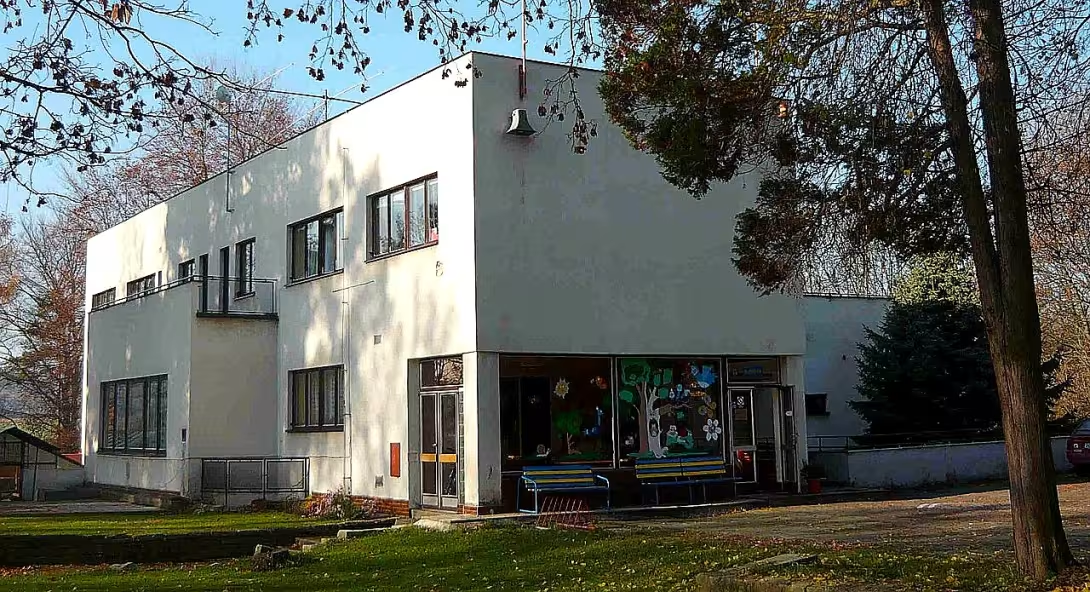
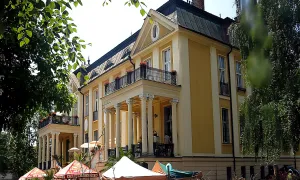
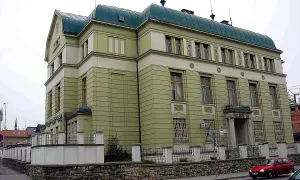
Vila Gočárova pro rodinu Sochorových in Dvořa Králové nad Labem is an important functionalist building from 1930. The building in Trutnov district represents the modern thinking of architect Josef Gočár and has been protected historically since 1958.
The incentive to build the villa gave Zdeněk Sochor, one of the five sons of businessman Josef Sochor. In 1904 he founded a weaving plant and a printer, thereby laying the foundations of the textile industry in the city. In his work he worked with important artists such as František Kyla, Jiří Trnka, Josef Čapek and Antonín Kybal. Later he developed a construction company and collaborated with architects Josef Grus, Josef Gočár and brothers Jarolíčka. Josef Gočár was addressed for the design of the family villa.
The villa was designed in 1928 and completed in 1930. The project was co-financed by Josef Grus from Gočár's studio and the construction was carried out by builder Karel Jarolímek. The building is set in a narrow terrain surrounded by a large garden and shows asymmetrical availability typical of functionalism. The whole complex consists of two separate buildings: a two-storey cubus in the lower part of the plot and a single-storey object in the higher part of the slope. Both parts connect the stairwell which leads to the roof terrace of the lower building, which is partly covered by the awning.
Architecture uses oblong windows and ingenious vertical lighting of staircases. The east side of the house has a terrace. The original layout included an entrance lounge with a staircase, a large dining room and a kitchen with prepared meals. On the floor were located bedrooms with bathroom and access to the terrace, small dining room, guest room with separate bathroom and photo chamber. The basement contained economic facilities and a residential garden house, while the garage stands alone.
The project was based on Le Corbusier's ideas, which highlighted the beauty of dedicated and rational engineering structures. Josef Gočár has fully developed its modern thinking in the context of the development of the European architecture of the interwar period, when functionalism reflected new technological possibilities and social changes.
After 1945 the use of the villa changed. The building was adapted as the headquarters of the Forest Race and subsequently the House of Children and Youth was located here. During these periods there were modifications and several ports that marked the appearance of the villa. The later internal modifications to the office rooms resulted in major building changes, as a result of which almost nothing was preserved from the original interior equipment.
Vila Gočárova pro rodinu Sochorových remains a key example of interwar modernism in the region. Its architecture testifies to the development of functionalism and is a valuable goal for anyone interested in the work of Josef Gočár. Visiting this object allows you to explore the era of rational planning of space.
Historical milestones
- 1904
- Zdeněk Sochor founded local weaving and printer
- 1928
- Josef Gočár designed a family villa project
- 1930
- Completion of the building of a villa for the Sochor family
- 1958
- The building was declared to be a protected monument
- after 1945
- Change of use of the building to the Forest Plant and Children's House
Architectural development
The villa was designed in 1928 and built until 1930. Architects Josef Gočár and Josef Grus participated in the design while builder Karel Jarolímek carried out the construction. Later modifications of internal equipment led to major structural changes.
Historical events
- 1958
- The villa was declared a monument.
- 1904
- The foundation of the weaving plant Josef Sochor, which laid the foundation for the textile industry in the city.
Owners
Founded by the Sochor family in 1930. After 1945 it was adapted as a seat of the Forest Race, followed by the House of Children and Youth.
Points of interest
- Vila Gočárova pro rodinu Sochorových is a significant functionalist building from 1930. The building has been protected as a monument since 1958. - Josef Gočár designed a villa that was realized by builder Karel Jarolímek. - Architecture uses oblong windows and sophisticated vertical lighting of staircases. - The villa is a key example of interwar modernism and is a testament to the development of functionalism.
Guide
Show guide text
This text was created by artificial intelligence and has not been editorially reviewed. It may contain inaccuracies.
Welcome to the Queen of Kings. Right now, you're standing in front of one of the most important architectural pearls in this city. Stop for a moment, take a breath and look around you. Before you is Villa Gočárov, who was built for the Sochor family. The first impression of this building is very strong and modern, although it has been standing in this narrow terrain for more than 90 years. Notice how the building naturally fits into the surroundings and how it is surrounded by garden greenery. You see in front of you a fascinating game of geometry. The dominant is a two-storey building in the shape of a cubus, which is stable and courageous. It is connected to a lower, single-storey part, and both of these different volumes connect the outer staircase. This whole set creates a unique rhythm, which is absolutely crucial to this building. In order to understand why this villa was created, we have to go back a little further in time. It all began in the year nine hundred and four, when Mr. Zdeněk Sochor founded a local weaving plant and printer in this city. Industrial expansion and success in textiles have brought prosperity and a desire for housing to the Sochor family, reflecting their social status and taste. Many years later, in the year one thousand nine hundred twenty eight, the famous architect Josef Gočár was commissioned to design a project of their family residence. Gočár was at that time one of the most prominent creators in our countries and his vision was to create a house that would not only be beautiful but, above all, practical. The construction was completed in the year one thousand nine hundred thirty and since then it has defined this piece of town with its presence. Now please focus on the architecture itself that you see right in front of you. This villa is a model representative of functionalism. This is a style that says that the appearance of a building must follow its function. Look at the overall layout of the house. Notice it's not symmetrical. The left side didn't match the right, which was a very modern approach at the time. Instead of old-fashioned ornaments and useless bullies, you will find clean lines and clear shapes. Pay attention to the windows. They are oblong, simple and spaced in such a way as to penetrate the interiors with maximum daylight. It is the light in this house that is Treating as a building material. If you look at the staircase connecting both parts of the villa, remember that architect Josef Gočár used very sophisticated vertical lighting here. He wanted the light to go deep into the house and make the space air and open. When we think about the people who were connected to this place, first of all we see the Sochor family, specifically Zdenek and Josef Sochor. It was people who believed in progress and modernity, which is reflected in every detail of this house. But the villa is not the work of just one person. Besides Josef Gočár, architect Josef Grus worked on the project. And we must not forget who turned these plans into concrete and stone reality. The construction was carried out by builder Karel Jarolímek, who had to write down all the details with precision in order to match the resulting effect to the strict vision of architects. But the history of the villa is not just the story of one wealthy family. After a year of nine hundred forty-five, the life of the house changed dramatically. With the advent of the new political system, the use of the building has changed. A private family home stopped being the Sochor residence and the object was taken over by the state. The building began to serve as a seat of the Forest Race and later the Children's House was located here. It's fascinating to imagine the atmosphere changing in these areas. The intimate family environment of the villa became a place of work and a place for childcare. Despite these changes and possible modifications in the interior, the building retained its dignity and architectural value. That is why in the year one thousand nine hundred fifty-eight it was officially declared a protected monument. This meant that the State recognised its special importance for Czech architecture and decided to protect it for future generations. You may be interested in one strange thing that makes this villa more than just an ordinary house. Notice again how the villa is put in the field. Architecture does not fight nature here, but cooperates with it. The use of the sloped land has allowed for the creation of a split into two parts, which are connected, but each has its own character. One part used to represent and live together, the other was more private. This game with space and height is typical of the best works of the time. The mystery can be for many how to feel cozy in such a strictly geometrical house. The answer is precisely the ingenious lighting and connection to the surrounding garden that wipes the border between the inner and outer world. Now that you know the story of this building, I suggest you slowly bypass the villa from the outside. Feel how the view of cubist shapes changes depending on where you're looking from. Try to imagine how in the year one thousand nine hundred thirty people looked at this house, which at that time had to be absolutely futuristic, almost like from another world. Take a look at the window details and watch how the staircase lines lead your eyes upwards. Vila Gočárova pro rodinu Sochorových is more than just a concrete construction. It is a monument to human ambition, industrial success and courage in architecture. It is proof that functionality may not be boring and that simplicity may be the highest form of elegance. Thank you for spending a moment with us at this beautiful monument. We now invite you to explore further the surroundings and discover other hidden corners of the Court of Kings over Labem. We wish you a pleasant continued journey and many new experiences. Goodbye.
Tips for visitors
The best time to visit the villa Gočárová is during the summer months when the weather is favourable and the garden offers a beautiful atmosphere. The functionalist design of the building is reflected in a great whole in combination with nature.
Visitors' parking can be found near the sights, but we recommend checking the actual availability of parking lots. The villa is also accessible by public transport; It is advisable to use route search engines for the current connection.
When visiting the villa bring protective clothes such as shoes and hat, especially if you plan to explore the gardens. Photos can become hairy, so remember to take the camera with you.
The best place for photography is at the entrance to the villa, where the building is projected against the background of the garden. Preferably choose the time before the start of the afternoon sun for ideal lighting conditions.
In the vicinity of the villa you can visit the historical Dvůr Králové nad Labem, which offers interesting architecture and culture. For families with children it can be fun to explore the surrounding natural routes.
Businesses nearby
Do you run a restaurant, accommodation, shop, museum, rental, wellness or other visitor service near this monument? Show yourself directly to the people heading to it — this is how they will see you in the app and on the web:
Events nearby
Zdroj akcí: otevřená data měst a obcí ČR (Národní katalog otevřených dat) a kalendář akcí Národního památkového ústavu.
Nearby
🏰 Historic sites (130)
- Městské muzeum - hlavní budova 0.5 km
- Městské muzeum - Špýchar 0.5 km
- sv. Jan Nepomucký 0.5 km web
- sv. Šimon 0.5 km
- sv. Barbora 0.5 km
- sv. Juda Tadeáš 0.5 km
- Tomáš Garrigue Masaryk 0.5 km
- Šindelářská věž 0.7 km
- Mariánský sloup 0.8 km
- památník odboje 1.0 km
- Josef Vágner 1.4 km
- Galerie minerálů 2.5 km V Zahrádkách 3278 web
- Barokní socha sv. Františka Xaverského 3.5 km
- Šoupátkový úzávěr 3.8 km
- Cyklomuzeum Žireč 3.8 km 46348948
- Franz Mihan + 10.3.1940 3.8 km
- 1914 - 1918, 1938-1945 3.8 km
- Pochod smrti II.1945 3.9 km web
- Barokní Sousoší sv. Floriána 4.6 km
- bývalý Hotel Betlém 4.8 km
🍽️ Restaurants and dining (123)
- Karlov 0.5 km Jiráskova 200
- Hostinec Kotelna 0.5 km
- Piraňa 0.5 km
- Na Slovanech 0.6 km
- Restaurace Sport 0.6 km
- Cafe 0.6 km Věžní 97
- Local cafe garden 0.6 km
- RAFONI restaurant 0.6 km
- Pub U Laušmanů 0.7 km Vrchlického 788
- Restaurand Radnice 0.7 km náměstí T. G. Masaryka 1
- Hostinec U Rudolfa III. 0.7 km
- American Bar 0.8 km
- Restaurant u Svobodných Pánů 0.8 km náměstí T. G. Masaryka 84
- Country restaurace 0.8 km náměstí T. G. Masaryka 37
- Restaurace U Venduly 0.8 km
- Restaurace Labe 0.8 km
- Cukrárna a restaurace U Pastvů 0.8 km web
- Café Karen 0.8 km web
- Steak House 0.9 km
- Cafe Kino 0.9 km Revoluční 3097
🏨 Accommodation (59)
- Hotel Central 0.7 km
- Pension u Venduly 0.8 km web
- Art Hostel 0.8 km +420 774 591 477 web
- Penzion Na náměstí 0.8 km web
- Hotel Safari 1.1 km
- Hotel Za Vodou 1.1 km Poděbradova 2014 +420 499 620 904 web
- Safari Kemp 1.5 km web
- Sterbova vila 1877 3.7 km web
- Minicamp Pension Doctor 4.9 km
- Pension Doctor 5.0 km web
- Penzion 65 - Bílá Třemešná 5.0 km +420 724 174 741 web
- Tábořiště Nemojov – louka Indiana 5.2 km Skautský tábor web
- Šporkův mlýn 5.9 km +420 777 876 095 web
- Miroslav Polák - Ubytování Pod Lipou 6.4 km
- Letní dětský tábor Doubravice 6.5 km web
- Sportovně turistické zařízení Lanžov 6.9 km web
- Pension Kohoutov 7.0 km web
- Hotel pod Zvičinou 7.2 km +420 499 396 381 web
- Penzion Na Faře 7.4 km
- Hotel Zámek Bílé Poličany 7.9 km web
🚲 Rentals and sport (25)
- football stadium Tiba 0.3 km
- Kupkolo.cz 0.6 km
- Sport World 0.7 km Vrchlického 735
- sportovní hala 0.7 km
- SPOŠ - sportovní hala 0.7 km
- sokolovna 0.8 km
- football stadium 0.9 km
- Cykloservis TP 1.1 km +420 724 620 968 web
- Petr - Bike 1.3 km
- Sportisimo 1.4 km
- Tyršovo koupaliště 1.4 km
- Velo servis - Medikus Jaroslav 2.0 km
- Veloservis Potocký 5.1 km +420 603840877 web
- Sjezdovka Debrné 9.0 km
- sportovní hala 10.3 km
- Plavecký bazén 12.2 km
- ACTIVESport cz, s.r.o. 12.4 km
- sportovní hala 12.4 km
- Koupaliště Dachova 13.6 km +420 493 624 114 web
- Koupaliště Dachovy 13.6 km
🥾 Hiking and nature (176)
- Podharťský park 0.1 km
- Podharťský park 0.2 km
- Schulzovy sady 0.8 km
- Na Borkách 2.3 km
- Pramen svobody 3.4 km
- U Františka 3.7 km
- Čertovy hrady 3.8 km
- Záleský vrch 3.8 km
- Hřibojedský vrch 4.5 km
- Na Větrníku 5.1 km
- Komenského jeskyně 5.2 km
- Na Šturmově kopci 5.2 km
- studánka U jeskyně Narození páně 5.3 km
- Větrník 5.4 km
- Dehtovská horka 5.4 km
- Mezihoří 5.5 km
- Červený kopec 6.0 km
- Areál Environmentální Výchovy v Hájemství 6.0 km
- Odpadky 6.1 km
- Říčařův kopec 6.2 km
Accommodation nearby
Themed route
1. Tanks, type: entrance space. First meeting with unique architecture and entrance to the premises. 2. External space and facade, type: architecture. Admiring bold shapes and materials that define the style of the construction. 3. Interior and exposition, type: tour. Experience with original layout of rooms and period equipment. 4. Garden, type: park. Rest in the green, which is the natural end of the visit.
Seasonal recommendations
In the spring of September the villa accompanied by the waking green. Light is soft and highlights clean lines of architecture. I recommend visiting the house in the morning when it is quiet. Put on light layers, because the weather is variable in this period.
Summer season brings rich colors of surrounding nature and sharp sun rays that play with the inner spaces of the house. Expect more visitors in the main season, so come as soon as you open. Vote for air clothes and don't forget enough fluids.
Autumn covers the construction with golden tones of leaves and melancholy atmosphere. Fog can give the building a mysterious look and quiet the surroundings. Ideal is a walk in the afternoon. Prepare a waterproof coat or umbrella in case of rain.
In winter, the villa has a rough and quiet appearance, especially if snow covers it. The contrast of the white landscape and the geometry of the house is fascinating. Pay attention to shorter opening times and dress very warm so that the cold does not prevent you from exploring the interiors.
Visualizations and artistic views

The visualisations are generated by artificial intelligence and serve as inspiration.
Photos from the area
Real photos taken near the monument

Zdroj a licence jsou uvedeny u každého snímku.
Tips from visitors
No tips yet. Be the first!
Log in and add your tip.
Sources and literature
Photos: LPDKNL / CC BY-SA 3.0 — Wikimedia Commons. The author and licence also appear when you hover over the image.
Faktickým podkladem tohoto textu byl článek na Wikipedii, jehož autory jsou přispěvatelé Wikipedie. Článek je dostupný pod licencí CC BY-SA 4.0.
Location on the map
Příběhy a pověsti
Legendy, pověsti a příběhy spjaté s touto památkou
Fotografie návštěvníků
Zatím žádné fotografie. Buďte první, kdo přidá fotografii z návštěvy!
Log in a přidejte svou fotografii nebo hodnoťte.
Za ověřenou návštěvu v aplikaci získáte víc bodů — poznáme podle GPS, že jste na místě.
Reviews and comments