






Městské opevnění (Dvůr Králové) Town walls
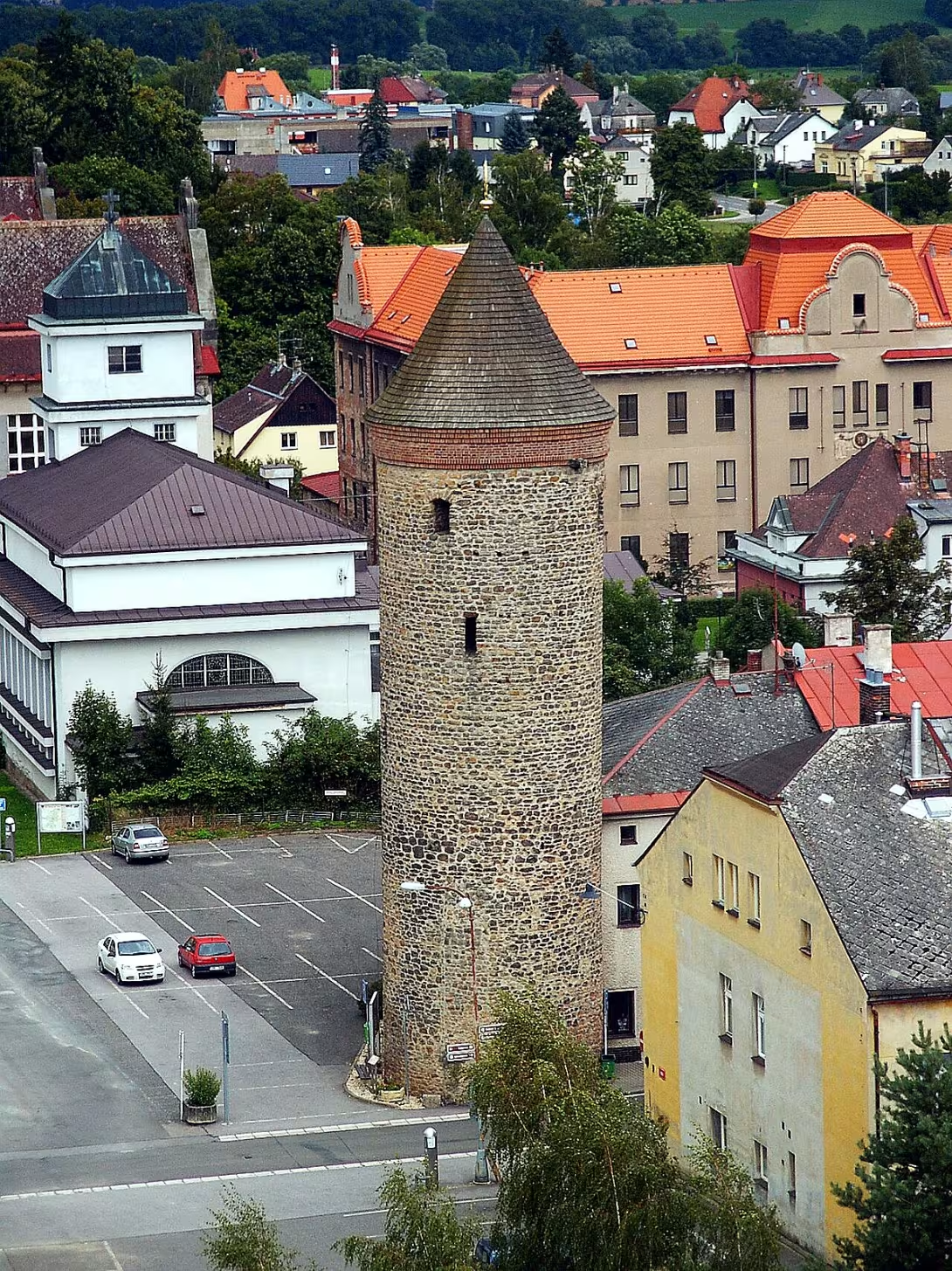
The town fortification in Dvoře Králové nad Labem, Trutnov district, represents a partially preserved medieval wall from the turn of the 14th and 15th centuries. This fortification system consisted of a wall with a series of towers, moat and an outer vall. The most significant element of today's view is the Shingler Tower. This monument is protected as a cultural monument.
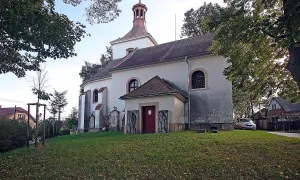
The city of the Court of Kings appeared in the 13th century, and the walls were probably founded before the Hussite wars or at the turn of the 14th and 15th centuries. At the same time with them or shortly before them was the church of St. John the Baptist, which illustrates the time of their creation. Originally there was a Geophane residence or a hypothetical royal castle.
The historical core of the city has an oval plan of 7,5 hectares and is extended in the north by a prolapse with the church of St. John the Baptist. The natural borders are a slope descending towards the Elbe in the west and the Harta creek in the east. The wall, about 140 centimetres thick and approximately seven metres high, was surrounded by a battleship with bulletproof roofs and brick guns. The inner gallery here was made up of stone slabs. On most of the district of the city the wall lacked a gallery and ended only with a counter roof with a gutter ledge.
The defence was amplified by the towers that were located on the east and west sides at a distance of 12 to 15 meters. They were missing in the north because of a steep slope. They mostly had a segment plan with an external diameter of about five metres, they were open inside and they were only used for active defence on the top floor. Some had a square plan.
Four gates led to the city: Upper, Lower, Hradištská and Shindeláří, with a smaller fort. Most of the gates were equipped with a cylindrical tower, except for the Upper Gate, which was in prism form. According to the 18th century plan, there was a barbadian outside the Hradiště Gate.
The only preserved branch tower is a round Shindler tower with a diameter of seven metres and a height of 20 metres. The entrance to it was led by a semi-circular portal at the level of the first floor, while access to the ground floor was only possible through a hole in the ceiling. The interior consisted of five floors with beam ceilings and wooden staircases. Defensive firing sites were 28 to 35 centimeters wide, 65 to 70 centimeters on the fourth floor. The tower originally had a four-sided brick tent roof with an open gallery, a brick parapet wall and two gargoyles.
In 1450, the fire hit the city, leading to repairs of the wooden structures of the tower. This intervention confirms the dendrochronological dating from 1451 to 1462. The whole system was supplemented by approximately 20 meters wide moat, partly filled with water from slopes north of the city. The moat was only missing from the church on the west side because of steep terrain.
Today, more complete sections of the walls are preserved on the west side behind houses in Palacky Street and southeast of Shindelářská Gate, where the remains of the ditch are visible. The upper gate fragment can be seen on Husova Street.
The remains of the city fortification are valuable evidence of medieval urbanization and defence architecture in the region. Visiting these fragments allows a better understanding of the original layout and strategic importance of the city.
Historical milestones
- 13th Century
- The creation of the city of the Court of Kings
- zlom 14th and 15th centuries
- Establishment of city fortification
- 1450
- City fire
- 1451-1462
- Repair of wooden tower structures
- 18th Century
- Documentation of barbacan at Hradiště Gate
Architectural development
Fortification consisted of a wall wall about 140 centimetres thick and a tower with a mostly segment plan. The wall was closed with either a battleship with a canopy cap, or only a guttering ledge. The towers were built at the same time as the walls and were used for active defence.
Historical events
In 1450 there was a fire followed by repair of wooden elements of the tower.
Points of interest
- The town fortification represents a partially preserved medieval wall from the turn of the 14th and 15th centuries. - The Shingles Tower is the most significant element of today's view. - Four gates led to the city: the Upper, the Lower, the Hradištská and the Shindler. - The only preserved branch tower is a round Shindler tower with a diameter of seven meters and a height of 20 meters. In 1450, the fire hit the city, which led to repairs of the wooden structures of the tower.
Guide
Show guide text
This text was created by artificial intelligence and has not been editorially reviewed. It may contain inaccuracies.
Welcome to the remnants of the town fortification in Dvoře Králové nad Labem, a unique monument, which shows a rich history. You are standing in front of parts of the wall that capture the spirit of the Middle Ages and tell the story of the city, its origin and its defensive strategies. In front of you is the landscape, where the land of the walls and its elements comes to life the spirit of the past.
The town of the Court of Kralove was founded in the early 13th century, a period of intense development and urbanisation. At the turn of the 14th and 15th centuries, an urban fortification was built here, which served as protection against external threats. The walls were the result of the need to strengthen the city's defence capabilities while underlining its strategic importance. This fortification system, consisting of a wall wall with a range of towers, moat and an outer vall, was key to protecting the population.
Look up at the Shingler Tower, the most distinctive element of today's view. This round branch tower is the only one preserved from the four gates of the city - Upper, Lower, Hradištské and Shindelářský. The tower is proud of the diameter of its fortress and architectural art of the time. Its construction represents the techniques and knowledge of construction from this era.
Although specific personalities associated with the creation of this fortification are not known, the history of the city is full of stories. In 1450 there was a fire that hit many parts of the city. The following year, repairs were made to the wooden structures of the tower, which shows the efforts of the inhabitants to preserve their homeland and defence capabilities.
An interesting feature of this place is documentation of barbacan at the Hradiště Gate from the 18th century. Barbakan was an important element of defense that provided further protection from unwanted guests. This documentation allows us to better understand strategic planning and architectural details of the time.
Now pay attention to the atmosphere that this monument radiates. You feel like you've reached a time tunnel where the past and the present also exist. This local spirit invites you to explore the Dvoří Králové nad Labem, whose history is so rich and fascinating.
Thank you for your visit. We hope you enjoyed your stay here and will continue to discover this beautiful city. When we meet again!
Tips for visitors
The best time to visit is spring and autumn, when mild weather and light is soft, which allows a comfortable walk along partially preserved walls and fewer people.
Parking is possible in the city parking lot at the entrance to the fortifications; the location is also well accessible by car and public transport - you can find the current connection to Dvora Králové nad Labem.
Take comfortable shoes, a bottle of water, an umbrella or a raincoat, and a map or a mobile phone with an offline map. The camera or smart phone with stand will help you capture historical details.
For photography are the most suitable places on the south tower overlooking the Labská valley in the morning or evening light; Also, the section of the wall near the Hartic creek offers interesting shadows and reflections of water.
Visit the Church of St. John the Baptist in the surroundings, walk along the Hartic creek and enjoy the natural scenery of the Labe Valley. For families, short paths are also suitable for young children and there is a playground near the creek where children can relax.
Businesses nearby
Do you run a restaurant, accommodation, shop, museum, rental, wellness or other visitor service near this monument? Show yourself directly to the people heading to it — this is how they will see you in the app and on the web:
Events nearby
Zdroj akcí: otevřená data měst a obcí ČR (Národní katalog otevřených dat) a kalendář akcí Národního památkového ústavu.
Nearby
Church of St. John the Baptist, Hartika stream, Elbe valley.
Accommodation nearby
Themed route
1. Church of St. John the Baptist (sacral monument) - This historic building represents an important architectural element near the walls. 2. Městské opevnění (Dvůr Králové) (historical walls) - The main destination of the trip, which shows the former city defense. 3. Hartic stream (water flow) - Walk along this stream offers a quiet environment in nature. 4. Labské valley (natural area) - This vast landscape offers beautiful views of the surroundings.
Seasonal recommendations
Spring: In spring, the ruins of the fortifications awaken along with nature. The stone ruins here are surrounded by freshly green leaves and first flowers, creating a fresh and optimistic atmosphere. The lighting is very pleasant to capture the details of architecture thanks to the soft sun. We recommend wearing layered clothes because the morning cold can quickly take turns with heat in the afternoon. It is best to visit the place in the morning when there are even fewer people.
Summer: Summer months bring intense sunlight and heat to the Court of Kings, which is reflected from old walls. Green is the most dense in this period, which gives the ruins a rich look. Due to the increased attendance in the main summer season, it is advisable to come right after opening to enjoy the peace. Don't forget the headgear, enough drinking water and light, breathable clothes to protect you from heat.
Autumn: Autumn season offers the most melancholic and nostalgic atmosphere. The colours of leaves on the walls turn into shades of gold and orange, which in combination with morning fog creates a magical picture. The light is low and soft at this time, ideal for lovers of landscape photography. Due to the damp terrain and frequent rains, we recommend choosing fixed, waterproof shoes to make your walk on the ruins comfortable.
Winter: In winter, the city's fortifications are very raw and monumental. The bare branches of trees and grey skies highlight the age history of stone structures. The atmosphere is quiet and lonely, allowing deep perception of history without disturbing influences. Due to the shorter daylight, it is best to arrive early in the morning. The need is a very warm jacket, scarf and gloves, because there can be considerable draught in open space.
Visualizations and artistic views


The visualisations are generated by artificial intelligence and serve as inspiration.
Photos from the area
Real photos taken near the monument


Zdroj a licence jsou uvedeny u každého snímku.
Tips from visitors
No tips yet. Be the first!
Log in and add your tip.
Sources and literature
Photos: JiriMatejicek / CC BY-SA 4.0 — Wikimedia Commons. The author and licence also appear when you hover over the image.
Faktickým podkladem tohoto textu byl článek na Wikipedii, jehož autory jsou přispěvatelé Wikipedie. Článek je dostupný pod licencí CC BY-SA 4.0.
Location on the map
Příběhy a pověsti
Legendy, pověsti a příběhy spjaté s touto památkou

Fotografie návštěvníků
Zatím žádné fotografie. Buďte první, kdo přidá fotografii z návštěvy!
Log in a přidejte svou fotografii nebo hodnoťte.
Za ověřenou návštěvu v aplikaci získáte víc bodů — poznáme podle GPS, že jste na místě.
Reviews and comments