



Českobudějovická radnice Town hall
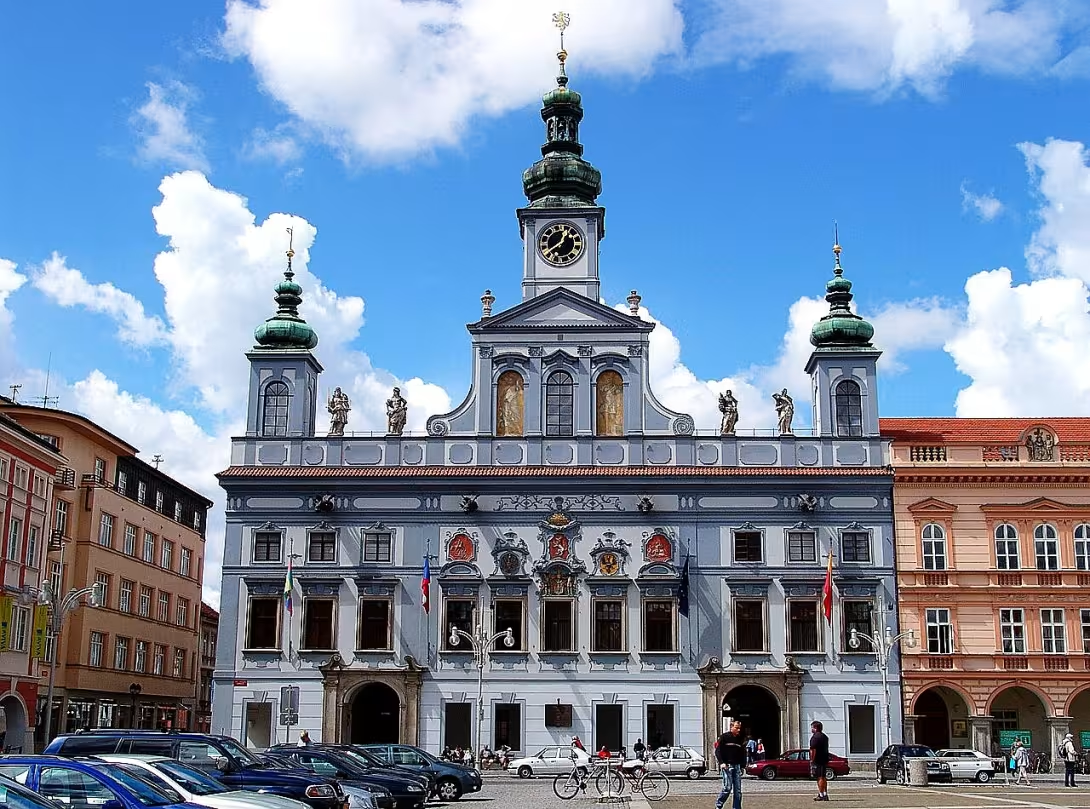
Českobudějovická radnice is located on the southwest corner of Přemysla Otakar II. in České Budějovice. This Baroque building was created by joining two Gothic townhouses. It represents an important historical object that underwent major reconstruction in the Renaissance and Baroque era.
The original town hall was used until the first third of the 15th century. It stood at the site of today's Phoenix Palace, south of the current building. Between 1418 and 1433, the town hall was moved to the site of today's mansion, where two townspeople's houses originally stood. One of them was owned by councilman and magistrate Ondrej Knoll, the neighboring house belonged to the Klaric family and then Terczebuch. In 1494, the city redeemed these buildings from the Terczebuch family and joined them in one whole. The back chamber of the Knoll house, which is still part of the town hall cellar, is best preserved from the original Gothic parts.
In the 16th century, the town hall in Renaissance style was rebuilt under the leadership of Hon Vlach. The new building had a massive corner tower with gold-plated fighting. The façade was decorated by sgraffiti with motifs of flowers and sea waves. The City Hall gained its present Baroque form between 1727 and 1730. The design was prepared by architect Anton Erhard Martinelli, while the implementation was covered by Pavel Kolečný. This reconstruction radically changed the appearance of the object, which obtained a symmetrical three-tower facade.
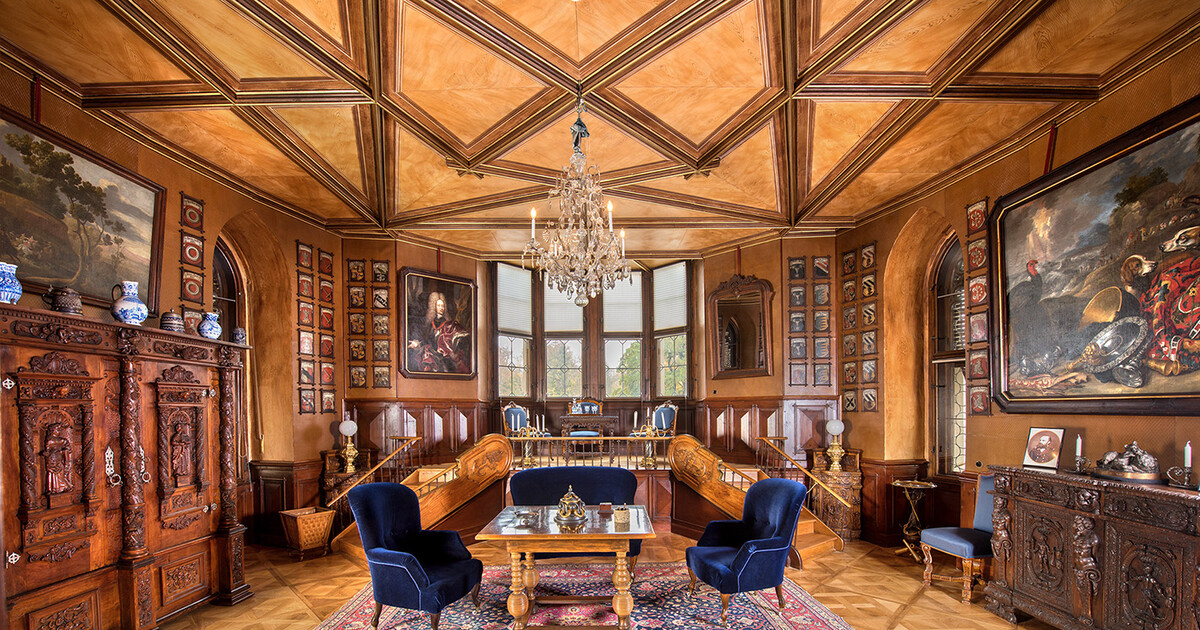
The exterior of the town hall is characterized by three towers and central risalite. The towers resemble a city emblem and four allegorical statues from Josef Dietrich are placed on the attics. The central tower is equipped with clock and the whole silhouette is supplemented by four gargoyles in the form of dragon heads. The interior is richly decorated with Baroque elements. The main meeting room excels especially in the ceiling fresco of Solomon's court, created by Jan Adam Schöpf.
The history of the object is linked to important events. For example, in 1531, Queen Anna Jagellonská was housed here during the Czech Parliament. In the 16th century the building served also for practical purposes; There was a warehouse of salt, armory or powder room. The mention from 1552 is interesting. Due to concerns about poor static conditions, it was allowed to hold a upstairs wedding only on condition that it would dine, but not dance.
In the 19th century, namely between 1825 and 1905, the building served as a seat of the city court and prison. In recent decades, the city hall has undergone further modifications. The facade was reconstructed in 1983 and there was a connection with the neighbouring building between 1999 and 2000. This last reconstruction created a new 36-metre tower with a lookout platform. Since 1988 the town hall has been a protected cultural monument owned by the city of České Budějovice.
The town hall has been a fascinating witness to the changes in building styles and urban life for centuries. Its rich history and architectural details make this place an important point in the tour of the historic city centre.
Historical milestones
- 1418
- Moving City Hall to the butcher's house
- 1494
- Redemption of the neighboring house from the Terczebuch family and connection of both buildings
- 1555
- Start of construction of the new Renaissance Town Hall
- 1727
- Decision on Baroque building reconstruction
- 1988
- Wherever declared a protected cultural monument
Architectural development
Originally two Gothic cores, which were replaced in the 16th century by Renaissance construction with corner tower and sgraffiti. Between 1727 and 1730, a major Baroque reconstruction took place according to the design of A. E. Martinelli. Interior decorated with ceiling fresco by Jan Adam Schöpf and sculpture accessories of Josef Dietrich.
Historical events
1531: Queen Anne of Jagellonian accommodation during the Earth Assembly; 1825-1905: seat of city court with prison.
Owners
City of České Budějovice
Points of interest
The building was created by connecting two Gothic townhouses. - In 1531, Queen Anna Jagellonská was housed here. - In the 16th century, there were rooms for salt storage, armory and gunpowder. Because of the fear of bad condition, in 1552 it was only allowed to hold a wedding on the condition that there was no dancing. - A new 36-metre tower with an observation platform was built during the reconstruction between 1998 and 2000.
Guide
Show guide text
This text was created by artificial intelligence and has not been editorially reviewed. It may contain inaccuracies.
Welcome to the heart of the city where history meets every step you take. Right now, you're standing in front of one of the most important buildings in the city, in front of the Budějovice City Hall. Look at her. You are on the southwest corner of the vast square of the Otakar Square. In front of you is a building that tells the story of many centuries, changes and ambitions of the people who built this city. Feel its power and the atmosphere of power that radiates from it after so long. It is a place where the fate of the people was decided and the development of the entire region is mirrored.
Now let's go back in time together to understand how this building came to be. It is the beginning of the fifth century, namely the year of a thousand four hundred and eight. At the time, the town hall was not as complex as you see it today. The city administration's headquarters moved to a house owned by a butcher named Ondrej Knoll. So imagine that in the early days, ordinary townspeople 'houses were used for official needs. Over time, however, the city grew and the administrative needs grew. In the year one thousand and four hundred and ninety-four, a major step occurred when the city bought up the neighboring house from the Terczebuch family. This combination of two Gothic houses created the core of the building you see before you.
Now pay attention to the architecture itself. When you look at the facade, remember that under the present resemblance lies the very Gothic foundation. But over the centuries, the building has been constantly changing its face. In the year one thousand and five hundred and fifty-five, the construction of a new Renaissance town hall began, which provided a new touch and elegance for the building. But history didn't stop here. In the years of a thousand seven hundred twenty-seven to a thousand seven hundred thirty, the building went through a great Baroque reconstruction. This process was signed by important creators such as Anton Erhard Martinelli, Pavel Kolečný, Hons Vlach or Nikolaus Steuber. Notice the details that are the result of these different epoch. It's a fascinating blend of styles that creates a unique whole. The building is not just an ordinary house, it's a layered record of time.
When we think about who was walking in these carrion, remember the names that wrote history in our books. In the year of the thousand and five hundred thirty one, Queen Anna Jagellonská was housed here. Imagine the commotion that caused her to come into town, and how everything in these premises must have been prepared to receive the royal hostess. Other important men, such as King Vladislav the second or Quirin Mašťovský, were connected to the city hall. These places witnessed diplomatic meetings, political disputes and celebrations.
But City Hall was not just a place for noble guests and administration. Let's look at a less famous but very practical side of things. In the sixteenth century, there were places that we may now consider unusual in the administration building. There was salt stored in the town hall, which was an extremely valuable commodity at the time, essentially white gold. In addition, there was an armory, and dangerous substances were stored here, specifically gunpowder. It's a fascinating idea that there were people sitting next to officials who were guarding weapons and explosives.
There are also stories associated with City Hall that can entertain us today, but were perceived very seriously at the time. Let us remember, for example, the year of a thousand five hundred fifty-two. The building was in such a bad state that the city feared for its stability. There was a curious situation where it was allowed to hold a wedding in the building, but only under strict condition that no one in the building would dance with it more loudly so that the building would not collapse. Imagine the atmosphere where people try to celebrate the happiest day of their lives, but they have to be very careful not to stir up wall instability.
In later times, specifically in the nineteenth century, the building changed its function and internal layout. In addition to the ordinary office there was a municipal court and a prison was set up here. While important urban issues may have been addressed on the upper floors, other parts of the building were closed by people who broke the law. This contrast between power, justice and punishment gives the building depth and cierto tension.
Today City Hall is no longer a prison or salt warehouse. Since a thousand and nine hundred and eighty eight, it has been officially declared a protected cultural monument. This means that it is our joint task to guard and honor this space so that it can serve future generations. If you look at her again, you don't just see her as an old house on the corner of the square, but as a living organism that survived fires, wars and regime changes.
Take another look at the overall views of the building, perceive its location in the square area, and try to imagine what noise and hustle must have been here hundreds of years ago when Butcher Knoll started his journey with the city administration. This building is a symbol of the stability and continuity of the Budějovice city.
You can now continue your journey through the city. I recommend walking slowly around the building and trying to imagine all the people who went through them, from kings to prisoners. Thank you for spending a moment with us at this wonderful monument. We wish you a pleasant rest of the day and many other discoveries in our beautiful streets. Goodbye.
Tips for visitors
The best time to visit is morning or late afternoon when the sun hits the façade of the building at the best angle and highlights its historical details. The building is located in the heart of the city, where you can transport by car or public transport; Check the specific transport possibilities in the maps.
You don't need special equipment to visit, you just need comfortable shoes to walk around the square. We recommend taking the camera because the building is very photographable from the outside, especially from the corner of the square where you can see the connection of the original houses.
For photo lovers we recommend to watch the light play on the Gothic and Renaissance facade elements. The best pictures can be taken from the opposite side of the square, where you can get a wider view of the whole building.
During a short walk in the surrounding area you can visit the Black Tower or take a walk around the Square of Přemysl Otakara II. With the children you will appreciate the area square where the children have enough space to move before you begin to explore the appearance of the town hall.
Frequently asked questions
Can the monument be visited?
The building is in use (offices, a school, shops and the like). The interior is generally accessible only during operating hours and tours are not usually offered; we have not verified the details. You can see the exterior from the street.
Where is the monument?
Location: České Budějovice 1. The map on this page shows the exact spot.
Why is the monument protected?
It is listed in the Central List of Cultural Monuments of the Czech Republic as a cultural monument (register no. 1000139188).
Businesses nearby
Do you run a restaurant, accommodation, shop, museum, rental, wellness or other visitor service near this monument? Show yourself directly to the people heading to it — this is how they will see you in the app and on the web:
Events nearby

Zdroj akcí: otevřená data měst a obcí ČR (Národní katalog otevřených dat) a kalendář akcí Národního památkového ústavu.
Nearby
Náměstí Přemysla Otakara II., Černá věž
Accommodation nearby
Trips and activities nearby
Guided tours, tickets and activities nearby from GetYourGuide
Affiliate link: if you buy from the partner, we may receive a commission. The price for you does not change.
Search tours and activities →Themed route
Here is the design of the cruise route:
1. Mohysl Otakar Square II. (open space) - Huge city heart that serves as the entrance gate to the center. 2. Black tower (construction) - A tall building from which a beautiful view of the whole city is possible. 3. Českobudějovická radnice (administrative building) - The main destination of the journey, which will capture its unique architecture and history.
Seasonal recommendations
In spring, the surrounding square awakens to life and first trees bloom. The light is fine, which helps to observe the facade detail. We recommend light outdoor clothes and a visit in the morning when the air is the cleanest.
Summer brings strong sun that highlights the color of the building and creates sharp shadows. The main season is around the most people, so it is advisable to choose the time shortly before sunset. Don't forget the hat and plenty of water.
The atmosphere is calmer in the autumn. Frequent mists can give the construction a mysterious look. Layer clothes and solid shoes are suitable because the weather is unstable and wet.
Zimą makes a monument monumentally in contrast to a short day and freeze. In advent time, the space around is lit and cozy. It is necessary to have a warm salary coat and gloves to admire the exterior in peace.
Visualizations and artistic views

The visualisations are generated by artificial intelligence and serve as inspiration.
Photos from the area
Real photos taken near the monument


Zdroj a licence jsou uvedeny u každého snímku.
Tips from visitors
No tips yet. Be the first!
Log in and add your tip.
Sources and literature
Photos: Hans Lemuet (Spone) / CC BY-SA 3.0 — Wikimedia Commons. The author and licence also appear when you hover over the image.
Faktickým podkladem tohoto textu byl článek na Wikipedii, jehož autory jsou přispěvatelé Wikipedie. Článek je dostupný pod licencí CC BY-SA 4.0.
Location on the map
More monuments – České Budějovice 1
Show all in the municipality
Příběhy a pověsti
Legendy, pověsti a příběhy spjaté s touto památkou
Fotografie návštěvníků
Zatím žádné fotografie. Buďte první, kdo přidá fotografii z návštěvy!
Log in a přidejte svou fotografii nebo hodnoťte.
Za ověřenou návštěvu v aplikaci získáte víc bodů — poznáme podle GPS, že jste na místě.
Reviews and comments