






chrám Povýšení svatého Kříže v Teplicích Chapel
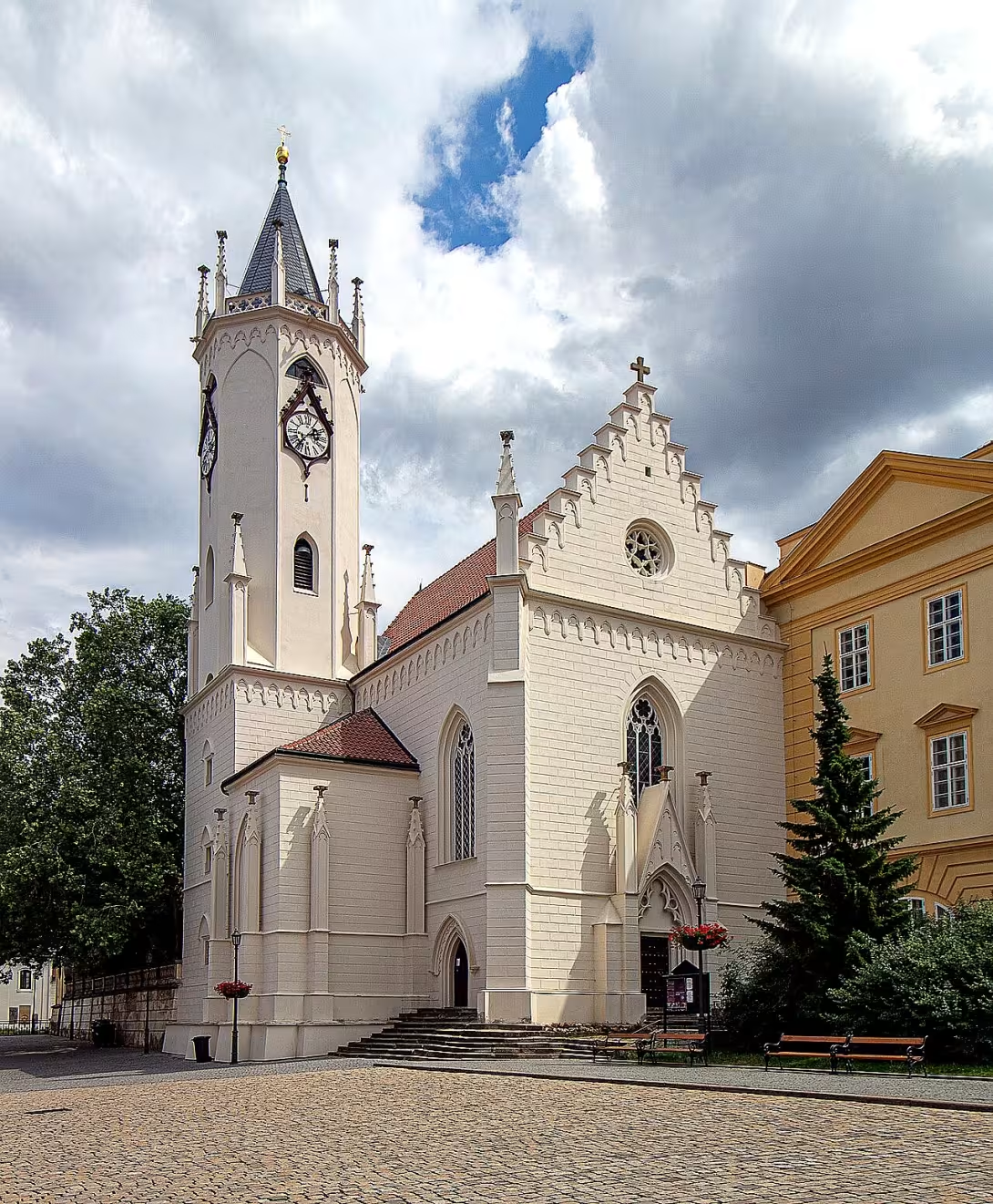
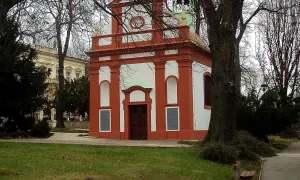
The building is located in the Castle Square in Teplice with the number described by 517 / 14 in the immediate vicinity of the temperature lock with which it is historically and constructively bound. The chapel was originally built as part of the chateau area for the needs of the family of owners of the estate and spa guests Teplice.
The construction was built gradually in a relatively long period between 1549 and 1586 for the Vřesovice Vrísovice, owner of the Teplice estate. Architecturally, the chapel belongs to a late Gothic or early Renaissance style. Stone building elements - more precisely, blocks from the Romanesque basilica of the extinct monastery of St. John the Baptist - were used to build the tower. Under the temple is the tomb of the lords of Vrísovice; Volf himself was buried here in 1598, after which he is supposed to bury his two wives and granddaughter of the House of Schönberg. It is also possible that his brother Bernard z Vřesovic found his last rest here.
In the middle of the 17th century, the building expanded with a square chapel dedicated to Saint Anthony. The fundamental transformation came between 1798 and 1806 when the chapel was comprehensively modified in the style of romantic goth with Empire dominance. These works were carried out according to the designs of the Dresden builder Johann Augustus Giessel, who personally travelled to Teplice to show the masonry of the masonry the facade of the tower and other elements to look like. One of the most visible interventions was the increase of the north tower and the lock of the old entrance to the oratory; At its new height and shape, the tower became a significant dominant feature of the entire city. She's being crowned by an eight-Phil balustrado. The original plan also included a new window behind the main altar, but it did not take place because of the disagreement of the local prince. The chapel was re-consecrated in 1806 after the completion of its work and gained the reputation of one of the first manifestations of romantic style in Czech territory.
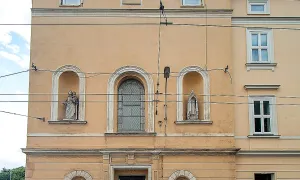
The construction is a one-ship brick building with a polygonal conclusion reinforced by supporting pillars, ending with fials. The northwest facade is felt by shallow stucco, the main entrance is shaped by a broken arch with rich decoration and a thin vimper. The window above the entrance is lined with double champagne and divided by three nuns with circular motifs.
Since the end of the 19th century the chapel was sporadically opened for Orthodox services of spa guests. Since 1950, the Czech Orthodox Church has been its home, which has been performing regular religious services here on Sundays and holidays since 10: 00 in the morning. From the same year there is an iconostas located at the main altar. In 2016, the remains of Saint Clara were shown in the side chapel.
Then and now
Drag the slider to compare how the landmark may have looked when it was built with the view today.
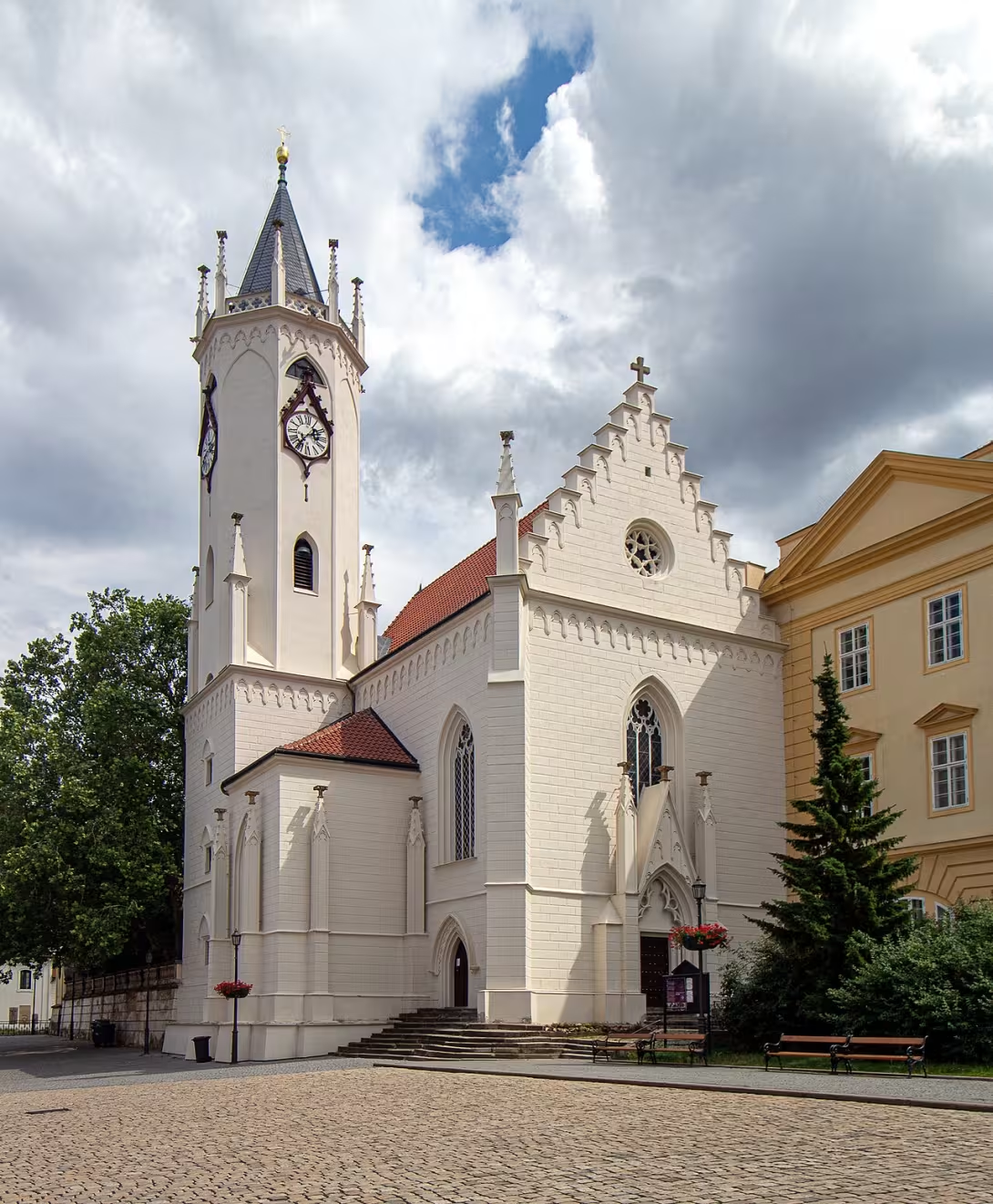
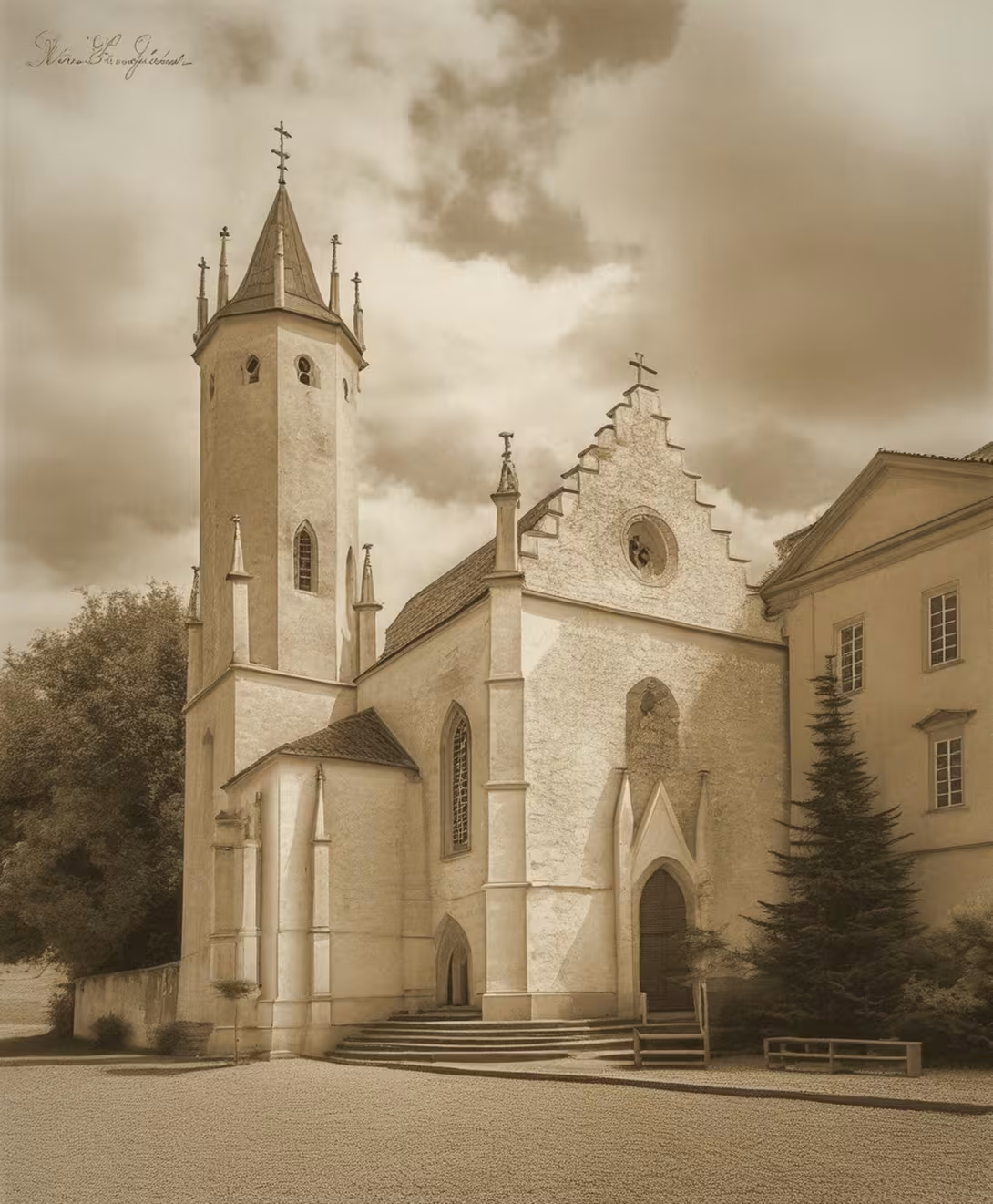
The historical appearance on the left is an AI-generated visualisation and serves as inspiration only.
Historical milestones
- 1598
- Wolf's funeral from Vrísovice.
- 2016
- Exposing the remains of St. Clara in the side chapel.
Architectural development
Originally built as a Catholic church in the late Gothic style or early Renaissance style, the chapel was built in the middle of the 17th century by a square chapel of St. Anthony and in 1798-1806 it was modified in the romantic Gothic style according to the plans of Johann Augustus Giessel, which included lifting the north tower.
Historical events
- 1549
- The beginning of the chapel construction as a Catholic church for the needs of the family of the owners of the chateau.
- 1806
- Finishing romantic adjustments and reconsecration of the temple.
Points of interest
- The chapel was originally built as part of the chateau area for the needs of the family of owners of the estate and spa guests Teplice. - The building of the tower used stone building elements - blocks from the Romanesque basilica of the extinct monastery of St.
Guide
This guide is narrated by a synthetic voice generated by artificial intelligence.
Show guide text
This text was created by artificial intelligence and has not been editorially reviewed. It may contain inaccuracies.
Welcome to one of the most important symbols of Teplice. You are standing right where time has stopped and yet in every stone there is a constant movement of history. In front of your eyes is the Temple of the Holy Cross. Feel this building not as a static object, but as a living organism that has been changing, growing up for centuries and adapting to the needs of the people who lived here, believed and departed into eternity. This chapel is not just part of the urban landscape; She is her spiritual center, the dominant one who, by her presence, determines the character of the whole neighborhood.
Now let's go back deep into the past to understand why this place is standing right here. The whole story begins with the family Vrísovic, the original owners of the Teplice estate. This chapel was not created as a random element, but was deliberately built as part of the chateau complex. You have to imagine Teplice back then, as a place that started its journey to the spa glory, and the family of owners needed a place for their private prayers, but also for the spiritual needs of their precious guests. The first deep print to the history of this place was left in 1598, when the funeral of Wolfe of Vřesovice, the founder of this place, took place here. This tells us that even then this building was seen as a sacred place, a place where the earthly power of noble generations meets divine.
Now pay attention to the very form of the building that surrounds you. If you look at her face, you'll notice she's not uniform. It is not just one style, but rather a fascinating match and consent of various epoch. This building has undergone an incredible transformation. It began as a simple construction of Gothic origin, which was essentially modest. But over time, her character changed. There was a renaissance reconstruction that gave her new dignity, and finally, during the period of romanticism, the construction was transformed into what you see today - romantically Gothic architecture. Behind this particular, very impressive form is the name Johann Augusta Giessel. He was the planner who, at the time of romanticism, breathed into this building the right atmosphere of mystery and nobility that you perceive right now.
Look up now, especially towards the tower. Here is one of the largest architectural treasures of this place. When building the tower, it wasn't just ordinary materials that were used. Notice these stone elements, these massive blocks. These stones are not just ordinary building material. They're pilgrims from another time. They come from the Romanesque basilica of the extinct monastery of St. John the Baptist. Imagine the continuity - the stones of a long-lost, ancient temple were reused to form the basis for a new tower. It's like history is literally touching history, like old ruins are connecting with a new city figure.
When we look at this temple, we cannot forget the people whose destinies are inherent in it. In addition to the founder of Wolf from Vřísovice, the name Bernarda from Vřísovice appears here in history. There are assumptions that he can be buried in the tomb under this chapel. Imagine the quiet presence of those who rest here under your feet. These places are always connected to the invisible world of the ancestors. And even in modern history, we have new characters. For example, in 2016 there was significant exposure of the remains of Saint Clara in one of the lateral chapels, which revived the spiritual importance of this place for current generations.
But now I want to invite you to think about one interesting thing that resonates in this building. The Church of the Holy Cross is a fascinating example of how the historical monument can adapt without losing its soul. Since the second half of the twentieth century, the Czech Orthodox Church has served here. It is a fascinating transformation - from a private chateau chapel for a noble family and spa guests became an important centre for another community. This ability to take over a new function, a new faith and new needs without losing its historical integrity is what makes it such an exceptional monument.
You are standing in front of a building that has survived for centuries, which has seen the ups and downs of the families, which have absorbed stones from other structures and which has been constantly reforming to remain an important part of Teplice. Feel the atmosphere of calm and the constant transformation.
Thank you for spending this moment with us and paying attention to this place. We hope that this view of history has helped you better understand the face of your city. Continue to walk now and let yourself be carried away by the beauty of Teplice, which still have many more secrets to reveal. Goodbye.
Tips for visitors
Best time to visit the temple The promotion of the Holy Cross in Teplice is early spring or late autumn, when the weather is pleasant and fewer people. These periods offer a peaceful atmosphere to explore historical architectural details without the pressure of a large visitor.
Parking in Teplice is possible on many public car parks located near the centre. For those who prefer public transport, there are several bus and tram lines that will bring you to the historic heart of the city. The current connection should be checked online or via mobile applications for transport.
When visiting the temple, take a quality camera with you to capture its architectural beauty. It is also important to have a protective coat or mantle blankets with you, because the visit to the temple includes a walk through the outdoor areas, which are often cold in winter.
For photography is the best place at the beginning of the afternoon when the sun illuminates the building with its soft light. The best angles for photography can be found in the vicinity of the temple, especially from higher terraces or when looking at it from a distance.
In the vicinity of the temple you can visit Teplický chateau and its parks, which are an ideal place for relaxation and walking. For families with children, the city offers several attractions such as Teplice Spa or Aquapalation, where children can enjoy swimming time.
Frequently asked questions
Is chrám Povýšení svatého Kříže v Teplicích open to the public?
Yes, the chapel is open for public visit. It is appropriate to verify the current opening times on the official site of the monument or in local information sources.
How do I get to the place by car / public transport?
The temple is easily accessible by car and public transport. Parking can be found in nearby parking lots. To use public transport you can check the current connections of buses and trams, which will take you to the historical centre of Teplice.
How much is the entrance fee and is it paid on the spot?
Admission fees are usually paid when visiting. For current prices we recommend checking information on the official site of the sights or in local tourist centres.
Is the tour suitable for children and seniors?
Yes, the chapel is also accessible to children and seniors. Its quiet environment allows a relaxed visit without excessive physical effort.
How long does the tour take?
A tour of the temple can take from 30 minutes to an hour, depending on how thoroughly you want to view the site and how much time you spend taking pictures.
What are the opening times and booking is required?
Opening hours may vary depending on the season. It is advisable to check the current opening hours online or before visiting. Generally booking is not necessary but may be useful in time tips.
What's interesting in the immediate vicinity?
In the vicinity of the temple is the historical centre of Teplice, which offers several other monuments and parks. Visit for example the spa area or explore quiet green areas in nearby parks.
For kids
Hi! Imagine the ancient city of Teplice, where around 1549 a small chapel was built like the magnificent house of God. It was exactly 477 years ago! The chapel of the Holy Cross was built by Count Volf for himself and his family to have a place to pray or for a quiet time. And best of all, it was also there for the guests from the Teplice Spa who were enjoying the thermal springs and the comfort of the chateau at the time.
Businesses nearby
Do you run a restaurant, accommodation, shop, museum, rental, wellness or other visitor service near this monument? Show yourself directly to the people heading to it — this is how they will see you in the app and on the web:
Nearby
ITEX Show interactive overview of the surroundings - restaurants, accommodation, rentals and other places within a 15 km radius.
Data: OpenStreetMap contributors, 15 km radius.
‡ Historical monuments
- Regional Museum in Teplice (0.0 km)
- Memorial 313 to death victims (4.5 km)
- Catastrophe on Döllinger (6.3 km)
- Search bridge Old Martin (6.8 km)
- Pomník (8.8 km)
- memorial to victims of death march (9.4 km)
- Memorial on former neighbors in ČSR (10.0 km)
- Prussian monument 1813 (12.3 km)
Restaurant and catering
- U Chateau (0.1 km)
- U Tits (0.2 km - Roosevelt 262 / 11)
- Cherry - beer club (1.2 km)
- Pizzeria bar Týna (6.0 km)
- Casanova (6.9 km)
- Dubín (7.5 km)
- U Ondřije Stropník (9.5 km)
- Black Orel (9.8 km)
Accommodation
- Hotel Horal (5.9 km)
- Motel Sport (6.0 km)
- Hotel Casanova (6.5 km)
- Hotel u Lva (10.6 km)
- Ferienwohnung Kubis (11.6 km - Rosengrund 8)
- GrumbtmühleX3ZX (11.6 km - Rosengrund 13)
- Kemp Kyselka (11.8 km)
- Kemp Kyselka (11.8 km)
› Rental and sports
- Regal Bike (1.6 km)
- D-Sport (3.8 km)
- Sportisimo (3.8 km)
- FITNESS shop (3.9 km)
- Killtec (3.9 km)
- Sport Vision (4.0 km)
- Tennis courts (6.0 km)
- Flat track - moto club Chabarovice (8.6 km)
© Tourism and nature
- Sandy top (1.3 km)
- Fox top (7.7 km)
- Komaria (8.0 km)
- Pramenáč (9.6 km)
- Storm (10.0 km)
- Traugotthöhe (10.4 km)
- Miles (11.8 km)
- Kleiner Lugstein (11.8 km)
Accommodation nearby
Trips and activities nearby
Guided tours, tickets and activities nearby from GetYourGuide
Affiliate link: if you buy from the partner, we may receive a commission. The price for you does not change.
Search tours and activities →Themed route
Thematic cruise route: Temple of the Holy Cross in Teplice
1. Temple of the Holy Cross (chapel) * Type: * Religious monument * Why is it worth a visit: * This chapel is one of the oldest sacral buildings in the area and is associated with the legends of St. Wenceslas. It is a place of peace and shelter where you can enjoy a beautiful view of the surrounding countryside.
2. Thermal Spa Teplice * Type: * Spa facilities * Why is it worth visiting: * Thermal baths are not only for medical purposes but also offer the possibility of relaxation in the historical environment. Their origin dates back to the 13th century, making them one of Europe's older spa institutions.
3. Church of St. Nicholas * Type: * Cathedral * Why is it worth a visit: * This Baroque church is the largest sacral building in Teplice and serves as a seat of the diocese. Its rich interior and history make it a fascinating place for visitors interested in architecture and spiritual life.
4. Victory Memorial * Type: * Historical memorial * Why is it worth visiting: * This monument is dedicated to war victims and symbolizes peace. Its location on the platform offers impressive views of the city and its surroundings, making it an ideal place to stop and reflect.
5. Teplický Theater Station * Type: * Cultural place * Why is it worth a visit: * The station is an exceptional place for cultural events and concerts. Its architecture and atmosphere provide ideal space for entertainment and relaxation, making Teplice Theatre a key part of the cultural life of the city.
This route offers a combination of history, culture and nature within Teplice, allowing visitors to explore the wealth of the region.
Seasonal recommendations
Spring brings the awakening of nature around the chapel. Blossoming trees and lush greenery create an optimistic atmosphere with a gentle spring light highlighting the details of the building. We recommend to dress well because the weather is unstable. It is best to visit the memory in the morning when the peace and air is the cleanest.
In the summer months, the surrounding area is dominated by green and intense sun, which illuminates the facade beautifully. The atmosphere is full of energy, but there are more visitors in the premises. It is advisable to come first thing in the morning to avoid the biggest crowds and heat. Choose light, breathable clothes and don't forget enough fluids.
Autumn is a period of golden colours and frequent fogs that give the place a mysterious and melancholy touch. The low sun falls at a sharp angle and creates deep shadows, which is ideal for photography. Moisture-resistant shoes and waterproof jackets are practical. The ideal time to visit is late afternoon.
Zimą rules peace and quiet, possibly a snowy landscape that surrounds the memory with a white blanket. The atmosphere is withdrawn and valiant, especially in advent time. It is necessary to wear warm thermal clothing and watch shortened opening times. We recommend a visit before dark to give the inner space enough daylight.
Visualizations and artistic views


The visualisations are generated by artificial intelligence and serve as inspiration.
Photos from the area
Real photos taken near the monument

Zdroj a licence jsou uvedeny u každého snímku.
Atmosphere of the place
This atmospheric visualisation of the place and period was generated by artificial intelligence. It is not real footage of the location.
Tips from visitors
No tips yet. Be the first!
Log in and add your tip.
Sources and literature
Fotografie: VitVit / CC BY-SA 4.0 — Wikimedia Commons. The author and licence also appear when you hover over the image.
Faktickým podkladem tohoto textu byl článek na Wikipedii, jehož autory jsou přispěvatelé Wikipedie. Článek je dostupný pod licencí CC BY-SA 4.0.
Location on the map
Příběhy a pověsti
Legendy, pověsti a příběhy spjaté s touto památkou

Fotografie návštěvníků
Zatím žádné fotografie. Buďte první, kdo přidá fotografii z návštěvy!
Přihlaste se a přidejte svou fotografii nebo hodnoťte.
Za ověřenou návštěvu v aplikaci získáte víc bodů — poznáme podle GPS, že jste na místě.
Reviews and comments