



kaple Panny Marie (České Žleby) Chapel
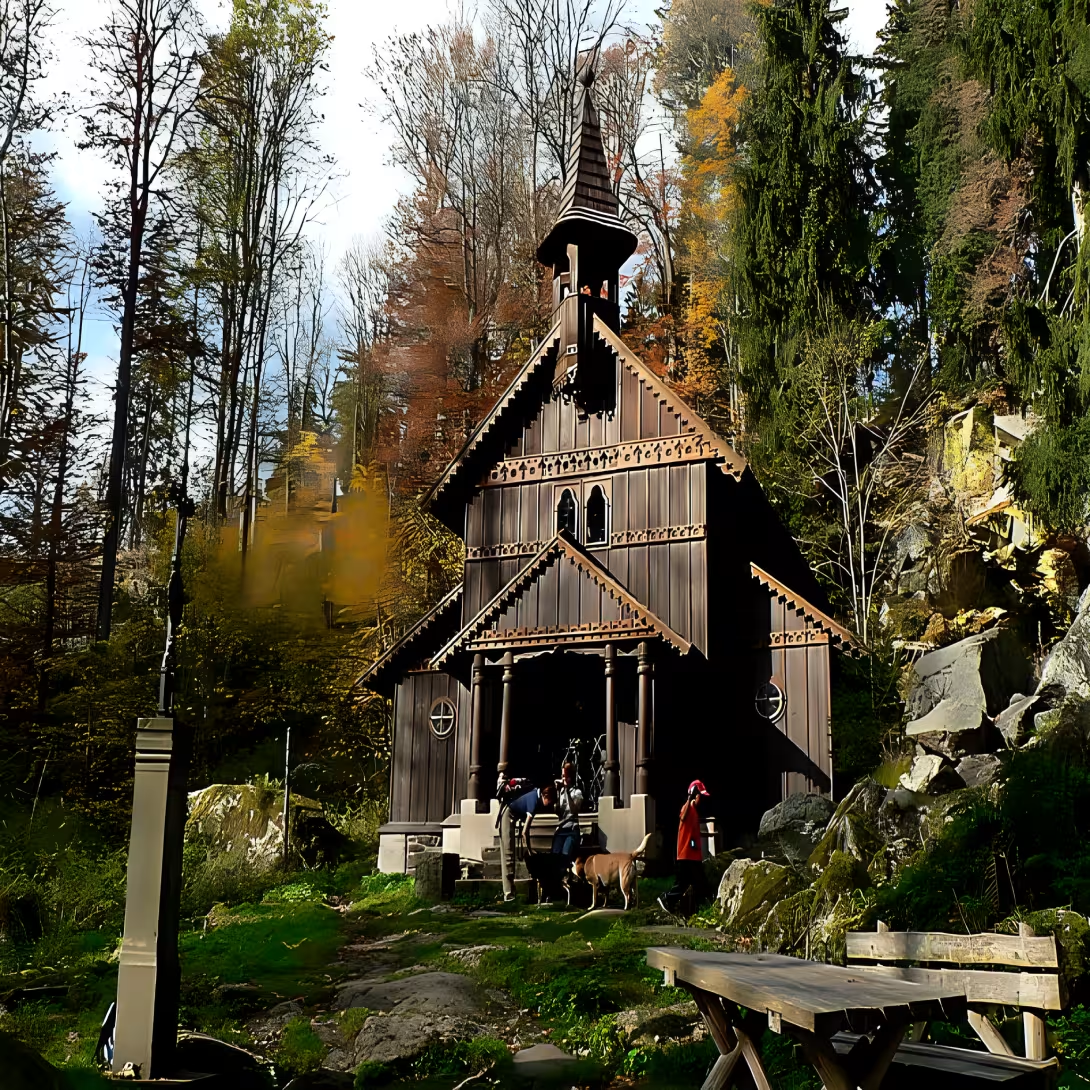
The Chapel of the Virgin Mary, also known as the Stozecká Chapel, stands in the solitude of mixed forests near the Czech Žleb in the territory of the village of Stožec in Volarsk at a height of 950 meters above sea level. Above the chapel is a standing rock reaching 974 metres, from which the view of the village of Stážec and part of Šumava is spread in clear weather. This wooden building is protected as a cultural monument.
The origin of the chapel dates back to 1791, when the veneer Jakub Klauser built it as an expression of gratitude for healing - according to legend, he accidentally damaged his eyes in the spring and miraculously returned them. The original building was made of wood, but already in 1804 it was rebuilt from a combination of stone and wood. The first Holy Mass was held here on 24 July 1865. After a long-standing dispute over the ownership of the wooded area, the chapel came from the property of the city of Volary into the hands of the Schumalavian Schwarzenberg, who entrusted it to the care of the municipality of České Žleby.
During the 19th century, the chapel gained a reputation as a place of miracles. The miraculous painting that was hanging here was carried to their parish and had the priest Riegler build a chapel at the church in 1818. But in the great fire of the city in 1863, the painting was destroyed. A new painting was painted here by Czech believers in 1815; his author was supposed to be the ballerina painter Ignac Schraml. Already in the middle of the 19th century the chapel enjoyed considerable popularity - pilgrims from nearby towns and villages, both Czech and Bavarian, regularly flowed to it. A great procession took place on the Day of the Assumption of the Virgin Mary (15 August). To accommodate an increasing number of visitors, it was extended in 1867 by an extension. In 1920, up to 5,000 people participated.
The freedom of visitors ended in 1946. The chapel has been abandoned, access has become restricted by the Border Guard. In the mountain climate conditions, it gradually faded and left nothing but debris. It was only in 1987 and 1988 that Jan Kocourka of Prachatic was involved in the renewal. At that time, they were also managing the tolerated service regime under State Security supervision. The ceremonial opening of the renewed chapel took place on 9 November 1988, the reconsecration then took place on 25 August 1990 by the then Czech-Budějovic bishop Miloslav Vlk, to whom later присуd the title of cardinal.
At present, the chapel is held annually, with the main pilgrimage always coming at the earliest of August 15. Since 2019 a renewed cross path has led to the chapel from České Žleb. At the foot of the chapel there is a well with a spring. The location has been located in the first zone of the national park since 2017 and represents an important natural and spiritual symbol on the border of the Czech and German states.
Then and now
Drag the slider to compare how the landmark may have looked when it was built with the view today.
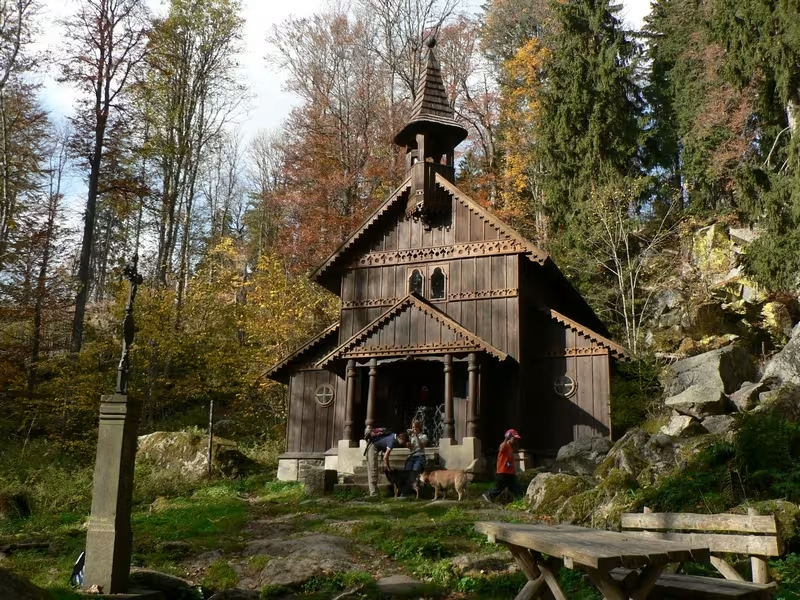

The historical appearance on the left is an AI-generated visualisation and serves as inspiration only.
Historical milestones
- 1791
- Construction of original wooden chapel by molar blacksmith Jakub Klauser.
- 1804
- The reconstruction of the chapel of stone and wood.
- 1867
- The extension of the chapel on the annex due to the great popularity of pilgrims.
- 1987-1988
- Restoring the ruin thanks to Jan Kocourek from Prachatic.
- 1990
- Reconsecration of the chapel by Bishop Miloslav Wolf.
Architectural development
The original wooden structure from 1791 was replaced by a combination of stone and wood in 1804. In 1867 the chapel was extended by an extension. The current form with a stone presbytery and a wooden ship with a triangular shield was created in the reconstruction in the 1980s.
Historical events
1791: construction of the original wooden chapel; 1946: leaving the chapel and limiting access; 1988: festive opening of the renewed chapel.
Owners
city of Volary, family of Schwarzenberg, municipality České Žleby
Points of interest
- The Chapel of the Virgin Mary is also known as the Stozecká Chapel and stands at a height of 950 meters above sea level near České Žleb. - The original construction from 1791 was built by the molar blacksmith James Klauser as an expression of gratitude for the healing of the eyes. - The chapel became a place of wonder during the 19th century and was a popular pilgrimage place, especially on the Day of the Assumption of the Virgin Mary (15 August). Up to 5,000 people attended the chapel in 1920. - The freedom of the visit ended in 1946, but the renewal took place in 1987 and 1988 under the direction of Jan Kocourek of Prachatic.
Guide
This guide is narrated by a synthetic voice generated by artificial intelligence.
Show guide text
This text was created by artificial intelligence and has not been editorially reviewed. It may contain inaccuracies.
The Stožecká Chapel, dedicated to the Virgin Mary, is a wooden pilgrimage chapel in mixed forests near České Žleby, in the territory of the municipality of Stožec in the Volarsko region. It lies at an altitude of 950 meters above sea level. Above it rises Stožecká Rock, from which Stožec and part of Šumava can be seen in clear weather. The chapel is protected as a cultural monument.
According to legend, the first small wooden chapel was built in 1791 by Volarsko blacksmith Jakub Klauser. It was his thanksgiving for regaining his sight after washing his eyes in a local spring. In 1804, a structure made of stone and wood was erected. Shortly after, a long dispute over the use of the surrounding forests came to an end. The chapel thus passed from the ownership of the town of Volarsko to the Krumlov property of the Schwarzenberg family, who entrusted it to the municipality of České Žleby. The people from Volarsko took the miraculous image of Mary to Volarsko. In 1818, the parish priest Riegler had a side chapel built for it at the church, but the image was destroyed in a great fire of the town in 1863. Meanwhile, the people from České Žleby had a new image painted in 1815. Its author was probably Volarsko painter Ignác Schraml, who painted the original one as well.
Already in the first half of the 19th century, pilgrims came here from both the Czech and Bavarian sides of Šumava. The largest processions were held on August 15th, the Feast of the Assumption of Mary. Due to the influx of believers, the chapel was extended with an annex in 1867. In 1920, up to five thousand people came on pilgrimage here.
After 1946, the chapel remained abandoned. Access to the border, guarded by the Border Guard, was heavily restricted, and the building deteriorated in the harsh mountain climate until only ruins remained. The restoration was undertaken in 1987 and 1988 by Jan Kocourek from Prachatice. Services were held here at that time, which the regime tolerated, but always under the supervision of the Prachatice State Security. The restored chapel was opened on November 9th, 1988, and on August 25th, 1990, it was re-consecrated by the bishop of České Budějovice and later cardinal Miloslav Vlk. The main pilgrimage takes place today on the Sunday nearest to August 15th. Directly below the chapel is a renovated spring with water, and since 2019, a restored Way of the Cross has led here from České Žleby.
A faithful replica of the chapel was built between 1983 and 1985 in nearby Philippsreut on the Bavarian side of the border.
The area around the chapel has been the first zone of a national park since 2017. The late settlement of this inhospitable region and the closed border helped preserve hundreds of hectares of primeval forest.
Tips for visitors
The best time to visit the Chapel of the Virgin Mary in České Žlebí is from May to September, when the forest trails are best accessible and the surrounding landscapes offer their full bloom. This time of year also offers ideal conditions for photography, when sunlight is the most beautiful and the natural color of the forest is the most lively.
To reach the Chapel of the Virgin Mary you can use both passenger cars and public transport. You can verify the current connection in the search engine.
When visiting the chapel, it is advisable to take a guide or map with you as the surrounding terrain offers different directions of exploration. We also recommend durable shoes and when visiting in colder months warm clothes, as forest areas can be cold.
Photography of the chapel of the Virgin Mary offers the best possibilities from the direction of the spring with a well at the foot of the chapel. The sunlight is here at noon and afternoon best suited for capturing the details of the building and surrounding landscapes.
In the vicinity of the Chapel of the Virgin Mary you can visit the forests in the first zone of the National Park Šumava which are ideal for families with children. The cross road from České Žleb offers the possibility of beautiful walks and an opportunity to learn the history and nature of the region.
Frequently asked questions
Can the monument be visited?
Religious buildings are usually open mainly during services; at other times a visit is normally arranged with the parish or the operator. We have not verified specific times.
Where is the monument?
Location: České Žleby, Jihočeský kraj. The map on this page shows the exact spot.
Why is the monument protected?
It is listed in the Central List of Cultural Monuments of the Czech Republic as a cultural monument (register no. 25383/3-3761).
For kids
Imagine coming back 222 years and finding yourself in the beautiful village of Stace in the heart of Šumava. The chapel of the Virgin Mary, which stands here today, was still a small building with red roofs and white canvas. Who lived here? Farmers, livestock farmers, merchants... They were people who fed off land and nature.
Businesses nearby
Do you run a restaurant, accommodation, shop, museum, rental, wellness or other visitor service near this monument? Show yourself directly to the people heading to it — this is how they will see you in the app and on the web:
Nearby
Stace rock (974 m above sea level), a spring with a well at the foot of the chapel, a cross road from České Žleb and forests in the first zone of the national park Šumava.
Accommodation nearby
Themed route
1. Cross Way from České Žleb - religious path. Provides a peaceful introduction to the path and space for reflection during the exit.
2. Chapel of the Virgin Mary (České Žleby) - sacral building. The main destination of the trip, which is the centre of the whole area and offers spiritual narrow.
3. A spring with a well at the foot of the chapel - a natural spring. Ideal place for a short stop and refreshment at clean water right by the chapel.
4. Forests in the I. zone of the National Park Šumava - Protected Nature. Possibility to observe the pristine wilderness in the most guarded part of the national park.
5. Standing rock - view. The final point of the route offers panoramic views from 974 meters above sea level.
Seasonal recommendations
Spring: The Chapel of the Virgin Mary in České Jábích offers a unique experience in the spring when nature begins to awaken and flowers develop their most beautiful colors. The sun illuminates the chapel sweetly, highlighting its historical appearance. This time of year is ideal for visiting due to mild temperatures and relatively small number of tourists. We recommend visiting the chapel at the beginning of the day when the atmosphere is calm and nature is full of blood. Due to the alternating weather, you should carry clothes suitable for different temperatures.
Summer: Summer is the highlight of the tourist season in České Jábích and the chapel of the Virgin Mary attracts a large number of visitors. The sunny days shine over the historical monument, making it an ideal place for photography. Due to the high number of tourists we recommend to arrive in the chapel early in the morning or late in the afternoon to avoid peak points. A wet summer means it is advisable to carry a protective umbrella and plenty of drinking water. Clothes should be light and comfortable.
Autumn: Autumn offers the Chapel of the Virgin Mary in České Jábí in an atmosphere full of golden and red colours of trees. The sun illuminates a new way, adding romance to its historical character. This period is ideal for visiting thanks to mild temperatures and fewer tourists compared to the summer overfill season. We recommend visiting the chapel in the late afternoon when the atmosphere is calm and nature offers the most beautiful colors. Clothes should be suitable for mild temperatures with the possibility to approach colder conditions.
Winter: Winter visit to the Chapel of the Virgin Mary in České Jábích offers unique experiences where the monument is surrounded by snow and the trees are without leaves. Sunshine lights the chapel in a specific way, creating a magical atmosphere. This period is ideal for lovers of calm and quiet beauty, as the number of tourists is significantly reduced. The chapel can only be open for limited hours, so it is important to check the actual visiting times. We recommend wearing warm clothes and suitable shoes for cold conditions. In addition, you should consider bringing a protective umbrella with you, because snow reflective light can be very strong.
Visualizations and artistic views


The visualisations are generated by artificial intelligence and serve as inspiration.
Photos from the area
Real photos taken near the monument


Zdroj a licence jsou uvedeny u každého snímku.
Tips from visitors
No tips yet. Be the first!
Log in and add your tip.
Sources and literature
Photos: Martin Vavřík / Public domain, rozlišení zvýšeno umělou inteligencí — Wikimedia Commons. The author and licence also appear when you hover over the image.
Faktickým podkladem tohoto textu byl článek na Wikipedii, jehož autory jsou přispěvatelé Wikipedie. Článek je dostupný pod licencí CC BY-SA 4.0.
Location on the map



Příběhy a pověsti
Legendy, pověsti a příběhy spjaté s touto památkou

Fotografie návštěvníků
Zatím žádné fotografie. Buďte první, kdo přidá fotografii z návštěvy!
Log in a přidejte svou fotografii nebo hodnoťte.
Za ověřenou návštěvu v aplikaci získáte víc bodů — poznáme podle GPS, že jste na místě.
Reviews and comments