



kostel svaté Máří Magdaleny (Chvalšiny) Church
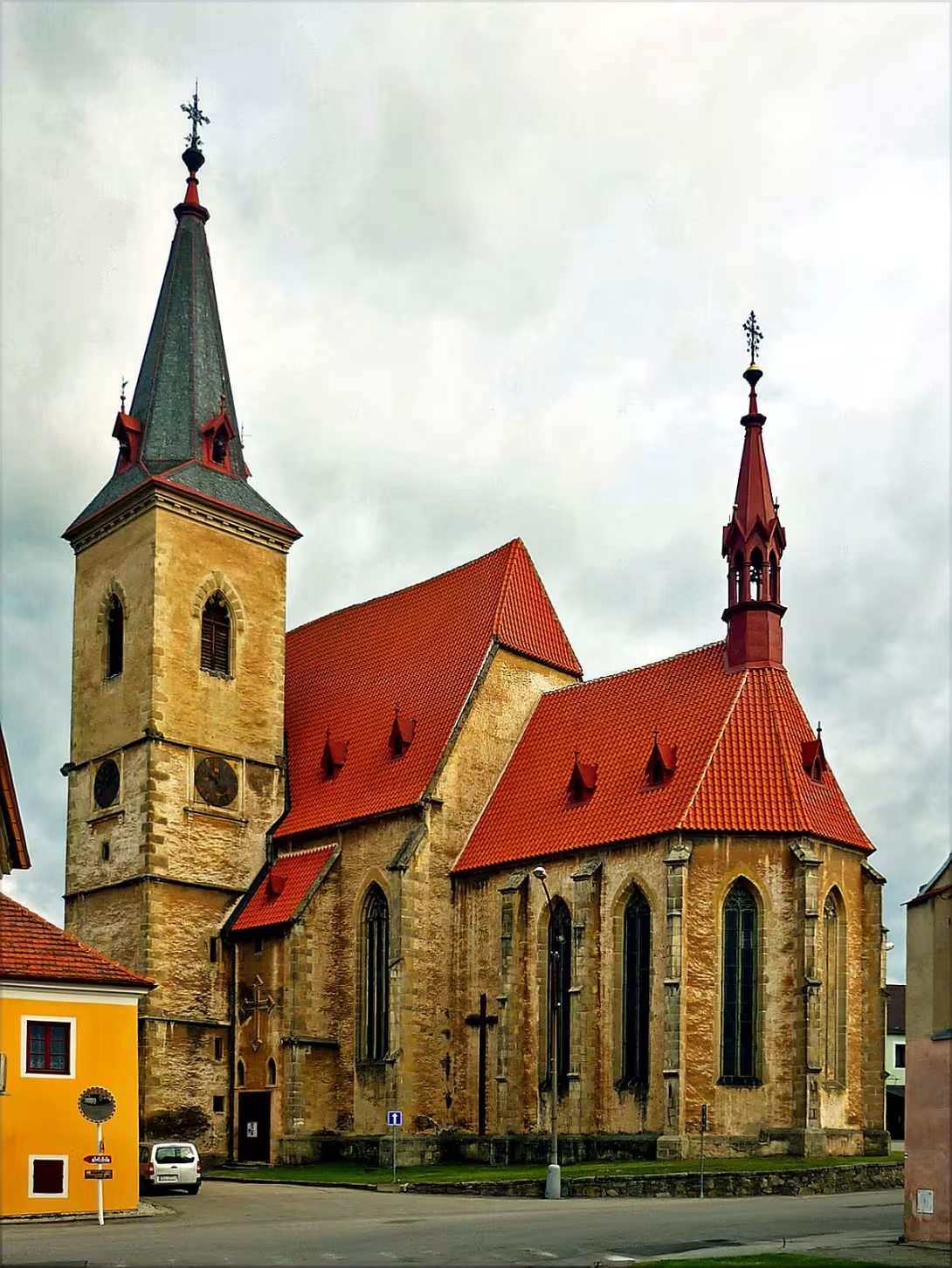
The church of St. Mary Magdalena is located in the upper part of the village square Chvalšiny in the district of Český Krumlov in the South Bohemia region. It is a late Gothic temple that was built at the turn of the 15th and 16th centuries and represents one of the most fundamental urban elements of its location. Its massive prismatic tower and sophisticated building material defines the character of the square and creates a characteristic panorama of the village, visible from virtually all surrounding hills.
Today's form of church grows from the decision of the guilds and the town from the 1980s to rebuild and enlarge the original early Gothic church, which stood here around the middle of the 13th century. The construction began by measuring the foundations of the sacristy and the priesthood in 1487, when the sacristy was also completed. In 1494 the priesthood was sealed, in 1499 the south hall was built with a representative entrance portal. Around 1500 he took over the construction of the ship Hans Getzinger from Haslach, which belonged to the main builders of the Rozberg construction plant and worked on churches in Zatoni and Rožmberk. Under his guidance, in 1507 a ship was completed with a bay on the western shield and subsequently, between 1507 and 1514, let Getzinger cover the ship with a net vault and paint his name into its peak. A monumental painting of the Last Court was created during this period. The construction later had an early Baroque finish in the mid-17th century, in 1760 the central Marian chapel on the north side, and in 1773 the tower increased. The last major changes were made in the form of neo-gothic renovations between 1886 and 1887.
The construction form corresponds to a single-boat type with a tripod ending in a priesthood of two fields. The rectangular boat contains four arches and is accessible by a portal in the south hall. On the north side of the presbytery is attached sacristy with a vault basement serving as a skeleton. The tower with the needle roof grows at the south front of the boat, complementing it with a prism staircase in the southwest corner. Despite numerous modifications, the church maintained the characteristic form of late goth.
The repeatedly mentioned position of the church at the crossroads from Český Krumlov to Prachatice and towards the Upper Plana and Austria reflects the importance of the Phalshins as the centre of the parish administration and testimony of the Christian faith in the region. The visitor will find in this temple not only architectural value, but also a symbol of eight centuries of continuity of liturgical life and development of building styles from the high Middle Ages to the modern ages.
Then and now
Drag the slider to compare how the landmark may have looked when it was built with the view today.
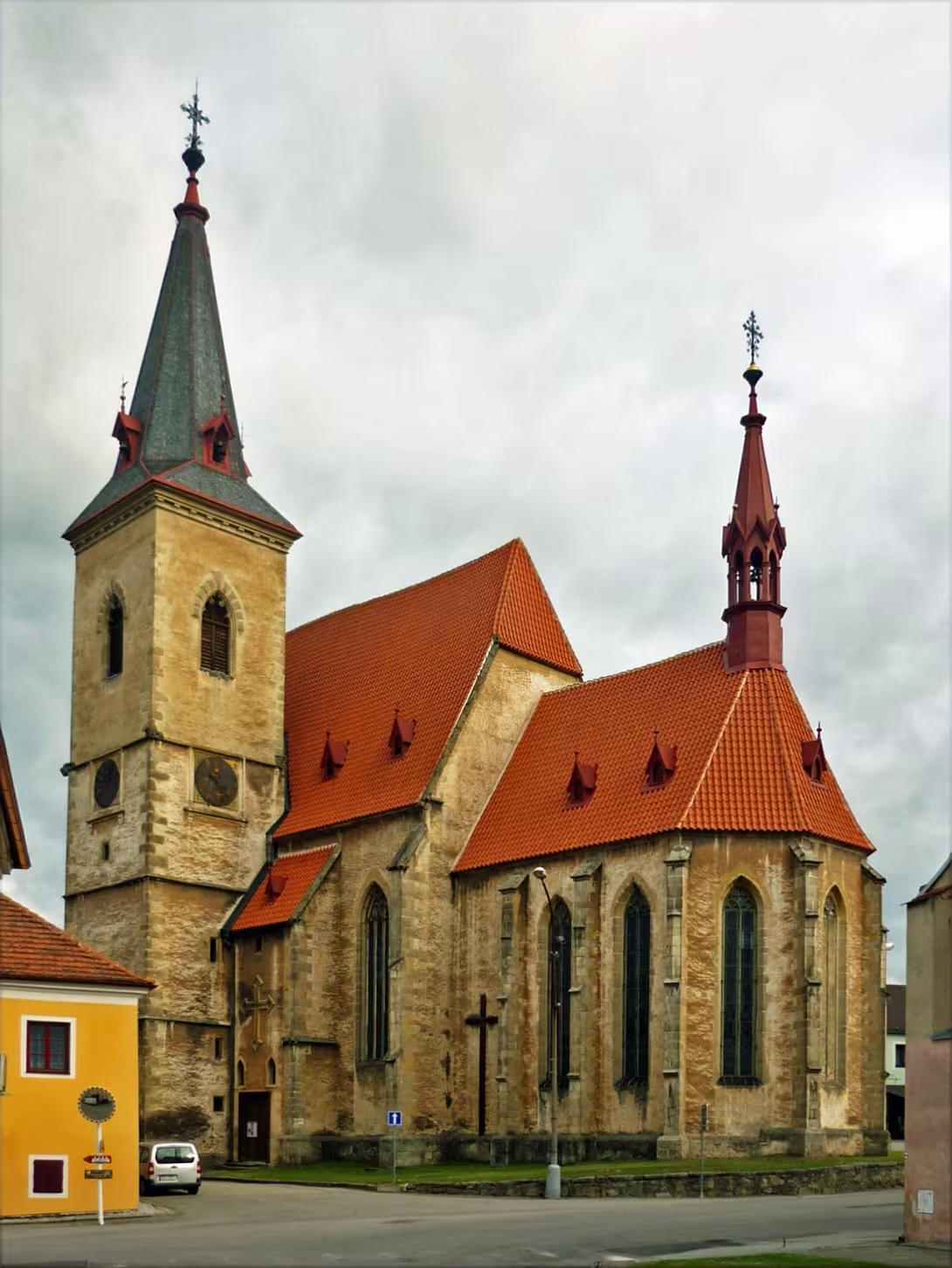
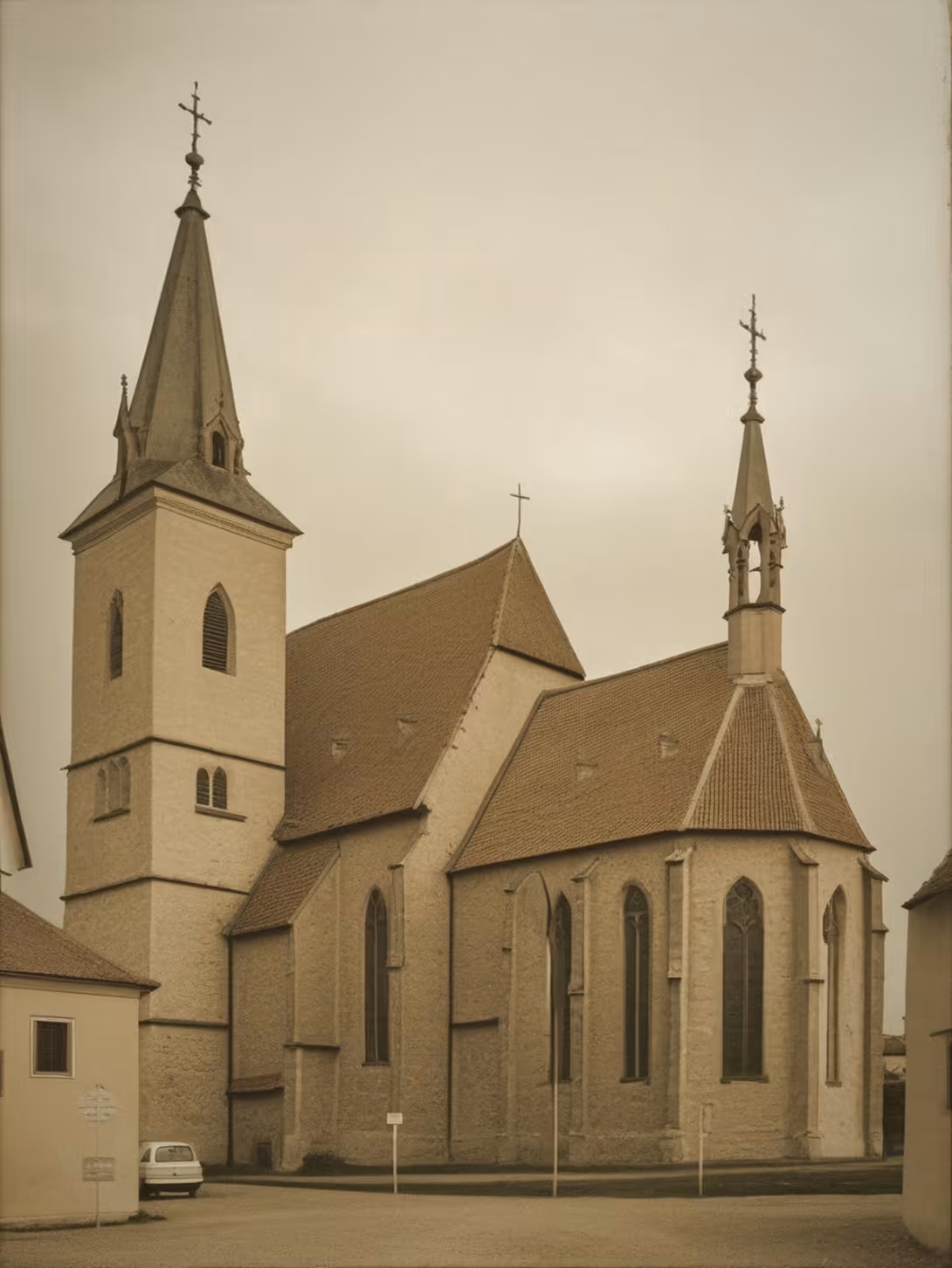
The historical appearance on the left is an AI-generated visualisation and serves as inspiration only.
Historical milestones
- 1507
- Completion of the perimeter wall of the ship with an bay on the western shield.
- 1514
- He'll knock the ship out with a mains vault and paint the name Getzinger.
Architectural development
The church was built as a one-ship building with sacristy and chapel of the Virgin Mary. The interior of the boat was encapsulated by Hans Getzinger network vault between 1507-1514, which brought the church its characteristic appearance. The church has undergone several modifications, including baroque and neo-gothic changes.
Historical events
- 1487
- Finish the sacristy.
- 1494
- The spell of the presbytery.
- 1507
- Completion of the perimeter wall of the ship with an bay on the western shield.
Points of interest
- The church of St. Mary Magdalena is a late Gothic temple built at the turn of the 15th and 16th centuries.
- Its massive prism tower and sophisticated building material define the character of the square and form the characteristic panorama of the village Chvalšiny.
- The construction began in 1487 with the assessment of the foundations of the sacristy and the priesthood, which were completed the same year. In 1494, the priesthood was sealed.
- The boat was taken over by builder Hans Getzinger around 1500, which finished the boat with the bay in 1507 and covered between 1507 and 1514 with a mains vault.
The church has, despite numerous modifications, maintained a distinctive form of late Gothic.
Guide
This guide is narrated by a synthetic voice generated by artificial intelligence.
Show guide text
This text was created by artificial intelligence and has not been editorially reviewed. It may contain inaccuracies.
The Church of Saint Mary Magdalene stands in the upper part of the square in Chvalšiny in the Český Krumlov region. It originated at a crossroads. One road led from Český Krumlov to Prachatice, the other headed towards Horní Planá and further into Austria. With its massive form, it shapes the character of the square and determines the panorama of the village, which is clearly visible from the surrounding hills.
A early Gothic church dedicated to Saint Mary Magdalene already stood in this place around the middle of the thirteenth century. It was most likely surrounded by a cemetery from the beginning. At the beginning of the eighties of the fifteenth century, the guilds together with the town decided to rebuild and enlarge the church. The plan and construction were taken over by a stonemason master who was at that time building the church of Saint Catherine in Hořice. The new presbytery and sacristy were measured out around the old presbytery, so services could continue there.
The construction is documented by dates preserved directly in the church. By the end of the eighties of the fifteenth century, the sacristy with an ossuary was completed, in the year 1494 the presbytery was vaulted, and in the year 1499 the southern vestibule with a representative entrance portal was finished. The tower was first founded separately and the walls of the nave were attached to it only later.
Around the year 1500, Hans Getzinger from Haslach took over the construction of the nave. He was the chief builder of the Rožmberk building workshop and also worked on churches in Zátov and in Rožmberk. In the year 1507, the oriel window on the western gable and the roof were completed. Between the years 1507 and 1514, Getzinger had the nave vaulted with a ribbed vault and had his name painted in its apex. At the same time, a monumental painting of the Last Judgment was created.
The church is single-naved with a presbytery of two bays, ending in a three-sided shape. A sacristy adjoins it from the north and below it is a vaulted ossuary. A rectangular nave with four vaulted bays is accessed by a portal in the southern vestibule. On the southern side rises a prismatic tower with a pyramidal roof, and in the corner next to it stands a staircase annex.
The church underwent numerous modifications over the centuries, yet it retained its late Gothic appearance. In the middle of the seventeenth century it was modified in an early Baroque style, and in the years 1886 and 1887 in a Neo-Gothic style. In the year 1760, a central Marian chapel, the so-called Rosary Chapel, was added on the northern side. The only significant intervention in the overall composition came in the year 1773, when the tower was heightened. The original height is still revealed by the gargoyles above the clock storey.
Tips for visitors
The best time to visit the church of Saint Mary Magdalena in Chvalšiny is the early spring or late autumn season when the weather is quiet and warm. These months offer ideal conditions for exploring the church without overcrowding tourists and with beautiful colored effects on green forest areas around.
For those arriving by public transport, buses from nearby towns and municipalities are available. We recommend checking the current connection with an online search engine or contacting the local tourist institute for details.
When visiting the church, it is advisable to bring a quality camera, especially if you are interested in shooting architectural details. Also remember the sunglasses and sufficient water, especially during the summer months.
For families with children, visiting the church of St. Mary Magdalena is an interesting opportunity to learn about the history and architecture of the region. Children can be intrigued by stories about the past and details of the construction that can be observed in the interior.
The church photography offers the best effects in sunny weather. The most beautiful light for photos is usually in the afternoon when the shadow is played on the facades and in the interior. In addition, it is advisable to visit the church before the sun sets in order to capture the atmosphere of evening lights.
Frequently asked questions
Can the monument be visited?
Religious buildings are usually open mainly during services; at other times a visit is normally arranged with the parish or the operator. We have not verified specific times.
Where is the monument?
Location: Chvalšiny, Jihočeský kraj. The map on this page shows the exact spot.
Why is the monument protected?
It is listed in the Central List of Cultural Monuments of the Czech Republic as a cultural monument (register no. 29289/3-1293).
For kids
Imagine going back to when the church of St. Mary Magdalena was the only dominant point in the village of Chvalšiny. Back then, the village was a small village, where there lived people who fed on agriculture and animal breeding.
Life here was hard and difficult, but people were full. The church was the centre of the village where weddings, funerals and other important events took place. People were also gathered here for prayer and for singing songs. It was like one big family house where everyone gathered.
Businesses nearby
Do you run a restaurant, accommodation, shop, museum, rental, wellness or other visitor service near this monument? Show yourself directly to the people heading to it — this is how they will see you in the app and on the web:
Nearby
Ambient landscape, other sights
Accommodation nearby
Trips and activities nearby
Guided tours, tickets and activities nearby from GetYourGuide
Affiliate link: if you buy from the partner, we may receive a commission. The price for you does not change.
Search tours and activities →Themed route
Thematic cruise route: Church of St. Mary Magdalena (Chvalšiny)
1. Church of St. Mary Magdalena - Type: Religious monument - Why is it worth a visit: This Baroque church, built in the first half of the 18th century, is one of the most beautiful sacral buildings in the Český Krumlov district. Its rich interior and historical architecture offer visitors a view of the past.
2. St. John Nepomuk Chapel - Type: Chapel - Why is it worth a visit: It is located in the vicinity of the church and is known as a place of comfort for the locals. Its simple but impressive design attracts those who seek peace and quiet.
3. Church courtyard - Type: Tanks - Why it is worth a visit: Church courtyard is an ideal place for relaxation and a view of the surrounding countryside. Here you can enjoy a quiet moment while looking at the architectural context of the church.
4. Church Tower - Type: Tower - Why is worth a visit: Visiting the tower offers a unique view of the village Chvalšiny and surrounding landscape elements. This is a great opportunity for photography or just for the use of panoramic views.
This route offers visitors the opportunity to immerse themselves in the history and culture of the village Chvalšiny while enjoying quiet moments in the surrounding nature.
Seasonal recommendations
Spring: In the spring season, the church of St. Mary Magdalena opens in a strange atmosphere when flowers and trees begin to bloom. The sun rays through the church windows form an impressive lighting that emphasizes historical architecture. In this period nature is in full bloom and the ideal time for visiting is noon, when the sun is at its highest level while avoiding crowds. We recommend wearing comfortable clothes suitable for mild temperature and perhaps some protective sunglasses.
Summer: Summer in Praise brings long, bright days that are ideal for exploring the church and surrounding park. Solar lighting highlights architectural details and creates a warm, welcoming atmosphere. At the end of summer the number of visitors may increase, so it is advisable to visit the memory early in the morning or later in the evening. We recommend combining warm clothes with protective sun cream and sufficient water to make the visit comfortable even at higher temperatures.
Autumn: In autumn the church of St. Mary Magdalena opens in a great atmosphere when tree leaves start to change colour. Sunshine days create a beautiful contrast with a variety of colours and garden flowers in purple and red shades. During this period the visit is calmer, which allows you to focus on the details of architecture without obstacles to large crowds. We recommend wearing warmer clothes and carrying an umbrella or a coat cover because the weather can suddenly be variable.
Winter: Winter visit to St. Mary's Magdalena Church offers a unique atmosphere when the surrounding landscape is covered with snow and the pale sun illuminates architectural elements. The church creates a sense of peace and quiet, which is ideal for contemplating and enjoying views of snow landscape beauty. The visit may be limited due to a shorter opening time, so it is advisable to come early in the morning. Hot clothing, including fur and gloves, is essential for comfort during cold days, and we also recommend wearing high-quality shoes with adhesive soles.
Visualizations and artistic views


The visualisations are generated by artificial intelligence and serve as inspiration.
Photos from the area
Real photos taken near the monument


Zdroj a licence jsou uvedeny u každého snímku.
Atmosphere of the place
This atmospheric visualisation of the place and period was generated by artificial intelligence. It is not real footage of the location.
Tips from visitors
No tips yet. Be the first!
Log in and add your tip.
Sources and literature
Photos: SchiDD / CC BY-SA 4.0 — Wikimedia Commons. The author and licence also appear when you hover over the image.
Faktickým podkladem tohoto textu byl článek na Wikipedii, jehož autory jsou přispěvatelé Wikipedie. Článek je dostupný pod licencí CC BY-SA 4.0.
Location on the map




Příběhy a pověsti
Legendy, pověsti a příběhy spjaté s touto památkou
Fotografie návštěvníků
Zatím žádné fotografie. Buďte první, kdo přidá fotografii z návštěvy!
Log in a přidejte svou fotografii nebo hodnoťte.
Za ověřenou návštěvu v aplikaci získáte víc bodů — poznáme podle GPS, že jste na místě.
Reviews and comments