






Miranka Homestead
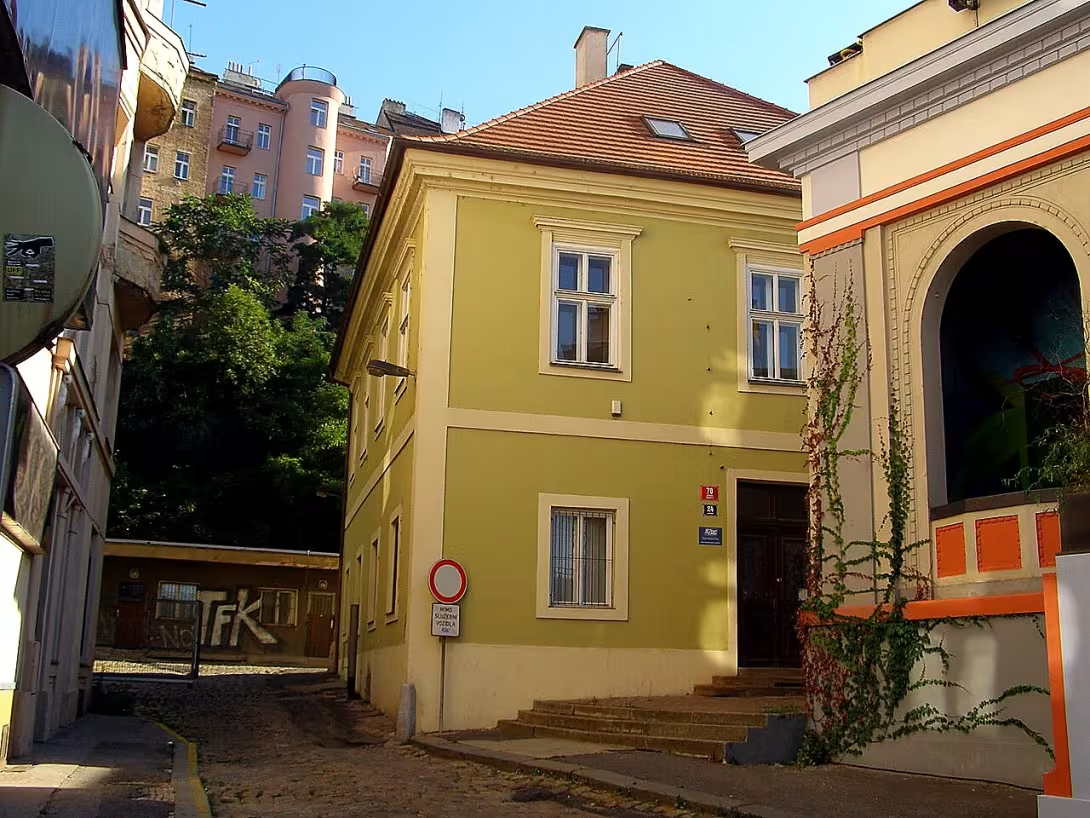
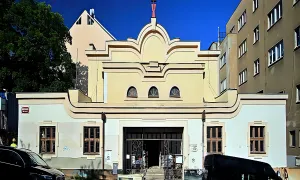
The residence Miranka, also known as Bontámka, Miřanka or Halovka, is a historical building in Prague 3 on Žižkov in Husita Street 70 / 24. Since 2005, this complex, which includes a residential building, a production hall with the logo of the cinema Ponec and a chimney from a concrete masonry, has been protected as a cultural monument of the Czech Republic.
The history of the place dates back to the 16th century, when vineyards are documented in the territory between today's Trocnovska Street and Kostnický Square. In the 18th century the estate was owned by Václav Mirany. In the middle of the 19th century, there was a vineyard that, according to the reports, produced quality sweet grapes. The original extensive swimming yard, documented in 1843, consisted of a residential building, stables, a coloring workshop, a forge, a rapeseed oil factory and a large garden.
The original building was preserved by a storey residential building on a rectangular plan, covered with a shingles roof from the 18th century. On the ground floor there were apartments for craftsmen, specifically for wheelers, knives and bakers. The first floor was used to accommodate summer guests. In the garden, in the places of today's Kostnik Square, there was a gloriet and a vineyard house was built on the vineyard. The milk cellar was situated in the area where the railway viaduct later grew.
In 1832, Josef Hall bought the estate and set up a factory for the production of rapeseed oil and coffee substitutes. In the second half of the 19th century, Rudolf Stabenow took over the premises, which dealt with copper and the production of equipment for breweries and sugar factories. In 1887, the company had the original factory buildings removed and replaced them with a new construction. After the completion of the operation in 1905 and the subsequent relocation of the company to Čelákovice complex in 1909, the city of Žižkov bought it. Part of the factory buildings were subsequently demolished to make room for the construction of four cubist houses.
The remaining part of the factory has undergone a significant transformation since František Ponec established a biograph here. The reconstruction of the hall for cinema needs, including the creation of a three-piece facade, probably designed by architect Karel Masek. This project is an early example of the conversion of an industrial building for cultural purposes. In 1999 the cinema underwent reconstruction under the direction of architect Michael Klang and today serves as a dance theatre Ponec.
Today's appearance of Miranda is a testament to the transformation of the Zizkov building from the agricultural and wine tradition to the industrial boom to modern cultural use. Visiting this place offers an opportunity to see the history of the Prague periphery, which has naturally integrated into the urban organism over the centuries. For people interested in architecture and industrial history, Miranka represents a valuable example of historical care for objects that have been able to find new applications in the current life of the metropolis.
Historical milestones
- 1832
- Josef Halla bought the estate and set up a coffee and rapeseed oil factory.
- 1887
- Rudolf Stabenow had the original factory removed and built a new factory.
- 1905
- The factory ceased its operation and moved to Čelákovice the following year.
- 1909
- The buildings were purchased by the City of Žižkov.
Architectural development
The estate was made up of a residential building, stables, a column for wheelers, a forge, a rapeseed oil factory and a large garden. A storey residential building on a rectangular floor plan had a shingles roof from the 18th century. On the ground floor there were apartments for wheelers, knives and bakers, on the first floor apartments for summer guests. The milk cellar was located in the places of the railway viaduct. In a large garden in Kostnik Square, there was a gloriet, and a vineyard house.
Owners
Josef Halla, Rudolf Stabenow, City of Žižkov
Points of interest
- The estate is known under several names, namely Bontámka, Miřanka or Halovka. Since the year two thousand and five, the resort has been protected as a cultural monument. - In the eighteenth century the estate was owned by Václav Mirany and in the middle of the nineteenth century there was a vineyard with quality sweet grapes. - The original sailing yard included a residential building, stables, a coloring workshop, a forge, a rapeseed oil factory and a large garden. - On the ground floor of the preserved residential building, craftsmen lived as a wheelbarrows, a knife and a baker, while the first floor used to accommodate summer guests. - František Ponec established a biographer here in the year of a thousand and nine hundred ten, one of the early examples of the transformation of an industrial building for cultural purposes.
Guide
Show guide text
This text was created by artificial intelligence and has not been editorially reviewed. It may contain inaccuracies.
Welcome, distinguished visitors, to the heart of Prague's Žižkov. Stop for a moment, take a deep breath and feel the atmosphere of this place. You are standing just outside the residence of Miranka, which is located in Hussite Street. It is a place where the calm of old gardens meets the dynamics of urban life and where in one spatial context the agricultural past meets the industrial boom of the last century. Look in front of you at the buildings that form this area. CZECH NOTE: You may not know at first sight that it is a monument, but it is in the lastiness of time that its greatest value lies. Now, if you look around, notice the total set of objects. The production hall, which is now associated with the logo of the cinema Ponec, will probably take your view. Also look at the chimney from the concrete wall that stands out into the sky. These elements, together with the main building of the estate, have since two thousand and five been protected as a cultural monument of the Czech Republic. This chimney is not just an ordinary building element, it is a silent witness of the time when Žižkov was not just a residential neighborhood but a place of hard work, smoke and machinery. Let us now return together in time, much deeper than the walls of current buildings. Imagine this place in the 16th century. There was no car noise or concrete road back then. In the territory between today's Trocnovsky Street and Kostnický Square, vineyards were decaying. At that time, this area was perceived in a completely different way as a landscape full of green and grape bushes. Vinohradship was firmly rooted here and in the eighteenth century the estate was owned by a man named Václav Mirany, from whom the name of this place probably came. If we move to the middle of the nineteenth century, we can imagine how good sweet grapes smelled here in the summer months. It was a period when the estate served primarily for agricultural purposes and was part of a wider network of Prague vineyards. Just imagine the morning fog over the vineyards and the quiet rhythm of working in the gardens. But everything changed with the arrival of a new era, an era of industrial revolution, which changed the face of the whole of Prague and especially Žižkova. The break occurred in the year one thousand eight hundred thirty-two. It was this year that Josef Hall bought the estate. Halla wasn't a winemaker, he was a vision entrepreneur. He decided to turn a quiet estate into a place of production. He set up a factory here that focused on the production of two products that were very desirable at the time. The first was a coffee substitute, which was a common product at the time for people who could not afford real coffee from remote regions. The second product was rape oil. So imagine how the smell of grapes gradually began to mix with the smell of roasted raw materials and pressed oil. The Miranka estate was thus part of the emerging industrial Žižkova. However, time did not stand and production needs increased. In a thousand and eight hundred and eighty-seven, Rudolf Stabenow came into play. He realized that the original Josef Hall factory was no longer enough for modern needs. So he had the original factory buildings removed and in their place he had a new, more modern and more efficient factory building. It was during this period that the appearance of the site that you see today, including the industrial elements we mentioned earlier, began to be confirmed. But this industrial boom did not last forever. In the year one thousand and nine hundred and five, the factory had to put an end to its activities in these premises. A year later, in the year one thousand nine hundred and six, the entire operation moved to the city of Celakovice. This was the moment when the estate Miranka lost its function as a place of oil production and coffee substitutes. The buildings remained, but their meaning had to change. A few years later, in the year one thousand nine hundred and nine, the city of Žižkov bought land and buildings. This step brought the place into the hands of the public and began a new chapter of its existence. Now that you're standing in front of these buildings, feel the contrast. On the one hand, we have a memory of the winery and a quiet life in the estate, on the other hand, traces of the factory rumble and ambition of industrialists. It's fascinating how one place can change like that over the centuries. Notice that architecture is not uniform because each owner added something of his own. Although we don't know the names of the particular architects who designed these buildings, their work speaks for them. Here we see practical approaches to space, which were intended primarily for production, but at the same time there remains some dignity of the old Prague estate. You may be interested to know that Miranka is not the only name under which this place is known. History is full of different names and local people used names like Bontámka or Halovka. The middle name probably refers to Josef Hall, who founded his factory here. It is typical of Prague's neighborhoods, where the names of the places often change depending on who is currently owned or what is being produced in the building. While you're looking at facades and masonry, try to imagine all the people that were passing through here. From winegrowers collecting sweet grapes, to workers in dusty linen who pressed rape, to officials of the city of Žižkova who took care of the management of this property. Each of them left a trail in this place, even though the names of most of them are no longer known. This estate reminds us that Žižkov is not only about popular pubs and steep streets, but it also has deep roots in agriculture and the early industry. The fact that the site has been protected as a cultural monument since 2,000-five tells us that these clues are valuable. It's evidence of how our society was changing, how our needs were changing and how our city was changing. Take one last look at the chimney and the hall building. Feel the silence that exists here today in contrast to the noise that must have been here over a century ago. It's where history stopped to tell us its story. Now we invite you to slowly say goodbye to the Miranka estate and continue to explore the beautiful Žižkova. We suggest you go through the surrounding alleys, which may still be hiding secrets similar to the ones we discovered today. Take note of the details on houses, old signs and atmosphere, which is so unique for this part of Prague. Thank you for spending a moment with us at this historic monument. We hope this short trip in time has helped you better understand the spirit of this place. We wish you a pleasant further walk and many new discoveries in our beautiful city. Goodbye.
Tips for visitors
We recommend planning the tour for the morning hours during the working week when traffic is quieter around Hussite Street. The light in this part of Žižkova excels best in the morning sun, which illuminates historical facades.
The location is very well accessible by public transport, whose current connections can be checked in mobile applications. Parking in adjacent streets is limited, so we recommend using mass resources instead.
Bring comfortable shoes to walk on the city pavement. For photography, the most interesting detail of the concrete wall is the chimney and architectural elements of the hall, best stand out during side lighting.
Within 30 minutes' walk there are Trocnovská Street, Kostnický Square, Jeronýmov Street, Blahnikov Street, Husitský Street and Seifertova Street, offering an interesting view of the Žižkov Building.
For families with children, the location is suitable as part of a walk around the historic Žižkov. We recommend connecting a visit with a rest at Kostnický Square, which offers a short stop.
Businesses nearby
Do you run a restaurant, accommodation, shop, museum, rental, wellness or other visitor service near this monument? Show yourself directly to the people heading to it — this is how they will see you in the app and on the web:
Events nearby

Zdroj akcí: otevřená data měst a obcí ČR (Národní katalog otevřených dat) a kalendář akcí Národního památkového ústavu.
Nearby
Trocnovská ulice, Kostnické náměstí, ulice Jeronýmova, Blahníkova, Husitská, ulice Seifertova
Accommodation nearby
Trips and activities nearby
Guided tours, tickets and activities nearby from GetYourGuide
Affiliate link: if you buy from the partner, we may receive a commission. The price for you does not change.
Search tours and activities →Themed route
1. Kostnický square (square) - The central point of the village, which serves as an ideal beginning of the journey. 2. Hussite (street) - Walk the local way leading to the main monument. 3. Miranka (homestead) - The main destination of the trip, historical construction with a rich past. 4. Trocnovska street (street) - Continuing the route through a quiet part of the village. 5th Street Seifertova (Street) - Final stop for looking at surrounding buildings.
Seasonal recommendations
In spring, the estate awakens into life. The flowering garden and fresh greenery create an optimistic atmosphere, while the fine spring light highlights the details of architecture. We recommend to dress in layered clothes because the weather is usually variable. It is best to arrive in the morning when the area is quiet and the air is the cleanest.
The summer season brings thick shade of old trees and rich colors of blooming nature. The atmosphere is playful and full of energy, but there are more visitors in the high season. It is advisable to choose light, breathable clothes and visit the monument immediately after opening to avoid the biggest crowds and the midday heat.
Autumn in Žižkov is a period of golden leaves and hazy mornings, which give the settlements a mysterious and melancholy touch. Nature is quiet and the colors of the surroundings turn into orange and brown tones. Don't forget the waterproof shoes and raincoat. The ideal time to visit is late afternoon when the sun paints the walls into warm shades.
In the winter, the monument is strenuous and peaceful, especially if it is covered by a layer of snow. Freezing air and bare branches of trees reveal the line of the building that is hidden in summer. Due to low temperatures, it is necessary to wear a warm sweater, hat and gloves. In advent time we recommend to follow the shortened opening hours and plan a visit to clear hours.
Visualizations and artistic views

The visualisations are generated by artificial intelligence and serve as inspiration.
Photos from the area
Real photos taken near the monument

Zdroj a licence jsou uvedeny u každého snímku.
Tips from visitors
No tips yet. Be the first!
Log in and add your tip.
Sources and literature
Faktickým podkladem tohoto textu byl článek na Wikipedii, jehož autory jsou přispěvatelé Wikipedie. Článek je dostupný pod licencí CC BY-SA 4.0.
Location on the map
Příběhy a pověsti
Legendy, pověsti a příběhy spjaté s touto památkou
Fotografie návštěvníků
Zatím žádné fotografie. Buďte první, kdo přidá fotografii z návštěvy!
Log in a přidejte svou fotografii nebo hodnoťte.
Za ověřenou návštěvu v aplikaci získáte víc bodů — poznáme podle GPS, že jste na místě.
Reviews and comments