






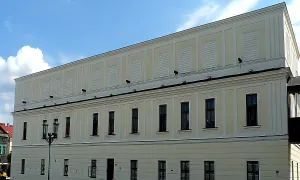
ohradní zeď kostela Povýšení svatého Kříže v Karviné Church
The Church of the Ascension of the Holy Cross, formerly known as the Church of the Virgin Mary, is the oldest building monument in the town of Karviné and one of the oldest in Karvinsk and Těšín. It is located near the Fryštát Chateau, with which it forms a historical building unit. The church was built as part of Fryštát Chateau under the rule of Měšek I. of the House of Piastovci in 1288. Its original Gothic design was later modified renaissance and baroque, suggesting its long history of adaptation and sustainability.
The creation of the church is closely linked to the creation of the Fryštát Chateau. Under the rule of Měšek I., a member of the Piastovce family, the chateau was built here as an administrative and market centre of the northwest part of the Těšín Duchy. The church served as a spiritual centre for the emerging city of Fryštát, founded between 1303 and 1306. The first written mention of the church dates back to 1376, when it was extended by the Prince Primohmi I. Těšín by the foundation of the altar of God's body and Saint John Evangelist. This event suggests that the church had already played an important role in the social and religious life of the area.
The architecture of the church is originally a single-boat Gothic building with a Latin ground plan. After the fire in 1511 there were changes, including the reconstruction of the ceiling structure and the position of the wall tower between 1515 and 1530. The church was without a tower until this fire when the tower was built as a reaction to damage caused by fire. This architectural adaptation shows the Church's ability to adapt to change and maintain its functionality even after disasters.
The property and administration of the church was in the hands of the masters of the owners of the Fryštět estate, who left the right to appoint a bishop's shepherd and priest to the bishop's throne. This fact shows the importance of the church as a spiritual centre that was under the administration of local monarchical dynasties. After the fire in 1511 there was a reconstruction and then changes in interior decoration, which reflects the dynamic history of the church.
Key events in the history of the church include his fire in 1511 and subsequent reconstruction. A significant change was also the reappointment of the church to the Holy Cross Ascension at the end of the 18th century, when the painting above the main altar was replaced by the painting of the Holy Cross. These events point to the adaptability and continued importance of the church in a regional context.
Today the church has been protected as a cultural monument of the Czech Republic since 1958, which underlines its historical and architectural importance. The church is worth visiting not only for its ancient architecture, but also as a witness to the rich history of Fryštát and its surroundings. Its proximity to the Fryštát Chateau and chateau gardens from 1804 gives visitors an overall idea of the historical importance of this place. The Church of the Elevation of the Holy Cross is not only a monument to the past, but also a living part of the cultural heritage of the region that attracts visitors from all over the world.
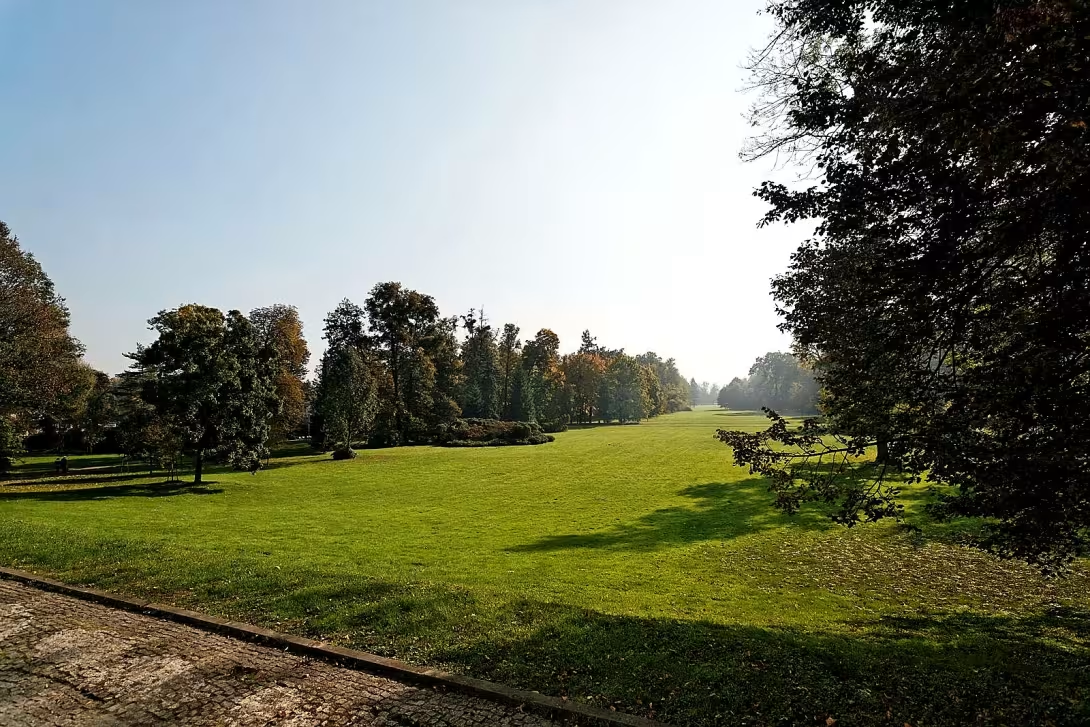
Then and now
Drag the slider to compare how the landmark may have looked when it was built with the view today.
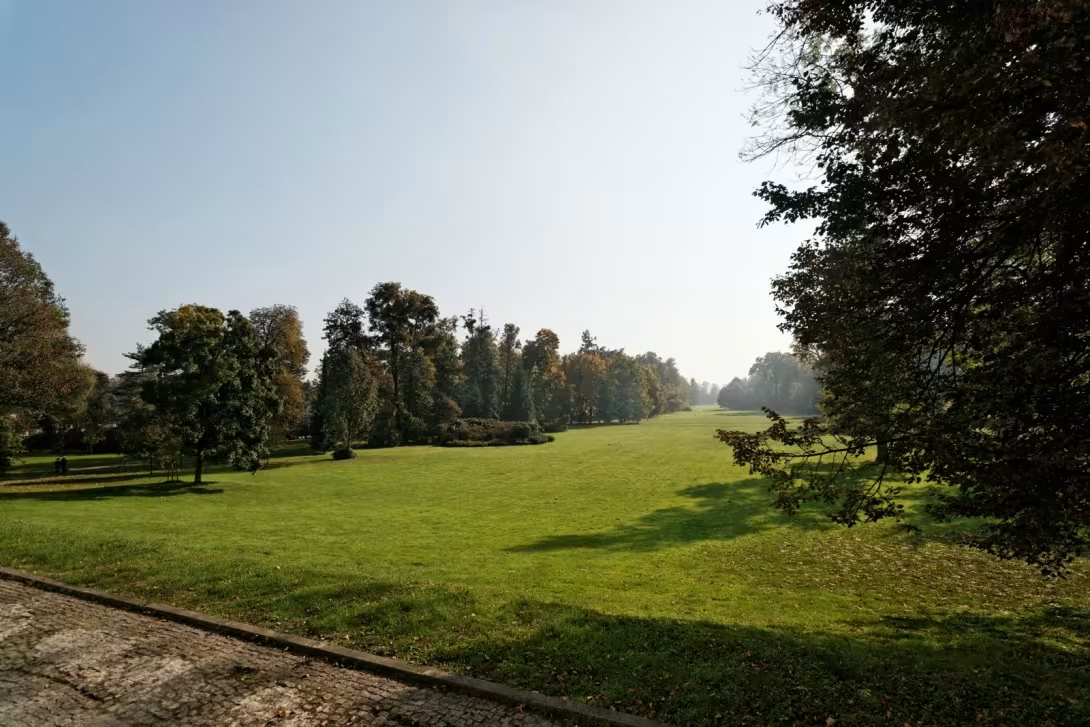
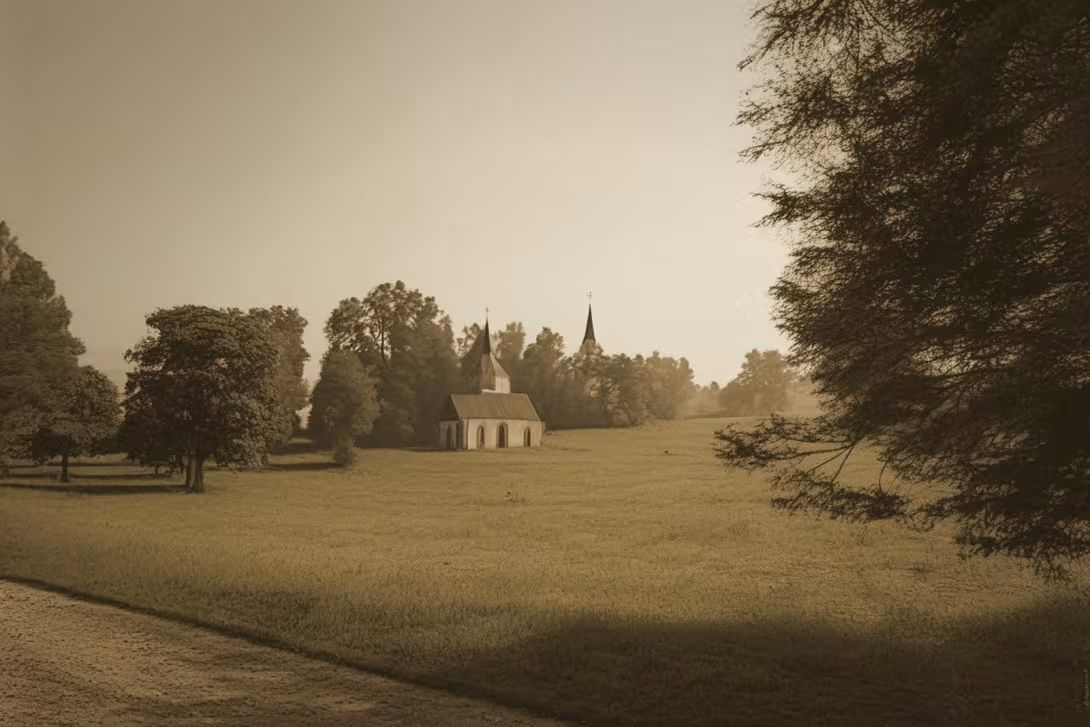
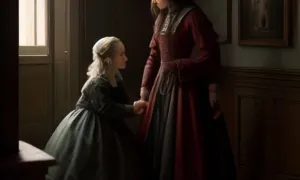
The historical appearance on the left is an AI-generated visualisation and serves as inspiration only.
Historical milestones
- 1958
- Protected as a cultural monument of the Czech Republic.
Architectural development
The church was originally a single-boat Gothic building with a Latin cross plan. After the fire in 1511 there were changes, including the reconstruction of the ceiling structure and the position of the wall tower between 1515 and 1530.
Historical events
- 1376
- First written mention of the church.
- 1420
- A draft of the charter confirming the construction of the chapel dedicated to the Virgin Mary.
- 1511
- A big fire in Fryštát caused damage to the church.
Points of interest
- The church is the oldest building monument in the town of Karviné and one of the oldest in Karvinsk and Těšín. - It is located near the Fryštát Chateau, with which it forms a historical building unit. - The church was built as part of Fryštát Chateau under the rule of Měšek I. of the House of Piastovci in 1288. - The property and administration of the church was in the hands of the masters of the owners of the Fryštět estate, who left the right to appoint a bishop's shepherd and priest to the bishop's throne. - Today the church is protected as a cultural monument of the Czech Republic since 1958.
Guide
Show guide text
This text was created by artificial intelligence and has not been editorially reviewed. It may contain inaccuracies.
Welcome to the heart of Fryštát. Right now, you're standing in front of the wall of the Holy Cross Church. Stop for a moment, take a breath and feel the peace and quiet of this place. In front of you is a masonry that is not just an ordinary obstacle to stone, but a silent witness to centuries of history. When you look at these walls, you realize you're at the oldest building monument in the entire town of Karviné. It's a place where time has stopped and where every crack tells its own story about the people who lived here long before us. This wall, which you are standing at right now, separates the rush of today's world from the space that has been dedicated to prayer and contemplation for centuries.
Let us now move together deep into the past, namely two hundred and eighty-eight years. Imagine a landscape back then that looked completely different than the one we know today. At that time, the first of the Piastas was ruled here. It was he who decided to create a temple here, which was to be an integral part of the Fryštát Chateau at the time. However, this church, which we now know as the Ascension of the Holy Cross, was in its beginnings known as the Church of the Virgin Mary. It was created as a spiritual sanctuary and a symbol of power within the chateau complex. It's fascinating to think that this place was the cornerstone of the development of the whole neighborhood in the late 13th century. By the time the woods were cut down and the first solid walls were built, a building was born here to survive all the storms of history.
Now pay attention to the very form of the construction and its appearance. Although we are looking today at the resulting entity, which has undergone many changes, its basis is the Gothic style. Gothic has brought to architecture a desire for height, light and spiritual uplift, which you can see in the overall atmosphere of this place. However, history is dynamic and people's needs have changed over time. In later centuries, the church was adapted to meet the new trends and demands of its time. Notice how elements of the Renaissance and the Baroque have been integrated into the original Gothic core. These layers of different epoch form the unique character of the monument. Look not only for one clean line, but rather for dialogue between the different styles that intersect here. Look at the facade and see how aesthetic preferences have changed over the centuries. It's like reading a book where every chapter is written in different letters, but it tells one coherent story about faith and survival.
When we think about this place, we can't forget the people who formed it. We mentioned the first of the Piastas, whose vision began here. The Piastos were an important dynastic family that left a deep mark in this area and influenced its political and cultural development. In addition to him, the Přemysl's first Tesínský is closely connected to this place. These personalities were not only rulers, but also founders of order and stability in the region. Imagine them walking on the paths you're walking through and planning the development of this chateau and church complex. Their ambitions, their power and their faith are still present in these walls. Every stone you see was laid with some purpose and served the people who sought safety and hope in this place.
Now I'm going to lead you to something that makes this place really special and that you should fully understand. You are not just standing at the old church, but at one of the oldest buildings not only in Karviná, but in all Karvinsk and Těšín. That makes this place a real regional treasure. It is an anchor that connects us to our hooves and reminds us that the history of our region is much deeper and richer than we often realize. The relationship of the church to the Fryštát Chateau is also very important, located in close proximity. These two buildings are not only neighbors, but together they form one historical building unit. It's like one big chronicle where one part tells about the power, administration and life of the nobles in the chateau and the other part about spirituality, peace and prayer in the church. It is this closeness that shows how closely secular and church powers have been connected in the past and how they have supplemented each other within the chateau system.
In the year one thousand nine hundred fifty-eight this monument was officially recognised and protected as a cultural monument of the Czech Republic. This is proof of the great value these walls have to us all in modern times. It is our common duty to guard and respect them for future generations, so that they can feel the same amazement of history that we feel now. This protection is not only an administrative act, but by recognising that without such places, we would lose part of our identity.
Now that you know the basic story of this place and know who created it and how it changed, I suggest you look around in peace. Feel the silence, watch the light play on the rocks, and let yourself drift by the thoughts of all those people who have stood before you in the last seven hundred years. Try to imagine the sound of bells that once echoed over Fryštát, and the noise of people coming here looking for escape. This wall is like a gateway to another world, which encourages us to stop and reflect on the timeliness of time and endurance of stone.
Come now slowly explore the surrounding space and discover other hidden corners of Fryštát. Let yourself be guided by your curiosity and perceive the atmosphere of this historical whole. I hope this short trip to the past has helped you better understand the importance of the Church of the Holy Cross and its role in the history of our city. Thank you for taking this journey with me in time and for paying attention to this unique place. I wish you a pleasant rest of your tour and many other beautiful experiences while exploring our sights. Goodbye.
Tips for visitors
The best time to visit the wall wall of the Holy Cross and the church itself is early in the morning or late in the afternoon, when sunlight creates ideal shadows on the historical wall and surrounding park, which will be appreciated by every lover of peace and history.
You can use a passenger car or local public transport for transport to the memory. Parking is possible at reserved places within walking distance from the historical centre of Fryštát. We recommend to check the specific parking options in advance.
Take with you comfortable shoes suitable for walking on historic tiles and paved roads in the chateau park. Also remember the camera because the surroundings offer unique shots of ancient architecture associated with nature.
It is best to take advantage of morning fog or evening golden hour for photography of the wall wall and adjacent church, when the sun beautifully accentuates the structure of the old masonry. The best looks open from the side of the chateau park.
In the immediate vicinity of the monument, within a walking distance of 30 minutes, you can visit the magnificent Fryštát Chateau and the chateau gardens from 1804, which form a single historical whole with the church and the fenced wall.
Businesses nearby
Do you run a restaurant, accommodation, shop, museum, rental, wellness or other visitor service near this monument? Show yourself directly to the people heading to it — this is how they will see you in the app and on the web:
Nearby
Fryštátský zámek
Zámecké zahrady z roku 1804
Accommodation nearby
Themed route
1. Fryštát Castle Type: Historical construction Why is it worth a visit: This beautiful noble house offers a view into the life of former owners of the estate and represents the main historical pride of the whole site. It is located in the village Fryštát.
2. Castle Gardens from 1804 Type: Historical park Why is it worth a visit: The large green corral from 1804 attracts peaceful walks between rare trees and landscaped grassy areas right next to the nobility.
3. The Garden Wall of the Church of the Holy Cross in Karviné Type: Church monument and historical construction Why is it worth a visit: It is the main purpose of this pilgrimage, which defines the sacred space around the shrine and carries strong traces of the past of the entire area.
Seasonal recommendations
Spring: During the spring season ohradní zeď kostela Povýšení svatého Kříže v Karviné is lit with a sunny light, which brings live colour to green vegetation. The atmosphere is full of new beginnings and renewal. At this time, you can expect less visitors, because people are starting to leave the winter calm. It is recommended to come in the early afternoon when the temperature is pleasant and the sun rays illuminate the architectural details of the wall complex. Good shoes on impenetrable floors are suitable because the green can still be in full swing.
Summer: Summer brings long sunny days and warm evenings that are ideal for visiting the fenced wall. This season is often the most visited due to the attractiveness of outdoor activities in Fryštát and its surroundings. At the beginning of the day it is recommended to come because temperatures can be high and the crowd is more. Don't forget the sun protection and enough drinking power. Avoid visits on the middle of the day when the temperature reaches its peak.
Autumn: Autumn season offers fenced walls of the church in beautiful shade of leaves. Sunny and mildly cold days are ideal for exploring historical monuments when nature prepares for winter. Less visitors allow you to enjoy a more relaxed tour and better photos without many people in the background. Hot clothes are important because temperatures are gradually decreasing, and suitable shoes for dry floors.
Winter: Winter visit can be a unique experience where the wall looks in snow or in an icy atmosphere. Sunshine days are short and temperatures are low, so you need to be well prepared for cold. The opening hours may be more limited, so check the current information before visiting. Hot clothes, protective carrying and suitable shoes are essential for comfortable stay in the outdoor area. Winter light gives architecture something mysterious and peaceful, which can be very attractive.
Visualizations and artistic views


The visualisations are generated by artificial intelligence and serve as inspiration.
Photos from the area
Real photos taken near the monument

Zdroj a licence jsou uvedeny u každého snímku.
Tips from visitors
No tips yet. Be the first!
Log in and add your tip.
Sources and literature
Faktickým podkladem tohoto textu byl článek na Wikipedii, jehož autory jsou přispěvatelé Wikipedie. Článek je dostupný pod licencí CC BY-SA 4.0.
Location on the map
Příběhy a pověsti
Legendy, pověsti a příběhy spjaté s touto památkou
Fotografie návštěvníků
Zatím žádné fotografie. Buďte první, kdo přidá fotografii z návštěvy!
Log in a přidejte svou fotografii nebo hodnoťte.
Za ověřenou návštěvu v aplikaci získáte víc bodů — poznáme podle GPS, že jste na místě.
Reviews and comments