



Praha-Satalice Railway station
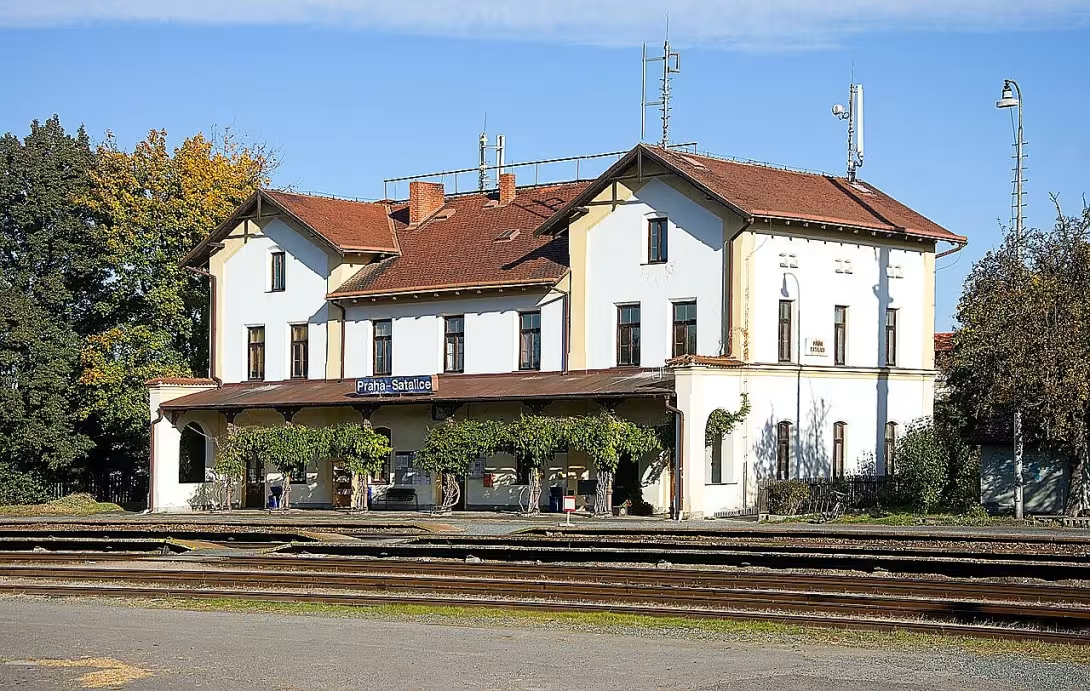
The railway station Praha-Satalice is a historic transport station on the line Praha- Turnov. It lies in the territory of the city of Praha-Satalice at the address K station 25 / 1. Its station building has been protected since 2002 as a cultural monument of the Czech Republic. This object represents an important example of the railway architecture associated with the development of transport in the nineteenth century. The station building has been preserved in its original form until now.
Operation of the Turnovsko- Kralupsko- Prague railway and Satalická railway station started in 1872. During this period, the intensive development of the rail network in Austria-Hungary was a key element for the economic development of the region. At first, trains went to Dennis Station. After its abolition in 1972, the Highlands ended up at the station. The village Satalice was connected to the capital city of Prague in 1974. Since 1976, this station has been named Praha-Satalice. In the past, a station presenter, a cargo teller, a personal treasurer and a station worker, or a pakr, served at the station. Today, the station's only on shift are the exodus and the signals. In the 1920s, an electromechanical safety device was set up in the station with a control device in the transport office and two dependent exodus devices, which still work today. A semi-automatic castle block was introduced to the Skály turn and telephone communication was introduced to Čakovice station, which today replaced the automatic gate. Over time, three trawls and a cargo hold were set up in the station. Loading and unloading reached very high levels. In the 1970s, five handling trains a day were used to drive cars to Satalic. A rail weight has been set up on the already abolished second handling track. In connection with the construction of the Prosek site, the station was used to import housing equipment. Since the 1990s, loading has been in decline. Of today's three lifts, only one is regularly served, namely the Czech Gas Company, K. s., which is based on the Chakovická name.
The station building has been preserved in its original form since the start of operation in 1872. The technical equipment includes four transport tracks marked one, three, five and seven, followed by train journeys. Manipulative track number nine serves for the shutdown of wagons and the occasional loading of scrap from the local metal collection. The switches in the main tracks are centrally converted from the structure and operated by signalists. Between Skály and Satalice station, the castle semi-automatic block worked until June 2012. This was an absolute rarity in the railway network, as it was supplemented by track-side consent always in unsatisfactory condition. The lights in the station are light, type AŽD, with speed indicator system. In the transport office are set up indication elements of the crossing safety equipment AŽD 71, located in the interstation section Praha- Čakovice - Praha-Satalice. Indicator and control elements on the structure two are operated by signalist. The train journey shall be ensured by the position of the main signal on the driving signal.
The shipping building has been transferred to the Railway Administration since 2016. The waiting room is open only in winter and has no internal inventory. Delay of trains is recorded on the board in front of the transport office. The neighbouring transport stations are the Skála junction in the direction to Prague and the railway station Praha- Čakovice in the direction to Neratovic. Stations and trains are part of Prague Integrated Transport. They stop here passenger trains in half an hour, one express train and the S34 passenger trains of KŽC to Masaryk Railway Station. After their introduction, the frequency of passengers increased slightly while the speedsters pass through the station. Freight transport is provided by ČD Cargo's handling train usually on working days once a day.
The main historical milestones include the year 1872 with the start of operation, 1974 with the connection of the village to Prague, 1976 with the change of station name, 2002 with the announcement of the building cultural monument and 2016 with the transfer of the building to the property of the Railway Administration. The Satalic station also served the filmmakers. In 1999, it was renamed Pieschen for the needs of the German series and several pictures appeared in the film Family Tramps of the official Troika.
This monument-protected building illustrates the historical development of railway transport and technology of the 19th and 20th centuries in Prague. A visit to the Satalic railway station offers a remarkable view of the functioning historical track with preserved electromechanical signalling equipment and an original station building.
Historical milestones
- 1872
- Start of the line and station operation
- 1974
- Connection of the village Satalice to Prague
- 1976
- Change of station name to Praha-Satalice
- 2002
- Announcement of station building cultural monument
- 2016
- Transfer of the building to the property of the Railway Administration
Architectural development
The station building has retained its original form since the start of operation. In the 1920s, an electromechanical safety device was set up. In the past, there were also various freight trains.
Historical events
1872: Start of the line and station operation. 1974: Connection of the village Satalice to Prague. 1976: Change of station name to Praha-Satalice. 2002: Announcement of the station building by cultural monument.
Owners
Railway Administration (since 2016)
Points of interest
- The station building has been protected as a cultural monument of the Czech Republic since 2000 and has been preserved in its original form until now. - The operation of the track and the Satalite station started in the year one thousand eight hundred seventy-two. - In the 1920s, an electromechanical signalling device was set up in the station, which still works today. - The castle semi-automatic block between the Skály turn and the Satalice station was an absolute rarity in the railway network because it was supplemented with line conforms always in unsatisfactory condition.
Guide
Show guide text
This text was created by artificial intelligence and has not been editorially reviewed. It may contain inaccuracies.
Welcome to your trip today. Right now you're standing outside the railway station Praha-Satalice and your headphones are on. Look around you and see the atmosphere of this place. In front of you is a historic station building, which is part of the route connecting the capital and Turnov. Notice how this station affects you when you look at its facade and surrounding space, where the past combines with the everyday life of modern transport.
Let's go back together in time to when this whole history began. The operation in this location was festively launched in the year of a thousand eight hundred seventy-two. That's when the tracks began to serve their purpose and connect people and goods on the route from Prague to Turnov. Satalice was in great development at the time. Over the years the appearance of the area changed and in the year one thousand nine hundred seventy-four the municipality Satalice was connected to the capital city of Prague. Two years later, in the year one thousand nine hundred seventy six, there was a change of station name to the current name Praha-Satalice.
Now pay attention to the station building itself in front of you. Look at it in detail. This building has been preserved in its original form up to now, which in itself is a small miracle and a witness to the honest craft work of our ancestors. The building was recognized in the year two thousand and two, when it was officially declared a cultural monument of the Czech Republic. In the year two thousand and sixteen then the building was transferred to the property of the Railway Administration, thereby ensuring its further care and future.
If you look at the tracks and the spaces around you, you can imagine how busy it was here in the past. In these places, a very intensive freight transport took place. This transport was not self-efficient, it was closely linked to the large construction of the Prosek estate. Trains brought materials and helped build new homes for thousands of people.
You may be surprised by an interesting piece of history that shows how the runway evolved. In the 1920s, an electrical device was set up in the station to control switches and signals, which represented huge technical progress at that time. Today steam locomotives and old equipment have replaced modern technology, but genius loci of this place remains preserved. At present, the station is a fixed part of Prague's integrated transport and is used daily by passengers who go to work, to school or to rest.
I hope you enjoyed the tour of this monument. Now, I invite you to explore the surroundings, whether you go along the tracks or into the streets of Satalic. Thank you for your attention, I bid you farewell and wish you the rest of the day.
Tips for visitors
With you take a camera with good light, comfortable shoes to move around the tracks and snacks, because there may not be any refreshments in the immediate vicinity of the station. During photography it was best to capture the historical building from a front view in the morning or late afternoon light, which gives old plaster and architectural elements depth.
Frequently asked questions
Can the monument be visited?
The building is in use (offices, a school, shops and the like). The interior is generally accessible only during operating hours and tours are not usually offered; we have not verified the details. You can see the exterior from the street.
Where is the monument?
Location: Satalice, Hlavní město Praha. The map on this page shows the exact spot.
Why is the monument protected?
It is listed in the Central List of Cultural Monuments of the Czech Republic as a cultural monument (register no. 1000471805).
Businesses nearby
Do you run a restaurant, accommodation, shop, museum, rental, wellness or other visitor service near this monument? Show yourself directly to the people heading to it — this is how they will see you in the app and on the web:
Nearby
V blízkosti se nachází železniční stanice Praha-Čakovice a výhybna Skály.
Accommodation nearby
Trips and activities nearby
Guided tours, tickets and activities nearby from GetYourGuide
Affiliate link: if you buy from the partner, we may receive a commission. The price for you does not change.
Search tours and activities →Themed route
Praha-Satalice Main objective This station and its surroundings represent a railway traffic juzel on the outskirts of the capital. The site offers a view of the historical and current operation of trains.
Railway station Praha- Čakovice Transport point This destination near the main point of the route serves as an important stop for passengers. The area around the station is illustrated by the character of the local rail network.
Switching Rocks Transport Node This technical construction is located nearby and is used for driving and crossing the train directions. The location is important for the continuity of transport in this area.
Seasonal recommendations
Spring in this Prague district brings a gradual awakening of nature, when the surrounding trees and grass turn into fresh green shades. The lighting is very pleasant and soft thanks to the lengthening days, which creates a calm and optimistic atmosphere suitable for peaceful walks through the historical core of the place. During this period you will usually meet only a few tourists here, so you can enjoy the memory in complete privacy. Wear solid shoes in any spring mud and a light jacket to protect you from the occasional colder wind. The best time to visit is in the afternoon when the sun warms pleasantly, but it still doesn't burn that much.
Summer on this historic site offers lush vegetation and full flowering surrounding areas that provide enough shade beneath the grown trees. The sunlight takes a very long time to create sharp contrasts between light and shadow, with the atmosphere alive and full of energy. Since it's the main holiday season, you may encounter a slightly larger number of visitors looking for rest from the big city. We recommend that you choose to explore the sights early in the morning or late in the evening to avoid the biggest heat of the day. Don't forget to wear breathtaking clothes, headgear and a sufficient supply of drinking water.
Autumn turns the countryside into a colourful palette of shades from yellow to orange to brown, which gives the whole area a somewhat bitter but very picturesque mood. Low sun creates long shadows and magical golden lighting that is ideal for lovers of photography of ancient corners. During dry days, the surroundings are almost empty, which increases the sense of calm and contemplation in the historical environment. For the autumn trip it is necessary to choose waterproof shoes and warmer layered clothes that will reliably protect you from cold air and fog. The best time to visit is around noon, when the temperature reaches its daily maximum.
Winter gives this place a quiet and fairy-tale atmosphere, especially when the landscape is covered by a layer of pure snow. The day is very short, so the sun will soon set and soon the shadow will rise, which is often amplified by fog or low clouds. The crowds of tourists are disappearing in this period and you have a unique opportunity to enjoy the absolute peace of frozen nature. It is imperative to wear warm winter shoes with anti-slip soles, a thick jacket, a hat and gloves, because your stay outside will check your resistance to cold. Plan your arrival for the morning hours so that you can take advantage of daylight and avoid a rapid evening drop in temperatures.
Visualizations and artistic views


The visualisations are generated by artificial intelligence and serve as inspiration.
Photos from the area
Real photos taken near the monument


Zdroj a licence jsou uvedeny u každého snímku.
Tips from visitors
No tips yet. Be the first!
Log in and add your tip.
Sources and literature
Photos: Petr Štefek / CC BY-SA 3.0 cz — Wikimedia Commons. The author and licence also appear when you hover over the image.
Faktickým podkladem tohoto textu byl článek na Wikipedii, jehož autory jsou přispěvatelé Wikipedie. Článek je dostupný pod licencí CC BY-SA 4.0.
Location on the map
Příběhy a pověsti
Legendy, pověsti a příběhy spjaté s touto památkou
Fotografie návštěvníků
Zatím žádné fotografie. Buďte první, kdo přidá fotografii z návštěvy!
Log in a přidejte svou fotografii nebo hodnoťte.
Za ověřenou návštěvu v aplikaci získáte víc bodů — poznáme podle GPS, že jste na místě.
Reviews and comments