



Tvrz (1000132040) Fortress
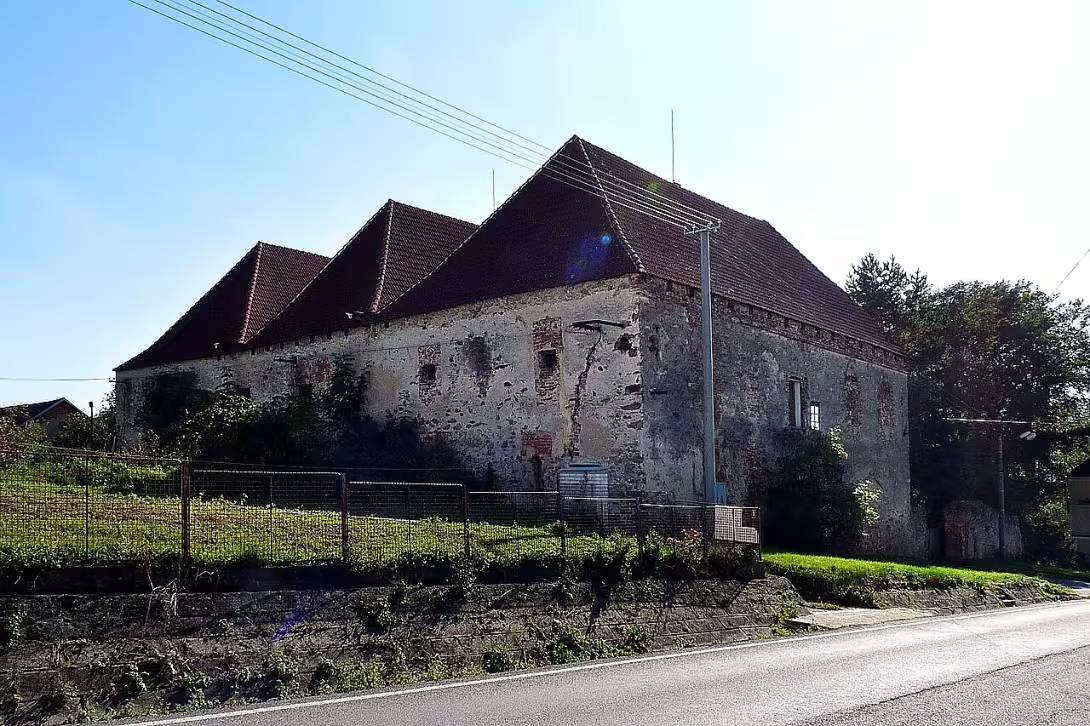
The Renaissance fortress in Chvalešovice near the village Dříteň is a historically valuable noble residence built after 1548 on the site of an older building. The building excels especially with preserved internal layout, original beam ceilings and unique architectural element in the form of three high parallel trapezoidal shields.
The seat was built shortly after 1548 by Zikmund Malovec z Malovic, a member of the Libějovic branch of the genus. The building served as the administrative centre of the estate, which the nobleman expanded further in the middle of the 16th century, for example by buying the chateau of Hrádek along with the villages of Březí, Baptist and Slavetice in 1556. The construction falls into the period of the flowering of Renaissance architecture in the Czech countries, when the nobility was greatly adjusting its mansions in accordance with period trends.
The construction has a storey available with a rectangular plan. The most prominent elements include three high parallel trapezoidal shields that give the object a specific look. The outside facade still shows the remains of the original Renaissance sgraffiti plaster. The original vaults, beam ceilings and baroque groves have been preserved in the interior. The original defensive moat that protected the fort in the past was buried over time.
After the death of the founder of Zikmund Malovka in 1597, the estate became his son Václav. The fort in 1616 sold Václav to a younger Malovka from Malovice. The Czech State uprising became an important turning point in the history of the building, after which after the defeat of the Walnut estate Václav to the younger Malovka was confiscated. In 1628, the property was sold to Balthazar Marradas.
The Chvaleshovická fortress is an important proof of Renaissance construction, which, despite centuries, has retained its internal and structural features. For those interested in the history of southern Bohemia, this building is a valuable example of a noble residence whose authentic details allow you to see the form of a rural residence from the mid-16th century. Visiting this place offers the opportunity to learn about architecture, which survived the dramatic events of the Thirty Years' War and subsequent property changes.
Historical milestones
- 1548
- The construction of the Renaissance fortress by Zikmund Malovc from Malovice.
- 1597
- The death of the founder of Zikmund Malovka and the transfer of property to the son of Václav.
- 1616
- Sale of the fortress of Václav to the younger Malovka from Malovice.
- 1628
- Confiscation of the estate and sale of Baltazar to Marradas after the state uprising.
Architectural development
The fortress was built in the Renaissance style in the mid-16th century. The internal layout has remained preserved over the centuries, as well as the structural elements of the roof and vault. The facade was originally decorated with sgraffiti.
Historical events
Confiscation of the Walnut estate of Václav to the younger Malovka from Malovice after the Battle of White Mountain in 1628.
Owners
Zikmund Malovec z Malovic (after 1548-1597), Václav Malovec z Malovic (1597- 1616), Václav younger Malovec from Malovice (1616- 1628), Baltazar Marradas (from 1628).
Points of interest
- The Renaissance fortress was built after 1548 on the site of the older building. - The building stands out for a unique architectural element in the form of three high parallel trapezoid shields. - The outside facade still shows the remains of the original Renaissance sgraffiti plaster. - The interior preserved original vaults, beams ceilings and baroque crows. - The original defensive moat that protected the fort in the past was buried over time.
Guide
Show guide text
This text was created by artificial intelligence and has not been editorially reviewed. It may contain inaccuracies.
Welcome to this fascinating building that carries a silent story of many centuries. You are standing right in front of the Renaissance fortress in Chvalesovice, a place where history, architecture and the fate of the people who once lived here, governments and faced the storms of their times meet. Before you go any further, stop for a moment and feel the atmosphere of this place. Imagine how the world around you has changed over the centuries, how political powers and the everyday life of the people have changed, while this solid structure remains an unchanging witness to everything that has happened.
Now let's go back deep into the past to understand why this fortress is standing right here where you're standing right now. Her entire history in this form begins after 1548. At that time, Zikmund Malovec z Malovic, an important person of his time, decided to build this new mansion. However, it was not a whole new project in the green field; This Renaissance fortress was built right at the site of an older mansion. This tells us that this place was strategically important long before we are used to thinking today. Zikmund Malovec therefore not only built here, but basically continued the tradition of settling his family in this place, bringing a modern Renaissance style that was a symbol of growth and stability at that time.
Now pay attention to the architecture of the building itself, which now stands before your eyes. If you look at the total ground plan of the object, you'll see its rectangular shape. It is a clear, rational foundation that is typical of the construction of this time. But what you need to be interested in immediately and what makes this fort truly extraordinary are its roofs and top of the facade. Look up and try to capture the three high, parallel trapezoidal shields. These are absolutely unique architectural elements that create a unique visual rhythm in this area. These shields give the building its distinctive, up to noble appearance and distinguish it from any other similar building around it.
When you approach the outside facade, see the details on the plaster. Although time and weather have left a trail, you can still see the remains of the original Renaissance sgraffiti plaster. Sgraphite is a technique that requires great skill - it is created by scratching into several layers of coloured plaster, creating geometric or ornamental patterns. Even the tiny remnants that you see here today are evidence of the period of wealth and effort of the owners to make their headquarters stand out from the surrounding landscape.
But the history of this place is not only the history of stones and plaster, it is mainly the story of people. The fate of the fort was closely linked to the Malovice family. After the death of the founder, Zikmund, in 1597 the property was transferred to his son Václav. This transition of generations was the natural order of things until another chapter appeared in 1616 - the sale of the fortress Václav to the younger Malovci. The family tried to maintain their position, but history was relentless at the time.
Now prepare for the moment when the atmosphere of the story narrows down and becomes much more exciting. 1628 was a turning point for this estate and perhaps tragic. After a turbulent period of the state uprising, there was a major twist. The estate was confiscated and then sold to Balthazar Marradas. Imagine the uncertainty and the change that must have happened when one family saw ownership of another as a result of political upheavals. This moment, when power and ownership are shifting due to major historical conflicts, is very strongly recorded in the history of this fortress.
Even though you are now outside, let yourself be inspired by what lies inside these tiny walls. If you went into the interior later, you should have the advantage of retaining the original vaults and beautiful beam ceilings that give space a sense of authenticity and history. The whole object is then crowned by baroque roof, which is another layer of history that entered the building later to create a fascinating blend of different epoch.
But what is the greatest secret that can interest you? It's the constant transformation. This building is not just a static object; It's a living organism that survived confiscation, family changes, and political upheavals. There is a hidden question about how this unique architecture, with its three shields, has managed to preserve itself despite all the instability that fate has brought it. There is something magical in it that, despite all human instability, this Renaissance base remains a fixed point in time.
Now we expect nothing more than to continue this journey and explore every detail that allows you to capture the eye. Look at the facade from other angles, see the shadows that cast those high shields, and try to imagine the steps that people took in these areas hundreds of years ago. Thank you for joining us in this brief view of the past. We wish you a pleasant and inspiring tour of this historic monument.
Tips for visitors
To visit the fortress in Chvalešovice we recommend to choose sunny days from spring to autumn when Renaissance architecture and surrounding South Bohemia landscape stand out. Don't forget to pack fixed shoes to move around and the camera, with the best lighting conditions for catching the facade details and the disposition of the fort being in the morning. In the vicinity you can visit the Chateau of Hrádek or explore the picturesque village Dříteň and the wider region of southern Bohemia near České Budějovice. For families with children, the trip is ideal as a simple walk in history, but we recommend to check the accessibility of the building in advance, as it is a historical monument.
Frequently asked questions
Can the monument be visited?
Some buildings of this kind are open for guided tours, others serve another purpose or are privately owned. We have not verified whether and when this monument is open – please ask the operator.
What are the opening hours and admission?
We have not verified the opening hours or admission. Current information is published by the operator.
Where is the monument?
Location: Dříteň, Jihočeský kraj. The map on this page shows the exact spot.
Why is the monument protected?
It is listed in the Central List of Cultural Monuments of the Czech Republic as a cultural monument (register no. 1000132040).
Businesses nearby
Do you run a restaurant, accommodation, shop, museum, rental, wellness or other visitor service near this monument? Show yourself directly to the people heading to it — this is how they will see you in the app and on the web:
Nearby
Obec Dříteň, tvrz Hrádek, oblast jižních Čech v blízkosti Českých Budějovic.
Accommodation nearby
Trips and activities nearby
Guided tours, tickets and activities nearby from GetYourGuide
Affiliate link: if you buy from the partner, we may receive a commission. The price for you does not change.
Search tours and activities →Themed route
1. Municipality of Dříteň, village: Walk through the villages will allow you to feel the local atmosphere and rural calm. 2. Fortress, Fortress: The main destination of the journey, which represents an important historical monument. 3. Castle Fortress, Fortress: Another interesting fortified object that complements the architecture of the surroundings. 4. Region of southern Bohemia near České Budějovice, area: The wider landscape offers typical South Bohemia views.
Seasonal recommendations
Spring: In the spring of the Fortress in Mortnes offers a unique view, where flowers and trees gradually shine in green. Sun rays penetrate between foggy clouds, creating an unforgettable atmosphere full of hope. At this time it is advisable to visit the memory early in the morning to avoid the initial doses of visitors and to enjoy a quiet moment. It is recommended to wear light clothes with the possibility to add a layer because temperatures can be variable.
Summer: Summer is an ideal time to visit the Fortress in Mortnes, when surrounding green meadows and trees offer pleasant shade. Sunshine days are perfect for photographing historic buildings with bright lighting. The main summer season may increase the number of visitors, therefore it is advisable to come in an early afternoon or evening when the place is quieter. Do not forget to protect against the sun and wear comfortable shoes for walking along lawn paths.
Autumn: In the autumn period, the Fortress offers a beautiful view of the golden and red pan. The sunny days are ideal for a tour where historical buildings are perfectly illuminated. At this time the weather may be variable, so it is advisable to bring a warm coat and protective clothing for a possible rain flood. Visit the memory in the early afternoon to enjoy a quiet environment in front of numerous visitors.
Winter: Winter visit to the Fortress in Mortnes offers a unique view of historic buildings covered with snow, giving the place a magical atmosphere. Due to the shorter opening time, it is advisable to come early in the morning and remember to bring warm clothes, including a belt for head protection, because the attendance is usually lower. In advent time the surroundings can be illuminated by light decoration, which adds to the enchanting winter atmosphere.
Visualizations and artistic views


The visualisations are generated by artificial intelligence and serve as inspiration.
Photos from the area
Real photos taken near the monument


Zdroj a licence jsou uvedeny u každého snímku.
Tips from visitors
No tips yet. Be the first!
Log in and add your tip.
Sources and literature
Photos: Czeva / CC BY-SA 3.0 — Wikimedia Commons. The author and licence also appear when you hover over the image.
Faktickým podkladem tohoto textu byl článek na Wikipedii, jehož autory jsou přispěvatelé Wikipedie. Článek je dostupný pod licencí CC BY-SA 4.0.
Location on the map



Příběhy a pověsti
Legendy, pověsti a příběhy spjaté s touto památkou
Fotografie návštěvníků
Zatím žádné fotografie. Buďte první, kdo přidá fotografii z návštěvy!
Log in a přidejte svou fotografii nebo hodnoťte.
Za ověřenou návštěvu v aplikaci získáte víc bodů — poznáme podle GPS, že jste na místě.
Reviews and comments