



Vodní mlýn Bukačov Water mill
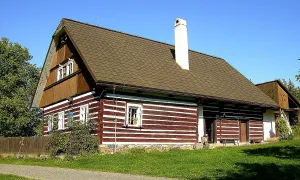
Vodní mlýn Bukačov in Kouřimi (district Kolín) is a protected real estate cultural monument of the Czech Republic, situated on the river Výrovka under the pond Strašík. This historical object is important mainly thanks to preserved technical equipment and unique architectural elements such as Romanesque stonework in its masonry.
The first historical mention of the mill dates back to 1404, when it was referred to as the Middle East in the White Paper of Rights and Freedoms. In the 16th century, the name Vojtěšský was used, which was probably related to the nearby church of St. Vojtěv or to the miller Vojtěch mentioned in the documents in 1516. The mill was also captured at the Vedute of the City of Kouřimi in 1600 created by Jan Willenberg.
The area includes a mill building with a mansard roof and an adjacent farm yard with a perpendicular, barn and barn. The whole area is bounded by a stone terrace wall with two pillar gates. On the south side there is a big house and a house. A significant architectural element is the use of stoneware articles from the demolished Romanesque church of St. Vojtěv, which were used in secondary use in the walls of buildings; These include, for example, the head of the pillar.
Since the 17th century the mill belonged to the family of the miller Bukac. In 1755 it was taken over by the family Šmejkalová, who had been here for almost a hundred years. At the end of the 19th century it was purchased by Augustin Beyšovec, whose family owned the building until the second half of the 20th century. The grinding took place until 1962, then the state preserved it.
The mill underwent a gradual technical modernization. Originally powered by two water wheels and a third wheel for the drive of a saw. In 1918, two Francis turbines were installed from the producer J. M. Voith of St. Pölten. In the southern part of the turbine house was placed the vertical Francis fountain turbine with dry mammal with a fall of 4.1 meters, an abundance of up to 550 liters per second and a power of 22.8 horsepower. A massive horizontal spiral turbine with a power capacity of 275 liters per second and 11.2 horsepower was located several metres north of it. In 1923 a Hindl high-pressure diesel engine of 30 horsepower from the Králové Opolské Engineering in Brno was installed in the engine room. The metal exhaust resulting from the roof of the turbine house and the original oil tank hanging on the wall remained in this engine. There used to be a bakery with a steam engine; Today, there is only a high brick chimney and probably a pressure tank above the bakery oven.
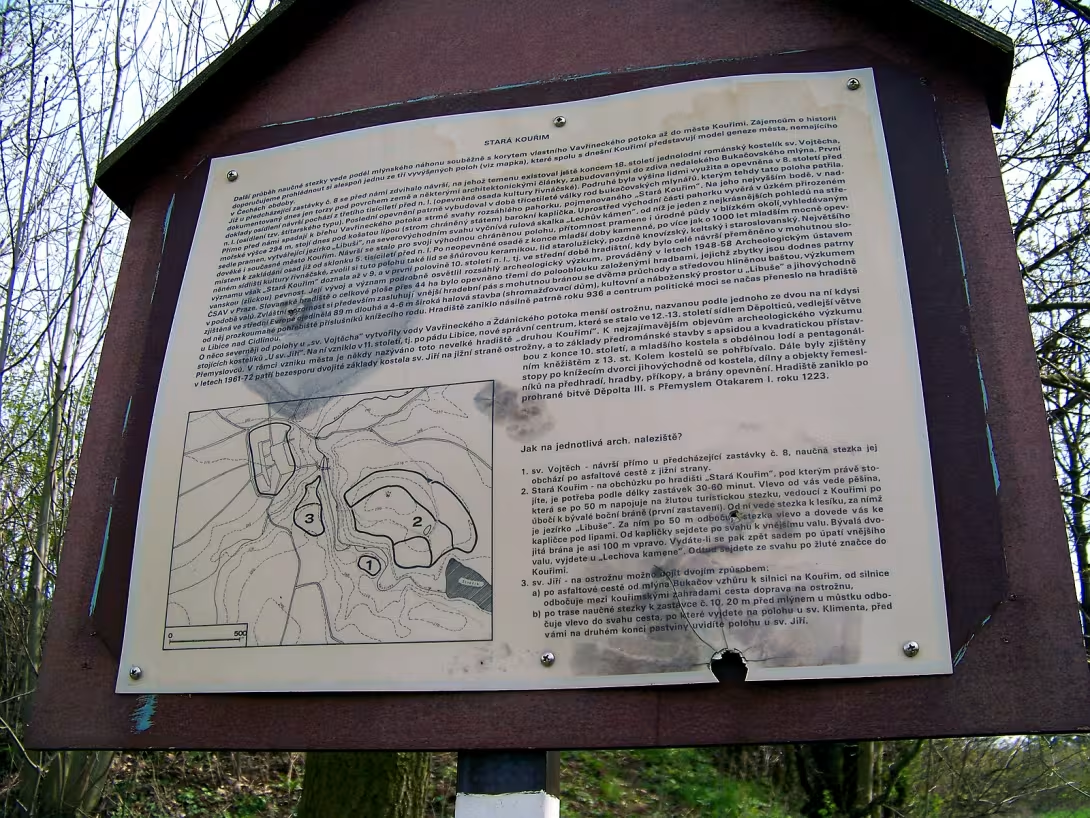
The mill is located between the original castle Stará Kouřim and the Svatojiřské sharpasse. In his vicinity, archaeologists discovered the Hradiz near St. Vojtěv. The area intersects the marked tourist route 1048 leading from Kouřim to Hatí. Today the mill is a preserved monument, which documents technical developments from traditional grinding to mechanisation.
Vodní mlýn Bukačov presents a rare set of historical architecture and technology. It is an important witness to the history of the region and is worth visiting interested in technical history and archaeological context.
Historical milestones
- 1404
- First mention of the mill called the Middle in the White Paper of Rights and Freedoms.
- 1516
- Mention of the miller Vojtěv.
- 1600
- The capture of the mill at the head of the city of Kouřimi by Jan Willenberg.
- 1918
- Installation of two Francis turbines from the producer J. M. Voith.
- 1923
- Installation of Hindl high pressure diesel engine from Kraloopolské strojíny.
- 1962
- End grinding and subsequent state preservation of the building.
Architectural development
The mill building is covered by a Mansard roof and the area is bounded by a stone taras wall with pillar gates. Romanesque heads of the column were inserted into the buildings. Over time the mill was modernized by installation of steam engine, diesel engine and turbines.
Historical events
1404: First mention in the White Paper on Rights and Freedoms; 1918: Installation of Francis turbines; 1962: End of grinding and state preservation.
Owners
The family of Bukachs (from the 17th century), the family of Šmekal (from 1755), Augustin Beyšovec (end of the 19th century until the second half of the 20th century).
Points of interest
- In the wall of the mill are secondary stoneware articles such as the head of the column, from the demolished Romanesque church of St. Vojtěv. - The first historical mention of the mill dates back to 1404, when it was called the Middle. - The mill was captured at the Vedute of the City of Kouřimi in 1600. - The original water wheels were later replaced by turbines and diesel engines. - There used to be a bakery with a steam engine, which now leaves a high brick chimney.
Guide
Show guide text
This text was created by artificial intelligence and has not been editorially reviewed. It may contain inaccuracies.
Welcome to Kouřimi, where history meets the calm of flowing water. Right now, you're standing in front of the Water Mill of Bukachev, which is now a protected cultural monument. Stop for a moment, take a breath and feel the atmosphere of this place. In front of you is an area that has served for centuries as the heart of local craft and livelihood. Look at the buildings that surround you. The dominant is the mill building, which captures you with its specific Mansard roof, a roof with a characteristic fracture, which gives the whole building an elegant and robust look. Next to it, you will see a hoarder, where grain was once safely stored, a residential house where generations of miller people lived, and various economic buildings that together form this harmonious whole. All of this is connected to the River Expedition, whose current has been the main source of energy for the entire enterprise for centuries.
Let us now return together in time so that this space begins to speak with its own voice. Imagine we're in the early 15th century. The first written mention of this mill dates back to 1404. At that time it was written in the so-called White Book of Rights and Freedoms, which was a very important document of its time. Interestingly, the mill was not called Bukachev at the time, but it was simply referred to as the Middle. This name probably referred to its location against other mills nearby. Imagine what the mill was doing at the time. It was not just a place for grinding grains, but a place for meeting people from surrounding villages, instead of shops and news. It was one of the most lively parts of the landscape.
When we move forward in time, until 1516, we meet with a particular person who did his work here. Historical records mention the miller Vojtek. Although we don't know much about him, his name reminds us that behind every stone and every piece of wood in this area was human work, sweat and responsibility. The milling industry was a demanding craft at the time, which required knowledge of water, weather and technology.
Now I would like to ask you to pay attention to the surrounding countryside and imagine what this place looked like more than four years ago. In 1600, the artist Jan Willenberg captured the so-called Vedute of the City of Kouřimi, which is basically a detailed panoramic painting. It is in this painting that the mill was captured, which allows us today to imagine with great precision what form it was in during the Renaissance. It is fascinating to think that the view you see today was captured in a similar composition centuries ago, and that we are connecting with people from the past with this close bond.
Now let's move on to something that may not be visible at first glance, but it is one of the greatest secrets and treasures of this place. Look carefully at the wall of the buildings. If you're lucky enough to look carefully, you'll notice that some of the stones in the murs look different than others. And that's true. In the wall of the mill are secondary used stoneware articles from the demolished Romanesque church of St. Vojtěv. These unique elements include, for example, the pillar head. In ancient times, it was not common to throw away a quality worked stone if a building was demolished. Instead, these rare fragments of sacral architecture became part of the practical building of the mill. It is an incredible contrast when you realize that the stone that once carried the vault of the church and witnessed the prayers now holds the wall of the building where the grain was grinding and the noisy work ruled. This hidden layer of history makes the mill Bukachev a real archive in stone.
In addition to the stony details, we are accompanied by the name Augustine Bejjejkova, another person associated with this place, who helped shape the fate of this complex. Every one of these people has added their trail to the image we see today.
Now let's think about how the technique that drove the grinding was changing. Originally, the mill was powered by classic water wheels, which in the rhythm of the flowing river Roads turned the mill stones. It was a slow but reliable process. However, with the advent of modern age Bukachev had to change. The year 1918 has brought major news. Two Francis turbines were put into operation by the producer J. M. Voith. The turbine was much more efficient than the old water bike and allowed to increase the power of the mill. However, technical progress has not been made. A few years later, in 1923, another news was installed, namely the Hindl high-pressure diesel engine from the Royal Polish Engineering. This engine was used as a backup or assistance to enable the mill to function even in times when the River Výrovka did not have enough water to drive turbines. This transition from the natural power of water to the mechanical power of the engine symbolizes the whole era of industrial revolution, which changed the face of the whole world and this little corner in Kouřimi.
But this era of active grinding had to come to an end. In 1962, mill stones and turbines finally died down. The milling of grain has ceased to be economically meaningful within the new system. However, instead of the mill being destroyed or demolished, its state preservation took place. It is thanks to this decision that we can stand before these buildings today and admire their architecture and history. Preserving kept the object in such a state that he could tell us his story today.
If you look around now, try to imagine the noise that used to be here. The whirl of water, the rhythmic beating of machines, the smell of freshly ground grain and the voices of miners and their customers. It's quiet here today, but if you listen, you may hear the echoes of all these years in the roar of the River Exantics.
This mill is not just a set of buildings, it is a monument to human ingenuity, patience and the ability to adapt to the times. From the White Book of Rights and Freedoms to the Renaissance Views to the modern twentieth century turbines. It's all connected in this one area.
Now I'm leaving you to explore this place at your own pace. Take a walk around the buildings, look in the moths for those mentioned stones from the old church and let the atmosphere of this historic place engulf you. Feel the contrast between the rugged hoarder and the elegant mansard roof of the mill. Don't forget to look at the stream of the river that was and is still a vital element of this whole.
Thank you for spending time with us at the Water Mill Bukachev. We hope you have felt the depth of history that lies in these walls. We wish you a pleasant further journey along Kouřimi and many other fascinating discoveries. Goodbye.
Tips for visitors
The best time to visit is the spring and summer season, when the surrounding nature is the most lively and the water in the River Výrovka seems the most remarkable.
You can reach the mill by car or use public transport; Please check the current connection in the Internet search engine.
Get comfortable shoes, drinks and snacks in the way. For families with children it is ideal to walk to the Strašík pond or along the 1048 tourist route towards Hatech.
For photography we recommend to use soft light in the morning or late afternoon hours, which will highlight the historic building beautifully.
In the surroundings you can visit the Hradištěv near St. Vojtěv, which is a great addition to the whole trip.
Frequently asked questions
Can the monument be visited?
This is a technical monument. Some are open as exhibitions, others are out of use or on private land. We have not verified whether this one is accessible.
What are the opening hours and admission?
We have not verified the opening hours or admission. Current information is published by the operator.
Where is the monument?
Location: Kouřim, Středočeský kraj. The map on this page shows the exact spot.
Why is the monument protected?
It is listed in the Central List of Cultural Monuments of the Czech Republic as a cultural monument (register no. 1000127286).
Businesses nearby
Do you run a restaurant, accommodation, shop, museum, rental, wellness or other visitor service near this monument? Show yourself directly to the people heading to it — this is how they will see you in the app and on the web:
Nearby
Hradiště u svatého Vojtěcha, rybník Strašík a turistická značená trasa 1048 směr Hatě.
Accommodation nearby
Trips and activities nearby
Guided tours, tickets and activities nearby from GetYourGuide
Affiliate link: if you buy from the partner, we may receive a commission. The price for you does not change.
Search tours and activities →Themed route
Thematic cruise route around the Water Mill Bukachev
1. Vodní mlýn Bukačov (mill) - This historical object is a unique monument, which represents the heritage of the area and tradition of the mill craft. It is an ideal place for those who are interested in the technique of old mills and their use.
2. Hradic near St. Vojtěs - This place is interesting for lovers of history, because there is an ancient castle associated with the legend of Saint Vojtech. It is an ideal opportunity to explore the ancient settlement and culture of the region.
3. - The pond is a beautiful place to relax in nature, offering quiet moments on its shores and the opportunity to observe wildlife. It is also an ideal place for a picnic or a short bath.
4. Tourist marked route 1048 direction Hate (tourist route) - This tourist route offers views of the surrounding countryside and is suitable for cycling or walking. It is an ideal way to immerse yourself in nature and discover new corners of the village Kouřim.
This route offers a combination of history, nature and relaxation, making it the perfect choice for a day trip.
Seasonal recommendations
Spring brings to the surroundings of the mill awakening life and fresh green color leaves. Water in the stream is very lively and loud in this period due to the melting snow. Light is soft and pleasant to the eyes these days. For a visit we recommend choosing layered clothes because morning temperatures can still be low. It's the best time for those who seek peace, because crowds of people don't appear at the mill yet.
In the summer months there is a bright and sharp sun that creates strong shadows under the trees. The air is warm and a refreshing cold can be found at the water wheel. Due to the increased number of visitors in the main summer time, it is best to arrive first thing in the morning. Don't forget to wear your headgear and enough water to avoid heat fatigue.
Autumn turns the surroundings into a landscape full of golden and brown shades that are beautifully mirrored in water. The morning mist above the surface gives the mill a mysterious and calm mood. It is advisable to wear waterproof shoes because the soil is wet. The best time to observe colored leaves is in the morning when the light is the purest.
Winter in this area is very quiet and often lonely. The ice cover on the surface and the grey sky create a raw but beautiful mood. Due to the short days, you must come early so you don't miss the light. A strong winter jacket, wool accessories and warm shoes are essential for comfort, so that you will not be unpleasantly surprised when staying.
Visualizations and artistic views


The visualisations are generated by artificial intelligence and serve as inspiration.
Photos from the area
Real photos taken near the monument


Zdroj a licence jsou uvedeny u každého snímku.
Tips from visitors
No tips yet. Be the first!
Log in and add your tip.
Sources and literature
Photos: MartinVeselka / CC BY-SA 4.0 — Wikimedia Commons. The author and licence also appear when you hover over the image.
Faktickým podkladem tohoto textu byl článek na Wikipedii, jehož autory jsou přispěvatelé Wikipedie. Článek je dostupný pod licencí CC BY-SA 4.0.
Location on the map





Příběhy a pověsti
Legendy, pověsti a příběhy spjaté s touto památkou

Fotografie návštěvníků
Zatím žádné fotografie. Buďte první, kdo přidá fotografii z návštěvy!
Log in a přidejte svou fotografii nebo hodnoťte.
Za ověřenou návštěvu v aplikaci získáte víc bodů — poznáme podle GPS, že jste na místě.
Reviews and comments