






zámek Fryštát Chateau
This page was machine-translated from Czech. The translation has not been language-checked and may contain errors.
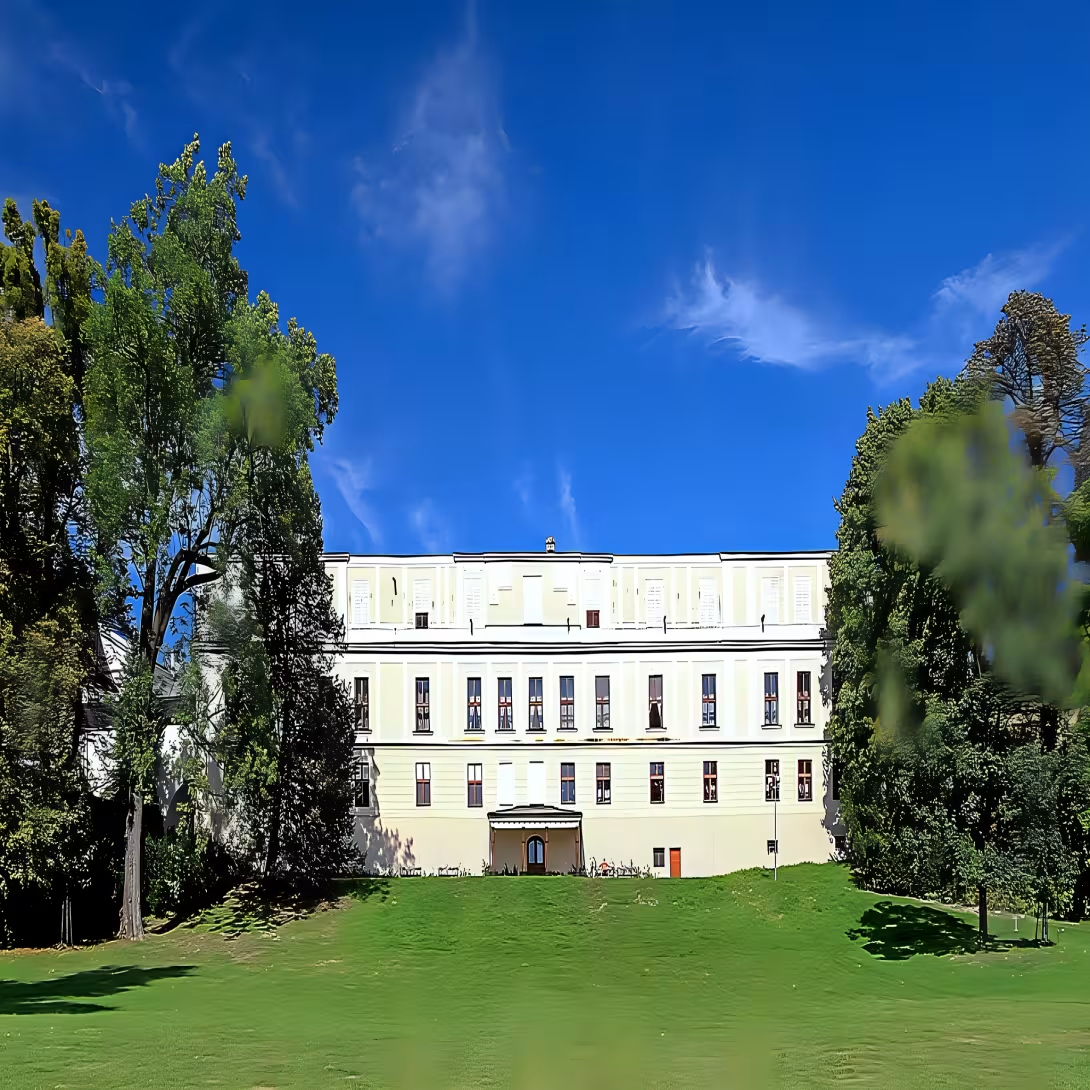
Fryštát Chateau stands on the edge of Karviná's historic centre, in the Fryštát district of the Moravian-Silesian Region. It is a cultural monument and forms a complex with the chateau, a courtyard, a church, stables and a park. Over the centuries it served as the seat of the Silesian Piasts and later of the noble families of Gaschin, Taaffe and Larisch-Mönnich.
The chateau stands on the site of the medieval ducal residence of the Piasts of Cieszyn. Fryštát was founded at the turn of the 13th and 14th centuries as a new centre after the original settlement by the Olše had suffered from frequent floods. In the first half of the 15th century, Duchess Euphemia of Masovia, widow of Duke Bolesław I, began converting the Fryštát seat into a residence.
In April 1511 a great fire swept through Fryštát, after which Duke Casimir II had the chateau rebuilt in the Renaissance style. In 1543 Elizabeth of Habsburg, daughter of Ferdinand I, stopped at the chateau on her way to Kraków to marry Sigismund II Augustus, and a banquet was held in her honour. Under the last Piast duke of Fryštát, Frederick Casimir, celebrations and a knights' tournament were held at the chateau in honour of his wife, Catherine of Legnica.
After Frederick Casimir's death, Fryštát was permanently separated from the Duchy of Cieszyn. In 1572 the estate was bought by Václav Cikán of Slupsko, and an independent estate lordship, the so-called status minor, was created. From 1749 to 1792 Fryštát was held by the Irish counts Taaffe.
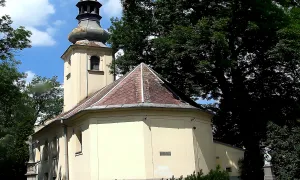
In 1792 Fryštát was bought by the Larisch-Mönnich family. They rebuilt the chateau in the Empire style, linked it to the neighbouring church with a covered passage and settled here; the chateau's present appearance dates from their time. At the beginning of the 20th century the Larisch family received guests such as Emperor Franz Joseph I, the German Emperor Wilhelm II and Tsar Ferdinand of Bulgaria.
In 1945 the Larisch family's property was nationalised. The chateau was then used by the Ostrava-Karviná Mines and later by the Municipal National Committee. It opened to the public in 1997, and the Lottyhaus building followed in 2003. The Lottyhaus houses a branch of the National Gallery Prague with 19th- and 20th-century art.
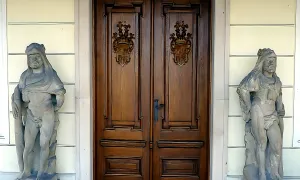
At the main entrance stands a pair of Baroque sandstone statues of Hercules from 1682, which originally stood at the chateau in Ráj and were moved to Fryštát in 1971. Behind the chateau lies Božena Němcová Park, founded in 1804 as an English-style landscape park.
Then and now
Drag the slider to compare how the landmark may have looked when it was built with the view today.
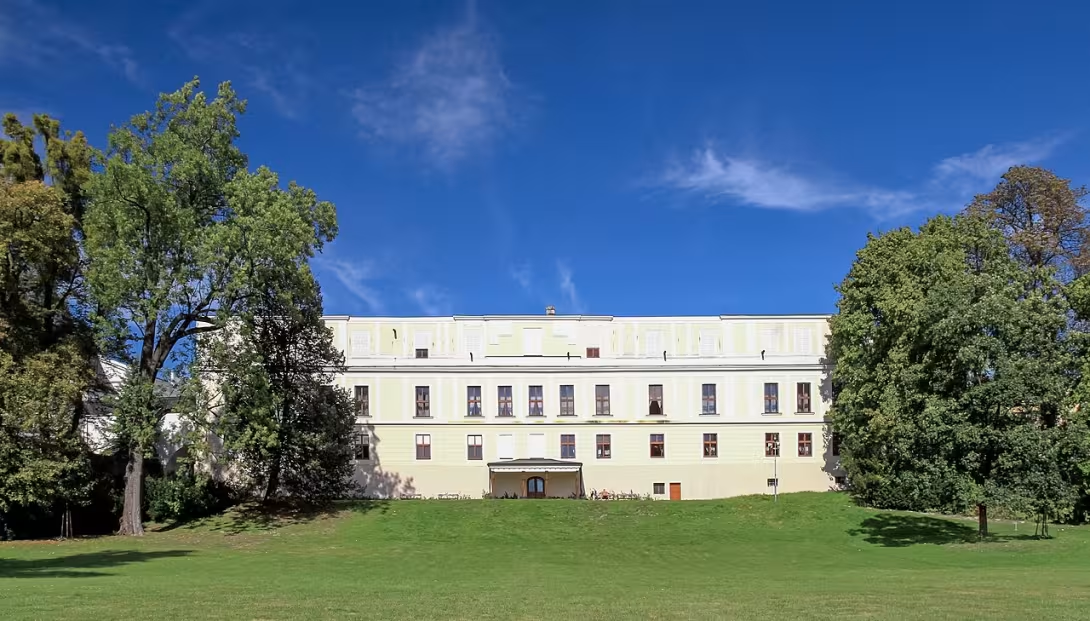

The historical appearance on the left is an AI-generated visualisation and serves as inspiration only.
Historical milestones
- Turn of the 13th and 14th centuries
- Fryštát and the ducal residence of the Piasts of Cieszyn are founded.
- First half of the 15th century
- Duchess Euphemia of Masovia begins converting the seat into a residence.
- 1511–1514
- After a great fire, Duke Casimir II has the chateau rebuilt in the Renaissance style.
- 1543
- Elizabeth of Habsburg stops at the chateau on her way to Kraków.
- 1572
- Václav Cikán of Slupsko buys the estate.
- 1792
- The Larisch-Mönnich family buys Fryštát, rebuilds the chateau in the Empire style and settles here.
- 1997
- The chateau opens to the public.
Architectural development
The chateau stands on the site of the medieval ducal residence of the Piasts of Cieszyn. In the first half of the 15th century Duchess Euphemia of Masovia began converting the seat into a residence. After the fire of 1511 the chateau was rebuilt in the Renaissance style under Duke Casimir II. It gained its present Empire-style appearance under the Larisch-Mönnich family, who settled at the chateau in 1792.
Historical events
1511–1514: Renaissance rebuilding of the chateau after the fire under Duke Casimir II
1563/1564: celebrations and a knights' tournament in honour of Catherine of Legnica, wife of Duke Frederick Casimir
Owners
from the late 13th century: the Piast dukes of Cieszyn
first half of the 15th century: Duchess Euphemia of Masovia begins converting it into a residence
1572–1792: various noble families, including Václav Cikán of Slupsko, the Gaschin family and the Taaffe family (1749–1792)
1792–1945: the Larisch-Mönnich family
Points of interest
- In 1543 Elizabeth of Habsburg, daughter of Ferdinand I, stopped at the chateau on her way to Kraków to marry Sigismund II Augustus. A banquet was held in her honour.
- Under the last Piast duke of Fryštát, Frederick Casimir, celebrations and a knights' tournament were held at the chateau in honour of his wife, Catherine of Legnica.
- When houses were numbered in 1770, the chateau was given number 1, and this numbering has survived.
- The two statues of Hercules at the entrance bear the inscription “Juráš 1682”, and local tradition links them with the outlaws Juráš and Ondráš.
- The Lottyhaus, connected to the chateau by an overhead passage, houses a branch of the National Gallery Prague with 19th- and 20th-century art.
Guide
This guide is narrated by a synthetic voice generated by artificial intelligence.
Show guide text
This text was created by artificial intelligence and has not been editorially reviewed. It may contain inaccuracies.
Fryštát Castle in Karviná is the only residential seat of the Silesian Principality on Czech territory. Later, Silesian aristocracy from the Gaschin, Taafe, and Larisch-Mönnich families resided there. It lies in the valley of the Olše River on the edge of Karviná and is protected as a cultural monument. Together with the courtyard, church, stable, and park, it forms a complex that grew out of the original medieval castle.
The castle was built in 1288 by Silesian Prince Měšek the First from the Těšín-Fryštát branch of the Piast dynasty. It was the first structure of the new Fryštát, which was relocated here from the banks of the Olše River. In the first half of the fifteenth century, Princess Eufemie of Mazovia began rebuilding the castle into a residential seat. The Piasts used the castle as their secondary residence after the Těšín Castle until 1572. Princes Boleslav the Second, Kazimír the Second, Václav the Third Adam, and Friedrich Kazimír stayed here, as did widowed princesses. The castle was not particularly extensive, yet it appeared impressive. The entire complex was surrounded by a city wall and an embankment with a water-filled moat.
In 1511, the castle caught fire and was largely destroyed. Prince Kazimír the Second renovated it in the Renaissance style between 1511 and 1514. The Gothic tower was not rebuilt, so a new Gothic-Renaissance tower was constructed in 1515 next to the neighboring Church of the Exaltation of the Holy Cross. In 1543, Elizabeth, the daughter of Czech King Ferdinand the First of the Habsburgs, stayed here with her retinue while traveling to Krakow for her wedding to Polish King Sigismund the Second Augustus. In 1563, a magnificent celebration was held at the castle to honor the arrival of Princess Catherine of Liegnitz, the wife of the last Fryštát prince Friedrich Kazimír. It culminated in a knights' tournament.
After the death of Friedrich Kazimír in 1571, an independent Fryštát estate was created. In 1572, it was purchased by the Land Captain Václav Cikán of Słupsk. Until 1792, various noble families took turns residing at the castle. The most significant was the Irish counts of Taafe, who left traces of Irish culture there. During their tenure, the castle was visited by the Swedish king.
The castle's present appearance is the work of the Larisch-Mönnich counts. Black coal was discovered on their estate in 1776, and the proceeds from it financed the reconstruction. The castle acquired an Empire style appearance on Piast foundations and was connected with the church into a single complex, though the church retained its Gothic appearance. A building called Lottyhaus was also added to the castle, connected to it by a corridor on the first floor. In 1804, an extensive park with a pond and stable were created. During a fire in 1823, the left wing of the castle was severely damaged but was later repaired.
The castle is also the main setting of the historical novel The Duke of Fryštát, which tells the story of the last prince who lived here and his magnificent court.
Tips for visitors
The chateau is fully open from April to October, Tuesday to Sunday. In late spring and early autumn it is pleasant to combine the tour with a walk through Božena Němcová Park behind the chateau.
The chateau stands on the edge of Karviná's historic centre, next to Masaryk Square. You can reach the centre by local public transport or by car; check current connections and parking options before you travel.
Wear comfortable shoes if you want to explore the park after your chateau tour. In the warmer months, bring a hat and water.
The main entrance with the two statues of Hercules and the view of the chateau from the park make good photographs. The light is softest in the early morning and late afternoon.
Right next to the chateau is Masaryk Square with its cast-iron fountain from 1900 and the old town hall. The Church of the Exaltation of the Holy Cross adjoins the chateau, and the Lottyhaus houses an exhibition of the National Gallery Prague.
Frequently asked questions
Can the monument be visited?
Yes. We verified the opening hours or admission on the official website (26. 9. 2026); you will find them in the visitor information on this page. Please double-check with the operator before you travel.
What are the opening hours and admission?
Details verified on the official website (26. 9. 2026) are listed in the visitor information on this page. Official website: https://www.zamek-frystat.cz/
Where is the monument?
Location: Masarykovo nám. 1/1, Fryštát, Karviná, Moravskoslezský kraj. The map on this page shows the exact spot.
Why is the monument protected?
It is listed in the Central List of Cultural Monuments of the Czech Republic as a cultural monument (register no. 12082/8-772).
Businesses nearby
Do you run a restaurant, accommodation, shop, museum, rental, wellness or other visitor service near this monument? Show yourself directly to the people heading to it — this is how they will see you in the app and on the web:
Nearby
🏰 Historic sites (207)
- Zámek v Karviné-Fryštátě 0.0 km web
- Socha TGM 0.0 km
- sv. Jan Nepomucký 0.0 km
- sv. Patrik 0.0 km
- Panna Maria Bolestná 0.1 km
- Kostel Povýšení sv. Kříže 0.1 km
- sv. Jan Nepomucký 0.1 km
- Madona 0.1 km
- Obětem 1. a 2. světové války 1.2 km
- Zdar Buh! Sześć Boże! 2.2 km
- 1914-1918 2.3 km
- Socha svatého Jana Nepomuckého 4.0 km
- Poslední vozík z dolu Darkov 4.0 km
- Poslední vozík z dolu ČSA 4.0 km
- Poslední vozík z dolu ČSM 4.0 km
- Poslední vozík z dolu 9. květen 4.0 km
- Panna Marie 4.3 km
- Kościół pw. Podwyższenia Krzyża Świętego w Kaczycach 4.3 km Ludowa 7
- Valtr Elsner 4.4 km
- Hermína Elsnerová 4.4 km
🍽️ Restaurants and dining (463)
- Elektra 0.1 km Masarykovo nám. 5/4
- cafe BB bar 0.1 km
- Venezia 0.1 km
- U Koplíků 0.1 km
- Rest&rt 0.1 km
- Restaurace Baron 0.1 km
- Bok of Ka 0.1 km Svatováclavská 33/2
- Antalya Kebab 0.1 km
- Vanilla 0.1 km web
- Restaurace Zlaté časy 0.2 km
- DLOUHÉ VIDLE, s.r.o. 0.3 km
- Dinos Restaurant 0.5 km +420 774 002 162 web
- Panda 0.9 km
- Delikana 0.9 km web
- Adamo Restaurace 0.9 km
- Le Café 1.1 km
- Majaček 1.2 km
- Občerstvení u kruháče 1.2 km
- Kino Centrum Café 1.2 km tř. Těreškovové 2234/24
- Společenský dům Lázní Darkov 1.3 km
🏨 Accommodation (60)
- Apartmany BB 0.1 km
- Koleje Slezká univerzita 1.9 km Na Vyhlídce 1079/1
- Lázně Darkov, a.s. 2.1 km Čsl. armády 2954/3 +420596372210 web
- Country Motorest 7.1 km
- Nasz Folwark 7.8 km
- Hotel Sport 8.2 km web
- Vulture 8.5 km U Pošty 371/4 web
- Hotel Impuls 8.8 km U Hřiště 1324/13b web
- Penzion Urban 9.6 km +420603783554 web
- Penzion Pod Zámkem 9.7 km +420 725 178 819
- U Jelena 10.1 km +420 608 751 517 web
- Penzion Amerika 10.3 km +420 736 627 315 web
- Penzion U Popelků 10.3 km +420 724 200 838 web
- Resort Těrlicko 10.4 km +420 724 387 666 web
- Restaurace a penzion U Lesa 10.5 km +420 732 595 205 web
- Hotel "Dąbrówka" 10.6 km
- Willa "Dąbrówka" 10.6 km
- Willa "Dąbrówka" II 10.6 km
- Noclegi Wiktoria 11.1 km Powstańców Śląskich 22 +48 534 544 416
- Hostel Dzika Kaczka 11.2 km +48 730 888 240 web
🚲 Rentals and sport (94)
- STaRS Karviná - víceúčelová hala 0.3 km
- Sportisimo 0.8 km
- Tipsport 0.9 km
- Hala házené 1.2 km
- Bazén Stars 1.4 km
- Modelářské letiště Hohenegger 5.8 km
- KKS Spójnia Zebrzydowice 5.9 km
- Petrovická kotlina 6.0 km Dolní Marklovice 253 +420 608712504 web
- Spójnia zebrzydowice 6.1 km
- Boisko Kończyce Małe 6.4 km
- Sportovní hala 6.9 km
- LKS OLZA Pogwizdów 7.3 km
- Sportovní centrum Na Císařství 7.4 km web
- Sportovní hala Horní Suchá 7.5 km
- Kola Go 7.5 km
- Letní koupaliště 7.9 km
- sportovní areál 8.1 km
- Klub Sportowy LKS Błyskawica 8.1 km
- Sportisimo 8.2 km web
- Squash centrum 8.7 km
🥾 Hiking and nature (98)
- sady Bedřicha Smetany 0.4 km
- Sad Boženy Němcové 0.4 km
- Univerzitní park 0.5 km
- Vrchlického sady 1.0 km
- Lázeňský park 1.2 km
- Lázeňský park, Lázně Darkov 2.3 km
- Kostel Nanebevstoupení Páně 4.8 km
- zámecký park 5.4 km
- Park Rudolfa Kolaczka 5.9 km
- Drewniany kościół św. Anny 7.1 km
- pingwin 7.5 km
- Zespół pałacowy 7.5 km
- lesopark 7.8 km
- Něbrojův kopec 7.9 km
- Lazy 7.9 km
- Zámecký park 7.9 km
- Park Ludowy 8.2 km
- Pastuchovka 8.6 km
- Volontérská studánka 8.8 km
- Stacja Szotkowice 8.9 km
Accommodation nearby
Themed route
Themed tour: Fryštát Chateau and its surroundings
1. Fryštát Chateau (chateau) Start at the chateau, the former seat of the Piasts, the Taaffes and the Larisch-Mönnichs. At the main entrance, take a look at the two statues of Hercules from 1682.
2. Božena Němcová Park (park) Behind the chateau lies an English-style landscape park founded in 1804. It is the largest park in Karviná, and the artificial Mlýnka millrace flows through it.
3. Masaryk Square (square) Fryštát's historic square with a cast-iron fountain from 1900 and the old town hall with its Renaissance tower.
4. Church of the Exaltation of the Holy Cross (church) The Gothic church, the oldest building in Karviná, is linked to the chateau by a covered passage from 1792.
All the sights lie in the historic core of Fryštát, which was declared an urban heritage zone in 1992, and are easy to explore on foot.
Seasonal recommendations
Spring: From April the chateau is open Tuesday to Sunday. The greenery comes back to life in Božena Němcová Park behind the chateau, and spring is a pleasant time for a walk. Dress in layers, as temperatures can vary.
Summer: The long days let you combine a chateau tour with a rest in the park. Cultural events are held during the year in the courtyard, on the square or in the park's amphitheatre; check the current programme in advance. On hot days, remember to drink and protect yourself from the sun.
Autumn: The trees in the chateau park turn yellow and red. Until the end of October the chateau is open Tuesday to Sunday. Expect cooler days and possible rain.
Winter: From November to March the chateau is open on Saturdays and Sundays with tours at 11 am and 1 pm. The National Gallery exhibition in the Lottyhaus is open all year round. Wear warm clothes and non-slip shoes.
Visualizations and artistic views


The visualisations are generated by artificial intelligence and serve as inspiration.
Photos from the area
Real photos taken near the monument


Zdroj a licence jsou uvedeny u každého snímku.
Atmosphere of the place
This atmospheric visualisation of the place and period was generated by artificial intelligence. It is not real footage of the location.
Tips from visitors
No tips yet. Be the first!
Log in and add your tip.
Sources and literature
Photos: Marcin Konsek / CC BY-SA 4.0, rozlišení zvýšeno umělou inteligencí — Wikimedia Commons. The author and licence also appear when you hover over the image.
Faktickým podkladem tohoto textu byl článek na Wikipedii, jehož autory jsou přispěvatelé Wikipedie. Článek je dostupný pod licencí CC BY-SA 4.0.
Location on the map
Příběhy a pověsti
Legendy, pověsti a příběhy spjaté s touto památkou
Fotografie návštěvníků
Zatím žádné fotografie. Buďte první, kdo přidá fotografii z návštěvy!
Log in a přidejte svou fotografii nebo hodnoťte.
Za ověřenou návštěvu v aplikaci získáte víc bodů — poznáme podle GPS, že jste na místě.
Reviews and comments