



Koňská kašna Fountain
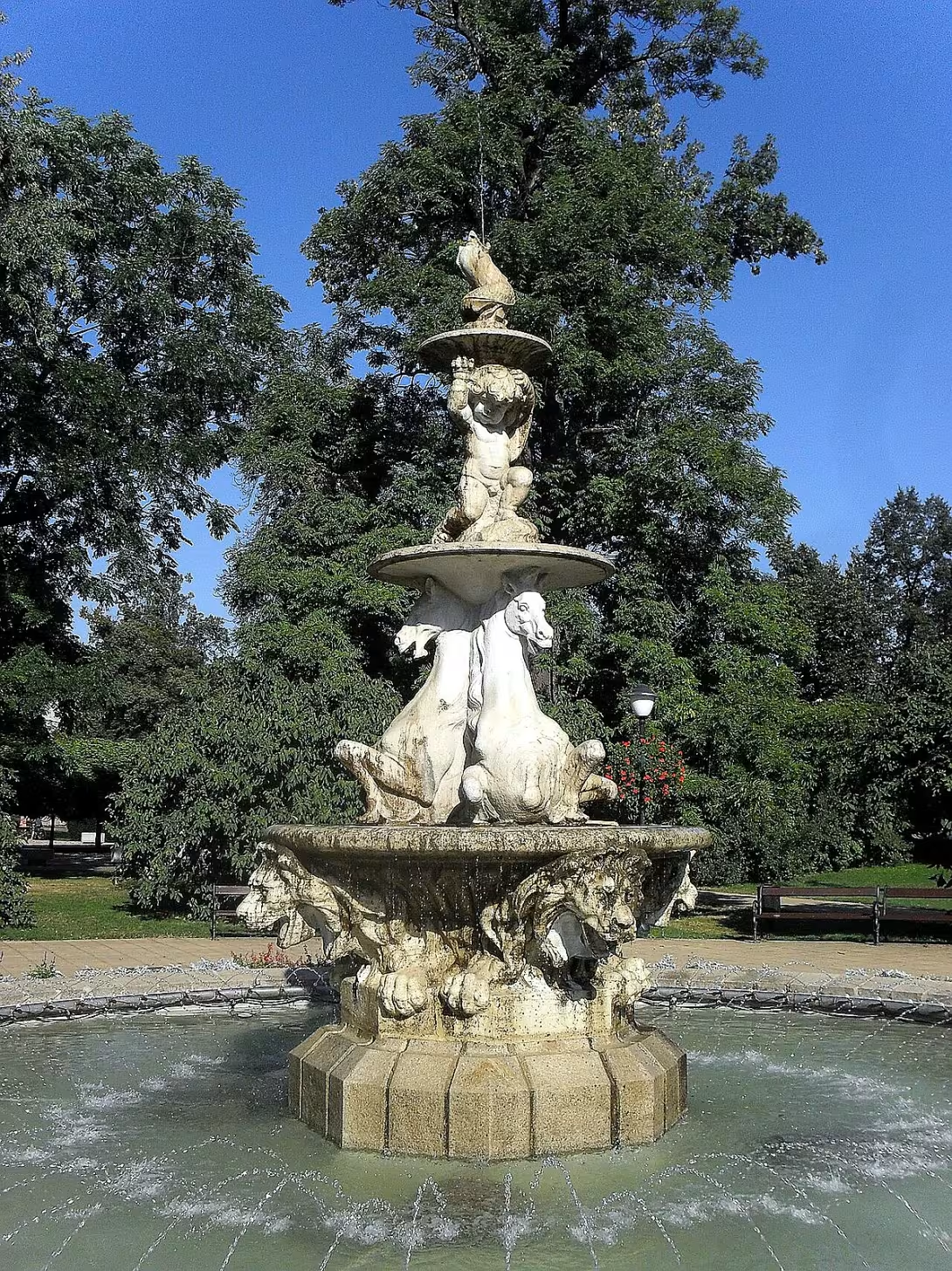
Koňská kašna is a marble Neo-Baroque monument situated in the Czechoslovak Army Orchards near the Stone Spa in Teplice. This object, which is a protected cultural monument, forms a tank of a circular plan with a four-stage fountain pillar. It adorns the figural motifs of lions, horses and boys with snakes.
The history of the fountain dates back to 1910, when Carlos Clary-Aldringen purchased it in Italy, probably in Venice. Austria-Hungary then experienced a period of late historism and the flowering of the spa, when the art was often inspired by baroque and classical patterns. The fountain was not installed in the park until 1948, which was the place where the Emanation Pavilion of the Šanov Spa originally stood.
The work is designed as a tank with a central four-stage column. On a two-stage footstool are placed statues of the front of the bodies of lions with open mouths and a detailed broken mane. Above them is a lower degree with a plastic decorated bowl, on which are seated statues of three rising or sitting horses. The middle degree, which is smaller in diameter, carries a statue of a chubby little boy. It sits on a hint of rocky terrain and on high raised arms holds the top, smallest degree of fountain. The entire composition is completed by a statue of a twisted, rising snake with an open mouth, from which water flows. The snake represents the symbol of the ancient god of medicine Aeskulapa, which directly refers to the spa tradition of Teplice.
The owner of the monument was originally the Clary-Aldringen family, later switched to the administration of the city Teplice. A significant milestone in the modern history of the building was 2007, when the total restoration took place. The work was carried out under the leadership of Antonín Vícha and included reconstruction of the water installation provided by the Teplice expert Milan Žofka.
Today, Koňská kašna is open to the public within the urban monument zone. Visitors will find it in the Czechoslovak army's Sades near the Stone Spa.
This monument is a valuable proof of the spa history and artistic taste of the early 20th century. Her visit offers the possibility to look at the detailed Neo-Baroque sculpture work in the authentic environment of the Šanov spa district.
Historical milestones
- 1910
- The purchase of a fountain by Carlos Clary-Aldringen in Italy.
- 1948
- Planting the fountain into the Šanov park in the place of the original emmanation pavilion.
- 2007
- Implementation of restoration works and reconstruction of water installation.
Architectural development
The fountain is made of marble in Neo-Baroque style. It consists of a round tank and a four-stage central pillar with statues of lions, horses and boys on it. The construction uses a water installation that was reconstructed in 2007.
Historical events
1910: Purchase of fountain in Italy, 1948: Installation in Šanov park, 2007: Total restoration of the monument.
Owners
Rod Clary-Aldringen, then city Teplice.
Points of interest
- Koňská kašna is a marble Neo-Baroque monument purchased in 1910 by Carlos Clary-Aldringen in Italy, probably in Venice. - The fountain was installed in 1948 at the place where the Emanation Pavilion of the Šanov Spa used to stand. - Part of the decoration is a statue of a snake which represents the ancient god of medicine Aeskulapa and refers to the spa tradition of the city. - In 2007 there was a total restoration of the monument under the leadership of Antonín Vícha, which included reconstruction of the water installation. - The original owner of the monument was Clary-Aldringen, later moved to the administration of the city of Teplice.
Guide
Show guide text
This text was created by artificial intelligence and has not been editorially reviewed. It may contain inaccuracies.
Welcome to the Horse Cough in the Czechoslovak Army Sades at the Stone Spa in Teplice. You are standing in front of a marble Neo-Baroque monument that has become one of the most significant elements of this park. Take a look up at the four-stage fountain column decorated with statues of lions and horses that give this monument nobility and elegance. In the centre, the statue of a boy with a snake in his mouth - the symbol of Aeskulapa, which reminds of the historical spa character of this place.
Let's dive into the history of this fascinating monument. In 1910 it was purchased by Carlos Clary-Aldringen in Italy, probably in Venice, where such marble works were common. After purchase, the fountain moved to Teplice and eventually took up its current position in the park in Chanov in 1948, where it replaced the original Emanation Pavilion of the spa complex. A reconstruction and a restaurant was carried out in 2007 to ensure the preservation of its historical appearance.
Notice the architectural details of this monument. The marble column is decorated with statues that represent lions and horses - animals symbolizing strength and beauty. The boy holding the snake in his mouth resembles the importance of healing and regeneration, which was crucial for the spa character of Teplice.
The key personality associated with this monument is Carlos Clary-Aldringen, who bought it. Milan Žofka and Antonín Vícha also participated in its installation and reconstruction in the Šanov park. Their efforts have ensured that Koňská kašna remains an important part of the local monument.
The interesting thing is that this horse fountain was originally purchased in Italy and brought here to decorate the Chahov park. Marble statues and the symbolism of the snake give this monument a mystical and historically rich character.
By inviting you to further explore, we will not leave you here without letting you know our hope that you will look at other interesting monuments of Teplice. We hope you will enjoy your stay and discover even more historic pearls of this beautiful city. And now we're going to go back to the other sound stimuli of our audio guide that will guide you all over the park.
Tips for visitors
The best time to visit is in the morning or in the evening, when the light is softer and the marble structure of the fountain excels better. At these times, there is also a calmer atmosphere in the orchards to observe the details of the Neo-Baroque architecture. Take your comfortable shoes with you for a walk through the park, a bottle of water and a camera, because the fountain offers beautiful details for macro images as well as the total footage in the context of green. For shooting it is ideal to use side angles that capture the light game on the tiered fountain column. In the immediate vicinity, within 30 minutes' walk do not miss a walk of the Czechoslovak Army Sades, a tour of the Stone Spa building and a visit to the historic Shanov district. The place is suitable for families with children thanks to the nearby park, where children can run freely while you rest at the snorting water fountain.
Frequently asked questions
Can the monument be visited?
This is a structure in a public space that can usually be seen from outside free of charge. We have not verified that this particular one is freely accessible.
Where is the monument?
Location: Teplice. The map on this page shows the exact spot.
Why is the monument protected?
It is listed in the Central List of Cultural Monuments of the Czech Republic as a cultural monument (register no. 1000155890).
Businesses nearby
Do you run a restaurant, accommodation, shop, museum, rental, wellness or other visitor service near this monument? Show yourself directly to the people heading to it — this is how they will see you in the app and on the web:
Nearby
Kamenné lázně, Sady Československé armády, lázeňská čtvrť Šanov.
Accommodation nearby
Trips and activities nearby
Guided tours, tickets and activities nearby from GetYourGuide
Affiliate link: if you buy from the partner, we may receive a commission. The price for you does not change.
Search tours and activities →Themed route
Route: Trip to Teplice with a visit to the Horse fountain
1.Koňská kašna - Type: Historical landmark - Why is it worth visiting: Koňská kašna is one of the oldest and most famous spa monuments in Teplice. It's where the first public spa was located, which makes it a key point for understanding the history of the city.
2. Sets of Czechoslovak Army - Type: Green Zone - Why is it worth a visit: These sets offer a peaceful and beautiful opportunity for relaxation. They are ideal for a short view of nature, projection or simply for a moment of rest after a visit to the spa.
3. Spa District Shanov - Type: Historical residential area - Why is it worth visiting: This neighborhood is famous for its historic buildings and architectural beauty. It offers a view of the rich past of the spa town, where some of the first hotels and treatment facilities were located.
4. Stone bath - Type: Historical building - Why is worth visiting: Stone baths are iconic symbols of Teplice and one of the oldest spa facilities in Europe. Their history dates back to the 18th century, which is an important place to understand the development of the spa.
5. Adder spa facilities - Type: Modern treatment centre - Why is it worth a visit: After visiting historical sites it is advisable to look at the modern treatment options offered by the present spa centres. Here you can find new methods and technologies in the field of healthcare.
This route combines historical value with an opportunity to relax, which makes Teplice an ideal place for a day's visit.
Seasonal recommendations
In the spring, the green blossoms around the Horse's fountain, and the air is fresh. The soft spring light highlights the details of the stone beautifully. I recommend visiting a place in the morning when it's quiet. Choose the clothes layered because the weather is very variable in this period.
In the summer months, the radiant sun and rich green trees in the area dominate. The atmosphere is full of energy and life. Due to a large number of visitors, it is best to come first thing in the morning. Don't forget light summer clothes and plenty of water to go.
Autumn brings golden leaves and softer, golden sunshine to the surroundings. The environment seems calmer and melancholy. The ideal time for a walk is late afternoon. Put on a warm sweater or a lighter jacket, so the cold wind doesn't surprise you.
In winter, snow can cover the memory, creating a contrasting and quiet scene. The lighting is shielded and the days are short. It is necessary to wear very warm clothes and solid shoes. Plan a visit in the morning before it starts to get dark soon.
Visualizations and artistic views

The visualisations are generated by artificial intelligence and serve as inspiration.
Photos from the area
Real photos taken near the monument


Zdroj a licence jsou uvedeny u každého snímku.
Tips from visitors
No tips yet. Be the first!
Log in and add your tip.
Sources and literature
Photos: Qwertz0451 / CC0 — Wikimedia Commons. The author and licence also appear when you hover over the image.
Faktickým podkladem tohoto textu byl článek na Wikipedii, jehož autory jsou přispěvatelé Wikipedie. Článek je dostupný pod licencí CC BY-SA 4.0.
Location on the map
Příběhy a pověsti
Legendy, pověsti a příběhy spjaté s touto památkou
Fotografie návštěvníků
Zatím žádné fotografie. Buďte první, kdo přidá fotografii z návštěvy!
Log in a přidejte svou fotografii nebo hodnoťte.
Za ověřenou návštěvu v aplikaci získáte víc bodů — poznáme podle GPS, že jste na místě.
Reviews and comments