



Kostel Narození Panny Marie (Nový Kostelec) Church
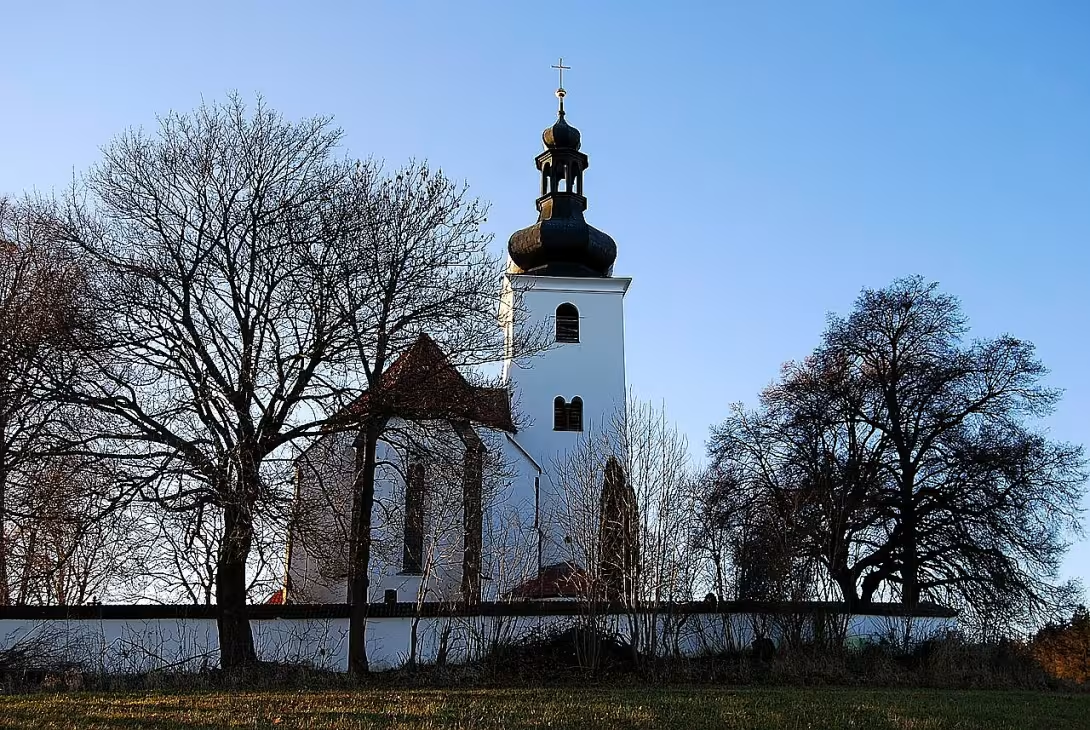
The Church of the Birth of the Virgin Mary at the New Church, the local part of Borotín in the district of Tábor, is among the oldest buildings in Táborsk. It is a single-boat temple combining Romanesque beginnings with Gothic and Baroque elements. It lies southwest of the village and is visible from a considerable distance as a distinctive landmark. The church with the adjacent court was also known in the past under the names Green Kostelec, Podolský Kostelec or Old Kostelec.
The construction dates back to the first half of the 13th century. The first written references appear in the description of the Prague diocese from 1344 to 1350, where the parish at Kostelka is listed as part of the Vltava Dean. The church belonged to the Borotín estate and it had a connected philical church in nearby Borotín, which was promoted to parish and separated in 1386. Catholic priests served here until 1416, then the Church became Hussite. In 1556 the property belonged to Bohuslav Malovka and stopped being part of the Borotín estate. In 1584, the new owner Oldřich Malovec let the bell pass.
After the Battle of the White Mountain, the church parish was abolished and the temple was managed by a Jewish priest. In 1724 the newly established parish in Borotín fell. In 1904 he received a new organ. After the First World War, he urgently needed a repair carried out in 1928 by the Borotín rectory. Between 1943 and 1954, services were banned because of the danger of breaking the ceiling. The extensive recovery took place between 1946 and 1947. In 1958 it was listed as a cultural landmark and two altars were brought here from a sunken church in Upper Vltavik. Another repair took place in the 1980s and its exterior was modified in 2003. After 1989, he suffered multiple robberies.
Architecturally, the church consists of a Romanesque tower with a five-sided presbytery. On the ground floor, the tower is glazed with a cross vault, on the first floor it has rectangular Romanesque windows. On the third floor there were originally three double windows, two of which were walled up. Individual windows have decorated elements - the northern windows are semi-rounded with a column ended with a ring and decorated with a cubic head, the eastern windows cover calichoid heads. The Gothic ship is based on a rectangle and accessible from the south. The masonry is granite and quarry, covered with a thick layer of plaster. The church has simple facades with attached armrest and stone armour. The cemetery surrounding the temple is surrounded by a brick wall.
Today the church is a witness to centuries of Czech history. The combination of Romanesque tower, Gothic ship and baroque elements creates a unique architectural complex that dominates the landscape. A number of local legends and legends relate to the Church. The construction remains a living testament to the medieval and modern history of Táborska.
Then and now
Drag the slider to compare how the landmark may have looked when it was built with the view today.
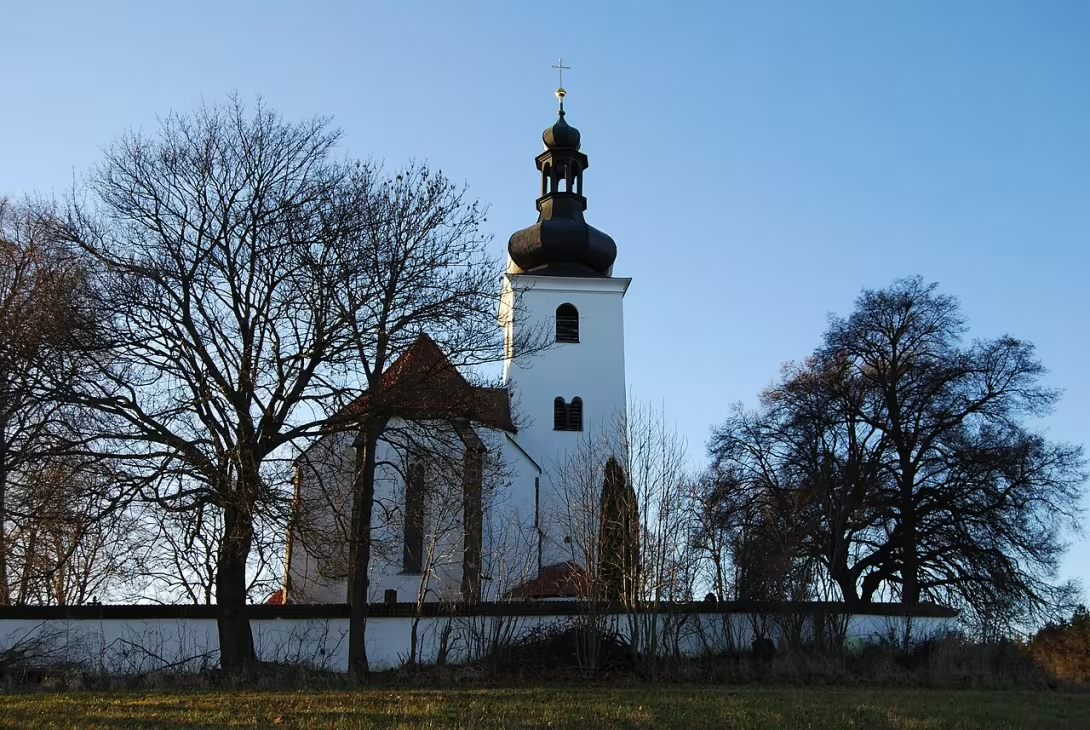

The historical appearance on the left is an AI-generated visualisation and serves as inspiration only.
Historical milestones
- 1344-1350
- First mention of the church in the description of the Prague diocese.
- 1958
- The church was listed among cultural monuments.
Architectural development
Originally a Romanesque church from the 1st half of the 13th century was modified Gothic and partly Baroque. The tower received a baroque helmet, the ship was demolished and accessible from a small foyer at the entrance. The wall of the church is granite and quarry with a layer of plaster.
Historical events
- 1344-1350
- First mention of the Church of the Birth of the Virgin Mary in the description of the Diocese of Prague.
- 1386
- The church lost a filial church in Borotín which was promoted to parish.
- 1556
- The church belonged to Bohuslav Malovka and no longer belonged to the Borotín estate.
Owners
The church belonged to Borotín Manor. After the Battle of the White Mountain, the church parish was abolished and managed by a certain parish. In 1724 Kostelec belonged to a newly established parish in Borotín.
Points of interest
- It is one of the oldest buildings in Tábor and comes from the first half of the 13th century. - In the past he was also known as Green Kostelec, Podolský Kostelec or Old Kostelec. After 1416, the church became Hussite. Between 1943 and 1954, services were banned due to the danger of breaking the ceiling. In 1958, two altars were taken to the temple from a sunken church in Upper Vltavik.
Guide
This guide is narrated by a synthetic voice generated by artificial intelligence.
Show guide text
This text was created by artificial intelligence and has not been editorially reviewed. It may contain inaccuracies.
The Church of the Birth of the Virgin Mary stands not far from the village of Nový Kostelec, a local part of the market town of Borotín in the Tábor region. The church with its adjoining farmyard was formerly also called Zelený, Podolský, or Starý Kostelec. The originally Romanesque building was probably built in the first half of the 13th century and is considered to be the oldest church in the Tábor region. Today it is a single-nave church that is Gothic and partly Baroque in style, and has been a cultural monument since 1958.
The church lies to the southwest of the village and, as a striking landmark, is visible from far away. It is surrounded by a square churchyard enclosed by a stone wall. A five-sided presbytery is adjoined on the north side by an original Romanesque tower. The rectangular nave is accessible from the south, where a small vestibule was added near the entrance. The original nave was demolished and the tower was given a Baroque cupola. Granite rubble masonry is covered by a thick layer of plaster.
The prismatic tower has a ground floor vaulted with a cross vault. To the east it opens into the apse with a pointed arch. On the west side there was a triumphal arch, now bricked up. On each side of the first floor there is a narrow Romanesque opening similar to an arrow loop. On the third floor one double window remains, while two others have been bricked up. Semi-circularly vaulted windows are divided by a column topped with a ring. On the north it bears a cubic capital, on the east a capital decorated with a chalice shape.
The first mentions date from a description of the Prague diocese from 1344 to 1350, where the local parish is listed in the Vltava deanery. The church belonged to the Borotín estate. A subsidiary church in Borotín also fell under it, but that became a parish church in 1386. Catholic priests served there until 1416, after which Kostelec became Hussite. In 1556 it came to Bohuslav Malovec, and his son Oldřich had a bell cast there in 1584.
After the Battle of White Mountain, the parish was abolished and the church was managed by the parish in Jistebnice. In 1724 it became part of the new parish in Borotín. In 1904 it received new organs. After the First World War it fell into disrepair and was not restored until 1928. Between 1943 and 1954 services were prohibited there because the ceiling threatened to collapse. Repairs in 1946 and 1947 significantly changed its appearance. In 1958, two altars from the church in Horní Vltavice, which had been flooded by a reservoir, were moved here. Further repairs took place in the nineteen eighties. After 1989 the church was broken into several times, and in 2003 underwent a major exterior renovation.
Tips for visitors
The best time to visit the Church of the Birth of the Virgin Mary in the New Church is from spring to autumn when the weather is favourable and you can enjoy beautiful outdoor entertainment. This place offers quiet moments in a pleasant environment, which is ideal for relaxing and exploring historical architectural details.
The place can also be visited by public transport; For the current connection it is recommended to use online search engines or contact information of local transport companies.
When visiting, bring protective clothes and shoes suitable for walking, because the terrain around the church can be irregular. Also remember the umbrella, UV filter glasses and plenty of drinking during long walks.
The photography here is great thanks to the rich historical architecture of the church. The best light usually occurs in the early morning or in the evening when shading and colors seem the sweetest. Try shooting from different angles for interesting compositions.
It is possible to visit the historical village Borotín in the vicinity of the church. It is a beautiful place to walk and discover local culture and traditions. For families with children it is advisable to visit surrounding forests or natural areas that offer the possibility of various outdoor activities.
Frequently asked questions
Can the monument be visited?
Religious buildings are usually open mainly during services; at other times a visit is normally arranged with the parish or the operator. We have not verified specific times.
Where is the monument?
Location: Nový Kostelec, Jihočeský kraj. The map on this page shows the exact spot.
Why is the monument protected?
It is listed in the Central List of Cultural Monuments of the Czech Republic as a cultural monument (register no. 14209/3-5009).
For kids
Imagine going back to when this church was still new and full of life. This place wasn't like it was now, but it was like a big village with many houses and people.
It was where people lived, worked and prayed. They had their own priests and priests who helped them fight evil and seek justice. People here were happy and sad at the same time because life was hard and full of danger.
Businesses nearby
Do you run a restaurant, accommodation, shop, museum, rental, wellness or other visitor service near this monument? Show yourself directly to the people heading to it — this is how they will see you in the app and on the web:
Nearby
Ambient landscape, natural elements in the vicinity of New Church
Accommodation nearby
Themed route
Thematic cruise route: Kostel Narození Panny Marie (Nový Kostelec)
1.Kostel Narození Panny Marie (Nový Kostelec) - * Type: * Historical landmark, religious place - * Why is it worth visiting: * This Baroque church is one of the most important sacral buildings in the village Nový Kostelec. Its architecture and history attract many visitors who want to explore rich interiors and learn more about the past area.
2. Saint Anne's Chapel (Nový Kostelec) - * Type: * Chapel - * Why is it worth visiting: * This chapel is part of the local cultural heritage and provides a quiet place to relax. Its space allows you to enjoy the peaceful atmosphere and beauty of the rural surroundings.
3. Church tank - * Type: * Historical area - * Why is it worth a visit: * The church reservoir is an ideal place for relaxing and learning the history of the village from an outdoor perspective. Here you can enjoy a moment of peace while observing the architectural details of the building.
4. Local traditional inn - * Type: * Restaurant - * Why is it worth a visit: * After a tour of the church and surroundings it is advisable to stop at the local inn where you can get to know the traditional Czech cuisine. This stop point allows you to enjoy hospitality and local specialities.
This route offers a combination of religious heritage, cultural attractions and opportunities to relax in a quiet rural atmosphere of the New Church.
Seasonal recommendations
Spring - In March and April, the church is surrounded by flowering trees and shrubs, whose pink and white flowers penetrate through the sunlight, which penetrate through the stained glass and create an inner space full of pastel colours. At this time the traffic is still relatively low, so it is worth arriving after noon when the sun reaches the western facade and lighting the interior is the most pleasant. We recommend comfortable shoes and a light jacket because the wounds can be cold, and don't forget to bring an umbrella or raincoat in case of a shower.
Summer - In the summer months the church emerges between green meadows and trees, which provide a pleasant shade while reflecting light into the windows, highlighting the rich colors of fresco and statues. The main visiting peak is in the afternoon, where tourists and locals are gathering, so it is wise to arrive early in the morning, preferably between six and eight, to avoid crowds and heat.
Autumn - In September and October the surrounding area of the church will be covered in golden and red shades of autumn leaves, which create a romantic atmosphere and contrasts with dark stone walls. The light in the late afternoon penetrates the colour leaves and gives the interior a warm feel. During this period it is advisable to plan a visit for late afternoon, when the sun slowly boils down and lighting is the most pleasant, while avoiding smaller crowds that concentrate more on weekends. Dress in layered clothes - sweater, light jacket and comfortable shoes because temperatures can fluctuate, and have an umbrella ready for occasional autumn showers.
Winter - In December and January the church gains a calm, almost mystical atmosphere when the snow covers the roof and surrounding trees, and the inner candles cast warm light on the stone pillars. We recommend arriving in the morning when there is still plenty of light and the crowds are minimal, and use a calm atmosphere to reflect on historical works of art.
Visualizations and artistic views


The visualisations are generated by artificial intelligence and serve as inspiration.
Photos from the area
Real photos taken near the monument


Zdroj a licence jsou uvedeny u každého snímku.
View from the area
This animation was generated by artificial intelligence from a real photograph of the surroundings. The motion and details are not real footage of the location.
Atmosphere of the place
This atmospheric visualisation of the place and period was generated by artificial intelligence. It is not real footage of the location.
Tips from visitors
No tips yet. Be the first!
Log in and add your tip.
Sources and literature
Photos: Richenza / CC BY-SA 3.0 — Wikimedia Commons. The author and licence also appear when you hover over the image.
Faktickým podkladem tohoto textu byl článek na Wikipedii, jehož autory jsou přispěvatelé Wikipedie. Článek je dostupný pod licencí CC BY-SA 4.0.
Location on the map


Příběhy a pověsti
Legendy, pověsti a příběhy spjaté s touto památkou
Fotografie návštěvníků
Zatím žádné fotografie. Buďte první, kdo přidá fotografii z návštěvy!
Log in a přidejte svou fotografii nebo hodnoťte.
Za ověřenou návštěvu v aplikaci získáte víc bodů — poznáme podle GPS, že jste na místě.
Reviews and comments