



Masné krámy (České Budějovice) Restaurant
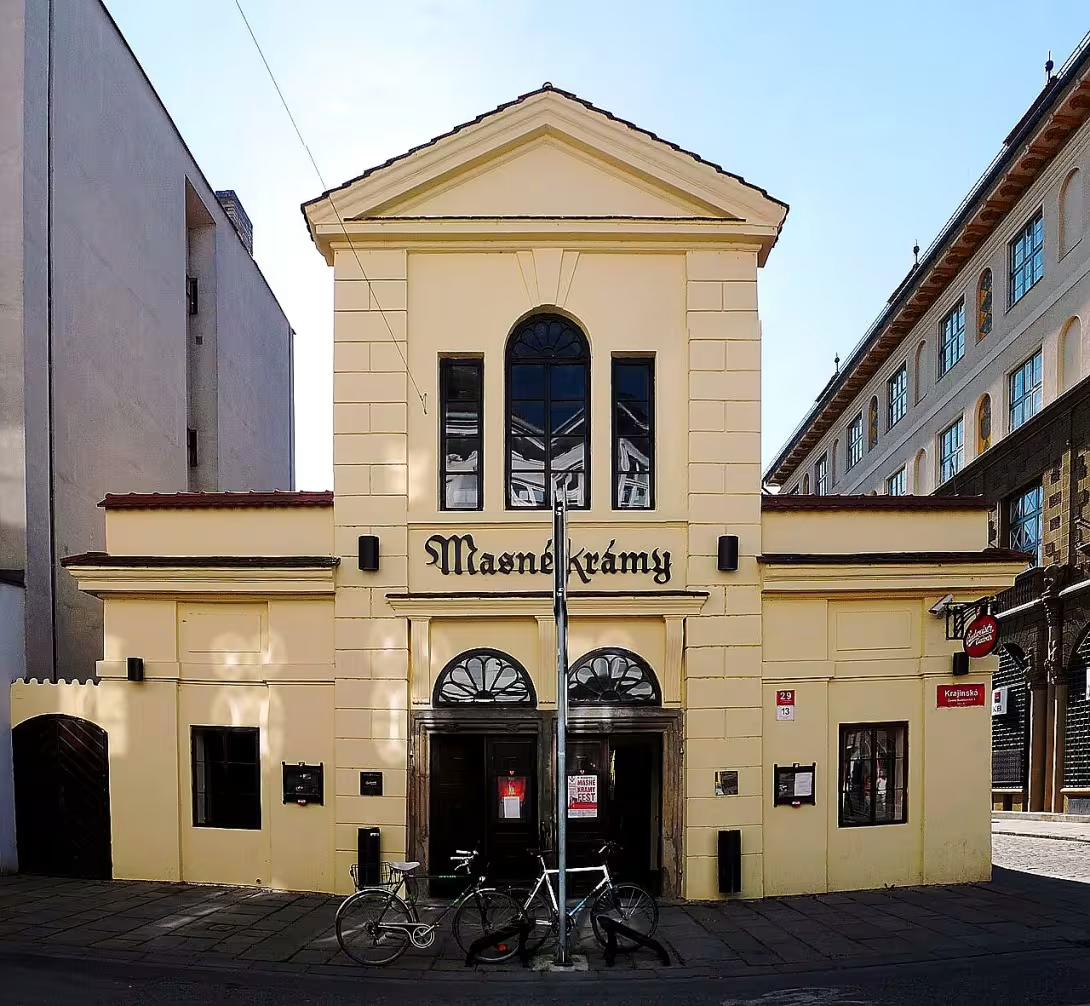
Meat shops in České Budějovice are a historical building in Krajinská street no. 13. Originally, they served as a butcher's market, now they operate as a renowned restaurant. This cultural monument of the Czech Republic excels with Renaissance architecture and internal breakdown into former butcher boxes. It represents one of the modern symbols of the city.
The beginning of meat sales in České Budějovice dates back to the 14th century. The first meat stuff was on Rynka, today's Přemysl Otakar II. The first written mention of them dates back to June 24, 1336. Later, the market moved to Krajin Street. In 1554, a stone corner building of the basilical type was built with a Renaissance western front and a concessions shield. It served its original purposes until 1899.
This architecturally important building underwent a fundamental transformation in the mid-20th century. The reconstruction was carried out from 1953 to 1954 according to the design of architect Jaroslav Fidry, which adapted the building to restaurant operation. Even after the modifications, the interior has retained a clear breakdown into the former butchers' shops. After the floods in 2002, which really hit the building, reconstruction followed. The kitchen was set up in the hall, which shortened the inner space. Further construction work took place at the beginning of 2026.
During the 20th century, the object faced repeated demolition efforts. The city planned to build a market on site both in the first half of the century and after 1945. However, these intentions did not occur. The restaurant was ceremoniously opened on 1 October 1954. Following forced closure due to floods and subsequent property negotiations, it was restarted on 5 December 2007. Today, the building is owned by fifteen co-shareholders, including the city of České Budějovice and the brewery Budvar, which runs the beer house.
The most famous persons associated with this place include Václav Havel. He visited the restaurant during his basic military service between 1957 and 1959 and later returned to it in 2008. Currently, the company offers a main hall with 170 seats in air-conditioned and sound boxes. The visitors are served with circled lager, dark lager and ten.
Meat shops represent a unique example of the adaptation of the historic butcher's market to modern gastronomic operations, which preserved its historical value. Visiting this place offers an opportunity to explore the history of the city in an authentic environment that is closely linked to the Budějovice brewery tradition.
Historical milestones
- 1336
- The first written mention of meat products in České Budějovice.
- 1554
- Construction of stone corner building in Krajinská street.
- 1954
- The opening ceremony of the Meat Stories Restaurant.
- 2007
- Restoration of the restaurant after extensive reconstruction.
Architectural development
The original stone corner building from 1554 has a Renaissance western front with a concession shield. In 1954 there was a major reconstruction according to architect Jaroslav Fidry. Other interior modifications followed 2002, when the kitchen was moved directly to the hall of the building.
Historical events
First written mention of meat products in 1336. Rebuilding to a restaurant between 1953 and 1954. Intervention of floods in 2002 and subsequent reconstruction.
Owners
The city of České Budějovice and Budějovický Budvar (co-shareholders).
Points of interest
- The building in Krajinska Street originally served as a butcher's market, today it works as a famous restaurant. - The first written mention of the sale of meat in České Budějovice dates back to the 24th June of the year a thousand three hundred thirty-six. - A stone building of the basilical type with a Renaissance front was built in the year 15-54-4. - During the twentieth century, the object faced repeated demolition efforts, which did not occur. - The restaurant was visited by Václav Havel during his basic military service between nineteen hundred fifty-seven and nineteen hundred fifty-nine and later in two thousand eight.
Guide
Show guide text
This text was created by artificial intelligence and has not been editorially reviewed. It may contain inaccuracies.
Welcome to the heart of Czech Budejovice. Right now, you're standing in front of one of the most important and oldest building units in this city, which will immediately transfer you to other times with its presence. In front of your eyes, there is a meat shop, a historic building that is much more than a wall and a stone. He's a living witness to centuries telling the story of trade, urban life and the constant transformation of the space we live in. Look at that building on Krajin Street. Feel the atmosphere of a place where the smell of fresh goods with the bustle of the city market has been mixed in the past. This building is not just an ordinary house, it is a symbol of stability and tradition that has resisted many storms of history.
Let's go deeper into the past together to understand why this place is so special. Although the building you see now has its clearly defined shape from later years, the roots of this place go incredibly deep. The first clues that tell us that meat has been traded here a long time ago can be found in historical records. The first written mention of this place dates back to a thousand three hundred thirty-six. More specifically, we know that meat sales in our city were documented already on the 24th of June in the year a thousand three hundred thirty-six. Imagine the time atmosphere, the noise and the movement of the people who were gathering here. This tradition has been going on for centuries, and it is this place that has become a central point for all butchers and traders.
Now pay attention to the construction itself, which is right in front of you. What you see is a stone corner building whose base face was defined in a thousand five hundred fifty-four. During this period this important building was built in Krajinská Street, which gave this place its unmistakable character. If you look up at the front of the building now, notice her Renaissance face. The Renaissance shield that adorns the facade is one of the most important architectural elements you can see here. It is this style that gives the building its nobility and elegance. Notice how the stone structure floats over the street and how it defines the space of the entire square. The whole building has a specific basilica available, which means that its internal breakdown corresponds to a certain formula that is no longer present in ordinary architecture. Although the building has undergone many changes, its internal structure has maintained its original logic and layout, which is very rare these days.
This object is not only the result of random construction work, but it is a work that has been shaped by many experts. The name of architect Jaroslav Fidry plays an important role in the history of this place, whose influence and work are visible within this architecture. This building is also linked to the great history and personalities that shaped our modern world. Although it may seem that the butcher market and the great statesmen belong to different worlds, history teaches us that everything is connected. Within the history of this city and its meaning, names like Václav Havel are also played in our memories, which reminds us of how deep traces people leave in the space they inhabit.
Now let's look at how this space turned into time. Meat stuff couldn't be forever just a place to sell meat. With centuries, life in the city and the needs of its inhabitants changed. After long years of food trade, there was a big change in the mid-twentieth century. In a thousand and nine hundred and fifty-four the restaurant was opened in these premises. The place where the butchers once stood became a place where people gather to enjoy food and company. This transformation was the next step in the life of a building that became a cultural monument. In order for the building to serve future generations, it had to go another difficult way. In the year two thousand and seven, the restaurant was reopened after a very extensive and thorough reconstruction, which was intended to preserve the historic soul that you feel in it right now.
You're wondering maybe what happened in these walls. Imagine the constant transformation. From the medieval market, where everything revolved around the basic needs of the people, to the Renaissance blossom, to today's role as an important symbol of the city and a declared place for lovers of good food. There's something mysterious about how a building can adapt to every time without losing its own identity. It's like the building's breathing with the city.
Now that you've gone through his history and looked at his face, I suggest you continue your walk around this historic core. Meat products serve as a great starting point for further discovering the beauty of České Budějovice. Don't forget to stop and look at the Renaissance shield again and the stone walls that have been standing here for so long. I wish your next steps in this city were as interesting as the history you've just experienced. Thank you for your attention and have a wonderful day.
Tips for visitors
A tour of the Exterior of Meat Stories in Krajinska Street is best enjoyed in the morning when the sun lights up the Renaissance shield and emphasizes historical architectural details of the building. Since it is an object in normal operation, we recommend choosing calmer days when the street movement is smaller and you can undisturbed the construction from the outside. It is ideal for photographers to use a wide-angle lens that captures the entire basilica available, while the best light for facade images is in bright sky. Take with you comfortable shoes to walk through the historical centre and the camera, because detailed elements of Renaissance architecture are very photogenic. In the immediate vicinity within 30 minutes walk you can visit the Square of Přemysl Otakar II, climb the Black Tower for city views or see the Cathedral of St. Nicholas. For families with children, the location is suitable thanks to a pedestrian zone in the centre where children can safely observe historical houses and soak up the atmosphere of the old town without the need for complex route planning.
Frequently asked questions
Can the monument be visited?
The building is in use (offices, a school, shops and the like). The interior is generally accessible only during operating hours and tours are not usually offered; we have not verified the details. You can see the exterior from the street.
Where is the monument?
Location: České Budějovice 1. The map on this page shows the exact spot.
Why is the monument protected?
It is listed in the Central List of Cultural Monuments of the Czech Republic as a cultural monument (register no. 1000133688).
Businesses nearby
Do you run a restaurant, accommodation, shop, museum, rental, wellness or other visitor service near this monument? Show yourself directly to the people heading to it — this is how they will see you in the app and on the web:
Events nearby
Zdroj akcí: otevřená data měst a obcí ČR (Národní katalog otevřených dat) a kalendář akcí Národního památkového ústavu.
Nearby
Náměstí Přemysla Otakara II., Černá věž, katedrála svatého Mikuláše.
Accommodation nearby
Trips and activities nearby
Guided tours, tickets and activities nearby from GetYourGuide
Affiliate link: if you buy from the partner, we may receive a commission. The price for you does not change.
Search tours and activities →Themed route
1. The square of Mohysl Otakar II., square. It is the main urban area, which is the ideal place to start the tour. The second cathedral of St. Nicholas, the temple. This magnificent object will immediately impress its architecture and size. 3. Black tower, lookout tower. It is a historic tower from which you can watch beautiful views of the city. 4. Meat shop, historical building. This ancient object shows the history of local trade and craft.
Seasonal recommendations
In spring, the surrounding area of the building awakens to life and the fine light highlights the facade details. The atmosphere is fresh and hopeful. I recommend wearing a lighter jacket and visiting the place in the morning when the air is the cleanest.
The summer season brings intense sun and bright colors of urban space. The air is usually hot and the surroundings are very lively. It is advisable to choose a light summer outfit and hat, with the best time to observe architecture being a late afternoon when the sun no longer burns.
Autumn in Budejovice smells of moisture and leaves around the monument change colors to gold. The light is softer and creates a melancholy mood. The practical thing is to carry a waterproof cloak and a warm shawl, ideally set out at a time when the sun falls to the horizon.
In winter, the atmosphere is severe, freezing and sometimes accompanied by white snow, which contrasts beautifully with the color of the walls. The evenings are short and the lighting in the area works comfortably. Don't forget the warm coat and gloves, so the frost doesn't interfere with the outside search.
Visualizations and artistic views

The visualisations are generated by artificial intelligence and serve as inspiration.
Photos from the area
Real photos taken near the monument


Zdroj a licence jsou uvedeny u každého snímku.
Tips from visitors
No tips yet. Be the first!
Log in and add your tip.
Sources and literature
Photos: Czeva / CC BY-SA 3.0 — Wikimedia Commons. The author and licence also appear when you hover over the image.
Faktickým podkladem tohoto textu byl článek na Wikipedii, jehož autory jsou přispěvatelé Wikipedie. Článek je dostupný pod licencí CC BY-SA 4.0.
Location on the map
More monuments – České Budějovice 1
Show all in the municipality
Příběhy a pověsti
Legendy, pověsti a příběhy spjaté s touto památkou
Fotografie návštěvníků
Zatím žádné fotografie. Buďte první, kdo přidá fotografii z návštěvy!
Log in a přidejte svou fotografii nebo hodnoťte.
Za ověřenou návštěvu v aplikaci získáte víc bodů — poznáme podle GPS, že jste na místě.
Reviews and comments