



Vodní elektrárna (Bavorov) Power plant
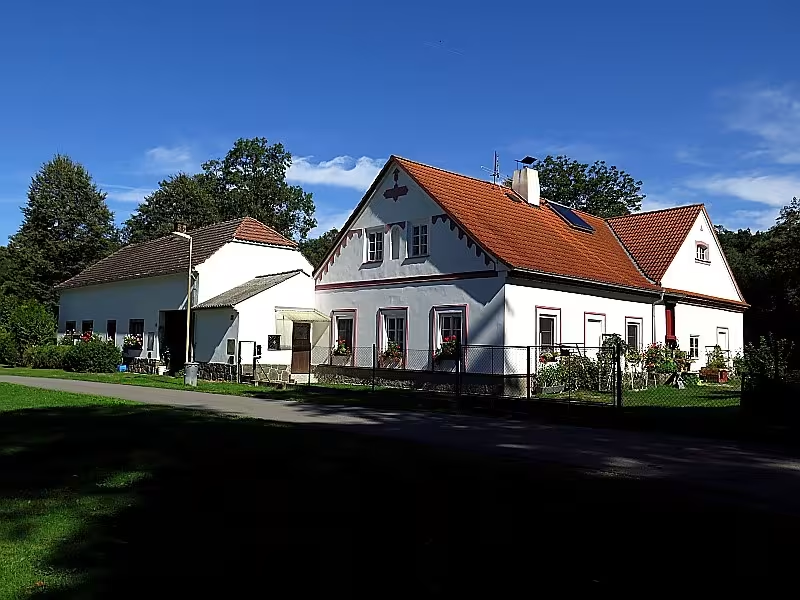
The ducháč mill, also known as Bavorov City Power Plant, is a water mill with a power plant situated on the Blanici River near the lake in Bavorov in Strakonica. The building is protected as a real-estate cultural monument of the Czech Republic and represents an important evidence of development of water mill and early electrification in the region.
There are conflicting reports of the oldest history of the place. Chronicler Březan attributed the foundation of the mill to Jakub Krčín already in 1570, but the map materials from the 3rd Military Survey confirm the establishment of the complex only in the mid-19th century. In this period, when the Czech countries underwent an industrial revolution, technical constructions developed and modernized traditional crafts. This created the basis for later use of the water works to produce energy.
The area consists of residential building no. 294, which is connected to the mill with power plant. Part of the complex is also the northwest located economic site No. 224, which has been rebuilt for housing in the past. The technical background uses the drive leading from the lake to the turbine porridge, from where the water flows back to Blanice through the drain channel.
The building was significantly transformed in the 1930s when the original mill was extended to a turbine power plant. As of 1930, the technical parameters of the operation are documented: gavage 1.66 m ³ / s, gradient 1.67 m and power 27,7 HP. A unique collection of historical machines was preserved in the area. These include a 1912 Francis turbine from Prague's electrical plants, a steam locomobile from J. Short from Přerov or Dynamo from František Křižík. There is also an asynchronous alternator from the Brno factory Janík a spole., dynamo from the Vienna company F. Machek and CES and gas engine.
In modern history, the site was hit by a devastating flood in 2002, which caused heavy damage to the building.
The Ducháč mill remains a valuable technical testimony about energy and miller craft changes in the Czech environment. Visiting this place offers an opportunity to look into the history of early electrification and to see preserved technology units that document the technical maturity of their time.
Historical milestones
- 1850
- The expected formation of the mill based on mapping.
- 1912
- Installation of Francis' turbine.
- 1930
- Supported plant operation with 27,7 HP output.
- 2002
- The object was hit and damaged by the flood.
Architectural development
The original mill building was supplemented with a turbine fountain and technological background of the power plant during the 1930s. The area uses the drive leading from the lake, the water being returned through the turbine through the drain channel back to the river Blanice.
Historical events
In 2002, the site was badly damaged during the flood.
Points of interest
- The ducháčova mill, known as Bavorov City Power Plant, is protected as a real cultural monument of the Czech Republic. - The area consists of a residential building, a mill with a power plant and an economic building, which has been rebuilt for housing in the past. - A unique collection of historical machines, such as the Francis turbine from 1912, steam locomobile or dynamo by František Křižík, was preserved in the area. - As of 1930, the technical parameters of the operation are documented, namely feed capacity 1,66 m ³ / s, gradient 1,67 m and output 27,7 HP. - The building hit a devastating flood in 2002 that caused him severe damage.
Guide
Show guide text
This text was created by artificial intelligence and has not been editorially reviewed. It may contain inaccuracies.
Welcome to the banks of the Blanice River. You're standing right where the constant movement of flowing water is connected to the silent force of history. In front of your eyes is the area of the Duchac Mill, which is now known primarily as the Bavorov City Power Plant. Feel the calm but constant sound of water flowing at the lake and imagine how this sound has been with this place for centuries. It was here, in this narrow belt between water and solid shore, that a constant story of human efforts to control the power of nature took place and used it for its progress.
Let's go back deep into the past together to understand how this place came to be. If we could go back to the middle of the nineteenth century, we'd probably just see a simple, functional mill here. According to the historical maps of the year one thousand eight hundred fifty, we can assume that at this very time the roots here began to be firmly rooted in the local landscape. At that time it was mainly the processing of crops, the basic needs of each village at the time. But time was not calm, and people's needs did not stop.
Now pay close attention to how this space gradually changed. The milestone that completely changed the face of this place was the year one thousand nine hundred and twelve. The Francis turbine was put into operation this year. This technological step was a huge leap forward. The mill was no longer just a place for grinding grain, but it began to turn into a modern energy machine. This process developed until the 1930s, when the power plant was already fully operational. At that time it was able to produce electricity with a power output of approximately 27 horsepower, which was a considerable force for the then needs, which probably significantly affected the lives of people around Bavorova.
Now look around you and perceive the architecture of this entire complex. It is not just one building, but a harmonically connected whole of three different objects that form one functional unit together. The first thing you probably perceive is a residential building. It served as a home for people who were part of this operation and gives the whole place a sense of human being and home. Then your view can move to the mill itself, which is the heart of the whole complex. It is in this building that the power plant is located and here is the most important work - the transformation of water movement into electricity. And finally, you'll see a rebuilt economic building here. It has its own history, because it has served for completely different purposes in the past, but it has been rebuilt over time for housing, making it part of the living environment again. Notice how these three parts interact with each other and how closely connected to the flow of the river and the local course.
When we look at this area, we cannot ignore the wider historical context surrounding this place. Although it did not work directly on the construction of each stone, the name of Jakub Krčín, an important person associated with the development of water management and landscape, is in connection with the overall development of the use of water flows in the region. This whole area is part of a wider story about how people in Czech countries learned to work with water, build dams and create systems that benefit entire communities.
Now, I want to invite you to think about what is really special about this place. The spirit mill is not just an ordinary historical object. It is a real cultural monument of the Czech Republic, which means that its value is recognised by the whole state. But what's so special about it? It's mostly what's inside. There was something very rare preserved in the complex - a unique collection of historical machines. Imagine the metal mechanisms, gears, and technology that used to be in constant motion here. It's living proof of the technical progress of our ancestors.
However, this area had to face great trials. History is not only about progress, but also about fighting unexpected events. In the year two thousand and two, this object was hit by a devastating flood. The water that was the original engine of this place became his enemy at the time and caused considerable damage to the building. Despite having to deal with the consequences of this natural disaster, this historic space has been preserved and it still stands here to tell us its story. This resistance of space is perhaps one of the most important things you can perceive here.
In your next look at buildings, try to think about how many generations of people have passed here, how many times the technology has changed and how many times the forces of nature have had to fight here. Every detail, from the residential walls to the mill itself, carries traces of these events.
Don't just stay by the road. I suggest you continue your search and try to perceive the atmosphere of this place in every corner of it. Every part of this compound has its own weight and its own story, waiting to be discovered. I hope that this brief introduction prepared you for a deeper understanding and that the combination of history, technology and elements in Bavorov will continue to fascinate you. I wish you a pleasant continuation in exploring this special place.
Tips for visitors
The best time to visit is during the sunny morning, when the light beautifully paints the technical details of the mill and reflections on the surface of the river Blanice. The place is ideal for a peaceful walk without crowds of tourists. We recommend that you take fixed shoes to move around the theme and a polarization filter camera to help you eliminate water level reflections while taking pictures of historical mill architecture. In the surrounding area you can explore the picturesque historical centre Bavorova, which offers an authentic atmosphere of South Bohemian town. For families with children, the location is suitable as a stop on a trip along the Blanice River, where children can observe the water flow and technical elements of the historical lake.
Frequently asked questions
Can the monument be visited?
The building is in use (offices, a school, shops and the like). The interior is generally accessible only during operating hours and tours are not usually offered; we have not verified the details. You can see the exterior from the street.
Where is the monument?
Location: Bavorov, Jihočeský kraj. The map on this page shows the exact spot.
Why is the monument protected?
It is listed in the Central List of Cultural Monuments of the Czech Republic as a cultural monument (register no. 1000134872).
Businesses nearby
Do you run a restaurant, accommodation, shop, museum, rental, wellness or other visitor service near this monument? Show yourself directly to the people heading to it — this is how they will see you in the app and on the web:
Events nearby

Zdroj akcí: otevřená data měst a obcí ČR (Národní katalog otevřených dat) a kalendář akcí Národního památkového ústavu.
Nearby
Město Bavorov, řeka Blanice, historické centrum Bavorova.
Accommodation nearby
Themed route
1. Historical Center Bavorova (urban zone) - The starting point of the journey where you can admire the architecture of the old village core. 2. City Bavorov (urban space) - A walk through the streets that connects the centre with the surrounding monuments. 3. Blanice River (Water Flow) - A relaxing road along the shore that leads you straight to the power plant. 4. Vodní elektrárna (Bavorov) (mill) (technical monument) - The main destination of the trip, where you will see the historical use of water for grinding and energy production.
Seasonal recommendations
Spring brings awakening nature and fresh greenery around the water stream, which complements the technical beauty of the power plant. The atmosphere is full of optimism and brightness. We recommend moisture resistant shoes for wet journeys and a visit in the morning when the air is the cleanest.
In the summer months the memory is dominated by a rich green landscape and bright sunlight, which highlights the details of the buildings. Expect more visitors in the season, so it is best to come first thing in the morning to avoid crowds. Choose light, breathable clothes and don't forget the sun protection.
Autumn wraps the mill with golden colours of leaves and morning fog over the water creates a mysterious, calm mood. It's the perfect time to photograph in a soft afternoon light. The practical recommendation is layered clothing to protect you from changing weather and colder wind.
Winter brings silence and strong contrast of white snow to the surroundings with dark walls of the power plant. The atmosphere is withdrawn and calm, which is suitable for walking itself. Remember the very warm shoes and gloves and we recommend that you check the opening times in advance, which are usually shorter in this period.
Visualizations and artistic views


The visualisations are generated by artificial intelligence and serve as inspiration.
Photos from the area
Real photos taken near the monument


Zdroj a licence jsou uvedeny u každého snímku.
Tips from visitors
No tips yet. Be the first!
Log in and add your tip.
Sources and literature
Photos: Sovicka169 / CC BY-SA 4.0 — Wikimedia Commons. The author and licence also appear when you hover over the image.
Faktickým podkladem tohoto textu byl článek na Wikipedii, jehož autory jsou přispěvatelé Wikipedie. Článek je dostupný pod licencí CC BY-SA 4.0.
Location on the map



Příběhy a pověsti
Legendy, pověsti a příběhy spjaté s touto památkou
Fotografie návštěvníků
Zatím žádné fotografie. Buďte první, kdo přidá fotografii z návštěvy!
Log in a přidejte svou fotografii nebo hodnoťte.
Za ověřenou návštěvu v aplikaci získáte víc bodů — poznáme podle GPS, že jste na místě.
Reviews and comments