



železniční most Děčín - Horní Žleb Railway bridge
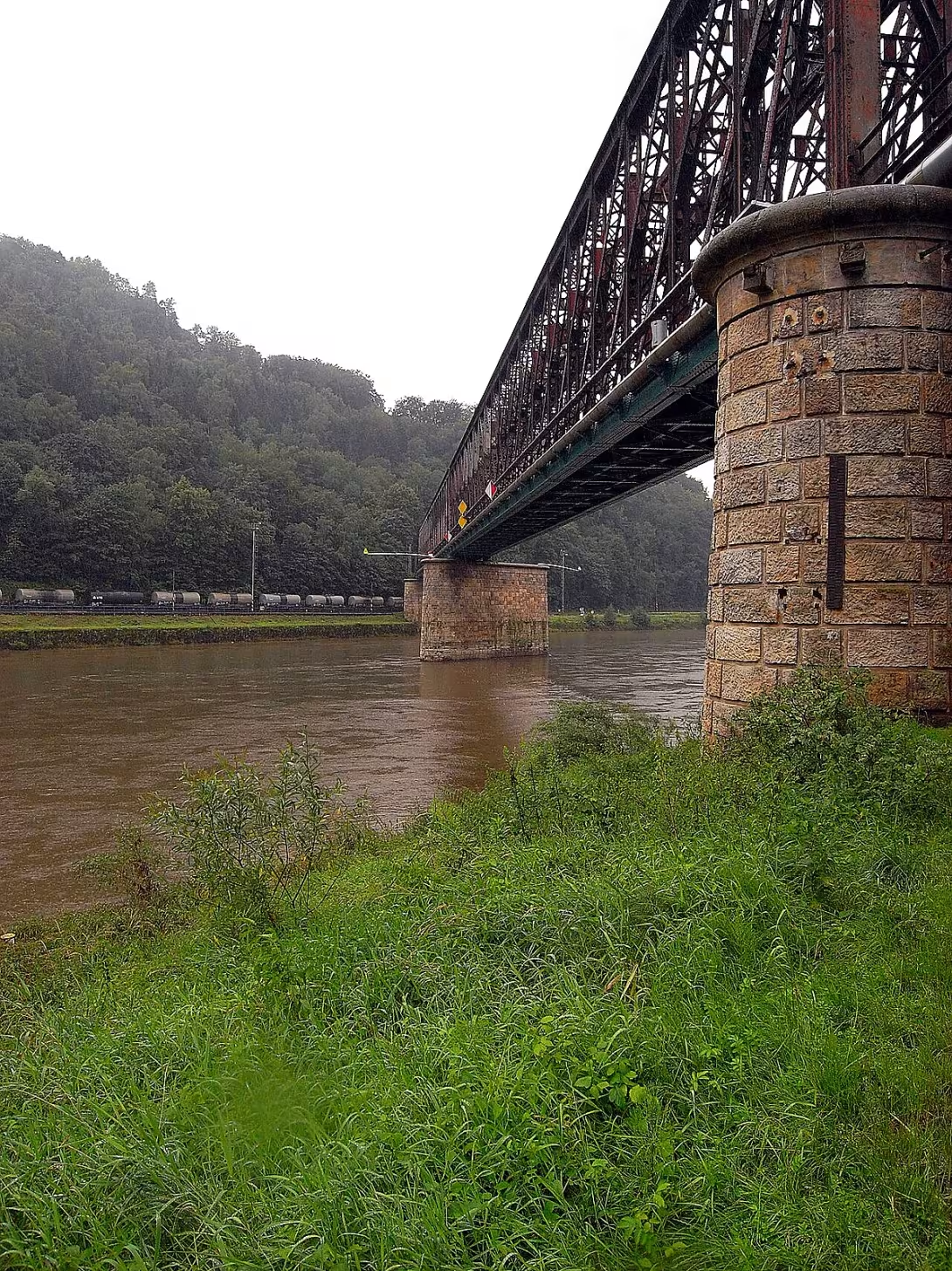
The railway bridge Děčín - Upper Žleb, officially known as the railway bridge in km 458,755 of the line (Vienna NWB) - Cologne - Děčín East, is a steel lattice structure over the Elbe on track 073 between the stations Děčín East and Děčiná-Prostřež. This bridge is the lowest placed crossing the Elbe on the territory of the Czech Republic, which crosses the river at an angle of 45 °. During construction in 1873- 1874 he was the longest railway steel bridge on Czech territory and is still considered an important technical monument with a rich history associated with the water infrastructure of the town of Děčín.
The bridge was built by the Austrian Northwest Railway Company, the implementation of the Vienna company Gebrüder Klein a Schmoll & Gaetner. The concept of railway in the Lake Valley was designed by Konrad Wilhelm Hellwag, the construction director of the Austrian Northwest Railway. The original one-track construction from 1874 was placed on the lower part of the two-track construction on the left. The bridge also contained a water pipeline with drinking water from the sources in Horní Žleb and Čertov's water to Decin, which shows its multipurpose use.
The total length of the bridge is approximately 252 meters, divided into fields 25- 101- 101- 25 meters. The bridge has a pillar in the middle of the river and two pillars on the shore with the bridgeheads. Braces and pillars consist of carved blocks of fine grain sandstone from several quarry in the Elbe sandstone area, combined with hydraulic lime mortar from Austrian Kufstein. During the construction of the pillars, the deposits of 7-10 meters were overcome to stand on rocky ground.
In 1916 a new bridge structure was built on the right side, which copied the original design with higher load capacity. The original left structure was excluded from operation and after the water supply line of the town of Děčín in 1927 was subsequently demolished in 1927 and 1928. The bridge was never double-lined, so it remained single-track even after the construction of the second part. In the 1960s the line was electrified and the bridge was painted.
By 2022, the bridge was one of the last lattice bridges with preserved original structures on the main Czech railway lines. The current bridge was in a technically unsatisfactory state: many elements were damaged by corrosion, steel did not have sufficient resistance to the fragile refraction and contained CO bubbles. The life of the elements of the bridge has been exhausted by cyclical load. On structures 2 and 3 there was a minimum distance of 1789 mm which did not correspond to the required free width of at least 3000 mm in the station circuit. The speed was limited to 30 km / h and the reduction was considered to be 10 km / h.
Therefore, in the years 2022-2023 (the start of the lockout on 1 March 2022), its complete reconstruction was carried out, which included replacement of supporting structure and remediation of the lower structure. The total weight of more than 200 m long steel construction is approximately 1741 tonnes. The new construction is based in shape and size on the original steel structure. In the main openings there is a steel lattice with lower orthotropic bridge with continuous rail bed, in the outer fields coupled with ocelconcrete with upper reinforced concrete bridge. After repair, the speed increased to 50 km / h.
On 26 October 2016, the National Monument Institute proposed a declaration of the bridge as a cultural monument. Both the Magistrate and the Regional Authority agreed to the proposal, but the owner did not comment. The Ministry of Culture declared the bridge a cultural monument on 29 March 2018. The Railway Infrastructure Administration opposed the decision to decompose on 18 April 2018. The Minister of Culture returned the matter to the Ministry for a renegotiation. On 22 March 2019, the Ministry of Culture decided not to declare a bridge as a cultural monument, which gained legal power on 9 April 2019. This process shows a complicated relationship between the protection and operational needs of the railway infrastructure.
The bridge continues to serve as part of the main railway line connecting Vienna to Cologne and Decin, transporting both passenger and freight trains. Its location in Decin I-Decin ensures accessibility from both sides of the Elbe. Due to the reconstruction from 2022-2023, the bridge represents an up-to-date example of preserving the historical structure with a modern technical solution, where the new structure respects the original shape and dimensions.
Děčín - Horní Žleb bridge combines the historical railway technology of the 19th century with the current transport needs and represents evidence of development of construction in the valley. Its existence resembles the importance of the railway network for connecting Czech countries with Austria and the whole of Central Europe. Worth a visit to all who are interested in railway structures, technical history or want to observe a functional transport structure with a rich destiny.
Historical milestones
- 1874
- Completion of original monorail bridge
- 1916
- Position of newer bridge construction on the right side
- 2013
- Damage to bridge pillars
- 2022
- Start of complete bridge reconstruction
Architectural development
The first one-track construction from 1874 was built on the lower structure. In 1916 a copy with a higher load capacity was built on the right, the original left bridge was later removed. During the reconstruction in the years 2022-2023 the supporting structure was replaced and the lower structure was saved, the bridge construction is now based on the original steel lattice type.
Historical events
1874 - completion of original monorail bridge; 1916 - position of newer bridge structure on the right side; 2013 - damage to the pillars of the flood bridge; 2022-2023 - complete bridge reconstruction
Points of interest
- Děčín railway bridge - Upper Žleb is a steel lattice structure over the Elbe. - During construction in 1873- 1874 he was the longest railway steel bridge on Czech territory. - The bridge also contained a water pipeline with drinking water from the sources in Horní Žleb and Čertov's water to Děčín, which shows its multipurpose use. - The bridge was never double-lined, so it remained single-track even after the second part was built. - Until 2022, the bridge was one of the last lattice bridges with preserved original constructions on the main Czech railway lines.
Guide
Show guide text
This text was created by artificial intelligence and has not been editorially reviewed. It may contain inaccuracies.
Welcome to a place where the untamed force of nature meets with incredible human ingenuity. You're standing in front of one of the most important technical machines in the whole country. Before your eyes, there is a massive steel construction of the railway bridge, which connects Decin with the Upper Žleb. Look at that massive network of steel beams reaching over the Elbe River. Feel the weight, the stability, and the rigor that this machine radiates from metal. It is a view that immediately brings you to a time when humanity was trying to conquer space with new materials and modern technologies that were just beginning to change the world.
Take a look at this steel colossus and try to imagine when it was formed. This bridge is not just a simple link between two shores. His story began in the 1870s. Between 1873 and 1874, a building took place here, which was at that time a unique one. When the bridge was completed, it became the longest railway steel bridge in our entire territory. It was a symbol of progress, proof of how far a human idea can go when it combines science and courage. It was the creation of important people and experts of their time. Names like Konrad Wilhelm Hellwag or the Klein brothers who have put their knowledge and effort into this building. Schmoll and Gaetner also helped them. All this had one common goal - to create a solid artery for transport that would bring the region together and allow goods and people to move.
Now pay attention to how this bridge is really built. If you look closely at it, you'll see the complex geometry of the steel elements. It's a so-called lattice structure. Notice how individual steel rods and beams intertwine and connect to a solid frame. It is this formula, these angles and interconnections, that creates a force that allows a bridge to carry the huge weight of trains. It's a fascinating dance of geometry and material. Notice also how the bridge flows across the river. It doesn't overpower it directly, but at a very specific angle of forty-five degrees. This slope is the technical detail that gives the whole part its unique character. And if you look down to the water level, you realize one more thing. This bridge is the lowest placed bridge across the Elbe in the Czech Republic. It is almost at the level of the river, which makes it feel that it is in constant, close contact with the water. In 1916 his appearance changed slightly when a newer part of the construction was built on the right side, which joined the original part and extended his ability.
You may not see it at first sight, but this bridge contains a secret that goes beyond the transport of trains. Imagine that something more fragile and important than iron was flowing inside of him, hidden in a steel body. Yes, that's right. This bridge served as a water pipeline carrier. Its construction included a lead with drinking water which was necessary for life in Decin. This water came from nothing but clean springs in the Upper Rye and from a place called the Devil's Water. It is a fascinating idea that this railway colossus was not just a route for machines, but it also served as a life-giving artery that brought water directly to the city houses. The bridge thus fulfilled two fundamental roles at once - it was the road for transport and the carrier of life.
Every great thing that tries to control nature must face its trials. Even this steel giant had to fight the danger of the Elbe River. In 2013, there was a devastating flood that tried to damage the bridge's pillars. It was a test of its resistance, the moment when the power of the water collided with the strength of the steel. Although the flood left a trail, the bridge remained standing, but his condition required intervention. That is why a complete and in-depth reconstruction began in 2022, so that this historical piece could be fully redeveloped and served by other generations without fear of its fragility.
Now that you know the secret of this steel giant, when you know the role he played in people's lives and the price he paid for his existence, I suggest you continue your walk. Feel the atmosphere of this place where history clashes with modern times and where the sound of the river mingles with the echo of the past. Thank you for spending this moment with this monument and for trying to understand her story. We wish you a beautiful and inspiring journey further.
Tips for visitors
This time of the season offers peaceful moments for understanding the historical architecture of the bridge without overloading tourists.
We recommend checking current connections with an online search engine or mobile applications for transport.
When visiting, wear a suitable suit because conditions can be variable. It is also important to have with you glasses or camera to capture the beauty of the bridge and surrounding region. Don't forget to drink, especially on warmer days.
For photography is the ideal place the west side of the bridge, where the sun illuminates the structure and the Elbe behind it. The best light appears usually in early morning or late afternoon, allowing you to capture dramatic shadows and colors.
In the vicinity of the bridge you can visit the historical part of the town of Děčín with its attractive buildings and park. For families with children there is also an opportunity to explore the natural environment, such as nearby forests or water routes to the Elbe.
Frequently asked questions
Can the monument be visited?
This is a structure in a public space that can usually be seen from outside free of charge. We have not verified that this particular one is freely accessible.
Where is the monument?
Location: Děčín I-Děčín, Ústecký kraj. The map on this page shows the exact spot.
Why is the monument protected?
It is listed in the Central List of Cultural Monuments of the Czech Republic as a cultural monument (register no. 1999990072).
Businesses nearby
Do you run a restaurant, accommodation, shop, museum, rental, wellness or other visitor service near this monument? Show yourself directly to the people heading to it — this is how they will see you in the app and on the web:
Events nearby

Zdroj akcí: otevřená data měst a obcí ČR (Národní katalog otevřených dat) a kalendář akcí Národního památkového ústavu.
Nearby
🏰 Historic sites (121)
- obelisk 0.4 km
- Starokatolický kostel 0.4 km
- Jan Amos Komenský 1.2 km
- Hladový kámen 1.5 km
- Friedrich Tirsch (Miroslav Tyrš) 1.5 km
- Kříž / lavice - pomník děčínských měšťanů z města na Mariánské louce 1.6 km
- Miroslav Tyrš 1.6 km
- Děčínský zámek 1.6 km Zámek 1253 web
- lachtan Gaston 1.7 km
- Padlým 1.7 km
- Hans Kudlich – der Bauernbefreier - 1848 1.9 km
- sousoší sv. Jana Nepomuckého, sv. Václava a Víta 1.9 km
- Muzejní expozice sdělovací a zabezpečovací techniky Děčín 2.2 km
- Oblastní muzeum Děčín 2.4 km
- Ukradená galerie 2.4 km
- Exposice Rajské Ostrovy (Aquarium) 2.5 km
- Vilhelmina Pächter 2.5 km
- pomník padlým v 1. světové válce 4.1 km
- milník 4.1 km
- Zachův palouček 4.9 km
🍽️ Restaurants and dining (221)
- ARRIGŌ 1.2 km Duchcovská 827 web
- Havana Club 1.2 km Duchcovská 129
- Pizzeria Casa Mia 1.3 km
- Wok 1.3 km +420 774 898 585
- Coffee&Books 1.3 km Pohraniční 3 web
- Taj Mahal 1.3 km +420 472 741 778
- Narodni 1.4 km
- Automat Děčín 1.4 km
- Bistro Garden 1.4 km
- Kávoteka 1.4 km
- Café Restaurant Franz Josef I 1.4 km U Plovárny 38 733332944
- U Růžové zahrady 1.4 km web
- VietThai 1.4 km
- Řížkárna 1.4 km
- Fabrika 1.4 km Oblouková 1413/3 +420 603573027 web
- Max 1.4 km
- Pizzeria U Tahira 1.4 km Karla Čapka 2 +420 728 037 357 web
- Restaurace Radnice 1.5 km Křížová 24
- OKR espresso bar 1.5 km Tyršova 1092/9
- Piknik Děčín 1.5 km Tyršova 347/30 web
🏨 Accommodation (169)
- Hotel Výpřež - Děčín 1.0 km
- Hotel Post 1.2 km
- Hotel Pošta 1.2 km
- Hotel Česká Koruna 1.3 km Masarykovo náměstí 60 +420 412 516 104 web
- Hotel Faust 1.5 km
- City Apartment Děčín 1.8 km
- Aqua Hotel 1.9 km Ploučnická 1297/10 web
- Kemp Děčín s.r.o. & Cyklostop 2.0 km Polabí +420 774 262 111 web
- Penzion Blanka 2.1 km +420 412 518 528 web
- Hotel Kocanda 2.1 km Rytířská 77/2 +420 736 481 003 web
- Hostel Děčín Na Skřivánce 2.3 km
- Penzion Lokotka 2.4 km Práce 1966/17 +420 737 005 766
- Hostel Děčín 2.4 km Čsl. mládeže 195/21 +420 777 286 963 web
- Andy 2.6 km Teplická 346/40a +420 733 115 298 web
- Hotel Zlatá Lípa 2.6 km Sv. Čecha 57 web
- Booking Tržní 2.6 km Tržní 110/17
- penzion Za větrem 3.1 km web
- převis 3.2 km
- Maxičky 3.7 km +420 412 528 466
- Dřevák 4.0 km
🚲 Rentals and sport (22)
- Zimní stadion 1.6 km Oblouková 638/21
- Labská plavební - Děčín - Hřensko - Dráždany 1.7 km
- Sportisimo 1.8 km Oblouková 1395/4 +420 226 292 537 web
- Cyklopůjčovna, ferratové sety 1.8 km +420 739 561 932 web
- ČD bike 2.5 km
- Cyklo Hladík 3.5 km web
- Střelnice Ludvíkovice 3.9 km
- HUDYsport a.s. 4.2 km
- Střelnice 5.5 km
- Biotop Nový Svět 6.0 km
- Pumptrack Růžová 7.0 km Růžová 319
- Termální koupaliště 7.5 km
- KURSPORT 7.6 km
- Hudy Sport 9.7 km +420 412 554 086 web
- SG Reinhardtsdorf Waldstadion 10.8 km
- Cyclosport 13.3 km
- Městské koupaliště 13.5 km
- Steganlage YC Postelwitz 13.9 km
- Örnis Radservice Fahrradverleih 13.9 km Elbufer 99 +49 160 97565973 web
- Bowling Bahn 14.1 km
🥾 Hiking and nature (2385)
- Stoličná hora 0.4 km
- Kvádrberk 0.4 km
- Altán na Šibeničním vrchu 0.5 km
- Sněžnická vyhlídka 0.5 km
- Lesopark Děčín 0.5 km
- Děčínská výšina 0.6 km
- Terč u Labské stráže 0.7 km web
- Soví věž 0.7 km web
- Leopoldův kámen 0.7 km web
- Leopoldova výšina 0.8 km
- Věž Loubské rokle 0.9 km
- Trpaslík 0.9 km
- Hornožlebský kámen 1.0 km web
- Horní vyhlídka 1.1 km
- Strážce údolí (Dům lásky) 1.1 km
- Troll 1.2 km web
- Suk 1.2 km
- Dolní vyhlídka 1.2 km
- Vrásník 1.2 km
- Loubská jehla 1.3 km
Accommodation nearby
Trips and activities nearby
Guided tours, tickets and activities nearby from GetYourGuide
Affiliate link: if you buy from the partner, we may receive a commission. The price for you does not change.
Search tours and activities →Themed route
Thematic trip route of the railway bridge Děčín - Horní Žleb
1. Decin railway bridge - Upper railway bridge (bridge) Type: historical monument Why is it worth a visit: this bridge is the longest reinforced concrete bridge in Europe and represents a technological success. It is an ideal place for understanding the history of Czech railway construction.
2. Decin main station Type: Railway station Why is worth a visit: The railway station is the starting point for a journey over the bridge and offers the opportunity to see its architectural elements. Here you can also find information about the history of the railway in the region.
3. Port Decin Type: port area Why is worth a visit: The port is an ideal place for relaxation and a view of the Elbe River. It offers beautiful views and the opportunity to enjoy a quiet moment after exploring the bridge.
4. Prague Gate Type: historical monument Why is it worth a visit: This gate is one of the oldest and most famous local monuments. It is part of the old castle Decin and offers a view of the history of the city.
5. Children's Castle Type: castle Why is worth a visit: The castle is a beautiful location that provides panoramic views of the city and river. It is an ideal place for ending the route with a view from a historical place.
This route offers a combination of technological, historical and natural attractions in the region of Decin.
Seasonal recommendations
Spring: In the spring season železniční most Děčín - Horní Žleb is decorated with flowers that revive the surrounding landscape with their colors. Sunny days and mild winter before this season make the atmosphere peaceful and friendly. For a visit it is advisable to choose the period when flowers are blooming most, which increases the beauty of the view of the bridge. Visitors are advised to wear clothes suitable for mild weather and bring a sun cap. Due to the lack of large events, there are relatively few people at this time, which ensures a quieter walk.
Summer: For years the bridge becomes a popular destination for tourists thanks to warm days and long evenings. Sunrise creates dramatic lights that decorate the bridge and surrounding landscape. This season it is recommended to visit in the morning or late afternoon to avoid heat and crowds of tourists. It is advisable to prepare warm clothes for the day and light jacket for the evening when cooler winds may appear. It is also good to bring drinks when visiting, because there is no food available.
Autumn: In autumn, the woods acquire around the bridge of color charm. Tree leaves turn into vivid colors and create a view that is unforgettable for nature lovers. Sunshine days are warmer, but evenings quickly become colder, which increases the need for warm clothes. Visitors are advised to use mild weather for long walks and nature observation. Due to the lack of big actions, there are fewer people than in the summer, which ensures a more peaceful visit.
Winter: Winter brings mild snow decoration to the bridge and surroundings. The sunny days are short, but they still offer views that radiate a calm atmosphere. It is advisable to visit in the morning or at noon when lighting is the best and warm time for walking. Visitors are advised to wear warm clothes because cold winds can be felt. In winter the opening time of the monument is often shorter, so it is good to know about the current condition before the visit.
Visualizations and artistic views


The visualisations are generated by artificial intelligence and serve as inspiration.
Photos from the area
Real photos taken near the monument

Zdroj a licence jsou uvedeny u každého snímku.
Tips from visitors
No tips yet. Be the first!
Log in and add your tip.
Sources and literature
Photos: Lysippos / CC BY-SA 3.0 — Wikimedia Commons. The author and licence also appear when you hover over the image.
Faktickým podkladem tohoto textu byl článek na Wikipedii, jehož autory jsou přispěvatelé Wikipedie. Článek je dostupný pod licencí CC BY-SA 4.0.
Location on the map
Příběhy a pověsti
Legendy, pověsti a příběhy spjaté s touto památkou

Fotografie návštěvníků
Zatím žádné fotografie. Buďte první, kdo přidá fotografii z návštěvy!
Log in a přidejte svou fotografii nebo hodnoťte.
Za ověřenou návštěvu v aplikaci získáte víc bodů — poznáme podle GPS, že jste na místě.
Reviews and comments