



židovský hřbitov ve Volarech Jewish cemetery
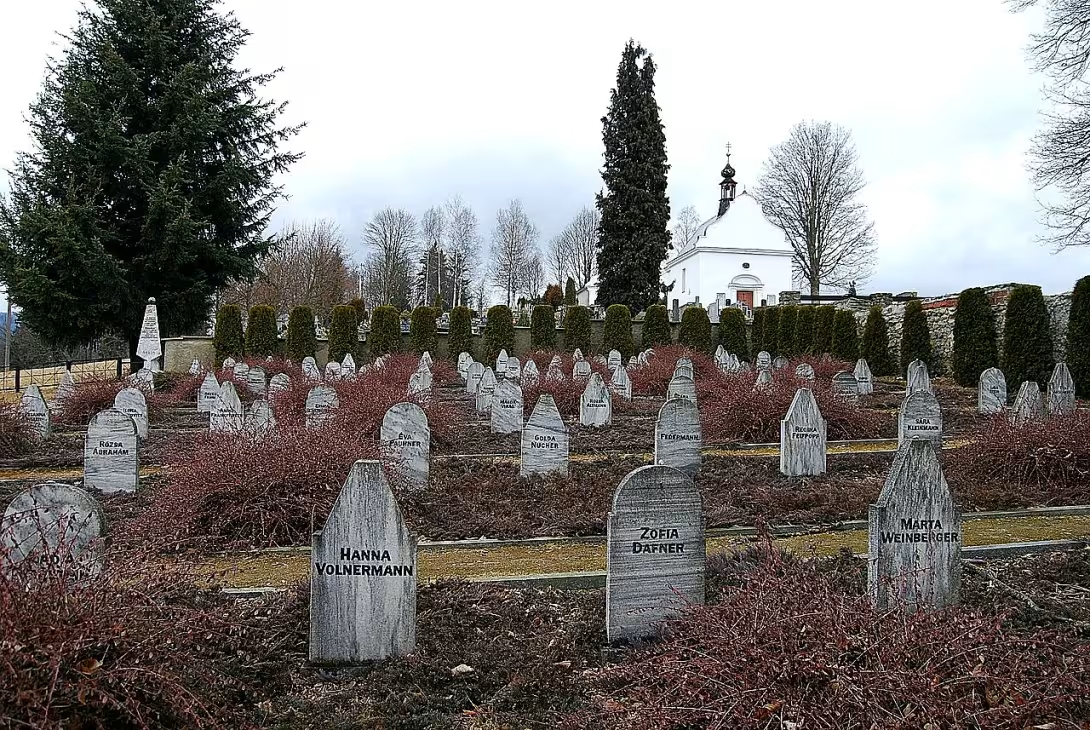
The Jewish cemetery in Volary is a historical monument founded in 1945, serving as a final rest for 95 Polish and Hungarian women, victims of the Nazi march of death. It is located in Volary in Prachatice district in South Bohemia and has been declared a cultural monument since 1963. The cemetery resembles the horrors of the Holocaust and the tragedy of these women.
The cemetery was founded immediately after the end of World War II, when in May 1945 American soldiers found victims of the death march that dragged from Poland through Helmbrechts to the Volarek area. Of these women, 95 people were buried in the cemetery, including 22 girls who died of malnutrition, and the others who were shot by the Nazis. This tragic stretch of history is firmly connected to the Volary cemetery.
The architecture of the cemetery is characterized by white granite used for tombstones which are placed in regular rows. Originally, they were equipped with tin nameplates, but later the inscriptions were carved directly into granite. The building was renovated in the years 1989- 1990 according to the design of architect Vojtěv Štorm from České Budějovice, who brought new architectural modifications. The cemetery is surrounded by stone fenced walls and is located in the vicinity of the town cemetery in Volary.
The key events that shaped the cemetery today were the discovery of the monument to the victims of the Nazism on 9 May 1956 and the later terraced treatment of the premises in 1962. In 1974, the sculpture of Torzo, the female academic sculptor Vojtěv Paris, was discovered in a high place outside the cemetery, and the original memorial from 1956 was removed. The new memorial plate with the number of victims and their Jewish origin was placed in 1995.
Today the cemetery is freely accessible and serves as a place of memory of the tragedy that took place during World War II. On the memorial at the entrance there is a inscription in four languages (Czech, Polish, German and Hungarian), reminiscent of the fates of 95 women murdered on the march of death. The cemetery is not only a memorable place for those who are interested in the history of the Holocaust, but also for those who value the places sacred and peaceful.
Visiting the Jewish cemetery in Volary is a reminder of the tragic events of the past and serves as a warning for future generations. It's a place where everyone can stop and reflect on the horrors of war and the importance of memory of the victims of Nazism.
Historical milestones
- 1945
- The creation of a cemetery after finding the victims of the death march.
- 1963
- Announcement of the cemetery with a cultural monument.
- 1974
- The discovery of the Torzo women's sculpture by Vojtěch Paris and the removal of the 1956 memorial.
- 1995
- Location of a new plaque indicating the Jewish origin of the victims.
Architectural development
In 1962 the cemetery was terraced and fenced. In the years 1989- 1990 there was a complete reconstruction and architectural adjustment according to the design of Vojtěv Štormo. The original tin labels were replaced by inscriptions carved directly into white granite.
Historical events
May 11, 1945: American soldiers found victims in a mass grave; 9 May 1956: Discovering the first monument to the victims of Nazism.
Points of interest
- The cemetery is the final rest for 95 Polish and Hungarian women, 22 of whom died of malnutrition. - The tombstones are made of white granite and were originally equipped with tin nameplates. - The area is surrounded by a stone wall and is located in the vicinity of the city cemetery. - In 1974, a sculpture of Torzo women by the sculptor Vojtěv Paris was discovered in a high place outside the cemetery. - The inscription on the monument at the entrance is given in four languages: Czech, Polish, German and Hungarian.
Guide
Show guide text
This text was created by artificial intelligence and has not been editorially reviewed. It may contain inaccuracies.
Welcome to the Jewish cemetery in Volary, a key monument full of historical memories and emotional significance. You stand before the silent grave where every stone and every piece of the wall tells stories of endurance and tragedy. Take a look at the huge wall that surrounds this monument, and look up at the tombstones made of white granite. Note the simplicity of their design, even though everyone wears a deep history.
Let's dive into the origin of this place. The cemetery was founded in 1945 as a final rest for 95 Polish and Hungarian women who were victims of the Nazi death march. This cemetery is not only a monument to these tragically murdered souls, but also to their resilience and suffering.
The architecture of this place is simple, but moved. The tombstones are made of white granite, giving them a distinct and lasting character. Originally, these stone monuments were provided with tin nameplates, which are no longer visible, but their presence is still felt in the silence and seriousness of this place.
The key personality associated with this monument is Vojtěch Pařík. His sculpture "Torzo Women," revealed in 1974, added another layer of historical and artistic importance to this place. This statue symbolizes the suffering and loss of those who lie here.
The fact is that the cemetery served as a final rest for 95 Polish and Hungarian women. In particular, the fate of 22 girls who died of malnutrition during their incarceration emerges from these tragic stories. This detail reminds us of the human side of history, which is so often forgotten.
Now look around and take a moment to take all these feelings. This place is not just a cemetery; It's a monument to humanity, courage and tragedy.
Thank you for visiting the Jewish cemetery in Volary. Let's look at another part of the city and discover more of its historical hiding places.
Tips for visitors
The best time to visit the Jewish cemetery in Volary is in the spring or autumn season when the weather is quiet and pleasant. This time of year offers ideal light for photography, which captures the historical atmosphere of the cemetery.
Public transport can also be used for access to the Jewish cemetery, it is advisable to verify the specific connection in the current route search engine.
When visiting, remember the clothes suitable for walking around the cemetery. It is also important to carry protective sunglasses, especially in the summer months, and plenty of drinking water.
Photography at the cemetery offers several interesting perspectives. The best light for photos can be found in the morning or evening when the sun is not directly above your head. Remember, respect and silence are important in such a sensitive place.
In the vicinity of the cemetery there is a town cemetery in Volary in Zlatá stoka street. This place offers other historical and cultural experiences that can be explored after visiting the Jewish cemetery.
Frequently asked questions
Can the monument be visited?
Cemeteries and graves are usually accessible; please respect the dignity of the place. We have not verified the opening hours of this cemetery.
Where is the monument?
Location: Volary, Jihočeský kraj. The map on this page shows the exact spot.
Why is the monument protected?
It is listed in the Central List of Cultural Monuments of the Czech Republic as a cultural monument (register no. 1000131246).
Businesses nearby
Do you run a restaurant, accommodation, shop, museum, rental, wellness or other visitor service near this monument? Show yourself directly to the people heading to it — this is how they will see you in the app and on the web:
Nearby
Městský hřbitov ve Volarech v ulici Zlatá stoka.
Accommodation nearby
Themed route
Thematic cruise route: City cemetery in Volary
1. Jewish cemetery in Volary (cemetery) - Type: historical monument - Why is it worth visiting: This ancient cemetery is one of the oldest Jewish burial grounds in Bohemia. It provides valuable information about the history and culture of the Jewish community in Volary, with memorable 17th century tombstones.
2. City cemetery in Volary (cemetery) - Type: city burial ground - Why is it worth a visit: This modern cemetery is part of the municipal area and offers quiet rooms for relaxation. It is a suitable place to understand the development of funeral traditions in the region.
3. Golden sewer street (street) - Type: historic street - Why is it worth a visit: Golden Streets is a key part of the city that combines various historical and cultural points. It is an ideal place to walk with an overview of the architectural development of the village.
4. Local Museum in Volary (Museum) - Type: local cultural institutions - Why is it worth visiting: The museum offers exhibitions focused on the history and culture of the village, which complements the understanding of the Jewish cemetery context. Here you can learn more about the history of the population.
5. Old Town in Volary (historical area) - Type: historical center - Why is it worth a visit: This complex offers a view of the ancient architecture and urban planning of the city. It is an ideal place for understanding the historical development of the village, which also affected the Jewish community.
This route offers a view of the cultural and historical aspects of the village Volary, with an emphasis on their Jewish heritage.
Seasonal recommendations
Spring: In the spring period, židovský hřbitov ve Volarech is transformed into a flood of flowering roses that spread among ancient tombstones and bring a cosy color shine into the atmosphere. Sun rays penetrate through fog, creating magical lighting that emphasizes the history and beauty of the cemetery. Visitors should choose a visit at the beginning of the day to enjoy a quiet atmosphere before tourists arrive. It is advisable to dress in clothes appropriate to mild temperatures and carry protective sunglasses.
Summer: During the summer period židovský hřbitov ve Volarech offers the most tourists who come to explore its historical essence. The sun illuminates the tombstone stone elements, creating a dramatic contrast between shadow and light. The burning heat increases the need for sun protection, so visitors should be equipped with an umbrella or a parasol. The best time to visit is early morning or late afternoon to avoid large crowds while enjoying a quiet atmosphere.
Autumn: In the autumn months, the Jewish cemetery in Volary offers peaceful walks between the leaves that turn into gold and red balls. Sun rays penetrate through trees, creating a cosy light effect that highlights the historical elements of the cemetery. The atmosphere is calm and friendly, making the visit ideal for those who want to enjoy the peaceful moments in nature. Moisture autumn days require clothes corresponding to mild temperatures and suitable footrests.
Winter: During the winter months, židovský hřbitov ve Volarech offers peaceful walks between the snow cover, which brings to the atmosphere a cosy and quiet feeling. Sun rays illuminate tombstone stone elements and create dramatic light effects that highlight the historical nature of the cemetery. Visitors should be equipped with warm clothes and protective legs against the cold surface. Thanks to shorter opening times it is best to visit the cemetery early to enjoy a quiet atmosphere before sunset.
Visualizations and artistic views


The visualisations are generated by artificial intelligence and serve as inspiration.
Photos from the area
Real photos taken near the monument


Zdroj a licence jsou uvedeny u každého snímku.
Tips from visitors
No tips yet. Be the first!
Log in and add your tip.
Sources and literature
Photos: Richenza / CC BY-SA 3.0 — Wikimedia Commons. The author and licence also appear when you hover over the image.
Faktickým podkladem tohoto textu byl článek na Wikipedii, jehož autory jsou přispěvatelé Wikipedie. Článek je dostupný pod licencí CC BY-SA 4.0.
Location on the map




Příběhy a pověsti
Legendy, pověsti a příběhy spjaté s touto památkou
Fotografie návštěvníků
Zatím žádné fotografie. Buďte první, kdo přidá fotografii z návštěvy!
Log in a přidejte svou fotografii nebo hodnoťte.
Za ověřenou návštěvu v aplikaci získáte víc bodů — poznáme podle GPS, že jste na místě.
Reviews and comments