



Pomník Rudoarmějců v Teplicích War memorial
Objekt se nedochoval — na místě dnes nestojí. Následující text popisuje jeho historii, ne současnou návštěvu.
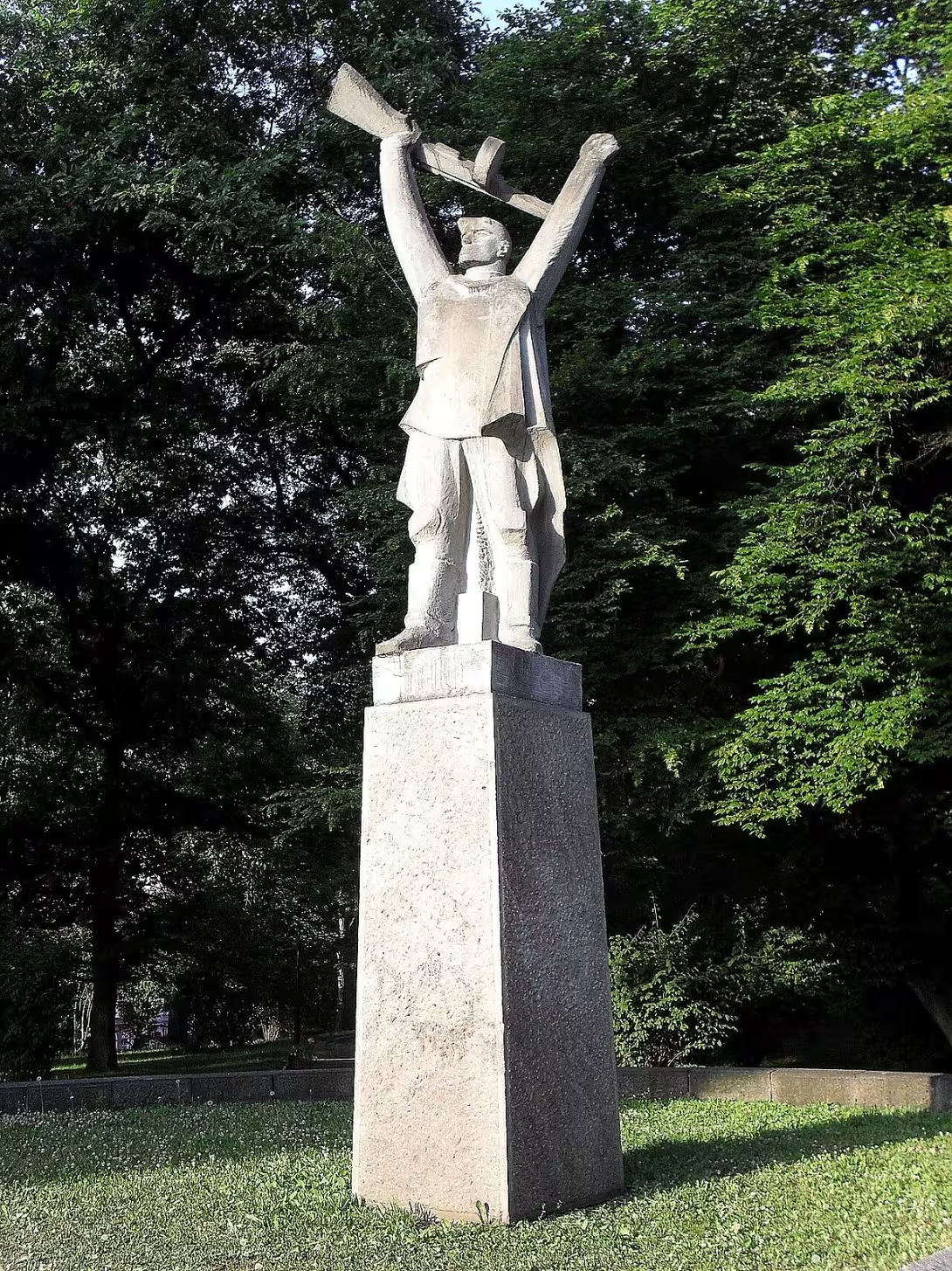
The Red Arm Memorial in Teplice was a piety place in Havlíček's orchards that honored the Red Army soldiers. The building from the mid-1950s is remarkable for its turbulent fate. This includes repeated demolishing of the statue and subsequent legal disputes about its removal from the city's property.
In the place of today's memorial, the monument to the Czechoslovak victims of the First World War has stood since 1930. In 1953 he was replaced by a complex called the Winning Red Arm. The creation of the work during this period corresponded to a wider trend. Similar sculptures served as political instruments or symbols of communist power and were often created at the sites of the original monuments dedicated to other victims of war.
The 1953 complex consisted of a paved area with a stone statue of an oversized Red Arm with an erect weapon. The author was the academic sculptor Antonín Kalvoda, who created the work in his Vinohrad studio in the spirit of socialist realism. The front of the complex was supplemented by two stone bases with metal bowls for fire. The whole area was closed by 18 low monuments placed in two rows, the shape and position of which evocaved the cemetery.
The fate of the monument has been dramatic since the beginning. On August 24, 1968, the citizens of the outrage of the Soviet occupation of Czechoslovakia tore down the original statue using rope and tractor. The perpetrators were subsequently punished with unconditional prison sentences ranging from 16 months to 3 years. Antonín Kalvoda then created a copy that was easier in detail and abandoned the concept of socialist realism. This new version was festively revealed on 8 May 1970. In 1988, the monument was described as a successful but philosophically unproven work.
On the night of May 7, 2025, the statue was torn down again, probably again using the car and the rope. In December 2026, the City Council of Teplice decided as owner to permanently remove the monument from real estate. This decision was subsequently contested by a citizen by an action before the Regional Court in Ústí nad Labem and then by an appeal before the Supreme Administrative Court. Both cases dismissed the actions. This was justified by the administration of the city's own property and found that the relevant regulations, including the Czech-Russian Treaty, did not imply a subjective right of access to a particular monument.
In the context of the war graves, it was emphasised that the fact that the memorial had evoked the cemetery was not a reason to interfere with the Russian authorities' investigation of vandalism. The war grave is defined as a place linked to specific persons.
The Teplice Memorial serves as a concrete example of the company's variable relationship to the symbols of totalitarian regimes. A visit to Havlíček orchards offers an opportunity to think about the history of the city and the political changes of the last ten decades.
Then and now
Drag the slider to compare how the landmark may have looked when it was built with the view today.
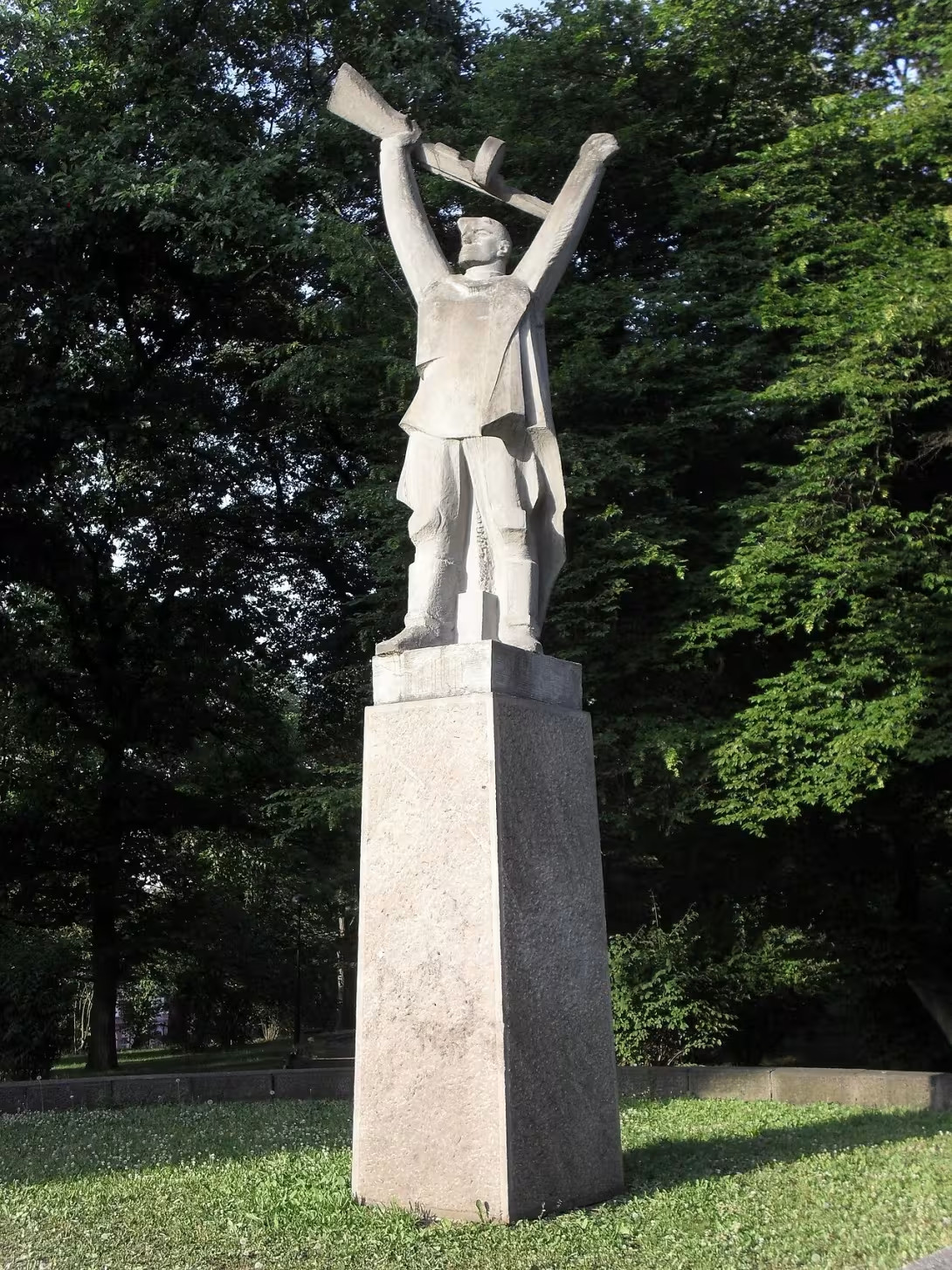
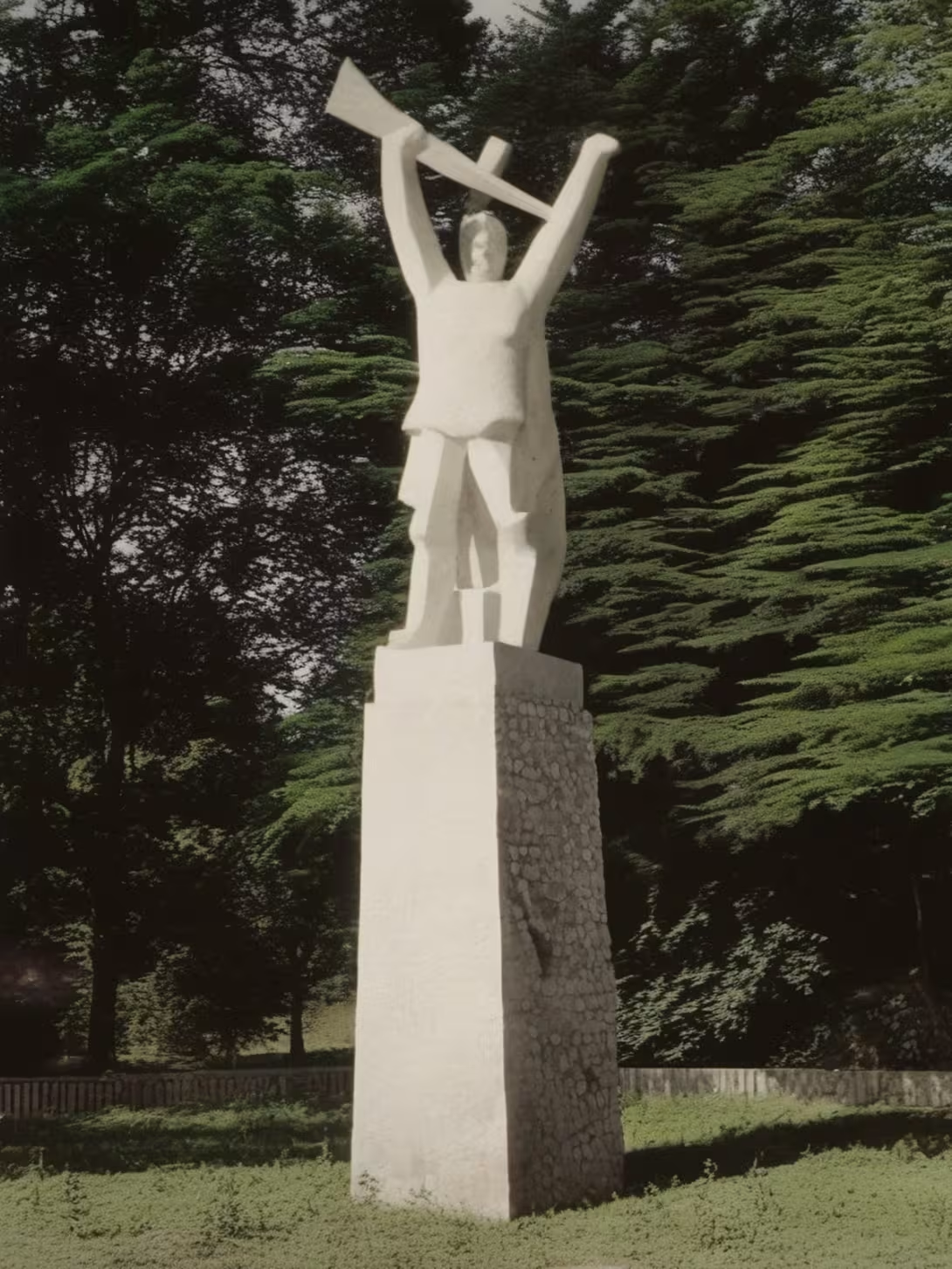
The historical appearance on the left is an AI-generated visualisation and serves as inspiration only.
Historical milestones
- 1953
- building a monument complex Winning Red Arm
- 1968
- tearing down statues of citizens outraged by soviet occupation
- 1970
- unveiling a copy of the statue created by Antonin Kaldov
- 2025
- removal of monument, probably using car and rope
- 2026
- decision of the council on permanent removal of the monument from immovable property
Architectural development
The first version of 1953 was carried out in the spirit of socialist realism with a stone statue and metal bowls for fire. The second version of 1970 was a simpler copy, which had already left the concept of socialist realism.
Historical events
august 24, 1968: tearing down the original statue of citizens using tractor and rope. may 8, 1970: festive unveiling of a new copy of the statue. may 7, 2025: the redestruction of the monument.
Owners
city of Teplice
Points of interest
The 1953 memorial replaced the former memorial with the victims of the First World War. - The work was made by a life-long statue of a soldier with a gun, two bowls of fire, and 18 low monuments resembling a cemetery. - In August 1968, citizens tore down the original statue with rope and tractor, for which they were punished by prison. The second version of the statue, which was simpler, was revealed on May 8, 1970. - In May 2025, the statue was torn down again, which led to legal disputes about its removal from the city's property.
Guide
Show guide text
This text was created by artificial intelligence and has not been editorially reviewed. It may contain inaccuracies.
Welcome to Teplice, the beautiful Havlicka orchards. You are standing in a place that has undergone a very turbulent development over the last few decades. If you look around now, you see space that has been designated as a piety place for a long time. It is a place that carries the heavy burden of history and reflects the changes in political moods in our state. In front of you there is a space where memories of two world wars and the tension of the occupation.
Let us now transfer back in time to the year one thousand nine hundred fifty-three. It was this year that a complex was built here to honor the Eastern Army soldiers. At that time it was common and required to build such monuments within the then social order. The goal was to create a place where gratitude for liberation would be shown, but it was also a powerful symbol of power and the presence of foreign troops in our territory. But it is important to know that this place was not empty. Before the statues of the soldiers from the east began to stand here, there was a completely different monument that reminded the victims of the First World War. By replacing the original monument with a new monument, one layer of history was erased for the benefit of the new, ideologically controlled one.
Now pay attention to what this complex looks like and what you should perceive here if you look at its form. The dominant was the superlife stone statue of a soldier holding a gun. This character was supposed to emit strength and victory. But it wasn't just about one statue. The entire space was designed to act as a cemetery. Note that in addition to the main figure, there were 18 low memoirs that were to evoke the tombstones. For that, there were two bowls designed to ignite the fires. This whole area was supposed to bring a visitor into the atmosphere of sadness, respect and unwavering military discipline.
When we look at the creator, we have to mention the name Antonín Kalvoda. He was the author of a copy of the statue that stood here in a later period. Kalvoda was a respected artist who had to work in the course of the then enquiries, which often meant to create works that were meant to serve as political posters in stone rather than as pure artistic expression.
We are now getting to the most dramatic moments that bind to this place. The history of this monument is not just a story of stone, but of human resistance. Let's go back to August of the year one thousand nine hundred sixty-eight. At that time Czechoslovakia was once again occupied by Soviet troops, causing a huge wave of outrage and anger in the population. The people of Teplice have decided that the symbol of the time they have right before their eyes in Havlíček's orchards cannot stand.
Imagine the scene. A group of brave citizens joined together and decided to remove the statue. They didn't use soft tools, they used brute force. With the rope and tractor, they tied the rope to the statue and simply pulled it off the ground. It was an act of profound symbolic resistance. Unfortunately, at that time there was a regime that did not tolerate such acts. These people paid dearly for their actions because they were punished by prison. But they didn't want to give up their symbol. Two years later, in the year one thousand nine hundred seventy, a new copy of the statue created by the said Antonín Kalvoda was discovered on the scene. By doing so, the regime tried to erase the trail of citizens' rebellion and restore the image of the victorious soldier.
But here begins one of the most interesting and recent parts of this story, which took place only in our days. In the year two thousand twenty-five something unexpected happened. The memorial was torn down again. This time, however, was not an organised protest with a tractor from the last century. All indications suggest that a car and rope were used to destroy the memorial. It's fascinating how history repeats itself. The method of a thousand nine hundred sixty-eight was essentially repeated after more than fifty years. It is proof that even after a long time, some symbols in people cause strong emotions and resistance.
This incident led to the final end of the memorial. In two thousand twenty-six, the council decided that the monument would be permanently removed from the city's property. This means that it will no longer return to its original form and this place in Havlíček orchards will have a different character from now on.
If you look around now, try to realize how many layers of time are buried in this country. First there was respect for the sacrifice of the First World War, then came the era of the victorious soldier from the east, followed by resistance from the citizens, forced restoration of the statue and finally its final demise. It's a mirror of our history in a small, mirror of how our values change and how our views of what they deserve to stand in the city centre as a monument.
The mystery remains exactly who was the author of the last intervention. Even though the tracks are clear, the identity of the people who tied the rope to the car in the year two thousand twenty-five stays in the dark. It's a modern legend that joined the old ones.
Thank you for coming through the history of this controversial place. I hope this story of power, resistance, and change of time interests you. We now invite you to explore the beautiful Havlíček orchards. Go through the rest of the park, feel the calm of the surrounding nature, and think about what traces history leaves in us. I wish you a pleasant ongoing tour of Teplice. Goodbye.
Businesses nearby
Do you run a restaurant, accommodation, shop, museum, rental, wellness or other visitor service near this monument? Show yourself directly to the people heading to it — this is how they will see you in the app and on the web:
Nearby
Havlíčkovy sady
Visualizations and artistic views


The visualisations are generated by artificial intelligence and serve as inspiration.
Photos from the area
Real photos taken near the monument


Zdroj a licence jsou uvedeny u každého snímku.
Tips from visitors
No tips yet. Be the first!
Log in and add your tip.
Sources and literature
Photos: Takmocsekretovanej! / CC0 — Wikimedia Commons. The author and licence also appear when you hover over the image.
Faktickým podkladem tohoto textu byl článek na Wikipedii, jehož autory jsou přispěvatelé Wikipedie. Článek je dostupný pod licencí CC BY-SA 4.0.
Location on the map
Příběhy a pověsti
Legendy, pověsti a příběhy spjaté s touto památkou
Fotografie návštěvníků
Zatím žádné fotografie. Buďte první, kdo přidá fotografii z návštěvy!
Log in a přidejte svou fotografii nebo hodnoťte.
Za ověřenou návštěvu v aplikaci získáte víc bodů — poznáme podle GPS, že jste na místě.
Reviews and comments